Friday, June 12, 2015

Transylvania, the Land of Enchantment

Cantacuzino Castle (photo: Ileana 2015)
Transylvania is a land of enchantment of middle and northern Romania with its breathtaking and spectacular landscapes, its rich and tumultuous history, bloody battles, occupations, and a proud population that maintains its distinct culture and art.

It is bordered on three sides by the Carpathian Mountains that appear on maps like a natural boundary between Transylvania and Wallachia, the province made famous by Vlad the Impaler, “Dracula,” Prince of Wallachia, who made Bucharest its capital in 1459. The pristine and wild countryside of Transylvania (Latin for “across the forest”) is sometimes impassable to humans.
Transylvania has a distinct Hungarian and German influence which can be seen in its fairy tale Hansel and Gretel architecture, its cuisine, the spotless streets, order and civility, in how successfully cities are run, and the seriousness on the faces of its population. However, many ethnic Germans have left in the 1970s when the communist Romanian state signed an agreement with West Germany.

Romanian settlements dating back to the Iron Age were found in the southwestern part of Transylvania. Because the area has been part of the Hungarian and later the Austro-Hungarian Empire for hundreds of years, there is a strong Hungarian and German influence everywhere. Schools, colleges, and theaters are still operating in Hungarian and German languages.

Hungarian kings had invited Saxons (from the province of Sachsen) in the 12th and 13th centuries to settle in Transylvania. Some of them were gifted goldsmiths, others were wood carvers  and builders. Their presence is reflected in the beautiful medieval citadel churches built in southern Transylvania.


Bran Castle in Brasov (photo: Ileana 2015)
Hungarians and Germans left behind castles, imposing manors, palaces, and churches in towns such as Cluj-Napoca, Alba Iulia, Sighisoara, and in the old Saxon city of Sibiu (Hermannstadt) with its famous medieval houses with rooftop “eyes,” roof vents that look like watchful eyes.

The miners and farmers in western Transylvania called “Moti” trace their roots for thousands of years. The Apuseni Mountains are rich in mineral reserves, rare metals, and gold, particularly in the contentious region of Rosia Montana.

The archeological evidence found at Sarmizegetusa speaks volumes of the rich civilization of the Dacians who were conquered by the Romans in 106 A.D. and colonized into a Roman Empire province. The story of the battles between the Romans and the Dacians is vividly told in the freezes of Trajan’s Column in Rome.

According to National Geographic , the eastern part of Transylvania has “the highest concentration of ethnic Hungarians.” Buildings have a different style, ethnic costumes vary, and many inhabitants speak both Romanian and Hungarian.

Cluj-Napoca is “the cultural and economic hub of Transylvania.” Alba Iulia, the former Hungarian capital, has an interesting Habsburg baroque citadel. It was the city where Romania and Transylvania became one on the great Union Day, December 1, 1918.

Bistrita, in the northern part, is the location where Bram Stoker set his novel “Dracula” in 1897. His fictional character, Jonathan Harker, spends the night in Bistritz (Bistrita) on his way to Tihuta Pass (Borgo Pass in Hungarian) where Voivode Vlad Tepes’ real castle ruins are located.  Bram Stoker never traveled to Romania; he used geographical information from his local library.

Sibiu house with "eyes" (photo: Ileana 2015)
Sibiu is the largest medieval town in Romania, built in the 12th century with three concentric fortified walls (a few have survived), squares (a large and a small one), stairways, and strongholds built and fortified between the 13th to the 18th centuries.

The two famous battles of Sibiu on March 18 and March 25 1442 were fought nearby between the army of the Hungarian Empire and the army of the Ottoman Empire. Approximately 4,000 Hungarians and 15-20,000 Turks were killed in the two battles which resulted in a defeat and push back of the Ottomans.

Tiny restaurant in Sibiu (photo: Ileana 2015)
 
The Large Square (Piata Mare) served as a grain market in 1411, medieval executions, and later used for carnivals, meetings, and now rock concerts. The little restaurant called Butoiul de Aur (The Golden Barrel) has been serving patrons since the 15th century. Houses dating back to the 13th and 14th centuries are the oldest surviving homes with colorful tiles, sometimes mosaic-ed in beautiful patterns and with “eyes” on the roof for air venting.


17th century iron vial (photo: Ileana 2015)
The tiny four-room pharmacy museum, that used to be a 17th century apothecary, displays curious instruments and recipes for potions perhaps made by Samuel Hahnemann (1755-1843), the father of homeopathy.

Sibiu Church (photo: Ileana 2015)
The largest Catholic Church in Sibiu stands majestically between Piata Mica (Little Square) and Piata Mare (Large Square). Interestingly, on the day I visited, it was displaying a large banner at the back entrance urging people to stop fracking for natural gas and to stop mining in Rosia Montana.  Since the Pope is now a climate change expert and population control expert, why not turn the church into an environmentalist NGO?

Brukenthal Museum courtyard (photo: Ileana 2015)
 
Brukenthal steam porcelain stove (photo: Ileana 2015)
 
Brukenthal Roman lapidarium (photo: Ileana 2015)
 
Medieval door (photo: Ileana 2015)
 
The National Brukenthal Museum is a treasure trove of art collections which Baron Samuel Von Brukenthal, the former Governor of Transylvania (1777-1787), housed in his Palace built in the Grand Square in Sibiu. Showcased in the baroque and rococo interiors are famous masters like Jan van Eyck from 1420, German and Austrian painters, Romanian painters, personal favorites like Teodor Aman and Nicolae Grigorescu, gold and silver coins, jewels, engravings, intricately carved furniture, books, weapons, silver and gold drinking cups and goblets, medals displayed in his former library, sculptures, costumes of the era, whimsical porcelain steam stoves interconnected throughout the palace, a novelty for that period,  a lapidarium with statues of Roman gods, Roman roads mile markers, and votive altars from Apulum and Ulpia Traiana Sarmizegetusa, dating to the 2nd and 3rd centuries A.D.

ASTRA barn with carriages (photo: Ileana 2015)
 
 
Interior of a floating mill at ASTRA (photo: Ileana 2015)
 
Four miles south of Sibiu, in the forest of Dumbrava, we found the largest Museum of Popular Traditional Civilization ASTRA in the country. Spread on 237 acres of rolling hills and lakes, it is the largest museum in Europe that showcases homes from different parts of the country, windmills, boats, barns with complete carriages, and many implements and tools necessary for everyday living. Each home is surrounded by a typical yard with ploughs, carts, barns, and interiors are decorated just like people were still living there and have left for the day to tend to the gardens or crops. The smell of old wood, mildew, wildflowers, and crushed fruits was overwhelming. A slow-moving red fox, accustomed to human presence, crossed the nearby yard.

ASTRA home interior (photo: Ileana 2015)
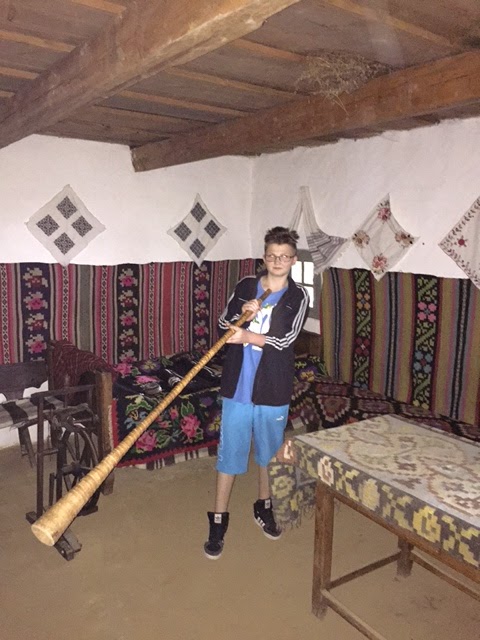
 
 
ASTRA home interior (photo: Ileana 2015)
 
The outdoor ASTRA museum is so hugely popular that locals use it for recreation, boating, and celebration of major life events. On the day we visited, there were three weddings at the wooden chapel and brides and their entourage were taking photos on the premises. I was fascinated by the various windmills displayed, and particularly a floating mill that used hydropower to grind grain.

All the workshops manufacturing silk and hemp, distilleries, forges, wine presses, paddle-wheel ferry, the blacksmith’s shop, and other machinery used by Romania’s country folk were actually in working order.

It is only fitting that this huge outdoor museum with its well-preserved history is called ASTRA. ASTRA was a patriotic literary society of the 18th century, located in Sibiu, which was instrumental in Transylvania’s unification with Romania in 1918.

To the east of Transylvania is the famous Seckler Land. The Secklers are Hungarian-speaking people which are called “secui” in Romanian. They use their own language, have fascinating traditions, customs, delicious cuisine, and schools. No industrial development has touched this plateau where old farming methods are still used today to cultivate the land. It is a land where Hungarians have migrated to in the 9th century from the Don River. The Hungarians were given land in exchange for the promise that they would protect the western Hungarian border against the invading hordes of Turkish tribes. There is a Crusader’s cross decorating a church in Tusnad as evidence of Christian support against the invading Muslims. Signs abound both in Magyar (the Hungarian language) and Romanian language.

The Hungarian king Endre II brought in the Teutonic Knights in 1211 to protect the southeast border of Transylvania from the Cumans, a migratory Turkic tribe.  It was these knights who built stone castles all over the area surrounding Brasov.  According to National Geographic, because the Teutonic Knights liked this magnificent area called Barsa Land and were going to claim it for the Pope, King Endre II forced them out in 1225 with Saxon help.

Brasov (photo: Ileana 2015)
The jewel of Transylvania is Brasov (Kronstadt). There are so many significant places in Brasov  and its vicinity that it merits a story onto itself.

Tuesday, June 9, 2015

Cetatea Fagarasului and Communist Punishment

Cetatea Fagarasului entrance (Photo: Ileana 2015)
We found Cetatea Fagarasului half-way between Brasov and Sibiu, an hour drive off the beaten path for foreign tourists. I would venture to say that we were the only overseas visitors on that drizzly morning. The fortress was surrounded by a fosse populated by black and white swans, perfect sentries for a castle that was often under Ottoman siege. Weeping willows lined the street leading to the entrance.

I thought we were going to see a 14th century fortress but I discovered one of the many prisons Ceausescu had used around the country to punish those who disagreed with his regime and dared to protest his reign of terror.
Fagaras Fortress was built between the 14th and 17th centuries. The fortress was preceded by a wooden fortification and earthen wall dating from the 12th century. In the 16th century the fortress was transformed into a castle. Gabriel Rakosi I and Gabriel Bethlen, Transylvanian princes, decorated it according to Renaissance models in the 17th century.

Moat with Swans (Photo: Ileana 2015)
The Fagaras Fortress, surrounded by a two-meter deep water moat (“fosse” in Old English) fed through a channel from the Olt River (since 1676 from “Superior lake”), was so impenetrable that, although attacked countless times, it was never conquered.

Scaffold (Photo: Ileana 2015)
The now green exterior courtyard had a medieval scaffold, which had been used for the last time in the 1970s. There was a carriage and a blacksmith’s shop with iron tools and bellows.

Access to the castle was made through two bridges (one pedestrian) and three consecutive lifting gates. On the northern side, built on wooden pillars, there were two powder houses (1667-1676). A boat and six swans were mentioned in 1656. Surviving on daily ration of rye bread, the swans multiplied to nine and four chicks by 1676. During our visit I saw two pairs of swans, a black and a white one.

One of the many inner courtyards (Photo: Ileana 2015)
 
The museum archives described how one Turkish historian, geographer, and traveler, Elvia Celebi, who crisscrossed the Ottoman Empire for 40 years, actually participated in the siege of Fagaras Fortress in 1661. He wrote that the Turks led by Ali Pasha, after setting fire to the citadel, were met with resistance from many soldiers and inhabitants gathered from the surrounding area. The Ottomans had to withdraw after 14 days of siege.

Gabriel Bethlen had a Hussars’ fortress built in 1623 in the northern part of the fortress, by the moat. The Ottoman sieges must have destroyed the Hussars’ fortress because it was never mentioned in any records or inventories after 1676.

Inner courtyard of the communist prison (photo: Ileana 2015)
 
According to museum archives, “After 1696, the fortress became a garrison for the Austrian army, then for the Magyar army, and after that for the Romanian army. Between 1948 and 1960 the fortress was a communist prison.”

Torture cell with tools (photo: Ileana 2015)
 
At the base of the Prison Tower was the jailer’s house. Records in 1632 mentioned 12 leg cuffs, 14 handcuffs, a tree trunk, an axe, leg iron weights, and a hangman’s broadsword. Under the jailer Ambrus Janos the inventory of his torture chamber swelled to 54 pairs of leg chains. By 1676, there were three dungeons in existence. One of the castle towers housed an Iron Maiden, a particularly cruel form of punishment. The unfortunate human was trapped inside an iron suit fitted with spikes which pierced his body, avoiding vital organs, but allowing for a slow and agonizingly painful death through blood loss.

Prison tower (photo: Ileana 2015)
The cells, where anti-communist fighters from Fagaras Mountains and other parts of the country were held between 1948-1960 when the fortress was a prison, were cold and dark. The treatment of political prisoners was beyond brutal. National Geographic mentioned that “During the brief moments when their cell doors were opened, they scratched messages on the walls” which are still visible today.

Faces of some of the victims (photo: Ileana 2015)
 
The museum exhibited photographs of those imprisoned and killed, original 1960 documents of peasants’ obligations to turn in a quota of everything they produced or grew, documents of rationed consumption, rationing of clothing and shoes, rationing of consumption of meat permitted only on Saturday and Sunday for a total of 250 grams weekly, with a supplement for those who actually worked in a factory, and the empty promise that bath soap and powdered detergent would be distributed soon. This rang similar to the current rationed consumption and dire economic situation in Venezuela where Hugo Chavez’s socialism has destroyed the once self-sufficient economy.

Passage to one of the jails (photo: Ileana 2015)
 
Before the socialists took complete control of the country, the Directive NKVD 2-6 of 1947 made sure that any farm would be unprofitable to farm or rent to farm in order to facilitate collectivization. If the peasants offered more resistance to collectivization, they were to be forced to turn over to the communist party a higher quota of what they produced.

A poster from that era stated, “Long live the Soviet Union, the liberator of the Romanian people.” The Soviets actually destroyed every freedom and the wealth and comfort that the Romanian people formerly enjoyed under the monarchy and imprisoned them into a terrifying concentration camp unlike any other for 41 years.

“Let us promise anything asked of us, but, when the moment will come, let us remember that the communist honor is to not fulfill these promises,” said V.I. Lenin in his “Empty words about freedom.”

The massive propaganda was directed from Moscow because the Romanian commies did not have experience yet. Under their guidance, the Romanian Communist Party started a campaign of constant agitation and mobilization of the population, and non-stop manufactured crises.

The “enemies of the people” were identified during public meetings, press releases, and public trials. Dailies, magazines, newspapers, posters, journals, brochures, and pamphlets continued the indoctrination. An entire army of community organizers were released to agitate the masses.

A massive campaign to destroy the national memory, to falsify the past, and to rewrite history and the present began. The press pushed communist utopia non-stop. “The political police, under Soviet control, began a societal surveillance by agents and informers,” according to museum archives.


Monument dedicated to anti-communism fighters (photo: Ileana 2015)
 
Once the urban population and the elites were subjugated, next came the peasants’ turn; they had been pretty much left alone until 1949. The commies made the peasants’ livelihood very difficult by forcing them into obligatory back breaking quotas and by controlling their commerce with agricultural products. The communists eventually destroyed the peasants’ individual property rights. Small farmers were constantly demonized, beaten, threatened, tortured, and imprisoned until they relented to become part of the communist collectivization agricultural machine.

In Tara Fagarasului which is the larger area surrounding this fortress prison in Cetatea Fagarasului, the social order was totally and systematically destroyed. Eighty percent of the population was considered well-off farmers, wealthy farmers, and middle peasants.  More than 1,000 locals suffered in forced labor camps, were deported to communist prisons around the country, and thousands of family members were discriminated and maligned socially and economically. 

The wealthy farmer was labeled “chiabur,” from the Turkish word “kibar,” meaning “a good steward.” The farmers were demonized and the word “chiabur” was successfully used by communists as a label to justify repression against private land owners.  The manufactured word “chiabur” was not unlike the bogus term of “white privilege” being floated by the main stream media and academia in our own country.

The first communist president, Gheorge Gheorghiu-Dej, was advising the apparatchiks involved in the land confiscation, that they should confiscate land in such a way that it did not look like nationalization, but at the same time, they should not leave the land owners much, “just enough to buy a cigarette,” and to pay them for their tractors scrap metal prices. “For better combines that do not need much repair, we should pay them 5 percent more.” (Gheorghe Gheorghiu-Dej speech on March 26, 1959)

Gheorghiu-Dej continued, “If a rich landowner protested, he can be shot on the spot, to let all know who would dare not to turn in their quotas what will befall them.” (Instructions to all member of Securitate, 1948)
I still remember, as a child, being forced to wait in long lines with my parents to view this man’s body in state when he passed away. The entire country was supposed to mourn his passing even though they hated his guts for what he had done to the country.

To justify the existence and establishment of the terror state, enemies had to be found. If none were found, enemies had to be invented, said one of the Soviet community organizers and agitators, Tzvetan Todorov. In 1951 forced deportations spread ethnic Swabians and Romanians around the country, especially those who opposed the regime and collectivization. Many were sent south in Baragan and Basarabians were deported to Fagaras. But an armed resistance developed in the Fagaras Mountains in Transylvania.

As part of the same Directive, NKVD 2-6 of 1947, all parties had to be unified under one party, making sure that all key positions would be occupied by the secret (Soviet) services.

Weeping willows, a fitting tribute to those who died (photo: Ileana 2015)
 
Cetates Fagarasului, the medieval fortress, saw the incarceration between September 1950-April 1960 of over 4,000 former employees from the Information Services, State Security, military judges, policemen, diplomats, and those who helped the anti-communism fighters. Prisoners were jailed without due process and without sentencing. Because of the harsh and inhuman imprisonment conditions, 166 generals, officers, clerks, workers, and peasants died there.
 
I dug up a tiny rock from the inner courtyard for my friend who collects stones from different parts of the world. I washed it carefully before packing it, wondering how much blood of innocents tortured or killed in battle or in prison had washed over these rocks over the centuries.

Monday, June 8, 2015

Prejmer Citadel and Cetatea Rasnov

Prejmer Citadel walls
Photo: Ileana Johnson 2015
Leaving our hotel in Brasov and barely avoiding two collisions from impertinent drivers who seem to be in so much hurry that they triple and quadruple pass other vehicles close to dangerous curves and impassable hills, we made our way a few kilometers north to the neighboring Saxon villages of Prejmer and Harman.

According to National Geographic Traveler, the villagers who emigrated to German-speaking countries have abandoned their terra-cotta tile homes built very close to the road and gypsies have moved in (p. 146).

Harman’s Citadel has four turrets which indicated that “the people of Harman had the right to pass the death sentence.” The 12 meter tall walls were built in the 15th century to protect the citizens from the many outside invaders, eager for loot and tribute. A 12th century Gothic church with a 13th century funerary chapel are enclosed within the citadel rock walls. The chapel contains fragments of Gothic frescoes.

Prejmer Citadel Inner Walls
Photo: Ileana Johnson 2015
Prejmer’s Citadel walls, built between 15th and 18th centuries, protected inhabitants from constant siege coming from Austrians, Tatars, Turks, and other neighboring provinces. The inside walls had 272 rooms on four levels, refectories, a school, and galleries to accommodate the entire community during an attack. A circular passageway connected the top level. The middle courtyard was dominated by a Gothic place of worship built in the Rhineland church style. The Citadel had an exterior portal, a 17th century wall, the original 15the century defensive wall, and a 19th century wall extension and entrance passageway with a dropping gate with sharp wooden spikes that could impale someone unfortunate enough to be in the way when the gate dropped.

Pigeons, lilacs, and blossoming trees were shading the courtyard between the Gothic church and the sleeping quarters accessed by steep and dangerous wooden stairs, not for the faint of heart or wobbly jointed. I could not climb all the way to the top where the very thick rocky retaining walls and ramparts were slightly separated six feet from the residential part of the structure.

Prejmer Citadel 19th century entrance Photo: Ileana Johnson 2015
 
Prejmer citadel tools Photo: Ileana Johnson 2015
 
When the Citadel of Prejmer was under attack or times were dangerous, the local population took refuge inside the fortress. According to museum archives, an old school functioned here, with its first teachers mentioned in 1460 and then in 1556. The surviving classroom decorated with frescoes from the 18th century was used as late as 1853 when a new school was built in the village of Prejmer.  

Inner Gothic church Photo: Ileana Johnson 2015
 
Prejmer Gothic Church Photo: Ileana Johnson 2015
 
Prejmer Gate Photo: Ileana Johnson 2015
 
One hundred-year old trees and purple lilacs bloomed in the courtyard, overwhelmed by the strong scent of mold and old, dry wood. The green grass made a lovely contrast with the dark and foreboding sleeping quarters now painted white, with black stained beams. Centuries ago, this citadel must have been an island of peace and protection from the constant Ottoman Empire attacks which continued for hundreds of years. Every time they were pushed back, they returned with a vengeance.

Prejmer residences Photo: Ileana Johnson 2015
 
Ten miles from Brasov, after a pleasant drive through valleys flanked by blue mountains and lush green meadows with billowing in the wind tall grasses, wheat, and wild flowers, we found the city of Rasnov with its Citadel built by Teutonic knights in 1215. The fortress is perched on a rock about 400 feet above town. Because its location is difficult to access, the medieval castle was only conquered once in 1612 by Gabriel Bathory. The observation tower, which can be reached by steep, creaking, and difficult to climb up or down stairs, gives a breathtaking 360 degree view of the Carpathian Mountains. The movie Cold Mountain was filmed not far from here.

Rasnov Citadel Photo: Ileana Johnson 2015
Archeological digs found evidence of a fortified Dacian settlement during the first century B.C. and first century A.D. named Cumidava/Comidava.  Earthen moats, ditches dug around the rocky peaks, and wooden palisades protected the population from the numerous invasions. Parts of the fortification are still standing on the north side and in the surrounding forest. Houses, some carved in stone, were located inside the fortifications. Buried Items who were unearthed suggest a prosperous settlement with trade relations. When the Dacians were conquered by the Romans, a new Roman castrum was built on Ghimbasel Valley, bearing the same name, Cumidava/Comidava.
Three buses of American soldiers were visiting the fortress that day, climbing to the citadel on foot, while children and less physically-abled adults were ferried up by a tractor pulling a train of sorts. Humidity was low, the sun was shining, the temperature was a balmy 72, and the rocky remains of the former castle were buffeted by strong winds. A Romanian flag was proudly displayed on the highest peak of the castle.

A resident cat disappeared below a big drop through an open window, as if jumping to her death. We found her later at the entrance, safe and sound, eating a treat dropped by one of the American soldiers.
We have met several Americans the night before, dining in an outdoor pizzeria near the Black Church in Brasov. Some of these young men, part of the “show of force” exercise in Romania which ended in Brasov, were happy to be off and around so many beautiful young Romanian girls.

A couple of soldiers were now interviewed by a young Digi-24 crew about their stay in Brasov. Romanians at large were buzzing with fear in cafes and on the Internet that the Americans have come to occupy them, albeit it too late, one older man joked. “We could have used American help during WWII,” he said. We certainly did not need the Soviets, he added with sarcasm.
We bought two walking canes; besides an interesting display in the office, the canes were quite handy for climbing or steadying when walking on cobble stones or rocky terrain. And this fortress is difficult enough because it was dug into the Carpathian Mountains.

The Carpathian Mountains chain covers about one third of Romania and once formed Europe’s largest volcanic link. There is only one extinct crater left with its volcanic lake Sf. Ana north of Brasov. The U-shaped mountain chain runs from the northwest to the southwest of Romania.
The drive back took us through the Poiana Soarelui Street, a road winding up with constant hair pin curves and dizzying drops until we reached Poiana Brasov, a popular tourist destination in summer time for outdoor recreation and horseback riding, and a fabulous ski resort in wintertime.

Copyright: Ileana Johnson 2015


Thursday, June 4, 2015

The Rally That Changed History

Rally in Brasov Photo: Ileana Johnson 2015
On a beautiful sunny morning, May 21, 2015 when the Orthodox celebrated Ascension Day and Sf. Elena, we walked in the beautiful park downtown Brasov set at the foot of Timpa Peak, where a crowd had gathered in front of a large cross and several tombs of the young men and women killed on December 22-26, 1989, during the Revolution that toppled Ceausescu’s brutal communist regime. Some of them came to a rally and some were simply walking through the park.

Shots rang out from many directions, mowing down those unfortunate enough to be in the path of the stray bullets. As many as 46 people were shot within ninety minutes. Two large flower wreaths were placed in front of the cross in their eternal memory.


Heroes Day May 21, 2015
Photo: Ileana Johnson
I interviewed Mircea Brenciu, member of Uniunea Scriitorilor din Romania (Writers’ Union) and spokesperson for Asociatia Revolutionarilor din Brasov (Association of Revolutionaries from Brasov). Brenciu gave a fiery speech to the crowd of mostly middle-aged men who had gathered on Ziua Eroilor (Heros’ Day) to pay respects to those who died for freedom, freedom that had been squashed in Romania during more than four decades of communist terror.

Fallen Heroes
Photo: Ileana Johnson 2015
The Association of Revolutionaries had asked City Hall repeatedly for a monument to honor the sacrifice of those who gave their lives in December 1989 in this park and elsewhere.

A monument is needed, Brenciu said, to commemorate not just those who died but those who have survived “an event that represents the most important moment in the contemporary history of Romania” – the defeat of Ceausescu’s communist tyranny.  This often-requested monument has been refused by officials under various explanations. Brenciu believes that these politicians who run the country have no gratitude and deny recent history. “Full of hypocrisy,” Brenciu said, “they come to place a wreath, pretending to care, and in the next second, they forget everything.”

In his opinion, disrespecting history is one of the many reasons that have determined the miserable state in life of Romanian citizens in general. Conditions have improved, he said, Romanians can go abroad to work, they can speak freely, they can travel, they can curse the regime freely, but nobody is listening, Brenciu added.

Prices rose to the European Union levels since 2007 but salaries are still “10-15 times smaller.” Austerity measures imposed by the EU have compounded the problem. “How can a Romanian citizen survive under these conditions,” he asked. We have become the beggars of the European Union even though our country is very wealthy in natural resources that have been sold out to foreign investors to benefit the ruling elite class while Romanians struggle to make ends meet.

“Poverty is glaring, nobody has any money. Doctors ask for bribe money (even though the medical system is socialized and generally free), officials ask for bribe money, food is extremely expensive, how can one live in a country that freed itself from communism?

Most people are still afraid to go to the doctor even for simple operations. Many good doctors have fled to the west for better pay and working conditions and, for a while, young people chose other fields of study. Who wanted to work so hard to become a doctor when they made the same paltry salaries like everybody else? I asked about the average college graduate pay and I was shocked at the answer, $300 per month. And unskilled workers in America demand an economically impossible living wage of $15-20 an hour.

Romanians have told me that dental care is very expensive and the quality of work lacks a lot to be desired. Few acquire the expert training of dentists in the U.S. Socialized medicine is a disaster, slightly better than during Ceausescu’s regime. Retirees are compensated at the 50 percent rate for the first three prescriptions; after that, they must pay full price for any additional drugs they need.

Forgetting and rewriting history is not occurring just in Romania, it is a wave happening around the globe, a groundswell of global revisionist curricular history smacking of communist indoctrination.
“Globalism is a form of anti-nationalism, with the idea of forming a unique global state, a utopia that begs the question, who is going to run this global state, who is going to establish the rule of law, what is going to happen to the principles of democracy? As long as there are nations, there is equilibrium and respect between countries, a tradition and history that balance out a social equilibrium. European Union is a first step of this globalization. Why is the EU abandoning us while exploiting the country for everything possible for their personal gain,“ asked Brenciu pointedly.

Brenciu described how the technocrats in Brussels lured Romania into the EU like the Conquistadors lured Indians with cheap beads and mirrors. “They are taking everything and we are applauding - so great that we are Europeans now.”

Brenciu talked about Rosia Montana mine exploration in the Apuseni Mountains of Western Transylvania, which is currently blocked, and its vast reserves of gold, rare earth minerals, and rare metals such as wolfram (tungsten), vanadium, nickel, manganese, which are more valuable than gold. Gabriel Resources of Canada is planning to reopen the currently blocked gold mine which has been closed since 2006.

“Why should Romanians not exploit their own resources? In this fight, Brenciu said, we are going to lose because we have traitorous politicians.”
Brenciu alleged that over $120 billion have been stolen since the fall of communism, enough to bring Romania to an economic development on par with the EU countries. This calculation, Brenciu stated, was based on Dr. Ilie Serbanescu’s opinion as an economist, academician, and Former Minister of Reform. The money that was stolen is now in foreign accounts, Brenciu said, while the country survives in dire economic needs.

Dr. Serbanescu explained in a TV appearance that EU is a colonial system that facilitated the control of Romanian natural resources (gold, silver, rare metals, minerals), the distribution of energy (gas, oil, electricity), and banking. Globalists challenged his views as nationalist. It is a no-brainer that none of the EU members were able to control their monetary policy once they accepted the euro as a national currency. https://www.youtube.com/watch?v=2JnVK5vg9DM
“I was personally shot at,” Brenciu said, but I was lucky to escape, “I ducked into the post office building nearby. Nobody knew who was shooting, we personally caught one guy who spoke no Romanian and we turned him over to the officials and I think they released him. He was wearing dark coveralls over his street clothes, had shiny eyes like a person on drugs, and was armed.”

“It was carnage, people were mowed down, and there was blood everywhere and screams of pain coming from the injured.” It is inconceivable to be the mayor of this town that has sacrificed so much for the Revolution and to refuse a monument to commemorate this profound event, I do not and cannot understand,” Brenciu added.
On November 15, 1987, in this same park, workers came out of factories to protest and took down Ceausescu’s “Dear Leader” portrait from Cladirea Prefecturii (the Prefect’s Building). Everybody was of course arrested and their fate unknown since they were dispersed around the country and held in the many political jails Ceausescu had built or opened. I discovered one such jail at Cetatea Fagarasului, located in a 15th century fortress, cold, damp, and mildewed from standing water in the basement. The solid rock construction made the interior considerably colder than the exterior.

Liviu Corneliu Babes Memorial in Poiana Brasov
Photo: Ileana Johnson 2015
Before the Iron Curtain fell, on March 2, 1989, a citizen from Brasov, Liviu Corneliu Babes (1942-1989) skied down the mountain in Poiana Brasov. Wearing a sign protesting Ceausescu’s vicious regime, he told the whole world that Romania was a communist Auschwitz and then set himself on fire.

I journeyed to Poiana Brasov to pay respects to Babes. A plaque commemorating his sacrifice (and erected by Mircea Brenciu and his organization) stood next to a small wood church. I went inside to pray for him and for my Dad and I encountered a young priest. I asked him about Liviu Babes and he let me know in direct language that the church considers him an apostate because suicide is not condoned. But his next words shocked me even more. He said that the church teaches the parishioners to obey the state and the government at all costs. I tried to reason with him by asking what he remembered from Ceausescu’s regime. This priest was barely 5 years old when Ceausescu was executed. He told me that he remembered long lines with his mom trying to buy food on rationing coupons, otherwise, he said, it was fine. I left speechless. His washed brain and twisted view of reality clashed terribly with historical facts.

Wood Church in Poiana Brasov
                   Photo: Ileana Johnson 2015
It is a shame that there is no monument where one can pay their respects and light up a candle to the memory of those who fought against communism. Brasov gave their heroes who sacrificed for the European fight against communism. It is shameful, “people who don’t respect their past, have no future,” Brenciu explained.
“I have a fear that we are going to lose our country,” Brenciu concluded. “I only see one solution, to bring back the institution of monarchy.” The people are disoriented and discouraged, he explained. “The biggest theft occurred under the ten-year rule of President Traian Basescu.” The Revolutionaries are supporting the new President, Klaus Johannis, the former mayor of Sibiu, but his success depends on the political class. Right now the country is terribly divided.

There is a saying that goes, “Our country is so beautiful, it is sad that it is inhabited.” We have so many simple and uneducated people who are easily manipulated by the mass-media, they are voting for the wrong people who control, lie, cheat, and steal. In exchange for a vote, bribes of 5, 10, 15 euros are paid and accepted.

And schools are no longer teaching healthy values and morality. Democracy and freedom are understood as a lack of morals, honesty, personal responsibility, and as a culture of welfare dependency somewhat different from the communist culture of dependency where at least one had to pretend to work. “We are losing our national identity and it is deplorable.”

Days after the interview I was mulling over the similarities between the fate of our countries in terms of purposeful destruction, curricular indoctrination, moral bankruptcy, banking corruption, crony capitalism, disinformation of the voting populace, and the endemic corruption of the ruling elites.


Wednesday, June 3, 2015

A Freak Start to an Amazing Trip

Photo: Ileana Johnson 2015
The plane was rocked violently on the tarmac at Dulles by a freak storm. The ten passengers and crew that had managed to board were wide-eyed, praying that the shaking of the Boeing 767 would stop soon and the boarding would resume. My husband was still in the terminal with the rest of the passengers. Lightning and wind gusts were so intense that boarding had been temporarily suspended.

The seven and a half hour flight to Zurich finally took off two and a half hours late amid scary dark clouds and soul-rattling sudden altitude drops. Fortunately, as we reached a cruising altitude of 39,000 feet, everything calmed down and we settled into a routine of getting up, stretching, bathroom trips, and watching movies for seven and half hours. I can’t sleep on planes; all my limbs go numb rather quickly.

Once we arrived in Switzerland, we were greeted by a huge, modern, and empty airport unlike any airport in the U.S. Bored, with no Wi-Fi or book to read, I started looking for interesting things around me. I was not disappointed. The vending machines were selling Cannabis Ice Tea for 3 Swiss francs a large can.
I bought a Swiss Army knife which would prove quite useful in the next two weeks and a couple of magnets for cousin Dragu which set me back almost $50 because the dollar was so weak against the Swiss franc and the credit card company had to get their lion’s share of exchange charges for generously allowing me to do business with them.  

A huge chocolate bar was calling my name. Who goes to or passes through Switzerland without buying the biggest chunk of chocolate one can find, an act of sheer visual greed since nobody can bite into the gargantuan bar without the help of a good knife.
We finally arrived in Bucharest the next day, almost 21 hours after we started our half way around the globe trek. But the entire flight time was only nine hours and 10 minutes. The Otopeni Airport seemed shinier – the international terminal had been completed since I was there three years ago.

We were elated that our luggage had made it and all suitcases arrived with us. A shower and clean clothes would become a reality soon. We headed to the Avis counter to claim our mid-sized car, a black, sporty, and spotless Ford Mondeo running on Diesel. We would find out soon enough that both gasoline and Diesel cost over $6 per gallon but the nice bonus was that attendants pumped the gas, a service that is lost in most states today. On the bright side, three years ago, Diesel was over $10 a gallon, and bio Diesel was $11 per gallon, so $6 seemed like a bargain.
For Romanian roads and the few designated parking spots, this Ford Mondeo was quite a large car, but it was just big enough to accommodate our luggage in the trunk, out of sight of potential thieves.

To mitigate for the lack of legal parking, intrepid Romanians double- and triple-park on sidewalks everywhere. I’ve never had to dodge traffic and cars on sidewalks in the U.S. but in Europe, it is common. Because many drivers carelessly blocked the exit of private garages, some owners posted signs that they would slash tires of anyone who obstructed their car exit and they meant it.
The engine purred nicely but it shut off every time we stopped in traffic. This feature paid homage to the environmentalist wackos who want to save the planet from a non-existent anthropogenic global warming, while endangering the lives of drivers who must press the accelerator hard before the engine roars again to life and the car can move. The sport transmission feature certainly helped when climbing the Carpathian Mountains and when managing hair pin curves.

The drive to Ploiesti flashed before my eyes long-ago forgotten memories of places, names, bridges, creeks, and fruit and vegetable stands lining up the main highway. Beautiful potted plants were decorating the fruit-laden trays. The May cherries were ripening just in time. The road was better paved and traffic police was seldom in sight. The GPS kept alerting us of electronic speed traps instead. James would tell us in a punctilious and robotic British accent to slow down. But nobody minds the speed limit as traffic rules are just laughable suggestions that no drivers take seriously.
We arrived at Ana’s house in the town of Ploiesti 50 km later, after getting lost numerous times, with the GPS telling us to go on non-existent roads, dead-ends, and closed roundabouts. With few traffic lights, we were in roundabout hell until we managed to learn the secret yield system, the meaning of hand gestures, and verbal cursing clues. The whole town was a construction site as the city planners had decided to dig up at the same time all the tram tracks and replace them with newer, more modern ones, paid for with EU funds.

Light rail, trams, trolleys, and buses are certainly encouraged and imposed in most towns by the lack of parking for individual vehicles. And pay garages are not adequate in size. Any way elitists can remove people from their cars and put them into public transportation like sardines, money is no object, while they personally jet around the world to locales ordinary humans can only dream of. Their private planes, yachts, and huge homes apparently can leave a huge carbon footprint – do as they say not as they do.
The town was dustier, dirtier, and more polluted than I remembered it. We drove by Brazi Refinery were my Dad used to work, now called Petrom. It was surrounded by green fields and the air appeared much cleaner than the air in town.

Ana’s three-story villa was even cozier; her daughter had made some wonderful changes to the décor. Our room was slightly hot so we opened the windows to the city noise and smells, loud gypsy music piped from speakers across the street, the trolley buses running all night, the incessant barking of dogs, and the cock-a-doodle of a time-confused and pesky rooster.
We slept fitfully that night but were glad to be horizontal, even on a mattress whose coils were stabbing us in the back every time we moved. But the price was right; our accommodations were free and came with unconditional love of my Romanian family and Ana’s spectacular cooking.

A huge herd of stray dogs, at least thirty “maidanezi” as the Romanians call them, were having a major street fight right below our window around 3 a.m.  I was home again, welcomed by the warm embrace of my family but missing tranquility and our home in Virginia.

To Be Continued