Showing posts with label Brasov. Show all posts

Tuesday, June 16, 2015

Brasov, a Jewel in Transylvania's Crown

Brasov Downtown (photo: Ileana 2015)
Brasov is truly a jewel, a rare pearl in the Transylvanian crown. The Barsa Land surrounding Brasov is a portal into the southern Carpathians’ thick forests, castles, citadels, Evangelical churches, and other historical sites.

The Teutonic Knights protected this area between 1211 and 1225 from the invasion of the Cumans, a Turkic migratory tribe. South of Brasov is the Prahova Valley where I was born and raised decades ago, a land rich in oil with fields of corn and wheat stretching as far as the eye can see.

Despite its heavy industrialization during the communist regime, Brasov kept its medieval character and fresh air. Workers were crushed here in 1987 during a revolt against Ceausescu’s tyrannical regime. Many were arrested and taken to infamous prisons around the country to serve as model for those who would dare again to oppose the dear leader.

Brasov pedestrian walk (photo: Ileana 2015)
The pedestrian walkway from the downtown center to the Black Church is dotted with cozy cafes and restaurants offering local cuisine, street food, Strudel, pizza, and gelato. The cobble-stoned Council Square is very close to the History Museum which holds among its collections the first known document written in Romanian in 1521; the Black Church and the Ethnography Museum, with displays like a walk through a medieval market, are flanking the square.

The famous “Cerbul Carpatin” (Carpathian Stag) restaurant serves delicious Romanian cuisine both indoors and outdoors. Folkloric groups entertain guests with their Romanian music and famous vocalists soothe the hearts of those longing for lost loves. Hunting trophies complement the décor, typical country art with handmade furniture, stained glass, and peasant table cloths.

The Black Church is actually St. Mary’s Evangelical Church. Its walls have been blackened by a fire during the Habsburg siege of Brasov in 1689 which killed 3,000 people. This church has been in existence since 1383. A statue of its most famous priest, Johannes Honterus (1498-1549), stands outside. Honterus helped disseminate Martin Luther’s 1517 “95 theses” challenging the “corrupt practice of selling ‘indulgences’ to absolve sin.” The Protestant Reformation that “emerged was shaped by Luther’s ideas. His writings changed the course of religious and cultural history in the West.”  http://www.history.com/topics/martin-luther-and-the-95-theses

Black Church on the left (Photo: Ileana 2015)
 
Black Church tombs in the walls (Photo: Ileana 2015)
 
Famous citizens of Brasov (Kronstadt) were originally buried in the Black Church and their sarcophagi with intricate tombstones are seen in the walls. The practice was stopped centuries ago for sanitary reasons. The local rich who could afford such a burial in the church walls are now entombed in the cemetery across town.

Black Church pew (Photo: Ileana 2015)
 
The pews are beautifully carved indicating which guilds owned them. There are over 100 Anatolian rugs gifted by Saxon merchants who bought them from Turkish soldiers.  The blue organ is used three times a week since there are worries that the heavy sounds vibrate the walls too much, further deteriorating the precious building.

Ethnography Museum in Brasov (Photo: Ileana 2015)
 
On my way to the quaint square where the First Romanian School is located, I came upon Strada Sforii (Rope Street), 3.6-4.4 feet in width, advertised to be the narrowest street in Europe.

First Romanian School (Photo: Wikipedia)
The First Romanian School is located on the grounds of a 16th century church, Sf. Nicolae (St. Nicholas), past the Schei Gate. The school was attended by one pupil per village as space was limited. This pupil was supposed to go back to his village and disseminate to others what he had learned.

According to the energetic caretaker and guide, Vasile Oltean,  the school was established in the 14th century but the building itself was not erected until 1495. Vasile Oltean was himself a former pupil and teacher at the school. The school was still used in the 20th century, closing in 1941. When I walked in, a jocular and animated guide was giving a lecture in the classroom to a group of Italian tourists.

First Romanian School printing press (Photo: Ileana 2015)
 
The first Romanian Bible was printed here and Deacon Coresi’s printing press on display in the museum managed to publish only 35 titles but in hundreds of copies. It was so labor-intensive, 10-20 apprentices toiled to hand-sculpt each page through a process called xilo-engraving. It was a labor of love because they helped promote the linguistic unity of the people.  The wooden press printed the first Romanian letter in Latin, the first Romanian grammar textbook and the first Bible printed on goatskin, with a cover weighing seven kilograms.

The square where the First Romanian School is located (Photo: Ileana 2015)
 
The plaque above the school entrance described the school as the first Romanian School of Greater Romania, rebuilt in stone 1595-1597 with a gift from Prince Aron of Moldavia under the care of Archpriest Mihai, and rebuilt in 1761. The center of education for hundreds of years, it enlightened children and adults alike.

After the primary schools and Orthodox high school of Brasov were built, the building served as a meeting place for the parish council and later housed the historic archives of St. Nicholas Church. The tiny school building to the left of the church was not very imposing, but, as a life-long teacher, it made an indelible impression on me on that rainy spring day.

Whimsical fountain downtown Brasov (Photo: Ileana 2015)
 
Rasnov Citadel (Photo: Ileana 2015)
 
The one location that attracts the most visitors about 10 miles past the Rasnov Citadel built by Teutonic knights in 1215 and past the National Park Piatra Craiului with its 7,000 foot peak, is the village of Bran with its famous Bran Castle.

Bran Castle in the village of Bran (photo: Ileana 2015)
 
Bran’s Castle is known to westerners as Dracula’s Castle even though Voivode Vlad Tepes III’s connection to this castle was rather vague. He briefly captured the castle during a period in 1459 when he was arguing with the town’s merchants.

Bran’s ownership has been a struggle across the centuries. According to the National Geographic, the castle has been controlled from the late 15th century until 1920 by the Saxons of Brasov even though the Turks have assaulted it and their last failed attempt happened in 1787. In 1920 the city of Brasov gave the castle to the royal family. It was remodeled by Regina Maria who had electricity installed. “After years spent as a summer palace, a field hospital, and a communist-run museum, the castle now belongs to three members of the Habsburg family; the Brasov city council hopes to raise $78 million to buy it back.” (National Geographic Traveler, p. 148)

The adjacent Village Museum is an outdoor vivid lesson about the history and culture surrounding the castle and Brasov. This museum is located on the border between Transylvania and Wallachia (Muntenia). Looking up from the verdant yard below, the sheer walls of the castle with its ominous aura of impenetrable solid rock appearance, one can understand why Bran was a perfect location for a frontier garrison and customs post, documented as early as 1377.

The castle, which is located on a crag and appears impossible to destroy, is actually crumbling under its own weight. Engineers discovered in 1989 that the rocky cliff is crumbling. During the engineering exploratory digs, medieval wall frescoes have been found.

A handmade iron (Photo: Ileana 2015)
 
Seven bastions and fragments of protective walls built by the Saxons in 1395 are still preserved today in Brasov. The circular bastion of the Weavers is the best preserved, built by the weaver’s guild in the 16th century. Life was organized around trade unions called guilds in medieval times. They kept their paperwork in beautifully carved wooden trunks.

Brasov view from Tampa Peak, 960 m (Photo: Ileana 2015)
 
An Orthodox church in Brasov at the foot of Cetatea (Photo: Ileana 2015)
 
A sixteenth century fortress named Cetatea still stands today. A steep climb through a wooded area of Brasov or a leisurely drive rewards the visitor with a breathtaking view of the downtown center of Brasov, the pearl of Transylvania.

Copyright: Ileana Johnson 2015 

Friday, June 12, 2015

Transylvania, the Land of Enchantment

Cantacuzino Castle (photo: Ileana 2015)
Transylvania is a land of enchantment of middle and northern Romania with its breathtaking and spectacular landscapes, its rich and tumultuous history, bloody battles, occupations, and a proud population that maintains its distinct culture and art.

It is bordered on three sides by the Carpathian Mountains that appear on maps like a natural boundary between Transylvania and Wallachia, the province made famous by Vlad the Impaler, “Dracula,” Prince of Wallachia, who made Bucharest its capital in 1459. The pristine and wild countryside of Transylvania (Latin for “across the forest”) is sometimes impassable to humans.
Transylvania has a distinct Hungarian and German influence which can be seen in its fairy tale Hansel and Gretel architecture, its cuisine, the spotless streets, order and civility, in how successfully cities are run, and the seriousness on the faces of its population. However, many ethnic Germans have left in the 1970s when the communist Romanian state signed an agreement with West Germany.

Romanian settlements dating back to the Iron Age were found in the southwestern part of Transylvania. Because the area has been part of the Hungarian and later the Austro-Hungarian Empire for hundreds of years, there is a strong Hungarian and German influence everywhere. Schools, colleges, and theaters are still operating in Hungarian and German languages.

Hungarian kings had invited Saxons (from the province of Sachsen) in the 12th and 13th centuries to settle in Transylvania. Some of them were gifted goldsmiths, others were wood carvers  and builders. Their presence is reflected in the beautiful medieval citadel churches built in southern Transylvania.


Bran Castle in Brasov (photo: Ileana 2015)
Hungarians and Germans left behind castles, imposing manors, palaces, and churches in towns such as Cluj-Napoca, Alba Iulia, Sighisoara, and in the old Saxon city of Sibiu (Hermannstadt) with its famous medieval houses with rooftop “eyes,” roof vents that look like watchful eyes.

The miners and farmers in western Transylvania called “Moti” trace their roots for thousands of years. The Apuseni Mountains are rich in mineral reserves, rare metals, and gold, particularly in the contentious region of Rosia Montana.

The archeological evidence found at Sarmizegetusa speaks volumes of the rich civilization of the Dacians who were conquered by the Romans in 106 A.D. and colonized into a Roman Empire province. The story of the battles between the Romans and the Dacians is vividly told in the freezes of Trajan’s Column in Rome.

According to National Geographic , the eastern part of Transylvania has “the highest concentration of ethnic Hungarians.” Buildings have a different style, ethnic costumes vary, and many inhabitants speak both Romanian and Hungarian.

Cluj-Napoca is “the cultural and economic hub of Transylvania.” Alba Iulia, the former Hungarian capital, has an interesting Habsburg baroque citadel. It was the city where Romania and Transylvania became one on the great Union Day, December 1, 1918.

Bistrita, in the northern part, is the location where Bram Stoker set his novel “Dracula” in 1897. His fictional character, Jonathan Harker, spends the night in Bistritz (Bistrita) on his way to Tihuta Pass (Borgo Pass in Hungarian) where Voivode Vlad Tepes’ real castle ruins are located.  Bram Stoker never traveled to Romania; he used geographical information from his local library.

Sibiu house with "eyes" (photo: Ileana 2015)
Sibiu is the largest medieval town in Romania, built in the 12th century with three concentric fortified walls (a few have survived), squares (a large and a small one), stairways, and strongholds built and fortified between the 13th to the 18th centuries.

The two famous battles of Sibiu on March 18 and March 25 1442 were fought nearby between the army of the Hungarian Empire and the army of the Ottoman Empire. Approximately 4,000 Hungarians and 15-20,000 Turks were killed in the two battles which resulted in a defeat and push back of the Ottomans.

Tiny restaurant in Sibiu (photo: Ileana 2015)
 
The Large Square (Piata Mare) served as a grain market in 1411, medieval executions, and later used for carnivals, meetings, and now rock concerts. The little restaurant called Butoiul de Aur (The Golden Barrel) has been serving patrons since the 15th century. Houses dating back to the 13th and 14th centuries are the oldest surviving homes with colorful tiles, sometimes mosaic-ed in beautiful patterns and with “eyes” on the roof for air venting.


17th century iron vial (photo: Ileana 2015)
The tiny four-room pharmacy museum, that used to be a 17th century apothecary, displays curious instruments and recipes for potions perhaps made by Samuel Hahnemann (1755-1843), the father of homeopathy.

Sibiu Church (photo: Ileana 2015)
The largest Catholic Church in Sibiu stands majestically between Piata Mica (Little Square) and Piata Mare (Large Square). Interestingly, on the day I visited, it was displaying a large banner at the back entrance urging people to stop fracking for natural gas and to stop mining in Rosia Montana.  Since the Pope is now a climate change expert and population control expert, why not turn the church into an environmentalist NGO?

Brukenthal Museum courtyard (photo: Ileana 2015)
 
Brukenthal steam porcelain stove (photo: Ileana 2015)
 
Brukenthal Roman lapidarium (photo: Ileana 2015)
 
Medieval door (photo: Ileana 2015)
 
The National Brukenthal Museum is a treasure trove of art collections which Baron Samuel Von Brukenthal, the former Governor of Transylvania (1777-1787), housed in his Palace built in the Grand Square in Sibiu. Showcased in the baroque and rococo interiors are famous masters like Jan van Eyck from 1420, German and Austrian painters, Romanian painters, personal favorites like Teodor Aman and Nicolae Grigorescu, gold and silver coins, jewels, engravings, intricately carved furniture, books, weapons, silver and gold drinking cups and goblets, medals displayed in his former library, sculptures, costumes of the era, whimsical porcelain steam stoves interconnected throughout the palace, a novelty for that period,  a lapidarium with statues of Roman gods, Roman roads mile markers, and votive altars from Apulum and Ulpia Traiana Sarmizegetusa, dating to the 2nd and 3rd centuries A.D.

ASTRA barn with carriages (photo: Ileana 2015)
 
 
Interior of a floating mill at ASTRA (photo: Ileana 2015)
 
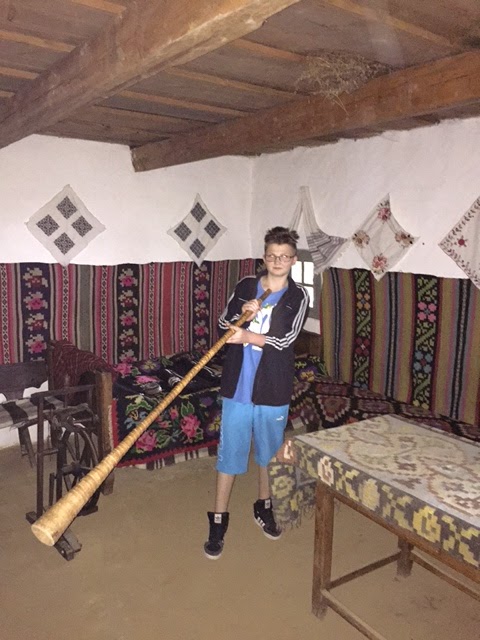
Four miles south of Sibiu, in the forest of Dumbrava, we found the largest Museum of Popular Traditional Civilization ASTRA in the country. Spread on 237 acres of rolling hills and lakes, it is the largest museum in Europe that showcases homes from different parts of the country, windmills, boats, barns with complete carriages, and many implements and tools necessary for everyday living. Each home is surrounded by a typical yard with ploughs, carts, barns, and interiors are decorated just like people were still living there and have left for the day to tend to the gardens or crops. The smell of old wood, mildew, wildflowers, and crushed fruits was overwhelming. A slow-moving red fox, accustomed to human presence, crossed the nearby yard.

ASTRA home interior (photo: Ileana 2015)
 
 
ASTRA home interior (photo: Ileana 2015)
 
The outdoor ASTRA museum is so hugely popular that locals use it for recreation, boating, and celebration of major life events. On the day we visited, there were three weddings at the wooden chapel and brides and their entourage were taking photos on the premises. I was fascinated by the various windmills displayed, and particularly a floating mill that used hydropower to grind grain.

All the workshops manufacturing silk and hemp, distilleries, forges, wine presses, paddle-wheel ferry, the blacksmith’s shop, and other machinery used by Romania’s country folk were actually in working order.

It is only fitting that this huge outdoor museum with its well-preserved history is called ASTRA. ASTRA was a patriotic literary society of the 18th century, located in Sibiu, which was instrumental in Transylvania’s unification with Romania in 1918.

To the east of Transylvania is the famous Seckler Land. The Secklers are Hungarian-speaking people which are called “secui” in Romanian. They use their own language, have fascinating traditions, customs, delicious cuisine, and schools. No industrial development has touched this plateau where old farming methods are still used today to cultivate the land. It is a land where Hungarians have migrated to in the 9th century from the Don River. The Hungarians were given land in exchange for the promise that they would protect the western Hungarian border against the invading hordes of Turkish tribes. There is a Crusader’s cross decorating a church in Tusnad as evidence of Christian support against the invading Muslims. Signs abound both in Magyar (the Hungarian language) and Romanian language.

The Hungarian king Endre II brought in the Teutonic Knights in 1211 to protect the southeast border of Transylvania from the Cumans, a migratory Turkic tribe.  It was these knights who built stone castles all over the area surrounding Brasov.  According to National Geographic, because the Teutonic Knights liked this magnificent area called Barsa Land and were going to claim it for the Pope, King Endre II forced them out in 1225 with Saxon help.

Brasov (photo: Ileana 2015)
The jewel of Transylvania is Brasov (Kronstadt). There are so many significant places in Brasov  and its vicinity that it merits a story onto itself.

Monday, June 8, 2015

Prejmer Citadel and Cetatea Rasnov

Prejmer Citadel walls
Photo: Ileana Johnson 2015
Leaving our hotel in Brasov and barely avoiding two collisions from impertinent drivers who seem to be in so much hurry that they triple and quadruple pass other vehicles close to dangerous curves and impassable hills, we made our way a few kilometers north to the neighboring Saxon villages of Prejmer and Harman.

According to National Geographic Traveler, the villagers who emigrated to German-speaking countries have abandoned their terra-cotta tile homes built very close to the road and gypsies have moved in (p. 146).

Harman’s Citadel has four turrets which indicated that “the people of Harman had the right to pass the death sentence.” The 12 meter tall walls were built in the 15th century to protect the citizens from the many outside invaders, eager for loot and tribute. A 12th century Gothic church with a 13th century funerary chapel are enclosed within the citadel rock walls. The chapel contains fragments of Gothic frescoes.

Prejmer Citadel Inner Walls
Photo: Ileana Johnson 2015
Prejmer’s Citadel walls, built between 15th and 18th centuries, protected inhabitants from constant siege coming from Austrians, Tatars, Turks, and other neighboring provinces. The inside walls had 272 rooms on four levels, refectories, a school, and galleries to accommodate the entire community during an attack. A circular passageway connected the top level. The middle courtyard was dominated by a Gothic place of worship built in the Rhineland church style. The Citadel had an exterior portal, a 17th century wall, the original 15the century defensive wall, and a 19th century wall extension and entrance passageway with a dropping gate with sharp wooden spikes that could impale someone unfortunate enough to be in the way when the gate dropped.

Pigeons, lilacs, and blossoming trees were shading the courtyard between the Gothic church and the sleeping quarters accessed by steep and dangerous wooden stairs, not for the faint of heart or wobbly jointed. I could not climb all the way to the top where the very thick rocky retaining walls and ramparts were slightly separated six feet from the residential part of the structure.

Prejmer Citadel 19th century entrance Photo: Ileana Johnson 2015
 
Prejmer citadel tools Photo: Ileana Johnson 2015
 
When the Citadel of Prejmer was under attack or times were dangerous, the local population took refuge inside the fortress. According to museum archives, an old school functioned here, with its first teachers mentioned in 1460 and then in 1556. The surviving classroom decorated with frescoes from the 18th century was used as late as 1853 when a new school was built in the village of Prejmer.  

Inner Gothic church Photo: Ileana Johnson 2015
 
Prejmer Gothic Church Photo: Ileana Johnson 2015
 
Prejmer Gate Photo: Ileana Johnson 2015
 
One hundred-year old trees and purple lilacs bloomed in the courtyard, overwhelmed by the strong scent of mold and old, dry wood. The green grass made a lovely contrast with the dark and foreboding sleeping quarters now painted white, with black stained beams. Centuries ago, this citadel must have been an island of peace and protection from the constant Ottoman Empire attacks which continued for hundreds of years. Every time they were pushed back, they returned with a vengeance.

Prejmer residences Photo: Ileana Johnson 2015
 
Ten miles from Brasov, after a pleasant drive through valleys flanked by blue mountains and lush green meadows with billowing in the wind tall grasses, wheat, and wild flowers, we found the city of Rasnov with its Citadel built by Teutonic knights in 1215. The fortress is perched on a rock about 400 feet above town. Because its location is difficult to access, the medieval castle was only conquered once in 1612 by Gabriel Bathory. The observation tower, which can be reached by steep, creaking, and difficult to climb up or down stairs, gives a breathtaking 360 degree view of the Carpathian Mountains. The movie Cold Mountain was filmed not far from here.

Rasnov Citadel Photo: Ileana Johnson 2015
Archeological digs found evidence of a fortified Dacian settlement during the first century B.C. and first century A.D. named Cumidava/Comidava.  Earthen moats, ditches dug around the rocky peaks, and wooden palisades protected the population from the numerous invasions. Parts of the fortification are still standing on the north side and in the surrounding forest. Houses, some carved in stone, were located inside the fortifications. Buried Items who were unearthed suggest a prosperous settlement with trade relations. When the Dacians were conquered by the Romans, a new Roman castrum was built on Ghimbasel Valley, bearing the same name, Cumidava/Comidava.
Three buses of American soldiers were visiting the fortress that day, climbing to the citadel on foot, while children and less physically-abled adults were ferried up by a tractor pulling a train of sorts. Humidity was low, the sun was shining, the temperature was a balmy 72, and the rocky remains of the former castle were buffeted by strong winds. A Romanian flag was proudly displayed on the highest peak of the castle.

A resident cat disappeared below a big drop through an open window, as if jumping to her death. We found her later at the entrance, safe and sound, eating a treat dropped by one of the American soldiers.
We have met several Americans the night before, dining in an outdoor pizzeria near the Black Church in Brasov. Some of these young men, part of the “show of force” exercise in Romania which ended in Brasov, were happy to be off and around so many beautiful young Romanian girls.

A couple of soldiers were now interviewed by a young Digi-24 crew about their stay in Brasov. Romanians at large were buzzing with fear in cafes and on the Internet that the Americans have come to occupy them, albeit it too late, one older man joked. “We could have used American help during WWII,” he said. We certainly did not need the Soviets, he added with sarcasm.
We bought two walking canes; besides an interesting display in the office, the canes were quite handy for climbing or steadying when walking on cobble stones or rocky terrain. And this fortress is difficult enough because it was dug into the Carpathian Mountains.

The Carpathian Mountains chain covers about one third of Romania and once formed Europe’s largest volcanic link. There is only one extinct crater left with its volcanic lake Sf. Ana north of Brasov. The U-shaped mountain chain runs from the northwest to the southwest of Romania.
The drive back took us through the Poiana Soarelui Street, a road winding up with constant hair pin curves and dizzying drops until we reached Poiana Brasov, a popular tourist destination in summer time for outdoor recreation and horseback riding, and a fabulous ski resort in wintertime.

Copyright: Ileana Johnson 2015


Thursday, June 4, 2015

The Rally That Changed History

Rally in Brasov Photo: Ileana Johnson 2015
On a beautiful sunny morning, May 21, 2015 when the Orthodox celebrated Ascension Day and Sf. Elena, we walked in the beautiful park downtown Brasov set at the foot of Timpa Peak, where a crowd had gathered in front of a large cross and several tombs of the young men and women killed on December 22-26, 1989, during the Revolution that toppled Ceausescu’s brutal communist regime. Some of them came to a rally and some were simply walking through the park.

Shots rang out from many directions, mowing down those unfortunate enough to be in the path of the stray bullets. As many as 46 people were shot within ninety minutes. Two large flower wreaths were placed in front of the cross in their eternal memory.


Heroes Day May 21, 2015
Photo: Ileana Johnson
I interviewed Mircea Brenciu, member of Uniunea Scriitorilor din Romania (Writers’ Union) and spokesperson for Asociatia Revolutionarilor din Brasov (Association of Revolutionaries from Brasov). Brenciu gave a fiery speech to the crowd of mostly middle-aged men who had gathered on Ziua Eroilor (Heros’ Day) to pay respects to those who died for freedom, freedom that had been squashed in Romania during more than four decades of communist terror.

Fallen Heroes
Photo: Ileana Johnson 2015
The Association of Revolutionaries had asked City Hall repeatedly for a monument to honor the sacrifice of those who gave their lives in December 1989 in this park and elsewhere.

A monument is needed, Brenciu said, to commemorate not just those who died but those who have survived “an event that represents the most important moment in the contemporary history of Romania” – the defeat of Ceausescu’s communist tyranny.  This often-requested monument has been refused by officials under various explanations. Brenciu believes that these politicians who run the country have no gratitude and deny recent history. “Full of hypocrisy,” Brenciu said, “they come to place a wreath, pretending to care, and in the next second, they forget everything.”

In his opinion, disrespecting history is one of the many reasons that have determined the miserable state in life of Romanian citizens in general. Conditions have improved, he said, Romanians can go abroad to work, they can speak freely, they can travel, they can curse the regime freely, but nobody is listening, Brenciu added.

Prices rose to the European Union levels since 2007 but salaries are still “10-15 times smaller.” Austerity measures imposed by the EU have compounded the problem. “How can a Romanian citizen survive under these conditions,” he asked. We have become the beggars of the European Union even though our country is very wealthy in natural resources that have been sold out to foreign investors to benefit the ruling elite class while Romanians struggle to make ends meet.

“Poverty is glaring, nobody has any money. Doctors ask for bribe money (even though the medical system is socialized and generally free), officials ask for bribe money, food is extremely expensive, how can one live in a country that freed itself from communism?

Most people are still afraid to go to the doctor even for simple operations. Many good doctors have fled to the west for better pay and working conditions and, for a while, young people chose other fields of study. Who wanted to work so hard to become a doctor when they made the same paltry salaries like everybody else? I asked about the average college graduate pay and I was shocked at the answer, $300 per month. And unskilled workers in America demand an economically impossible living wage of $15-20 an hour.

Romanians have told me that dental care is very expensive and the quality of work lacks a lot to be desired. Few acquire the expert training of dentists in the U.S. Socialized medicine is a disaster, slightly better than during Ceausescu’s regime. Retirees are compensated at the 50 percent rate for the first three prescriptions; after that, they must pay full price for any additional drugs they need.

Forgetting and rewriting history is not occurring just in Romania, it is a wave happening around the globe, a groundswell of global revisionist curricular history smacking of communist indoctrination.
“Globalism is a form of anti-nationalism, with the idea of forming a unique global state, a utopia that begs the question, who is going to run this global state, who is going to establish the rule of law, what is going to happen to the principles of democracy? As long as there are nations, there is equilibrium and respect between countries, a tradition and history that balance out a social equilibrium. European Union is a first step of this globalization. Why is the EU abandoning us while exploiting the country for everything possible for their personal gain,“ asked Brenciu pointedly.

Brenciu described how the technocrats in Brussels lured Romania into the EU like the Conquistadors lured Indians with cheap beads and mirrors. “They are taking everything and we are applauding - so great that we are Europeans now.”

Brenciu talked about Rosia Montana mine exploration in the Apuseni Mountains of Western Transylvania, which is currently blocked, and its vast reserves of gold, rare earth minerals, and rare metals such as wolfram (tungsten), vanadium, nickel, manganese, which are more valuable than gold. Gabriel Resources of Canada is planning to reopen the currently blocked gold mine which has been closed since 2006.

“Why should Romanians not exploit their own resources? In this fight, Brenciu said, we are going to lose because we have traitorous politicians.”
Brenciu alleged that over $120 billion have been stolen since the fall of communism, enough to bring Romania to an economic development on par with the EU countries. This calculation, Brenciu stated, was based on Dr. Ilie Serbanescu’s opinion as an economist, academician, and Former Minister of Reform. The money that was stolen is now in foreign accounts, Brenciu said, while the country survives in dire economic needs.

Dr. Serbanescu explained in a TV appearance that EU is a colonial system that facilitated the control of Romanian natural resources (gold, silver, rare metals, minerals), the distribution of energy (gas, oil, electricity), and banking. Globalists challenged his views as nationalist. It is a no-brainer that none of the EU members were able to control their monetary policy once they accepted the euro as a national currency. https://www.youtube.com/watch?v=2JnVK5vg9DM
“I was personally shot at,” Brenciu said, but I was lucky to escape, “I ducked into the post office building nearby. Nobody knew who was shooting, we personally caught one guy who spoke no Romanian and we turned him over to the officials and I think they released him. He was wearing dark coveralls over his street clothes, had shiny eyes like a person on drugs, and was armed.”

“It was carnage, people were mowed down, and there was blood everywhere and screams of pain coming from the injured.” It is inconceivable to be the mayor of this town that has sacrificed so much for the Revolution and to refuse a monument to commemorate this profound event, I do not and cannot understand,” Brenciu added.
On November 15, 1987, in this same park, workers came out of factories to protest and took down Ceausescu’s “Dear Leader” portrait from Cladirea Prefecturii (the Prefect’s Building). Everybody was of course arrested and their fate unknown since they were dispersed around the country and held in the many political jails Ceausescu had built or opened. I discovered one such jail at Cetatea Fagarasului, located in a 15th century fortress, cold, damp, and mildewed from standing water in the basement. The solid rock construction made the interior considerably colder than the exterior.

Liviu Corneliu Babes Memorial in Poiana Brasov
Photo: Ileana Johnson 2015
Before the Iron Curtain fell, on March 2, 1989, a citizen from Brasov, Liviu Corneliu Babes (1942-1989) skied down the mountain in Poiana Brasov. Wearing a sign protesting Ceausescu’s vicious regime, he told the whole world that Romania was a communist Auschwitz and then set himself on fire.

I journeyed to Poiana Brasov to pay respects to Babes. A plaque commemorating his sacrifice (and erected by Mircea Brenciu and his organization) stood next to a small wood church. I went inside to pray for him and for my Dad and I encountered a young priest. I asked him about Liviu Babes and he let me know in direct language that the church considers him an apostate because suicide is not condoned. But his next words shocked me even more. He said that the church teaches the parishioners to obey the state and the government at all costs. I tried to reason with him by asking what he remembered from Ceausescu’s regime. This priest was barely 5 years old when Ceausescu was executed. He told me that he remembered long lines with his mom trying to buy food on rationing coupons, otherwise, he said, it was fine. I left speechless. His washed brain and twisted view of reality clashed terribly with historical facts.

Wood Church in Poiana Brasov
                   Photo: Ileana Johnson 2015
It is a shame that there is no monument where one can pay their respects and light up a candle to the memory of those who fought against communism. Brasov gave their heroes who sacrificed for the European fight against communism. It is shameful, “people who don’t respect their past, have no future,” Brenciu explained.
“I have a fear that we are going to lose our country,” Brenciu concluded. “I only see one solution, to bring back the institution of monarchy.” The people are disoriented and discouraged, he explained. “The biggest theft occurred under the ten-year rule of President Traian Basescu.” The Revolutionaries are supporting the new President, Klaus Johannis, the former mayor of Sibiu, but his success depends on the political class. Right now the country is terribly divided.

There is a saying that goes, “Our country is so beautiful, it is sad that it is inhabited.” We have so many simple and uneducated people who are easily manipulated by the mass-media, they are voting for the wrong people who control, lie, cheat, and steal. In exchange for a vote, bribes of 5, 10, 15 euros are paid and accepted.

And schools are no longer teaching healthy values and morality. Democracy and freedom are understood as a lack of morals, honesty, personal responsibility, and as a culture of welfare dependency somewhat different from the communist culture of dependency where at least one had to pretend to work. “We are losing our national identity and it is deplorable.”

Days after the interview I was mulling over the similarities between the fate of our countries in terms of purposeful destruction, curricular indoctrination, moral bankruptcy, banking corruption, crony capitalism, disinformation of the voting populace, and the endemic corruption of the ruling elites.


Sunday, March 1, 2015

Exceptional Romanians and Their Amazing Country

Voronet Monastery Photo: Wikipedia
These days Romania receives bad press and Romanians are preceded by an unfair and negative reputation across the European Union thanks to its large indigenous gypsy population that travels to Western Europe in search of jobs and lucrative activities and businesses, legal or illegal.

You can only punish a person or a nation so much before that punishment starts to invade who they are, so I decided to write a short article highlighting some of the famous people and facts that are seldom mentioned or known about Romania. Truenomads.com has more interesting trivia and links for the curious traveler in search of history.


Peles Castle Photo: Ileana Johnson 2012
I wrote about Peles Castle in my newest book, Communism 2.0. Peles Castle, the royal residence and now a museum, with its first corner stone erected in 1875, was the first European Castle to have self-generated electricity and heat in 1888 which are still operational today. But during Ceausescu’s brutal socialist/communist regime, the rural population survived by oil lamps.

The town of Timisoara was the first European city that used electricity in 1884 to illuminate its streets, second after New York City. In 1869 Timisoara was also the first European city to operate trams pulled by horses.

Brasov - Black Church
The largest gothic church located in Eastern Europe is The Black Church in Brasov. Built in 1380 and partially destroyed by a fire in 1689, hence its name, the Black Church has an organ with 4,000 pipes and a bell that weighs 6.3 tons.

The tallest wooden church in the world (78 meters) is located at Peri-Sapanta Monastery in Maramures. With its 7-meter cross weighing 455 kg, the church was built by Ion Macarie in 1766 for the Greco-Catholic community, to replace the previous stone church that stood there for 312 years.

The Unitarian Church was founded in Transylvania, in western part of Romania, the birthplace of Francisc David in 1510.

The Voronet Monastery in Moldova is known by its moniker, the Sistine Chapel of the East. The Biblical figures painted inside and out have a folkloric twist and date back from 1488. The famous blue color of Voronet and the greens are as vivid today as they were when painted during the reign of Petru Rares.


Babes Mountain - The Sphinx
Photo: Wikipedia
Bucegi Mountains - Babele Photo: Wikipedia
The beautiful Carpathian Mountains with rare and interesting rock formations such as Babele and active mud volcanos are home to the most virgin forests in Europe with over 400 unique animal species, including the Black Goat and sixty percent of the European brown bear population.

Scarisoara Glacier Photo: Wikipedia
Romania is home to the second largest subterranean glacier in the world. Situated in the Apuseni Mountains, not far from the town of Campeni, the Scarisoara Cave (Pestera Scarisoara) was first mentioned in 1863 by the Austrian geographer, Adolf Schmididi, who drew the first map of the cave. The largest such glacier is in Slovakia. The glacier, jutting from the icy waters of the cave, at the 1150 m altitude, is 3000 years old, with a total surface of 5500 square meters of ice, as thick as 37 m in some places and as thin as 26 m in others. It is a cave explorer’s dream.

The best preserved natural wonder in Romania is the Danube Delta where the River Danube flows into the Black Sea. The Danube, originating from the Black Forest Mountains in Bavaria, flows into the sea, forming the second largest delta in Europe and the best preserved with 3,540 square kilometers of unusual fauna, flora, rivers, canals, swamps, lakes, and arbors with islands of reed.

The oldest Homo sapiens fossils, carbon-dated to 37,800-42,000 years ago, have been unearthed in the south-western part of Romania. It is an archeologist’s dream, amateur or professional, to join the many on-going digs around the country, finding evidence of Romania’s early history, and its ties to the Roman Empire and to the fights with the indigenous Dacians.

The discovery in 1961 by archeologist Nicolae Vlassa of three clay tablets with unusual inscriptions that predated the Sumerian writings from 3300 BC, convinced some archeologists and historians that the Tartaria tablets, dated around 5500 BC, could place the written language away from Mesopotamia to the Danube River area in Romania.

Among famous inventors and Romanians of note stands Henri Coanda. The Bucharest-born inventor presented at the International Aeronautical Exposition in Paris in October 1910 at Champs-Elysee a red airplane without a propeller marked “COANDA-1910.” The single-seat plane was different because it was propelled by a piston-motor with 4-cylinders cooled by water, producing 50 HP at 1,000 RPMs, and then transferred to a compressor at 4,000 RPMs. While trying to test the motor, Coanda actually took off in his propeller-less unusual airplane that was shooting flames. Since he had not flown such a contraption before, Coanda made a forced landing. His extraordinary flight occurred 30 years before Heinkel, Campini, and Whittle and was the precursor of the famous Concorde.

Petrache Poenaru from Benesti, Romania, obtained in May 1827 the French patent for “plume portable sans fin, qui s’alimente elle-même avec de l’encre,” the portable pen without end which supplies itself with ink, the first fountain pen in the world. The remarkable inventor was Tudor Vladimirescu’s secretary during the Revolution of 1821. He escaped by fleeing to Paris where he received in 1826 a scholarship to complete his engineering studies at the famous Ecole Polytechnique.

Professor Nicolae Paulescu discovered insulin in 1921, the hormone that regulates metabolic lipids, minerals, proteins, and named it “pancreina.”  He published his research and findings in a Belgian journal under the title, “Recherches sur le rôle du pancréas dans l’assimilation nutritive.” In 1916, during final research stages, the Germans occupied Bucharest and delayed his announcement of the final results.  However, two enterprising Canadians, Frederick Banting and Charles Best, using Paulescu’s 30 years of research and published papers, isolated insulin and used it to treat a patient 8 months earlier. For this reason, they received the 1922 Nobel Prize in Medicine. Millions suffering of diabetes are saved by Paulescu’s research.

Ioan Cantacuzino is said to have developed the “Cantacuzino Method” of the anti-cholera vaccination. He was also instrumental in treating typhus and tuberculosis effectively, developing the notion of contact immunity.

The Romanian inventor Traian Vuia was the first to build and fly on March 18, 1906 an “automobile-plane with fixed wings” that was totally self-propelled.

A Romanian doctor, Ana Aslan, specializing in gerontology, prepared a product in 1952 at her clinic in Bucharest, which she named Gerovital or Vitamin H3, patented in over 30 countries, to treat dystrophic ailments in the elderly. Among her more famous patients are Tito, Pinochet, Charles de Gaulle, Claudia Cardinale, Charlie Chaplin, royalty, bankers, famous businessmen, and even President John F. Kennedy.

Renowned for its gymnastics school made famous by Coach Bella Caroly, one of his pupils, Nadia Comanici, was the first gymnast to receive a perfect score of 10 in the Olympics in Montreal, Canada in 1976.

The huge Parliament building, a painful reminder of Ceausescu’s communist destructive megalomania, is second largest in the world after the Pentagon building. Many beautiful and important historical and religious landmarks had been destroyed to make room for this opulence.

So many exceptional young Romanians have left their home country and still do today, trying to find themselves, their art, talent, education, freedom, and economic opportunity. Some make it, some remain in anonymity.

Mihai Eminescu
Photo: Wikipedia
Most memorable are the famous sculptor Constantin Brancusi who, in his old age, wanted to leave his entire life’s work to his compatriots in Romania but was refused; the celebrated composer, violinist, pianist, and conductor George Enescu, one of the greatest composers of the 20th century;, and the legendary Romantic poet, novelist, and journalist Mihai Eminescu who wrote about valiant Romanian fighters and its tumultuous history; and the comedic and witty playwright Ion Luca Caragiale whose short stories, poems, political commentaries and plays rejoiced in painting the foibles of humanity; and the playwright Eugen Ionescu, who wrote mostly in French, a prominent figure of the French Avant-garde theatre.
Copyright: Ileana Johnson 2015