Showing posts with label Transylvania. Show all posts

Tuesday, June 16, 2015

Brasov, a Jewel in Transylvania's Crown

Brasov Downtown (photo: Ileana 2015)
Brasov is truly a jewel, a rare pearl in the Transylvanian crown. The Barsa Land surrounding Brasov is a portal into the southern Carpathians’ thick forests, castles, citadels, Evangelical churches, and other historical sites.

The Teutonic Knights protected this area between 1211 and 1225 from the invasion of the Cumans, a Turkic migratory tribe. South of Brasov is the Prahova Valley where I was born and raised decades ago, a land rich in oil with fields of corn and wheat stretching as far as the eye can see.

Despite its heavy industrialization during the communist regime, Brasov kept its medieval character and fresh air. Workers were crushed here in 1987 during a revolt against Ceausescu’s tyrannical regime. Many were arrested and taken to infamous prisons around the country to serve as model for those who would dare again to oppose the dear leader.

Brasov pedestrian walk (photo: Ileana 2015)
The pedestrian walkway from the downtown center to the Black Church is dotted with cozy cafes and restaurants offering local cuisine, street food, Strudel, pizza, and gelato. The cobble-stoned Council Square is very close to the History Museum which holds among its collections the first known document written in Romanian in 1521; the Black Church and the Ethnography Museum, with displays like a walk through a medieval market, are flanking the square.

The famous “Cerbul Carpatin” (Carpathian Stag) restaurant serves delicious Romanian cuisine both indoors and outdoors. Folkloric groups entertain guests with their Romanian music and famous vocalists soothe the hearts of those longing for lost loves. Hunting trophies complement the décor, typical country art with handmade furniture, stained glass, and peasant table cloths.

The Black Church is actually St. Mary’s Evangelical Church. Its walls have been blackened by a fire during the Habsburg siege of Brasov in 1689 which killed 3,000 people. This church has been in existence since 1383. A statue of its most famous priest, Johannes Honterus (1498-1549), stands outside. Honterus helped disseminate Martin Luther’s 1517 “95 theses” challenging the “corrupt practice of selling ‘indulgences’ to absolve sin.” The Protestant Reformation that “emerged was shaped by Luther’s ideas. His writings changed the course of religious and cultural history in the West.”  http://www.history.com/topics/martin-luther-and-the-95-theses

Black Church on the left (Photo: Ileana 2015)
 
Black Church tombs in the walls (Photo: Ileana 2015)
 
Famous citizens of Brasov (Kronstadt) were originally buried in the Black Church and their sarcophagi with intricate tombstones are seen in the walls. The practice was stopped centuries ago for sanitary reasons. The local rich who could afford such a burial in the church walls are now entombed in the cemetery across town.

Black Church pew (Photo: Ileana 2015)
 
The pews are beautifully carved indicating which guilds owned them. There are over 100 Anatolian rugs gifted by Saxon merchants who bought them from Turkish soldiers.  The blue organ is used three times a week since there are worries that the heavy sounds vibrate the walls too much, further deteriorating the precious building.

Ethnography Museum in Brasov (Photo: Ileana 2015)
 
On my way to the quaint square where the First Romanian School is located, I came upon Strada Sforii (Rope Street), 3.6-4.4 feet in width, advertised to be the narrowest street in Europe.

First Romanian School (Photo: Wikipedia)
The First Romanian School is located on the grounds of a 16th century church, Sf. Nicolae (St. Nicholas), past the Schei Gate. The school was attended by one pupil per village as space was limited. This pupil was supposed to go back to his village and disseminate to others what he had learned.

According to the energetic caretaker and guide, Vasile Oltean,  the school was established in the 14th century but the building itself was not erected until 1495. Vasile Oltean was himself a former pupil and teacher at the school. The school was still used in the 20th century, closing in 1941. When I walked in, a jocular and animated guide was giving a lecture in the classroom to a group of Italian tourists.

First Romanian School printing press (Photo: Ileana 2015)
 
The first Romanian Bible was printed here and Deacon Coresi’s printing press on display in the museum managed to publish only 35 titles but in hundreds of copies. It was so labor-intensive, 10-20 apprentices toiled to hand-sculpt each page through a process called xilo-engraving. It was a labor of love because they helped promote the linguistic unity of the people.  The wooden press printed the first Romanian letter in Latin, the first Romanian grammar textbook and the first Bible printed on goatskin, with a cover weighing seven kilograms.

The square where the First Romanian School is located (Photo: Ileana 2015)
 
The plaque above the school entrance described the school as the first Romanian School of Greater Romania, rebuilt in stone 1595-1597 with a gift from Prince Aron of Moldavia under the care of Archpriest Mihai, and rebuilt in 1761. The center of education for hundreds of years, it enlightened children and adults alike.

After the primary schools and Orthodox high school of Brasov were built, the building served as a meeting place for the parish council and later housed the historic archives of St. Nicholas Church. The tiny school building to the left of the church was not very imposing, but, as a life-long teacher, it made an indelible impression on me on that rainy spring day.

Whimsical fountain downtown Brasov (Photo: Ileana 2015)
 
Rasnov Citadel (Photo: Ileana 2015)
 
The one location that attracts the most visitors about 10 miles past the Rasnov Citadel built by Teutonic knights in 1215 and past the National Park Piatra Craiului with its 7,000 foot peak, is the village of Bran with its famous Bran Castle.

Bran Castle in the village of Bran (photo: Ileana 2015)
 
Bran’s Castle is known to westerners as Dracula’s Castle even though Voivode Vlad Tepes III’s connection to this castle was rather vague. He briefly captured the castle during a period in 1459 when he was arguing with the town’s merchants.

Bran’s ownership has been a struggle across the centuries. According to the National Geographic, the castle has been controlled from the late 15th century until 1920 by the Saxons of Brasov even though the Turks have assaulted it and their last failed attempt happened in 1787. In 1920 the city of Brasov gave the castle to the royal family. It was remodeled by Regina Maria who had electricity installed. “After years spent as a summer palace, a field hospital, and a communist-run museum, the castle now belongs to three members of the Habsburg family; the Brasov city council hopes to raise $78 million to buy it back.” (National Geographic Traveler, p. 148)

The adjacent Village Museum is an outdoor vivid lesson about the history and culture surrounding the castle and Brasov. This museum is located on the border between Transylvania and Wallachia (Muntenia). Looking up from the verdant yard below, the sheer walls of the castle with its ominous aura of impenetrable solid rock appearance, one can understand why Bran was a perfect location for a frontier garrison and customs post, documented as early as 1377.

The castle, which is located on a crag and appears impossible to destroy, is actually crumbling under its own weight. Engineers discovered in 1989 that the rocky cliff is crumbling. During the engineering exploratory digs, medieval wall frescoes have been found.

A handmade iron (Photo: Ileana 2015)
 
Seven bastions and fragments of protective walls built by the Saxons in 1395 are still preserved today in Brasov. The circular bastion of the Weavers is the best preserved, built by the weaver’s guild in the 16th century. Life was organized around trade unions called guilds in medieval times. They kept their paperwork in beautifully carved wooden trunks.

Brasov view from Tampa Peak, 960 m (Photo: Ileana 2015)
 
An Orthodox church in Brasov at the foot of Cetatea (Photo: Ileana 2015)
 
A sixteenth century fortress named Cetatea still stands today. A steep climb through a wooded area of Brasov or a leisurely drive rewards the visitor with a breathtaking view of the downtown center of Brasov, the pearl of Transylvania.

Copyright: Ileana Johnson 2015 

Friday, June 12, 2015

Transylvania, the Land of Enchantment

Cantacuzino Castle (photo: Ileana 2015)
Transylvania is a land of enchantment of middle and northern Romania with its breathtaking and spectacular landscapes, its rich and tumultuous history, bloody battles, occupations, and a proud population that maintains its distinct culture and art.

It is bordered on three sides by the Carpathian Mountains that appear on maps like a natural boundary between Transylvania and Wallachia, the province made famous by Vlad the Impaler, “Dracula,” Prince of Wallachia, who made Bucharest its capital in 1459. The pristine and wild countryside of Transylvania (Latin for “across the forest”) is sometimes impassable to humans.
Transylvania has a distinct Hungarian and German influence which can be seen in its fairy tale Hansel and Gretel architecture, its cuisine, the spotless streets, order and civility, in how successfully cities are run, and the seriousness on the faces of its population. However, many ethnic Germans have left in the 1970s when the communist Romanian state signed an agreement with West Germany.

Romanian settlements dating back to the Iron Age were found in the southwestern part of Transylvania. Because the area has been part of the Hungarian and later the Austro-Hungarian Empire for hundreds of years, there is a strong Hungarian and German influence everywhere. Schools, colleges, and theaters are still operating in Hungarian and German languages.

Hungarian kings had invited Saxons (from the province of Sachsen) in the 12th and 13th centuries to settle in Transylvania. Some of them were gifted goldsmiths, others were wood carvers  and builders. Their presence is reflected in the beautiful medieval citadel churches built in southern Transylvania.


Bran Castle in Brasov (photo: Ileana 2015)
Hungarians and Germans left behind castles, imposing manors, palaces, and churches in towns such as Cluj-Napoca, Alba Iulia, Sighisoara, and in the old Saxon city of Sibiu (Hermannstadt) with its famous medieval houses with rooftop “eyes,” roof vents that look like watchful eyes.

The miners and farmers in western Transylvania called “Moti” trace their roots for thousands of years. The Apuseni Mountains are rich in mineral reserves, rare metals, and gold, particularly in the contentious region of Rosia Montana.

The archeological evidence found at Sarmizegetusa speaks volumes of the rich civilization of the Dacians who were conquered by the Romans in 106 A.D. and colonized into a Roman Empire province. The story of the battles between the Romans and the Dacians is vividly told in the freezes of Trajan’s Column in Rome.

According to National Geographic , the eastern part of Transylvania has “the highest concentration of ethnic Hungarians.” Buildings have a different style, ethnic costumes vary, and many inhabitants speak both Romanian and Hungarian.

Cluj-Napoca is “the cultural and economic hub of Transylvania.” Alba Iulia, the former Hungarian capital, has an interesting Habsburg baroque citadel. It was the city where Romania and Transylvania became one on the great Union Day, December 1, 1918.

Bistrita, in the northern part, is the location where Bram Stoker set his novel “Dracula” in 1897. His fictional character, Jonathan Harker, spends the night in Bistritz (Bistrita) on his way to Tihuta Pass (Borgo Pass in Hungarian) where Voivode Vlad Tepes’ real castle ruins are located.  Bram Stoker never traveled to Romania; he used geographical information from his local library.

Sibiu house with "eyes" (photo: Ileana 2015)
Sibiu is the largest medieval town in Romania, built in the 12th century with three concentric fortified walls (a few have survived), squares (a large and a small one), stairways, and strongholds built and fortified between the 13th to the 18th centuries.

The two famous battles of Sibiu on March 18 and March 25 1442 were fought nearby between the army of the Hungarian Empire and the army of the Ottoman Empire. Approximately 4,000 Hungarians and 15-20,000 Turks were killed in the two battles which resulted in a defeat and push back of the Ottomans.

Tiny restaurant in Sibiu (photo: Ileana 2015)
 
The Large Square (Piata Mare) served as a grain market in 1411, medieval executions, and later used for carnivals, meetings, and now rock concerts. The little restaurant called Butoiul de Aur (The Golden Barrel) has been serving patrons since the 15th century. Houses dating back to the 13th and 14th centuries are the oldest surviving homes with colorful tiles, sometimes mosaic-ed in beautiful patterns and with “eyes” on the roof for air venting.


17th century iron vial (photo: Ileana 2015)
The tiny four-room pharmacy museum, that used to be a 17th century apothecary, displays curious instruments and recipes for potions perhaps made by Samuel Hahnemann (1755-1843), the father of homeopathy.

Sibiu Church (photo: Ileana 2015)
The largest Catholic Church in Sibiu stands majestically between Piata Mica (Little Square) and Piata Mare (Large Square). Interestingly, on the day I visited, it was displaying a large banner at the back entrance urging people to stop fracking for natural gas and to stop mining in Rosia Montana.  Since the Pope is now a climate change expert and population control expert, why not turn the church into an environmentalist NGO?

Brukenthal Museum courtyard (photo: Ileana 2015)
 
Brukenthal steam porcelain stove (photo: Ileana 2015)
 
Brukenthal Roman lapidarium (photo: Ileana 2015)
 
Medieval door (photo: Ileana 2015)
 
The National Brukenthal Museum is a treasure trove of art collections which Baron Samuel Von Brukenthal, the former Governor of Transylvania (1777-1787), housed in his Palace built in the Grand Square in Sibiu. Showcased in the baroque and rococo interiors are famous masters like Jan van Eyck from 1420, German and Austrian painters, Romanian painters, personal favorites like Teodor Aman and Nicolae Grigorescu, gold and silver coins, jewels, engravings, intricately carved furniture, books, weapons, silver and gold drinking cups and goblets, medals displayed in his former library, sculptures, costumes of the era, whimsical porcelain steam stoves interconnected throughout the palace, a novelty for that period,  a lapidarium with statues of Roman gods, Roman roads mile markers, and votive altars from Apulum and Ulpia Traiana Sarmizegetusa, dating to the 2nd and 3rd centuries A.D.

ASTRA barn with carriages (photo: Ileana 2015)
 
 
Interior of a floating mill at ASTRA (photo: Ileana 2015)
 
Four miles south of Sibiu, in the forest of Dumbrava, we found the largest Museum of Popular Traditional Civilization ASTRA in the country. Spread on 237 acres of rolling hills and lakes, it is the largest museum in Europe that showcases homes from different parts of the country, windmills, boats, barns with complete carriages, and many implements and tools necessary for everyday living. Each home is surrounded by a typical yard with ploughs, carts, barns, and interiors are decorated just like people were still living there and have left for the day to tend to the gardens or crops. The smell of old wood, mildew, wildflowers, and crushed fruits was overwhelming. A slow-moving red fox, accustomed to human presence, crossed the nearby yard.

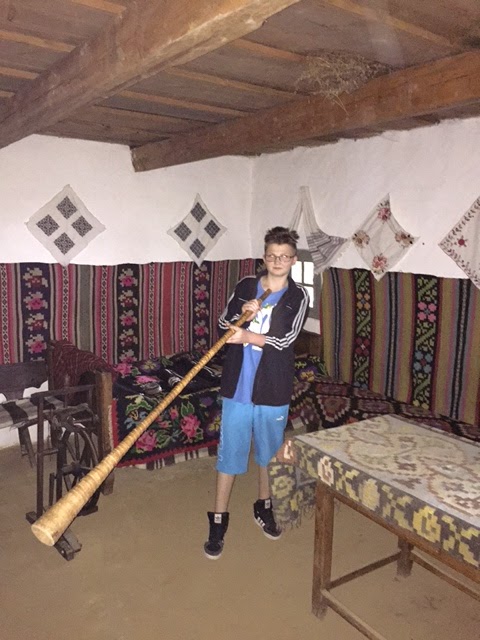
ASTRA home interior (photo: Ileana 2015)
 
 
ASTRA home interior (photo: Ileana 2015)
 
The outdoor ASTRA museum is so hugely popular that locals use it for recreation, boating, and celebration of major life events. On the day we visited, there were three weddings at the wooden chapel and brides and their entourage were taking photos on the premises. I was fascinated by the various windmills displayed, and particularly a floating mill that used hydropower to grind grain.

All the workshops manufacturing silk and hemp, distilleries, forges, wine presses, paddle-wheel ferry, the blacksmith’s shop, and other machinery used by Romania’s country folk were actually in working order.

It is only fitting that this huge outdoor museum with its well-preserved history is called ASTRA. ASTRA was a patriotic literary society of the 18th century, located in Sibiu, which was instrumental in Transylvania’s unification with Romania in 1918.

To the east of Transylvania is the famous Seckler Land. The Secklers are Hungarian-speaking people which are called “secui” in Romanian. They use their own language, have fascinating traditions, customs, delicious cuisine, and schools. No industrial development has touched this plateau where old farming methods are still used today to cultivate the land. It is a land where Hungarians have migrated to in the 9th century from the Don River. The Hungarians were given land in exchange for the promise that they would protect the western Hungarian border against the invading hordes of Turkish tribes. There is a Crusader’s cross decorating a church in Tusnad as evidence of Christian support against the invading Muslims. Signs abound both in Magyar (the Hungarian language) and Romanian language.

The Hungarian king Endre II brought in the Teutonic Knights in 1211 to protect the southeast border of Transylvania from the Cumans, a migratory Turkic tribe.  It was these knights who built stone castles all over the area surrounding Brasov.  According to National Geographic, because the Teutonic Knights liked this magnificent area called Barsa Land and were going to claim it for the Pope, King Endre II forced them out in 1225 with Saxon help.

Brasov (photo: Ileana 2015)
The jewel of Transylvania is Brasov (Kronstadt). There are so many significant places in Brasov  and its vicinity that it merits a story onto itself.

Tuesday, June 9, 2015

Cetatea Fagarasului and Communist Punishment

Cetatea Fagarasului entrance (Photo: Ileana 2015)
We found Cetatea Fagarasului half-way between Brasov and Sibiu, an hour drive off the beaten path for foreign tourists. I would venture to say that we were the only overseas visitors on that drizzly morning. The fortress was surrounded by a fosse populated by black and white swans, perfect sentries for a castle that was often under Ottoman siege. Weeping willows lined the street leading to the entrance.

I thought we were going to see a 14th century fortress but I discovered one of the many prisons Ceausescu had used around the country to punish those who disagreed with his regime and dared to protest his reign of terror.
Fagaras Fortress was built between the 14th and 17th centuries. The fortress was preceded by a wooden fortification and earthen wall dating from the 12th century. In the 16th century the fortress was transformed into a castle. Gabriel Rakosi I and Gabriel Bethlen, Transylvanian princes, decorated it according to Renaissance models in the 17th century.

Moat with Swans (Photo: Ileana 2015)
The Fagaras Fortress, surrounded by a two-meter deep water moat (“fosse” in Old English) fed through a channel from the Olt River (since 1676 from “Superior lake”), was so impenetrable that, although attacked countless times, it was never conquered.

Scaffold (Photo: Ileana 2015)
The now green exterior courtyard had a medieval scaffold, which had been used for the last time in the 1970s. There was a carriage and a blacksmith’s shop with iron tools and bellows.

Access to the castle was made through two bridges (one pedestrian) and three consecutive lifting gates. On the northern side, built on wooden pillars, there were two powder houses (1667-1676). A boat and six swans were mentioned in 1656. Surviving on daily ration of rye bread, the swans multiplied to nine and four chicks by 1676. During our visit I saw two pairs of swans, a black and a white one.

One of the many inner courtyards (Photo: Ileana 2015)
 
The museum archives described how one Turkish historian, geographer, and traveler, Elvia Celebi, who crisscrossed the Ottoman Empire for 40 years, actually participated in the siege of Fagaras Fortress in 1661. He wrote that the Turks led by Ali Pasha, after setting fire to the citadel, were met with resistance from many soldiers and inhabitants gathered from the surrounding area. The Ottomans had to withdraw after 14 days of siege.

Gabriel Bethlen had a Hussars’ fortress built in 1623 in the northern part of the fortress, by the moat. The Ottoman sieges must have destroyed the Hussars’ fortress because it was never mentioned in any records or inventories after 1676.

Inner courtyard of the communist prison (photo: Ileana 2015)
 
According to museum archives, “After 1696, the fortress became a garrison for the Austrian army, then for the Magyar army, and after that for the Romanian army. Between 1948 and 1960 the fortress was a communist prison.”

Torture cell with tools (photo: Ileana 2015)
 
At the base of the Prison Tower was the jailer’s house. Records in 1632 mentioned 12 leg cuffs, 14 handcuffs, a tree trunk, an axe, leg iron weights, and a hangman’s broadsword. Under the jailer Ambrus Janos the inventory of his torture chamber swelled to 54 pairs of leg chains. By 1676, there were three dungeons in existence. One of the castle towers housed an Iron Maiden, a particularly cruel form of punishment. The unfortunate human was trapped inside an iron suit fitted with spikes which pierced his body, avoiding vital organs, but allowing for a slow and agonizingly painful death through blood loss.

Prison tower (photo: Ileana 2015)
The cells, where anti-communist fighters from Fagaras Mountains and other parts of the country were held between 1948-1960 when the fortress was a prison, were cold and dark. The treatment of political prisoners was beyond brutal. National Geographic mentioned that “During the brief moments when their cell doors were opened, they scratched messages on the walls” which are still visible today.

Faces of some of the victims (photo: Ileana 2015)
 
The museum exhibited photographs of those imprisoned and killed, original 1960 documents of peasants’ obligations to turn in a quota of everything they produced or grew, documents of rationed consumption, rationing of clothing and shoes, rationing of consumption of meat permitted only on Saturday and Sunday for a total of 250 grams weekly, with a supplement for those who actually worked in a factory, and the empty promise that bath soap and powdered detergent would be distributed soon. This rang similar to the current rationed consumption and dire economic situation in Venezuela where Hugo Chavez’s socialism has destroyed the once self-sufficient economy.

Passage to one of the jails (photo: Ileana 2015)
 
Before the socialists took complete control of the country, the Directive NKVD 2-6 of 1947 made sure that any farm would be unprofitable to farm or rent to farm in order to facilitate collectivization. If the peasants offered more resistance to collectivization, they were to be forced to turn over to the communist party a higher quota of what they produced.

A poster from that era stated, “Long live the Soviet Union, the liberator of the Romanian people.” The Soviets actually destroyed every freedom and the wealth and comfort that the Romanian people formerly enjoyed under the monarchy and imprisoned them into a terrifying concentration camp unlike any other for 41 years.

“Let us promise anything asked of us, but, when the moment will come, let us remember that the communist honor is to not fulfill these promises,” said V.I. Lenin in his “Empty words about freedom.”

The massive propaganda was directed from Moscow because the Romanian commies did not have experience yet. Under their guidance, the Romanian Communist Party started a campaign of constant agitation and mobilization of the population, and non-stop manufactured crises.

The “enemies of the people” were identified during public meetings, press releases, and public trials. Dailies, magazines, newspapers, posters, journals, brochures, and pamphlets continued the indoctrination. An entire army of community organizers were released to agitate the masses.

A massive campaign to destroy the national memory, to falsify the past, and to rewrite history and the present began. The press pushed communist utopia non-stop. “The political police, under Soviet control, began a societal surveillance by agents and informers,” according to museum archives.


Monument dedicated to anti-communism fighters (photo: Ileana 2015)
 
Once the urban population and the elites were subjugated, next came the peasants’ turn; they had been pretty much left alone until 1949. The commies made the peasants’ livelihood very difficult by forcing them into obligatory back breaking quotas and by controlling their commerce with agricultural products. The communists eventually destroyed the peasants’ individual property rights. Small farmers were constantly demonized, beaten, threatened, tortured, and imprisoned until they relented to become part of the communist collectivization agricultural machine.

In Tara Fagarasului which is the larger area surrounding this fortress prison in Cetatea Fagarasului, the social order was totally and systematically destroyed. Eighty percent of the population was considered well-off farmers, wealthy farmers, and middle peasants.  More than 1,000 locals suffered in forced labor camps, were deported to communist prisons around the country, and thousands of family members were discriminated and maligned socially and economically. 

The wealthy farmer was labeled “chiabur,” from the Turkish word “kibar,” meaning “a good steward.” The farmers were demonized and the word “chiabur” was successfully used by communists as a label to justify repression against private land owners.  The manufactured word “chiabur” was not unlike the bogus term of “white privilege” being floated by the main stream media and academia in our own country.

The first communist president, Gheorge Gheorghiu-Dej, was advising the apparatchiks involved in the land confiscation, that they should confiscate land in such a way that it did not look like nationalization, but at the same time, they should not leave the land owners much, “just enough to buy a cigarette,” and to pay them for their tractors scrap metal prices. “For better combines that do not need much repair, we should pay them 5 percent more.” (Gheorghe Gheorghiu-Dej speech on March 26, 1959)

Gheorghiu-Dej continued, “If a rich landowner protested, he can be shot on the spot, to let all know who would dare not to turn in their quotas what will befall them.” (Instructions to all member of Securitate, 1948)
I still remember, as a child, being forced to wait in long lines with my parents to view this man’s body in state when he passed away. The entire country was supposed to mourn his passing even though they hated his guts for what he had done to the country.

To justify the existence and establishment of the terror state, enemies had to be found. If none were found, enemies had to be invented, said one of the Soviet community organizers and agitators, Tzvetan Todorov. In 1951 forced deportations spread ethnic Swabians and Romanians around the country, especially those who opposed the regime and collectivization. Many were sent south in Baragan and Basarabians were deported to Fagaras. But an armed resistance developed in the Fagaras Mountains in Transylvania.

As part of the same Directive, NKVD 2-6 of 1947, all parties had to be unified under one party, making sure that all key positions would be occupied by the secret (Soviet) services.

Weeping willows, a fitting tribute to those who died (photo: Ileana 2015)
 
Cetates Fagarasului, the medieval fortress, saw the incarceration between September 1950-April 1960 of over 4,000 former employees from the Information Services, State Security, military judges, policemen, diplomats, and those who helped the anti-communism fighters. Prisoners were jailed without due process and without sentencing. Because of the harsh and inhuman imprisonment conditions, 166 generals, officers, clerks, workers, and peasants died there.
 
I dug up a tiny rock from the inner courtyard for my friend who collects stones from different parts of the world. I washed it carefully before packing it, wondering how much blood of innocents tortured or killed in battle or in prison had washed over these rocks over the centuries.