Showing posts with label Trajan's Column. Show all posts

Friday, June 12, 2015

Transylvania, the Land of Enchantment

Cantacuzino Castle (photo: Ileana 2015)
Transylvania is a land of enchantment of middle and northern Romania with its breathtaking and spectacular landscapes, its rich and tumultuous history, bloody battles, occupations, and a proud population that maintains its distinct culture and art.

It is bordered on three sides by the Carpathian Mountains that appear on maps like a natural boundary between Transylvania and Wallachia, the province made famous by Vlad the Impaler, “Dracula,” Prince of Wallachia, who made Bucharest its capital in 1459. The pristine and wild countryside of Transylvania (Latin for “across the forest”) is sometimes impassable to humans.
Transylvania has a distinct Hungarian and German influence which can be seen in its fairy tale Hansel and Gretel architecture, its cuisine, the spotless streets, order and civility, in how successfully cities are run, and the seriousness on the faces of its population. However, many ethnic Germans have left in the 1970s when the communist Romanian state signed an agreement with West Germany.

Romanian settlements dating back to the Iron Age were found in the southwestern part of Transylvania. Because the area has been part of the Hungarian and later the Austro-Hungarian Empire for hundreds of years, there is a strong Hungarian and German influence everywhere. Schools, colleges, and theaters are still operating in Hungarian and German languages.

Hungarian kings had invited Saxons (from the province of Sachsen) in the 12th and 13th centuries to settle in Transylvania. Some of them were gifted goldsmiths, others were wood carvers  and builders. Their presence is reflected in the beautiful medieval citadel churches built in southern Transylvania.


Bran Castle in Brasov (photo: Ileana 2015)
Hungarians and Germans left behind castles, imposing manors, palaces, and churches in towns such as Cluj-Napoca, Alba Iulia, Sighisoara, and in the old Saxon city of Sibiu (Hermannstadt) with its famous medieval houses with rooftop “eyes,” roof vents that look like watchful eyes.

The miners and farmers in western Transylvania called “Moti” trace their roots for thousands of years. The Apuseni Mountains are rich in mineral reserves, rare metals, and gold, particularly in the contentious region of Rosia Montana.

The archeological evidence found at Sarmizegetusa speaks volumes of the rich civilization of the Dacians who were conquered by the Romans in 106 A.D. and colonized into a Roman Empire province. The story of the battles between the Romans and the Dacians is vividly told in the freezes of Trajan’s Column in Rome.

According to National Geographic , the eastern part of Transylvania has “the highest concentration of ethnic Hungarians.” Buildings have a different style, ethnic costumes vary, and many inhabitants speak both Romanian and Hungarian.

Cluj-Napoca is “the cultural and economic hub of Transylvania.” Alba Iulia, the former Hungarian capital, has an interesting Habsburg baroque citadel. It was the city where Romania and Transylvania became one on the great Union Day, December 1, 1918.

Bistrita, in the northern part, is the location where Bram Stoker set his novel “Dracula” in 1897. His fictional character, Jonathan Harker, spends the night in Bistritz (Bistrita) on his way to Tihuta Pass (Borgo Pass in Hungarian) where Voivode Vlad Tepes’ real castle ruins are located.  Bram Stoker never traveled to Romania; he used geographical information from his local library.

Sibiu house with "eyes" (photo: Ileana 2015)
Sibiu is the largest medieval town in Romania, built in the 12th century with three concentric fortified walls (a few have survived), squares (a large and a small one), stairways, and strongholds built and fortified between the 13th to the 18th centuries.

The two famous battles of Sibiu on March 18 and March 25 1442 were fought nearby between the army of the Hungarian Empire and the army of the Ottoman Empire. Approximately 4,000 Hungarians and 15-20,000 Turks were killed in the two battles which resulted in a defeat and push back of the Ottomans.

Tiny restaurant in Sibiu (photo: Ileana 2015)
 
The Large Square (Piata Mare) served as a grain market in 1411, medieval executions, and later used for carnivals, meetings, and now rock concerts. The little restaurant called Butoiul de Aur (The Golden Barrel) has been serving patrons since the 15th century. Houses dating back to the 13th and 14th centuries are the oldest surviving homes with colorful tiles, sometimes mosaic-ed in beautiful patterns and with “eyes” on the roof for air venting.


17th century iron vial (photo: Ileana 2015)
The tiny four-room pharmacy museum, that used to be a 17th century apothecary, displays curious instruments and recipes for potions perhaps made by Samuel Hahnemann (1755-1843), the father of homeopathy.

Sibiu Church (photo: Ileana 2015)
The largest Catholic Church in Sibiu stands majestically between Piata Mica (Little Square) and Piata Mare (Large Square). Interestingly, on the day I visited, it was displaying a large banner at the back entrance urging people to stop fracking for natural gas and to stop mining in Rosia Montana.  Since the Pope is now a climate change expert and population control expert, why not turn the church into an environmentalist NGO?

Brukenthal Museum courtyard (photo: Ileana 2015)
 
Brukenthal steam porcelain stove (photo: Ileana 2015)
 
Brukenthal Roman lapidarium (photo: Ileana 2015)
 
Medieval door (photo: Ileana 2015)
 
The National Brukenthal Museum is a treasure trove of art collections which Baron Samuel Von Brukenthal, the former Governor of Transylvania (1777-1787), housed in his Palace built in the Grand Square in Sibiu. Showcased in the baroque and rococo interiors are famous masters like Jan van Eyck from 1420, German and Austrian painters, Romanian painters, personal favorites like Teodor Aman and Nicolae Grigorescu, gold and silver coins, jewels, engravings, intricately carved furniture, books, weapons, silver and gold drinking cups and goblets, medals displayed in his former library, sculptures, costumes of the era, whimsical porcelain steam stoves interconnected throughout the palace, a novelty for that period,  a lapidarium with statues of Roman gods, Roman roads mile markers, and votive altars from Apulum and Ulpia Traiana Sarmizegetusa, dating to the 2nd and 3rd centuries A.D.

ASTRA barn with carriages (photo: Ileana 2015)
 
 
Interior of a floating mill at ASTRA (photo: Ileana 2015)
 
Four miles south of Sibiu, in the forest of Dumbrava, we found the largest Museum of Popular Traditional Civilization ASTRA in the country. Spread on 237 acres of rolling hills and lakes, it is the largest museum in Europe that showcases homes from different parts of the country, windmills, boats, barns with complete carriages, and many implements and tools necessary for everyday living. Each home is surrounded by a typical yard with ploughs, carts, barns, and interiors are decorated just like people were still living there and have left for the day to tend to the gardens or crops. The smell of old wood, mildew, wildflowers, and crushed fruits was overwhelming. A slow-moving red fox, accustomed to human presence, crossed the nearby yard.

ASTRA home interior (photo: Ileana 2015)
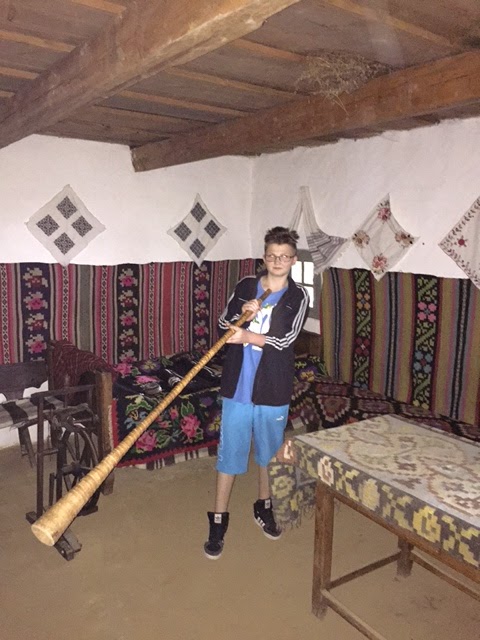
 
 
ASTRA home interior (photo: Ileana 2015)
 
The outdoor ASTRA museum is so hugely popular that locals use it for recreation, boating, and celebration of major life events. On the day we visited, there were three weddings at the wooden chapel and brides and their entourage were taking photos on the premises. I was fascinated by the various windmills displayed, and particularly a floating mill that used hydropower to grind grain.

All the workshops manufacturing silk and hemp, distilleries, forges, wine presses, paddle-wheel ferry, the blacksmith’s shop, and other machinery used by Romania’s country folk were actually in working order.

It is only fitting that this huge outdoor museum with its well-preserved history is called ASTRA. ASTRA was a patriotic literary society of the 18th century, located in Sibiu, which was instrumental in Transylvania’s unification with Romania in 1918.

To the east of Transylvania is the famous Seckler Land. The Secklers are Hungarian-speaking people which are called “secui” in Romanian. They use their own language, have fascinating traditions, customs, delicious cuisine, and schools. No industrial development has touched this plateau where old farming methods are still used today to cultivate the land. It is a land where Hungarians have migrated to in the 9th century from the Don River. The Hungarians were given land in exchange for the promise that they would protect the western Hungarian border against the invading hordes of Turkish tribes. There is a Crusader’s cross decorating a church in Tusnad as evidence of Christian support against the invading Muslims. Signs abound both in Magyar (the Hungarian language) and Romanian language.

The Hungarian king Endre II brought in the Teutonic Knights in 1211 to protect the southeast border of Transylvania from the Cumans, a migratory Turkic tribe.  It was these knights who built stone castles all over the area surrounding Brasov.  According to National Geographic, because the Teutonic Knights liked this magnificent area called Barsa Land and were going to claim it for the Pope, King Endre II forced them out in 1225 with Saxon help.

Brasov (photo: Ileana 2015)
The jewel of Transylvania is Brasov (Kronstadt). There are so many significant places in Brasov  and its vicinity that it merits a story onto itself.

Thursday, May 7, 2015

Dacian Gold's Heavy Price

Dacian bracelet from Sarmizegetusa
Photo: Wikipedia
Historians agree that some of the Roman military campaigns were motivated by the need to find and control ore reserves required for coinage. Monetary payments were made for a while using un-coined bronze called aes rude and cast bronze ingots called aes signatum.

Rome eventually built its own mint and coined silver denarii and smaller coins of bronze. During Emperor Augustus’ reign, a gold coin called aureus was minted, which could be exchanged into silver denarii. Because the Greeks kept their silver drahms as a basis for their monetary system, money exchangers of various currencies were found in large cities. Constantine introduced the gold solidus as a counter measure to the diminished weight and metal content of coins of the third century A.D.

A treasure trove of Roman coins, imperial aurei and denarii, was found in India, proof of the trade in spices and pearls, but also evidence that Indian merchants were collectors who may have prized the Roman gold and silver coins enough to horde them. According to Strabo, 120 ships “sailed every year to India from the Red Sea” and each cargo was extremely valuable.

Coins were not just a medium of exchange and store of value, but important means to advertise legendary figures, military campaigns and victories, buildings, roads, construction projects, and the image of the emperor. Julius Caesar was the first emperor to use his own visage on coins instead of the portraits of previous rulers as it was the custom.

It was thus of great importance for Rome to find new gold and silver reserves in order to feed the need for precious ore to mint coins for the Roman Empire.

Emperor Trajan, during his 19-year rule, managed to defeat in 105 A.D. the Dacians, a thriving civilization, the ancestors of the Romanians of today. Located north of the Danube River, the Dacians were a constant irritation, attacking and raiding the outskirts of the Roman Empire.

Following two years of Dacians Wars after Trajan’s 101 A.D. invasion of Dacia and a negotiated peace which the Dacians immediately broke, the Romans attacked again in 105 A.D., crushed them with tens of thousands of troops, and returned victorious to Rome, bringing back a half million pounds of Dacian gold and one million pounds of Dacian silver, including a very fertile new province with massive fields of grain necessary to feed an imperial army.

In May 2000, treasure hunters with metal detectors and exploratory knowledge found Dacian reddish solid gold bracelets and thousands of silver and gold coins buried at Sarmizegetusa, the former capital of the Dacian civilization. The stolen coins and 13 hammered bracelets weighing 27.5 pounds have been since recovered but Lot 26 is still missing. Individual coins have appeared for sale at various auction houses and online, ranging in price from $300 to $10,000.

The exploration for gold and silver took place after the fall of the communist regime in 1989 when digging permits and necessary materials became easy to obtain and the freedom to roam about undisturbed was returned to the population. For generations, the locals told stories about the buried Dacian gold, some of which was found in a rock chamber inside a 75 degree incline. The locals were unable to dig or explore around the area due to the stringent control of the communist regime over all natural resources, land, water, and any kind of human activity or movement.  http://news.nationalgeographic.com/2015/03/150320-romanian-dacian-sarmizegetusa-gold-looted-recovered/

Learning from the recovered coins interesting aspects of the Dacians’ life and religion, archeologists also determined that the coins were crude copies of Greek coins and were never in circulation. Likewise, the bracelets were never worn; they were made from local gold and buried into the ground for safekeeping.

Cassius Dio wrote that Decebalus diverted a river in order to hide silver and gold in the riverbed from the Romans. Dacian prisoners told their captors about the location of the treasure. However, Dr. Barbara Deppert-Lippitz argued that the burial of crudely made gold and silver coins and bracelets was not hoarding, they were sacrificial offers to the gods in caves and riverbeds because they believed caves and water were portals to the other world. https://www.facebook.com/media/set/?set=a.178024582360956.1073741832.167633503400064&type=3

It is perhaps because of Trajan’s conquest and the subsequent colonization of Dacia by the Roman Empire that Romanians, surrounded by Slavic-rooted countries, speak a beautiful and complicated language that is closest to Latin of all six Romance languages and their numerous dialects: Italian, French, Portuguese, Spanish, Romanian, and Romansch (spoken in one of Switzerland’s cantons).

When Sarmizegetusa, the capital of Dacia, fell and it was looted and burned to the ground by the Romans, its ruler, Decebalus, did not wait for the Romans to humiliate him into surrender; he committed suicide under an oak tree, as depicted by the top freeze of Trajan’s Column.

Andrew Curry describes for National Geographic how archeological digs in the area of Sarmizegetusa revealed the devastation left behind, the iron ore furnaces, tons of iron chunks ready for smelting, evidence of the fortress’ role in metal production of weapons and tools which were then exchanged for gold and grain. (Trajan’s Amazing Column, Andrew Curry, National Geographic, April 2015)

Curry said that “gold coins with Roman images and bracelets weighing up to two pounds each were looted from the ruins of Sarmizegetusa,” including jewelry and art, such as a gold and silver drinking vessel, “a wealth of ‘barbarian’ art.” They were not so barbarian after all, as the archeological finds reveal a sophisticated and thriving civilization wiped from “the face of Europe” by Trajan who “crossed the Danube River on two of the largest bridges the ancient world had ever seen, defeated a mighty barbarian empire on its mountainous home turf twice.”

Romanians analyze today the 126 feet stone column in Rome, topped with a bronze statue of the emperor who destroyed a thriving civilization. Like a boa constricting its prey, base-reliefs spiral to the heavens around Trajan’s Column, carved for eternity, telling the story of “Romans and Dacians who march, build, fight, sail, sneak, negotiate, plead, and perish in 155 scenes.”

The column is valuable historical evidence that has survived the fall of the Western Roman Empire in 476 A.D. It offers clues about uniforms, weapons, equipment, and tactical warfare, portraying Trajan as the victor and Decebalus as a worthy opponent but a vanquished leader.

Andrew Curry explained that the column was revered by tourists, writers, painters, sculptors, and archeologists. Goethe, the famous German poet, “climbed the 185 internal steps in 1787 to ‘enjoy that incomparable view.”’

If you ever visit Italy, the number one pastime of tourists is to climb stairs of towers, churches, and edifices left from generations of builders who always tried to outdo each other’s life work in height and majesty. The fact that Trajan’s column and many other buildings have survived the numerous earthquakes of time, fires, and plundering is a miracle in itself.

Filippo Coarelli, archeologist and art historian, described the dramatic scenes such as “The Dacian women torturing Roman soldiers” with flaming torches and “The weeping Dacians poisoning themselves to avoid capture” or perhaps drinking water. He compared the carving with a scroll (volumen) built on 17 drums of “the finest Carrara marble.”

Ernest Oberlaender-Tarnoveanu, director of the National History Museum of Romania, disagrees on the interpretation of the women’s freeze. He said, “They’re definitely Dacian prisoners being tortured by the angry widows of slain Roman soldiers.”

The victorious emperor is carved 58 times, his legionaries are depicted building forts, bridges, clearing roads, harvesting crops, and African cavalrymen are shown with dreadlocks, “Iberians slinging stones, Levantine archers wearing pointy helmets, and bare-chested Germans in pants.” (National Geographic, April 2015)

Tacitus called the Dacians “a people which never can be trusted.” They accepted protection money from Rome while sending their fighters to raid Roman frontier towns. Roberto Meneghini, as quoted by Andrew Curry, said, “Look at the Romans fighting with cutoff heads in their mouths. War is war. The Roman legions were known to be quite violent and fierce.”

The defeated Dacian fighters became a favorite subject for sculptors, said Curry. “Trajan’s Forum had dozens of statues of handsome, bearded Dacian warriors, a proud marble army in the very heart of Rome.”

The column was not built for Dacians, it became a monument to display the power of the imperial war machine, “capable of conquering such a noble and fierce people,” said Meneghini. The Dacians who had survived were captured and sold into slavery.

Given their tumultuous history and numerous occupations, including centuries of bloody battles, tribute to and plunder by the Ottoman Empire, and modern-day political corruption, it is easy to understand why Romanians today are so circumspect of any investors who are considering exploring and mining the gold reserves left in Roșia Montană and the potentially damaging environmental effects.

Mineral resources and gold have been extracted from the Apuseni Mountains in western Transylvania since Roman times. Concerns over cyanide pollution like the 2000 cyanide spill in the Someș River at Baia Mare (the worst environmental disaster in Eastern Europe since the Chernobyl disaster) by the mining company Aurul (Gold), and worries over the preservation of the remains of the Roman mining site, added to the controversy surrounding the opening of new mining operations under Gabriel Resources of Canada. http://en.wikipedia.org/wiki/2000_Baia_Mare_cyanide_spill

Ileana Johnson 2015