
We wanted to
follow the Freedom Trail from Boston Common around downtown Boston to the Navy
shipyard, across the river to Charlestown, a considerable distance on foot, 2.5
miles (4 km) as the crow flies, following a red brick line marked in the
pavement, the Freedom Trail. Unfortunately, the 2.5 miles turned into 9 miles,
according to my Fitbit, as we had to navigate the crowds and the streets that
never truly run in a straight line.
The red
bricks or red paint on pavement starts in Boston Common, downtown Boston, not
far from City Hall topped with its golden and highly glittering dome, to Bunker
Hill Monument in Charlestown. The stops along the trail include ground markers,
such as that for the Boston Massacre, three graveyards, notable churches and
buildings, and a historic naval frigate.
The Freedom
Trail route has been around since 1953, conceived and promoted by a local journalist
in 1951. At the time, 40,000 visitors were visiting the trail annually. It
spans sixteen historical sites of importance to the Revolutionary war but
excludes the Boston Tea Party and the narrative about it or about the Liberty
Tree. There is a separate museum in town dedicated to the Boston Tea Party
which is not included on the Freedom Trail.
We were
excited to be in the town that gave birth to the American Revolution and enabled
the colonies to throw away the shackles of the English crown by protesting in
the Boston harbor in the now famous Boston Tea Party.
Churches and
the Old South Meeting House, the Old State House, and Paul Revere House charge
a $5 admission. Boston National Historical Park and a few NGOs and foundations
oversee the Freedom Trail.
On the first
floor of Faneuil Hall there is a visitor’s center which documents the route.
The sixteen sites along the Freedom Trail, from south to north, are:
-
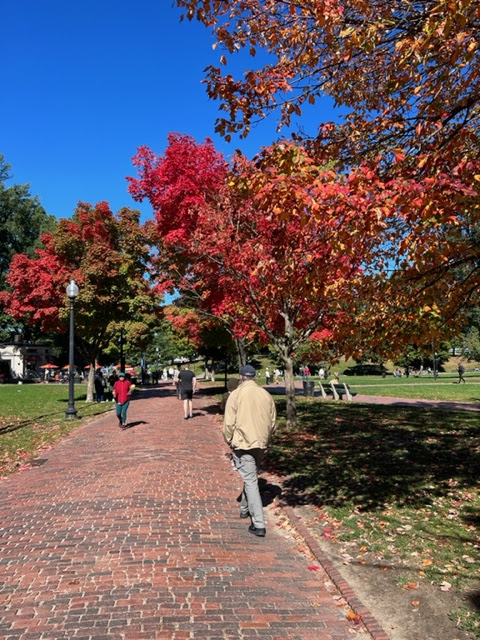
Boston Common (America’s oldest public park; it was beautifully enhanced by the fall foliage turning all shades of orange and magenta and the dogs and frisbees; this park had been used since 1635 for British militia training ground, public hangings, duels, public celebrations and public speeches)
-

Massachusetts State House (completed in January 1798, at a cost of $133,333, five times the budget; the dome was originally wood, then Paul Revere & Sons was commissioned in 1802 to cover it in copper to prevent leakage, and finally gilded with 23-karat gold leaf in 1874; it is the oldest building on Beacon Hill and now the seat of Massachusetts state government)
-
Park Street Church (founded in 1809 and located on Brimstone Corner, a reference to
fiery speeches but also the gun powder that was stored in the crypt during the
war of 1812; My Country ‘Tis of Thee was first sung on the church steps)
-


Granary Burying Ground (named so because of its proximity to Boston’s first granary; it is the resting place of many Bostonians such as John Hancock, Samuel Adams, eight governors, the five Boston Massacre victims, Paul Revere, Ben Franklin’s parents, Peter Faneuil, and allegedly the writer of Mother Goose)
-

King’s Chapel and King’s Chapel Burying Ground (in 1686 King James II seized land and built the first Anglican church in the colonies; when the wooden structure proved too small for the congregation, a Georgian chapel was built around the original one; slaves sat in the rear gallery on the cemetery side of the chapel and condemned prisoners sat to the right before being hanged on the Common; King’s Chapel became the first Unitarian Church in America in 1785; governor’s pew was used by President Washington on his 1789 visit to Boston; the first cemetery is to the left of the chapel and contains graves of governors, William Dawes who also made the ride to Lexington with Paul Revere, the Mary Chilton, believed to be the first woman to step off the Mayflower)
-


Boston Latin School site with the statue of Benjamin Franklin (embedded in the sidewalk is a plaque commemorating the site of the first public school in the U.S., 1635, in front of the old city hall; alumni of this school were Ben Franklin, John Hancock, Samuel Adams, Charles Bulfinch, and Ralph Waldo Emerson; the school still exists today, with four years of Latin still required; girls were not admitted until 1972)
-

Old Corner Bookstore (the building used to be the home of Anne Hutchinson, banished from Boston in 1638 for her “unorthodox” religious views; became a literary center and a publishing house for many famous writers; the liberal Atlantic Monthly was originally published here;
-
.jpg)
Old South Meeting House (second oldest church in Boston built in 1729; used for public meetings when “the angry crowds outgrew Faneuil Hall;” the most famous meeting was on December 16, 1773, when a crowd of 5,000 gathered to protest the tax on tea; it was the start of the Boston Tea Party; a notable member was the first black American published poet, Phillis Wheatley; her original work is on display)
-

Old State House Museum (built in 1713, it is the oldest surviving public building in Boston, center for political and commercial life, similar to today’s Stock Exchange)
-

Boston Massacre site (a ring of cobblestones adjacent to the Old State House commemorates the site where five men were killed in the clash between colonists and Redcoats)
-

Faneuil Hall (meeting place and open-air market, a gift in 1742 by the wealthy merchant Peter Faneuil; all wars since 1812 have been debated here; it is nicknamed the Cradle of Liberty because of the impassionate speeches given here by Samuel Adams and James Otis; “it was here that Bostonians met to form their opposition to British authority;” women’s temperance movement and anti-slavery speeches took place here)
-

Paul Revere House (built in 1680, 8 of his 16 children grew up in this home, his mother, his first wife, his second wife resided here; Revere started his midnight ride from here; he was an expert silversmith, a patriot, a copper manufacturer, engraver, and part-time dentist)
-

Old North Church (Sexton Robert Newman hung two lanterns from this steeple on April 18, 1775, to signal that Paul Revere’s night ride began – it was considered the “spark that ignited the American Revolution;” this remarkable church is the oldest church building, with the first bells brought to the Colonies, the original eighteenth century brass chandeliers and clock, seventeenth century carved angels captured by a Colonial privateer; more than 1,000 people were laid to rest in the underground crypt)
-

Copp’s Hill Burying Ground (largest colonial burying ground 10,000 plus since 1659, now only about 2,200 remain and the headstones have been moved from their location on the edge of all rows; Daniel Malcom, a member of the Sons of Liberty, Robert Newman, who hung the two lanterns are buried there and so is Edmund Hartt, the builder of the USS Constitution; being located on a bluff overlooking the Boston harbor, the British used the cemetery to aim their cannons on Charlestown during the Battle of Bunker Hill)
-

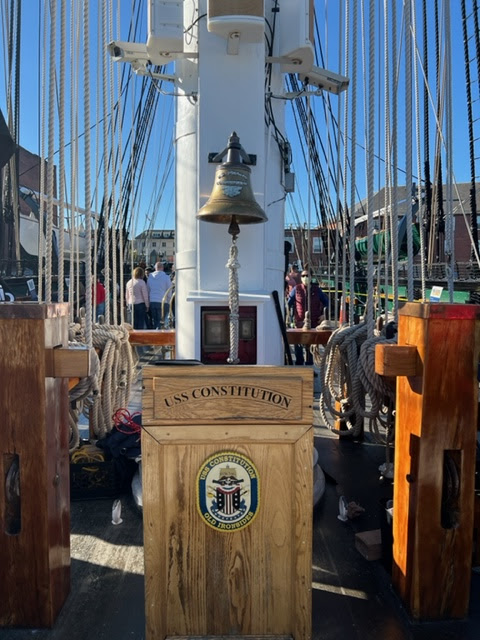
USS Constitution (Nicknamed Ironside because cannon balls would bounce off her impenetrable hull during the War of 1812, USS Constitution was launched in Boston in 1797; it is the oldest commissioned warship afloat in the world; every time a cannon ball would bounce off her hull, the seaman would yell Huzzah! Her sides are made of iron! Today the ship is manned by active duty U.S. Navy crew and docked in Charlestown Navy Yard)
-

Bunker Hill Monument (A 221-foot obelisk commemorates the bloodiest battles of the American Revolution which took place on June 17, 1775; Don’t fire until you see the whites of their eyes was the battle cry of the ill-equipped Colonist soldiers)
On the
beautiful morning we arrived by metro from Cambridge in Boston Common to start
our Freedom Trail walk, a very large group of young people, dressed in strange
outfits and offensive hats, were protesting in front of the Massachusetts State
House for the “human right” to kill babies in the womb.
Boston
Socialists had a booth in front of this protesting group, and they were
accepting donations to their cause. The utterly confused girl, a Harvard
student, manning the Boston Socialists booth attempted to tell me what kind of
socialism they wanted – it was neither the socialism so many escaped from in
Eastern Europe, nor the Scandinavian type of socialism many Americans believed
to exist and salivated over everything free. She was not quite sure what type they desired,
and she listed a salad of things that we already have and had a hard time
explaining, illustrating, or justifying her confused narrative. If she would
have been in my class, I would have failed her.
I was truly
overwhelmed and touched by the history surrounding us but, at the same time, I
was shocked to see all the historical monuments and churches being defaced by
Black Lives Matter posters and LGBTQ rainbow flags.
After we
crossed the bridge, we made our way to the Charlestown Navy Yard to board the USS
Constitution and the warship USS Cassin Young, a WWII era destroyer,
decommissioned in 1960. The sailors on
board of both ships graciously described to visitors the different quarters and duties,
while allowing us to go down all levels below deck.
After walking the Freedom Trail and downtown Boston all the way to Charlestown and Bunker Hill, we had covered 10 miles and we took the short ferry ride back to downtown Boston.


By the end of the day, we were so exhausted, we could not wait to get back to our hotel in Cambridge via the old and creaking green line metro with fascinating college student riders.
TO BE CONTINUED

