Saturday, November 19, 2016

Our Disposable Society

Photo: Ileana Johnson
In our throwaway society, where nothing is sacred anymore and is discarded with the speed of an unwanted darkening banana peel or a lit cigarette butt out the window of a moving car, the miser in me keeps coming out periodically.

Animals, love, life, family, relationships, marriages, appliances, trash, things recyclable, valuables, and trash are thrown out or disposed of mostly on purpose with no remorse and with a faster speed than you can say “I do.”

I sheepishly admit that I was washing Styrofoam containers and plastic forks from McDonald’s back in 1978. Why throw away perfectly reusable items, I thought, when I just landed from the land of poverty, misery, and long lines for food? We had rusty flatware on our table and chipped mismatched plates. My Grandpa used to wash her plates in a little tub of hot water boiled on the gas stove. And sometimes they still had dried food stuck to them from the previous meal. I tried to scrape it off and wipe it with a towel when she was not watching. I could not afford to be choosy or hurt her feelings.

My husband at the time made fun of my miser side because he could not possibly understand even though he visited my childhood home. No matter how many times he took me to the grocery store to see the laden shelves of abundance, my miser inner self could not comprehend so much food and I was certain, it would be gone the next day.

To this day, I wonder when we might have to be without food, water, and electricity, or things that everyone takes for granted, like toilet paper and vitamins. So I used to go from room to room and turn the lights off that my husband had left on and I still do today. Why waste energy? What if we had to be in the dark again like we were often under the socialist/communist regime that planned enough for them while the rest of us had to struggle hungry, cold, and in the dark after sunset?

I recycle today every piece of paper, plastic, glass, and aluminum that crosses my kitchen and my pantry. I even cut the plastic circles that hold bottles in place for fear that some wild animal might get stuck in them if the plastic winds up in a dumpster.

It pains me greatly and I do not understand how someone can throw a live human being or puppy tied in a garbage bag on the side of a deserted road, miles and miles away from a city, and leaves them there like trash, to suffocate and die? Isn’t the way we treat our helpless, animals, children, and old people, an indication of how civilized our society is?

We discard aborted fetuses, humans who are perfect and want to live because progressive society views that as a “choice.” We dump the elderly in nursing homes and seldom visit them. We depend on strangers to be good to them. We visit at holidays out of sheer guilt. There’s an influx of visitors at the nursing home around holidays, I suppose they don’t want to be left out of grandma or grandpa’s will.

We dispose of marriage quicker than we planned the lavish weddings – we get divorced at the drop of a hat. Nobody tries hard to get along anymore; everyone seeks instant gratification and personal happiness. If you ask, nobody is able to give a cohesive definition of what that personal happiness is. But rest assured, it revolves around the “me, myself, and I.”

The “selfish-me generation” throws away everything that is old, including their country, their citizenship, their culture, and their Constitution. Anything they do not understand but has been drilled into their heads by socialist teachers as evil must be discarded. If it is repeated enough times, it becomes their “social justice and equality” playbook.

We discard and abandon children to foster care like a used-up toy because we are too busy or too unable to care for our own offspring.

We euthanize those among us we do not wish to bother with anymore, and we abort the result of loveless hookups because nobody wants to be inconvenienced by a human breathing inside them.

We dump our friends on a whim – they just don’t share the same politics and ideology of the moment and are therefore no good. People we disagree with are suddenly poisonous snakes.

Yet grown Americans keep that one collegiate t-shirt from years ago, with holes everywhere, or that ratty disintegrating blanket one used to drag around for comfort as a toddler, or a favorite dog’s or cat’s toy. Those are holy objects that cannot be thrown away.

We keep that first car, often on cinder blocks, rusted out, and covered with weeds, spiders, and cobwebs. Sometimes rabbits, coons, and the occasional rattlesnake make their nests inside.

We keep that old moldy dresser that belonged to great-grandma because it’s an antique and it might be really valuable someday and fetch a big penny at auction.

We could feed an entire small country daily with the amount of food thrown away in locked dumpsters around the country, perhaps composted, incinerated, or buried later in the landfill.

Beautiful books of wisdom are recycled or buried all the time, in the drive to become a paperless society and to save the trees and the planet from progressive Armageddon. Who has time to read and learn something useful when there is the Internet?

Electronics are discarded as well, perhaps recycled and some buried in the city landfill. Valuable metals, plastics, and glass tubes get buried with them as well.

We throwaway a perfectly running TV that nobody wants in order to make room for a flat screen and top of the line smart TV, so smart, it can report anything you do to the mother ship.

And nobody has landline rotary dial or key punch phones anymore. They worked even when power went out. Those are dinosaurs, thrown away long time ago with the trash, not even recycled. They are buried somewhere in the city dump. When the smart grid goes out and it will eventually do, nobody will have a phone to communicate and answer that 3 a.m. call.

This disposable society mirrors the trashing of our culture in general, of our borders, our language, and our national identity. “We went through darkness so you can find the light." Why are you extinguishing it?


Tuesday, November 15, 2016

The Character of a Nation and Precious Snowflakes

Arlington National Cemetery
Photo: Ileana Johnson
A lot can happen to a nation’s soul, heart, and character in 70 years. In 1944, eighteen-year olds stormed the beaches in Normandy, embracing almost certain death; eighteen-year olds today need a safe space on campuses to cry or cower in fear because words hurt their precious snowflake feelings.

This fundamental change of the American character was accelerated by the Marxist indoctrination facilitated by Jimmy Carter’s Department of Education, founded in 1979.

The cultural demise exploded with help from academia who brainwashed our children into collectivism, from Hollywood’s culture of depravity, from its promotion of drugs, by progressive agendas entirely divergent from the best interests of a healthy and prosperous society, by sexual promiscuity, abortion presented as a choice when it is really murdering human beings as late as four days before live birth, the loss of faith, and by the destruction of the family unit.

The drugged up generations of today have no knowledge of Civics and therefore believe that democracy, a fancy notion of mob rule and anarchy, represents our country. In reality, our Constitutional Republic was founded on entirely different principles which are alien to these mentally insane progressives, useful idiots of global elites, who manipulate them like a fine-tuned violin to do their bidding in the form of riots, slashing and burning their way across our cities while this administration remains silent and the police is told to stand down.

Almost six million men served in WWI and 16 million in WWII. I’m not sure how many WWII vets are still alive, their numbers dwindle with each passing day. American soldiers served our country to preserve our freedom and the freedom of many nations and “our good and decent way of life.”

But today, our society is a corrupt cesspool of vile and immoral entertainment on every possible venue. Music and movies are laced with profanity and women are degraded in rap songs. Singers objectify themselves by imitating sexual acts on stage, scantily clad. Everything goes as long as it feels good.

Proper behavior, honesty, and law abiding citizens are denigrated. Rap and the worst elements of society are worshipped and invited to the White House and celebrated. Immorality and sexual promiscuity is rampant among high school students. Administrators in public schools and colleges have mandated that boys should use the same bathrooms and locker rooms as girls, inviting rapists and pedophiles into our schools. The majority must yield to the sexual confusion and psychological illness of the few.

The average student does not think twice about having multiple “loveless hookups” by the time they graduate. Sexually transmitted diseases, rapes, and unwanted pregnancies happen all the time. After all, the courts have ruled that it is the woman’s choice and her body; they can legally kill their babies conceived in “loveless hookups.”

Profanity rules in Hollywood, on radio, in normal conversations, and in young progressive crowds that are up-to-date on who the latest “reality nobody” is, but don’t understand the Socialists of the Democrat left whom they adore and whose polices they support – collectivist social justice and impossible equality.

Thousands of innocent babies are slaughtered in the womb every day but none of these leftists bat an eye. They only get upset that Donald Trump might take away their “choice” to murder a human being who wants to live.

Those who are lucky to be born are anchor babies from foreign citizens and babies of those Americans who are married and believe in the sanctity of life and family.  A large percentage of black mothers are “married” to Daddy Government and its life-long welfare and many fatherless children end up in gangs, on drugs, and in prison.

The birth demographics of citizens in most developed nations are on a civilization-suicide downward spiraling curve. Young women prefer to push carriages with dogs and cats instead of babies.

Marriage has been bastardized and made irrelevant by our government and the gay lobby has embarked on aggressive tactics to bankrupt and punish those whose religious views reject homosexual marriage.

The rabid and intolerant left has freedom of speech which they exercise violently through riots, assaults, beatings, and property destruction, but they want to destroy anybody else’s rights who disagree with them.

Dr. David Sponseller asked rhetorically in a recent letter on Veterans Day, “Would our soldiers, sailors, and airmen have been so willing to face possible death or crippling injury in combat, knowing that such a cultural way of life were in their future if/when they got back home? I rather doubt it. Rather, they must be rolling over in their graves now at the knowledge of how far the culture has collapsed.”

A gay person, whom I have known a long time, has publicly wished that Trump would deport me back to my home country. I have been a naturalized American citizen longer than this person has been alive. I was lucky to come to this country legally and I am proud of the opportunities it gave me to become everything I could not have become in the socialist/communist dictatorship I was born under.

Not letting truth get in their way, the intolerant progressives and the gay lobby are projecting their fascistic beliefs onto the one man that just might make everybody’s lives better now and in the future.

It seems that the left does not understand that in our Constitutional Republic the Electoral College plays an important role in elections. If the popular vote was the sole benchmark of elections, the overpopulated states bordering oceans would be the only ones in which American citizens and illegal aliens would get to elect our president, the rest of the country would have no voice. Hillary won the popular vote against her opponent, Barack Obama, but he was elected president. Somehow, it was fine then, but not now with Donald Trump.

The outlook for our country was dismal when the progressive candidate was promising more of the same immoral lifestyle, exalting abortion, and seeking to radicalize the Supreme Court for probably 50 years through liberal appointments. “A godless, secular culture so far gone would have been impossible to recover.”

“The winner gave us hope and satisfaction that the 22 million who have fought in WWI and WWII did not fight in vain.”  Dr. David Sponseller continued, “Millions of Christians stormed Heaven’s gates before the election. The Lord heard the prayers of God-fearing citizens and answered us with the most astounding political miracle in memory. He gave us a president-elect that will appoint judges respecting life, marriage, and the freedom of religion once again. He gave us hope for stemming the cultural decay and restoring our once-great country in the decades ahead.”

We must be vigilant. The rabidly progressive left is highly organized, with money to burn. The globalist coffers are never-ending. The progressive elites are not accepting this or any defeat graciously, they are massively financing the country-wide violent rioting which nobody seems interested in stopping; they are going to undermine Trump at every turn, along with the RINOs in Congress.

Thursday, November 10, 2016

When Our Neighborhoods Have Gone Global

Photo credit: Ileana Johnson
Washington, D. C.
As we cheer the election of a new President, the highly successful entrepreneur and businessman Donald Trump, having averted the advance of global communism and global citizenship, we must not forget the massive damage that has already occurred in our country and around the globe, involving the much debunked manufactured global warming turned into a profitable climate change industry worth trillions, accomplished through the non-stop work and indoctrination of the United Nations Agenda 2030, an onerous plan which has infiltrated every aspect of our society, limiting our freedoms and controlling every facet of our lives under the guise of “sustainable development.”

One month after the establishment of the United Nations, UNESCO was created by its first director, Julian Huxley.  UNESCO’s first task was to teach the world’s school teachers how to indoctrinate their students to become citizens of the world. Judging by the amount of global citizenship preparedness advertised by colleges and universities in the U.S. today, UNESCO has been highly successful.  Their materials on the topic of “Toward World Understanding,” brainwashed many generations in schools around the globe that “nationalism was bad, and had to replaced with the idea of world citizenship.” (UNESCO Publication 356, http://freedom.org/reports/unesco356.htm)

The effort to transform our children into global citizens mutated into the International Baccalaureate Program, an expensive and highly secretive curriculum from Switzerland, supported and paid for by local taxpayers. Parents thought that it was a superior education to our public schools when in reality it is just another attempt to indoctrinate them into global citizens, devoid of national pride, American history, and turning them into full supporters of global governance.

The relentless global governance promoters are convinced that their social engineering philosophy of collectivism is far superior to our free market capitalism. They are not dissuaded by the monumental failures of Cuba, Venezuela, Soviet Union, North Korea, China, Eastern European countries, and other nations forced to survive on the idea of ‘daddy government knows best.’

With its final goal of a “global neighborhood” (Our Global Neighborhood, 1995), the government-managed society rejects the idea of private property and does not think that controlling the use of private property constitutes taking, despite the existence of our 5th Amendment which requires that government justly compensate owners for the taking of their private property.

The final barrier in the United Nations completion of this global neighborhood is the voluntary funding for the United Nations. The ideas of creating a global tax and a global currency have been introduced numerous times. In 2010, the International Monetary Fund (IMF) revealed its plan to create a global currency.

“International rules, institutions and practices that limit the behavior of people in the United States come from international entities such as the UN, UNESCO, UNEP, UNDP, WTO, ISO and other alphabet bureaucracies,” which creep into domestic policy via non-governmental organization (NGOs) lobbyists who advocate for global governance, politicians, federal employees, and delegates to U.N. meetings. Most in Congress support and promote the principle of global governance but their constituents have no idea what that means.

Why is global governance bad? Our system of freedom and self-governance cannot co-exist in a world governed by the United Nations’ tin pot dictatorships.  They believe that “government is the source of individual rights, and can give or deny those rights to individuals or organizations as the government deems necessary,” in the interest of the collective.

American self-governance believes that the Creator is the “source of unalienable individual rights,” including the right to form a government and limit its power to the consent of the governed.

We are at the crossroads of global governance, enabled by the voluntary participation of developed nations, particularly the United States, who has dragged its citizens into agreements, initiatives, and partnerships, whereby the voters were never consulted about such partnerships and initiatives, they were only subjected to the Vision of the globalists, pushed forward by elected politicians’ voluntary membership in the International Council for Local Environmental Initiatives (ICLEI).

Our current government is pushing the Trans Pacific Partnership (TPP) which is slim on trade and heavy on controlling what is left of our manufacturing sector, our economy, and our sovereignty. If it is so good for America, why were the proceedings secret? TPP is modeled on the failed European Union system that deprived 28 nations of their sovereignty while seeking to create a huge empire with all the powers of a single nation but masquerading as a trade organization. The recent Brexit of the U.K. from this EU union was painfully obvious that the Brits have had enough of the political and economic control from the technocrats in Brussels.

Plans that erode our individual freedoms and national sovereignty start at the local level with promises and euphemisms that are relevant to a particular locality and sound benign enough to the busy American, preoccupied with making a living and supporting his/her family.

The visioning process starts at the local level by a local planning agency (an NGO) or ICLEI itself with a federal grant attached to it. ICLEI was created in 1990 “to advance the concept of sustainable development,” the lynchpin of U.N. Agenda 21 of 1992 and now U.N. Agenda 2030.

Once the grant is in place, a facilitator is appointed to lead the visioning process of the local community. Participants are initially chosen carefully in order to support the plan. One local elected official is also included while the community knows nothing about until the end of the process.  The group may call itself “Yourtown 2030” and will put forth their pre-planned ideas of what your town should look like in 2030 in order to have a “sustainable community” and “smart development.” Anything else is catastrophic for the community.

Any objections are eliminated by advertising a “consensus.” The goals chosen by this visioning are usually recommendations taken from U.N. Agenda 21 or the President’s Council on Sustainable Development documents.

Next comes the plan of action which includes “bike paths, walkways, greenbelts, conservation areas, high-density areas, mixed-use housing, five minute walk or bike to work, shopping, and play, urban boundary zones, and other buzz-words from the sustainable development vocabulary.

As the plan is near completion, the group starts feeding information to the press in the local media. Public events are held that gloat over the righteous sustainable development and sustainable communities. The elected official on board with the visioning plan is “expected to convince the majority of the governing board to adopt the plan of action.”

Glossies will be printed and mailed out to the population, convincing the community that their visioning plan will make the community better in the 21st century if they protect the environment by reducing their carbon footprint, their commute, their car use, their suburban living, and other activities that make life fun and free, but, the world will be a better place for all.

The elements of the plan are never really publicly debated before elected officials, and, it is too late to oppose it once it is so heavily publicized. The private landowners are usually never consulted, nor are the taxpayers. Many times, once the plan has been adopted and implementation has begun, the community starts feeling the pain of the visioning plan. Local comprehensive land use plans are often so restrictive, the farmers can no longer use their pastures, their lakes, their land, their water to grow food, or plant crops.

This brings me to my own back yard where Supervisor Frank Principi has embarked on the plan of “Smart Development for a More Connected Community.”  His flier describes the “Smart Development in New Woodbridge,” as connectivity. “In this type of development, communities are designed to be more compact, easily and safely transversed by foot or bicycle. Great thought is given to how “people will live, work and play in their neighborhoods.”  In his and Agenda 2030’s idea, Smart Development will be mixed housing, townhomes, single family homes, stack and pack apartments, with “employment opportunities in close proximity to these homes, which in turn are conveniently located to amenities such as schools, parks, entertainment, mass transit, churches, and shopping.”

He is concerned about your quality of life, “fostering a sense of community, (supporting the local community because you won’t be able to go very far), reducing commute times, promoting walking and biking and lessening environmental impact.” He is proposing a “50-mile pedestrian and bicycle network” as well as eliminating “sidewalks to nowhere.” You just can’t walk every which way you want, you must be on approved paths. These are specific goals listed in U.N.’s Agenda 2030.

Supervisor Principi states that funding to “build our network” (who is we) will come from “developer proffers, state and regional grants, and local tax dollars.”

I’ve lived in the area for eight years, I am a very well-informed citizen, yet I’ve never heard specifics on Supervisor Principi’s plan until now. However, in this brochure, he is announcing a town hall series on transportation, education, and development. The plans are already in place, now he has to inform us about them.

The first town hall is entitled “Get Woodbridge Moving.”
“New Woodbridge: Vision & Economic Impact” is advertised for November 10, 2016. “Classroom Overcrowding: Rethinking School Development” will be addressed on December 8, 2016.

Prince William County is overrun with illegal aliens that comprise most of the 40 percent population growth as published in the last census. Additionally, unaccompanied minors of school age have overcrowded our schools and drained the budget for special teachers who speak the obscure languages of some of these children.

Frank Principi talks about the “Region’s Global Reach” and the “Global Cities Initiative Report,” all elements of the globalist U.N. Agenda 2030.

Describing the area’s longest commute among its peer regions, Principi stated, “Strengthening infrastructure connections globally while improving connectivity regionally could facilitate increased global trade and investment.”
If you are scratching your head with that statement, you are not alone.

Principi encapsulates this region’s visioning plan, “The central pillars of the vision for a New Woodbridge – Smart Development, Better Transportation and Strong Neighborhoods – reflect the top concerns and goals that community members express for our neighborhoods.”

In most neighborhoods people don’t even know their closest neighbors, apartments are built all over the place to handle the influx of newcomers, legal and illegal, roads are inadequate, there are no alternate routes to major highways, and congestion is the norm. Would walking and bicycling, more government control, and “strong neighborhoods” resolve these issues?

The American Planning Association, one of the main vectors of sustainable development change in this country has a host of definitions and requirements for any inhabited place in the country as to how the Strong Neighborhood Initiative (SNI) should be implemented according to a specific blueprint designed years ago by the U.N. Agenda 21 planners in Rio.

The neighborhoods must “promote or protect air and water quality, protect groundwater resources, and respond to the growing threat of climate change,” a threat that is not real. “Green infrastructure” must be used, such as “local tree cover mitigating heat gain.” Communities must “utilize measures or practices to protect or enhance local biodiversity and the environment.” https://www.planning.org/greatplaces/neighborhoods/characteristics.htm

At the end of the day, none of these plans are really about improving the lives of the people; they are about herding humans into small areas where they are more easily controlled by the government.

Every human wants their community to thrive, to be safe, and desire clean air and water, but at what cost are we going to reorganize and socially engineer our cities, towns, communities, and way of life in order to fit a master plan designed by people who are only interested in saving the planet from an imaginary global warming and by controlling the population that they deem to be a threat to our planet.


Monday, November 7, 2016

Brescia, the Last Stop on a 17-Day Adventure

View of Brescia from castle armory museum
Last one day and half in Italy finally came. After we packed and had a leisurely early breakfast in the well-appointed restaurant in Olivia Thermae, overlooking the beautiful gardens, azure blue pools, and the wavy Lake Garda, we reluctantly started the gauntlet through the narrow streets of the fortress on our way to Milan. We paid our bill and, after a failed start into a dead end street, we found the right way through the labyrinth of narrow streets, endless left and right turns, and dodging the pedestrians in the area surrounding Scaligeri castle.  Even though it was a drizzly day, people were walking by with umbrellas, taking photographs and shopping.

Dave dodged them artfully, paid attention to the GPS directions, and made sure he did not run into buildings.  The streets were so narrow; I could stretch out my arm through the open window, and touch the walls. We finally came to the 11th century Scaligeri castle and exited through the even narrower moat gate.  I videotaped the entire gauntlet through the windshield wipers, just in in case our children would not believe us.  We drove by the police sentry gate where two days earlier we had to be checked off a police registry as hotel guests in the fortress.


The fortress moat entrance in Sirmione (Wikipedia photo)
With the beautiful Sirmione in the rear view mirror, we made it to the autostrada, on our way to Brescia, the former Roman castrum called Brixia. I had mixed feelings and memories of Brescia when, years earlier, our plane from Paris to Venice had to make an emergency landing in Brescia where the passengers were deplaned and transported the rest of the way to Venice by buses. My husband, who was expecting me at the airport in Venice, was very confused when he finally found me getting off a bus and without luggage.

We passed by Mantua, the 2016 Capital of Culture, 45 km out of our way. We had spent an entire day on a previous trip, visiting the centro storico, the Gonzaga family castles (Palazzo Te, Palazzo Ducale, and Palazzo Valenti Gonzaga), House of Mantegna, hanging gardens, and grottoes.

Mantua
Photo credit: Wikipedia.org
Mantua is surrounded on three sides by artificial lakes created during the 12th century to defend the city. Water comes from the Minicio River. Mantova, deriving its name possibly from the Etruscan god Mantus or from Manto, daughter of Tiresias, was an island settlement established about 2000 B.C. on the banks of the River Mincio, a tributary to the River Po, which flows from Lake Garda to the Adriatic Sea.

The medieval and Renaissance flavor give Mantua an important place in the cultural history of western civilization. In addition to architectural treasures and works of art, Mantua is known for its role in the history of opera.

Monteverdi’s L’Orfeo premiered here and Shakespeare’s Romeo was banished to Mantua. Giuseppe Verdi’s opera Rigoletto is set in Mantua. The medieval house that Verdi chose as residence for his character is said to be “Rigoletto’s house.” It was a building that belonged to the cathedral.

Mantua’s most famous inhabitant was Virgil (Publius Vergilius Maro), born in 70 B.C. in a village nearby now called Virgilio.

Brescia was a truly fascinating experience. After we parked in an underground garage called Piazzale Aranaldo (pretty much most parking in Italy is underground for lack of space and esthetics), we walked towards the 15 century castle perched on top of a hill overlooking Brescia.

The painful road to Castello
 
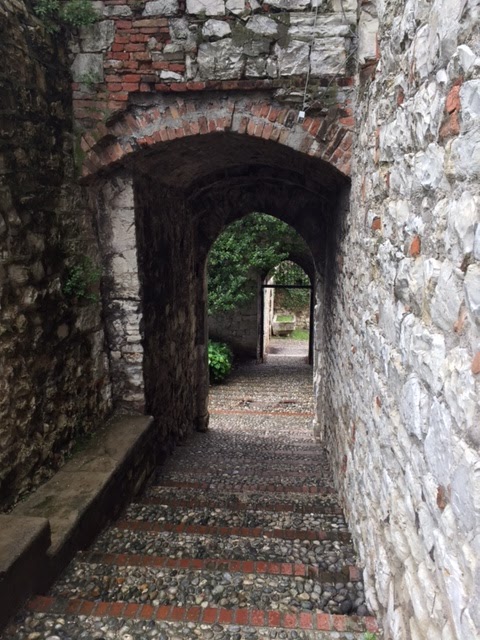
The hike up the road gave me particular agony as it was formed with small oblong river rocks embedded upright into the soil as a form of paving. With every step, the rocks dug through my shoes and I felt the pain in the soles of my feet. I suffered in silence like a penitent, while walking up to a sanctuary church, completely deserted, open, and eerie.

View of Brescia from our trail hike
 
Walking past round stones inlaid into the pavement with names of deceased Brescians, we ran into a group of Italian school kids having bagged lunches in a room on the premises of the church. Their presence was explained by the city’s museum of history, located nearby.

Mossy woods
 
The province of Brescia, located in Lombardy, is one of the largest in Italy, the industrial capital of Italy, with 1.2 million inhabitants. It is an area where utility companies, a steel producer, the firearms manufacturer Beretta, the shotgun manufacturer Perazzi, and machine tools manufacturer Camozzi have their headquarters. Brescia, nicknamed Leonessa d’Italia (The Lioness of Italy), is also home to Italian caviar, sparkling wine, and the Mille Miglia classic car race.

The actual town of Brescia, located at the foot of the Alps is rather small, 196,480 inhabitants. It was founded 3,200 years ago and it holds the best preserved Roman public buildings in northern Italy, specifically a Roman Forum. The medieval castle, to which we were hiking in a slow but steady rain, is a fascinating place to visit despite the long and arduous trek that we took. Coming down, we realized that we could have driven and parked the car not far from the entrance. But, why do things simply when the hike was so much more fascinating and the photo ops were amazing.

Misionari Saveriani in Brescia
 
Chiesa di Corpo di Cristo in Brescia
 
Cloister inner courtyard in Brescia
 
Corridor to Chiesa San Cristo
 
Cloister in Brescia
All photos: Ileana Johnson 2016
The monastic complex San Salvatore-Santa Giulia has a beautiful basilica from the 9th century, dedicated to San Salvatore.  It was built on a previous church which was also built on a Roman edifice from the first century B. C. A church was dedicated to Santa Giulia after it was finished in 1599. There is a museum on the premises with artifacts from the Bronze Age to Roman times and excavated Roman houses.
Charlemagne’s wife, Desiderata, and daughter of the Lombard King Desiderius, is said to have spent her exile years in this monastery after the annulment of their marriage in 771.

The Church of the Most Holy Body of Christ (Chiesa del Santissimo Corpo di Cristo) is also part of the convent complex built in the late 15th century by Jesuits on previous religious buildings towering above the Roman theater. There are 16th century frescoes by Friar Benedetto Marone, planned on the Sistine Chapel model. There is also a Romanino fresco with the Last Supper, reproduced on canvas. Near the church is the convent surrounding three cloisters. One of the cloister’s loggias opens up into a breathtaking panoramic view of Brescia.

View of the Castello from our hiking trail
 
We took the wrong turn to the castle, which led us on a steep uneven pebbled stone climb on the back side to the castle, with a dizzying drop to the city and to a vineyard below. We could see the turret to the castle but we were unable to reach it this way. We walked to the left, circling the hill on the lower levels, past trees so old and shady that they were completely covered by moss. This time we started climbing again on the side facing the castle.

Almost there - Castello's entrance
 
We reached the parking lot, climbed four more levels and entrances before we were actually able to see the moat of the castle with a drawbridge with creaking, rusty chains, and old mechanisms that raised and lowered the huge gate. We watched with amusement as a medium sized truck attempted to make a delivery to the museum inside but could not clear the height of the entrance to the castle, past the stony drawbridge. It was built in the first half of the 14th century, activated by ropes and chains and operated by winches. The mechanism “was faithfully recreated in the 20th century copy that can be seen today."

Entrance through the gate with the drawbridge
 
This main gate, between the rampart of St. Mark to the east and St. Faustino to the west, was built during the Venetian rule at the end of the 16th century. The portal is built from local calcareous stone, the famous Botticino marble. The sides display the Venetian rulers' coats of arms and the center displayed the coat of arms of the Doge, unfortunately destroyed by Napoleon’s soldiers. The whole structure shows the emblem of the Republic of Venice.

Governor's seat in Castello
 
A two-story yellow painted building, overlooking the Locomotive Square, is the former Governor’s seat built by Venetians in the 16th century.

Mirabella Tower
 
Upon entering the castle, the tower where they kept prisoners came into view. The prisoner’s tower, called the Burned Tower, was part of the defense system during the rule of the Visconti family of Milan. The four-story tower can be visited through a small door located below the porch leaning against the parapet.

The light came from my camera flash otherwise it was pitch dark
 
Downward spiraling tunnels
 
We went into the dungeons that offered an escape route as well as a delivery of supplies route. It was dank, dark, and scary.

Drawbridge with its rusted mechanism
 
Prisoner cell
 
Castello's inner courtyard
 
Drawbridge mechanism
 
Inner courtyard with Roman sarcophagus
 
More above ground tunnels
 
The 22-meters tall Mirabella Tower was one of the bell towers that flanked the Romanesque church of St. Stefano in Arce, whose foundation is below the lawn level. Climbing the spiral staircase, we could admire traces of the 13th century frescoes inside the tower.

Armory Museum
 
Horse armor
 
Fanning sword
 
View of Brescia from inside armory
 
Walking towards the underground escape and supply tunnels
 
Modern Brescia seen from the castle's tower
 
At the very top of the castle, we found the arms museum. The visit was most interesting as the museum contained medieval  weaponry such as arquebuses, swords, chain mails, body armor for humans, armor for horses, some complete, some incomplete, and evil swords that fanned out upon hitting flesh and bone, tearing it to pieces if the person would attempt to pull the sword out. There were very long barreled flint lock and match lock muskets as well.

Roman Temple ruins inside the armory museum
 
The castle had been built on the foundation of a Roman temple and the steps and ruins were still visible in the large opening in the floor. It is not unusual in northern Italy to find buildings such as restaurants and public places that have heavy glass floors exhibiting foundations with Roman ruins and mosaics. There is one restaurant in Piazza Erbe in Verona with such a large floor, and glass-covered escape tunnels in the old town of Assisi.

Brescia Castello side view
 
Tiled roof seen from armory museum interior
 
The staff of the arms museum in the Brescia Castello was not very friendly at all even though we were the only visitors on that rainy day and have paid 4 euros each entrance fee. I asked one of the attendants if he knew what the roofs looked like five centuries ago. It was plenty obvious that the tiled roof was relatively new. He gave me a snide remark in Italian as an answer, “how could I be so stupid to ask about the shape of roofs back then? Did I not know that none were preserved?” Actually there is archeological preserved evidence as I found out later.  

Locomotive built in 1901
Locomotive Square
 
There was a room on the castle grounds dedicated to an Italian club of engine modelers. A steam engine stood on the grounds in the Locomotive Square which survived WWI and WWII. It was built in 1901 and had over 2.5 million km on board before it was decommissioned and eventually placed in this park.

We made our way down on the front side of the castle this time and it seemed so much easier than the back side we had made earlier.

We found an interesting shop, a cobbler who actually made shoes to order, fitting a person’s foot, taste in leather, style, and comfort or fashion style. Mr. Alba reminded me of Dad’s cousin who was a cobbler by trade. He made many elegant and comfortable shoes for Dad and my husband Bill to the tune of 500 lei a pair. At that time, during the communist regime, 500 lei was more than half of most workers’ monthly salary determined by the Communist Party. The cheap shoes made by the communist regime for the masses were ugly, uncomfortable, and hard to find.

My first real purchase that I made in the States once I came in 1978 was a very soft leather pair of Clarks taupe sandals. I will never forget the joy of walking in something so heavenly comfortable and beautiful!

A few years later, on my first trip to Assisi, I discovered the Mephisto brand, “holy shoes,” as my husband called them. I bought my first pair in a tiny shop in Assisi, so narrow that two people could barely squeeze by. The building had been a prison prior to being bought by this lovely Italian couple who made a tiny shoe shop on the first floor and their apartment on the second. The windows still had the heavy bars from the prison period of the 13th century.

In Italy, no matter how old a person may be, pain and suffering must yield to fashion, style, and inimitable Italian flair. I’ve seen old ladies with canes, wearing impractical high heels.  But no self-respecting Italian woman, even a handicapped one, would find herself wearing orthopedic shoes meant for comfort and ease of walking. Tennis shoes are gauche unless they are bowling style in strange colors.

Roman forum ruins of the former Brixia castrum
 
As we were trying to find the parking garage to retrieve the car, we walked past the ruins of the former Roman castrum called Brixia. We took pictures of the imposing columns of the forum, the arena, or what was left of it with the tunnels, and the aqueducts. A few blocks further, we found a house that had remains of a Roman fresco embedded into the exterior wall.

Chiesa di Santa Maria della Carita during mass
 
A beautiful Baroque Roman Catholic church, St. Mary of Charity, was holding mass. This church and the monastery were erected by a wealthy patron, Laura Gambara, from 1481 to 1531. The current church was replaced in 1640 and consecrated in 1655. The convent sheltered fallen women or prostitutes. The portal had two columns of Egyptian marble and spoli, repurposed building stones from a Roman temple.

I entered, prayed, and listened for a bit while the priest was praying for the wisdom and health of Father Francesco, the sitting Argentinian Pope.

Last view of the town before we climbed down to town
 
We found our car in the public garage, paid for parking, and left for Milan. We had another 45 km to go our NH hotel by the airport. It was a four star but in a heavy industrial area, 2 km from the airport, with grey, dirty, and dingy exterior from traffic pollution. We filled the car with Diesel at the nearby Agip station.  Diesel was about 1.44 euros per liter.

We had supper at an interesting restaurant across the street called U-56, alluding to the German submarine U-56. In April 1945, a U.S. raid air raid badly damaged the submarine in Kiel and was decommissioned. Her crew scuttled it on May 3, 1945. The wreck was raised shortly after the war ended, but the boat was broken up.

The restaurant was painted solid black inside and outside, had a moat full of green water with tropical fish and mosquitoes, and the seating was bright red, with chairs arranged in a bizarre military style. Dandelion like pollen was flying from the surrounding trees and landing everywhere, including our clothes and the surface of the water, turning it into a gooey mess.

I expected the food to be terrible but, to my surprise, it was delicious. We sat across from a young couple on their first date and we enjoyed people watching, as more and more Italians started to show up. Nobody eats before 8 p.m.

We turned in for an early night as we were planning on getting up really early for our 11 a.m. flight to Paris and then to Dulles.

After packing and a very early breakfast, we took a few wrong turns, of course, necessitating help from a policewoman who directed us to the rental car return. The agent motioned for Dave to park the car in a very, very narrow space that only the petite Italians could fit and squeeze through with ease. Dave was angry and mumbling under his breath as he had to exit through the passenger side. It was no easy fit as a massage the day earlier had reinjured his rotator cuff wound. The agent looked over the car with a fine toothcomb, a flash light to be exact, but he found nothing. He was probably drooling at the prospect of charging the hapless Americans extra fees for some imaginary, non-existent damage. There are few people who can drive a car and maneuver it into tight spaces like Dave, without causing any damage. He is an exceptional and calm driver. The agent kept mumbling with huge disappointment in his voice, “perfetto, perfetto.”

The flight to Paris was uneventful, seated in very narrow seats that did not recline. The bare bone amenities and the smaller airport in Milan explained somewhat our reasonable tickets and car rental. The guy seated on my left was a retired Marine One crew chief who had served under Clinton and said, he really liked Bill but hated Hillary who was cussing people all the time. He told me, he would never vote for her, or Donald Trump. But he would have gladly voted Joe Biden for President because he liked the guy. I pretended that I was not into politics because I did not want to get into a political discussion with this gentleman.

The flight lasted one hour and thirty minutes and we looked around during our four hour layover in Paris, bought some chocolate, and boarded the eight-hour flight, hoping it would be more comfortable. The Air France, Airbus 777 had even narrower seats, the food was bad, but the entertainment was great.

After almost two hours through customs and luggage retrieval, our magnificent journey through central and northern Italy seemed like a world away and came sadly to an end. We were ready to go home and sleep in our own beds. It is also very hard to live out of two suitcases for 17 days. I was sad to leave so much beauty and history behind but glad to be home.

THE END