Showing posts with label social engineering. Show all posts

Tuesday, June 19, 2018

The 1970s America Is Gone Not by the Tides of Change

The Swamp
Photo: Ileana Johnson 2015
The first Americans I’ve met, Pam and her husband James from Chicago worked with my dad at the refinery.  He was an engineer from a small family and she followed him to this God-forsaken country where everyone seemed to be a prisoner. They appeared friendly in a plastic way, smiling all the time for no apparent reason, totally unconcerned about the misery of the oppressed Romanians around them, barely surviving under communism.

The couple relished in their monthly shopping trips – it was their escape from the depressing life around them. They would fly to places in the West that were forbidden to us, Hungary, Austria, and Germany. She would come back each time with expensive gifts for herself and her family. She could not wait to return to the land of plenty, far from “this dirty, drab and awful country where nobody smiled.”  

Insulated from reality, shopping at their special stores, treated by American doctors, Pam never really understood the pain and suffering white-washed by clean streets, summer flowers in well-manicured parks, and beautiful monuments erected to the dear leader.  The long lines for food, she said, must have been because the cashiers were really slow and ineffective. Americans did not stand in line for anything except tickets for games and rock concerts.

John came for the opportunity to share his skills in a communist country and to meet new people. In our conversations in English (they never tried to learn Romanian), the word opportunity seemed to crop up all the time. I did not understand what opportunity meant because such a word did not translate exactly into our vocabulary and into our lives, literally and figuratively. You were born in the proletariat class and that is where you remained for the rest of your life, no chance at anything else. The communist elites had any opportunity they chose to take for themselves by force.

America is the land of opportunity where immigrants dream to find success through hard work and a lifestyle with a picket fence, a nice home, plenty of food, and a traditional family comprised of mother, father, and children. Nineteen-seventy America was still the land of opportunity where, if one worked hard, one could reach whatever he/she was willing to sacrifice in order to achieve their goals. But Christianity, God, faith, and family were at the center of a successful life.

There were no pedestrians in the southern town where I lived. Americans were trapped inside large metal gas guzzlers that drank gasoline like water. Nobody strolled outdoors except in the square downtown. If anyone saw you walk on the side of the road, since sidewalks did not exist except in large cities, they would stop and offer you a ride. It was done from a sense of pity as well as concern for your safety, walking in 90-degree oven-like heat coupled with unbearable humidity that kept everyone’s face looking young and shiny.

Many foreigners who dared or were allowed to travel to America came by boat as it was still much cheaper than flying. Once here, some took the Greyhound bus across the U.S. and others, like me, flew everywhere or crisscrossed the country by car or truck, seldom taking the train.

In a very small southern town of 3,000, church was the center of life for young and old. I counted over 100 churches stretching as far away as a ten mile radius in the county. Many youth trips, activities, and summer camps were sanctioned or sponsored by the church.

There was a drive-in theater, and one grocery store, locally owned and operated. The closest chain grocery store was over 60 miles away. A tiny mall with boutiques and a Sears store is where people bought their washers and dryers, TVs, lawn mowers, bikes, toys, Christmas gifts, and clothing. Fancier TVs could be purchased in a Curtis Mathis store. There was no Super Walmart, Target, or such retailers.

Some cross-roads had a small convenience store that the local farmers frequented for their daily necessities, milk, bananas, ice cream, and candy bars. Americans of all ages consumed, I thought, way too much sugar then. The owners knew everybody and, if they just came from the field and did not have their wallets, the items purchased were put on an account which the farmer could pay later.

There was a level of trust that I have never seen anywhere else – nobody needed a credit card. People did not dare write bad checks and credit cards were hard to obtain and seldom accepted. My Egyptian friend Lula remarked that we bought everything with checks, not cash. She did not understand the western concept of banking.

People dressed simply, the local seamstress made a good living with Simplicity patterns and fabrics purchased by the yard at Hancock’s Fabrics. She charged $20 to make a dress at a time when minimum wage was $3.10.

The local beauty shop was a wooden building on the side of an empty highway, no sign, every lady in the county knew where it was, just big enough for a couple of chairs, a sink, and the window air conditioner. A southern belle dressed in jeans and a country shirt did her hair on Friday for $10 and then went to the grocery store and bought the week’s $20 supply of food for the family. Americans could buy a lot of food for $20 in the seventies and still only spent about 15 percent of their income to fill their refrigerators.

I was mesmerized how homes in the middle of a pasture had running water and a septic tank. In my Romania at the time, country folks still had smelly and unsanitary out-houses.

Eating out was unheard of unless you counted going to the Rexall Drug counter for a soda float or getting a Mickey Mouse ice cream bar at Vaughn’s country store. The small town had a Sonic drive-in but no McDonalds and no pizza parlor.

Locals bought their blue jeans at Varney’s Department Store on the square and Elegant Ladies, each the size of a master bedroom today, or at the Co-op store where you could pretty much purchase anything you needed to run a farm, including the tough Wrangler jeans for $10.

If you were willing to drive over 60 miles to buy food in a chain grocery store, you could also shop in a real Sears or J.C. Penney store, today’s dinosaurs. Catalogs came in every year but ordering by phone and receiving packages in the mail took time and effort and the shipping and returns were costly. The post office was not conveniently located either. Walking in the heat and the unforgiving sun to retrieve packages or mail from the mailbox on the side of the country road, far away from any farm house, was a sweat-drenching proposition.

Homes were sprawling and comfortable, simply decorated, with A/C units in the windows or the occasional central air heating and cooling. Poorer folks lived in trailers who rocked, rattled, and shook during the frequent Tornado Alley storms that seemed to crack the sky in two with thunder and lightning.  Powerful winds whipped and ripped old and venerable trees from the roots and occasional tornadoes demolished and flattened the forest, ripping anything else apart that stood in its path, and sending cows and humans flying through the air.

People dressed in their best for Wednesday and Sunday church services, followed by picnics and potluck suppers when everyone brought their best dishes to share with the congregation. And during football and baseball season, people attended the high school games and prayed before each game, cheering for the home team.

A stream of friends and acquaintances visited my in-laws to meet the Romanian girl who was lucky enough to escape Ceausescu’s communism while the Romanian was bewildered by all these well-meaning strangers who had no idea what kind of world she had left behind.

Without a myriad of TV channels of today, the drive-in was the only cinema that offered the latest movies. If your car broke down in the middle of the road, kind strangers stopped to help, change a tire, give you a lift home or to the nearest garage.

Cell phones did not exist in our bucolic lives and land lines were expensive. Many country folks had rotary dials with four parties on one phone line. You had to wait your turn to make a call or, in an emergency, ask the other parties to get off so that you can make the call. Everybody knew anybody else’s latest news and gossip as it was easy to listen in on conversations, intentionally or not.

Foreigners like me, an oddity from the communist world Americans despised, were a rarity in the South and Americans opened their homes to them but did not really accept them as part of their social milieu, they kept them at arm’s length and on the fringes because communists were not to be trusted. Yet foreigners like me learned the language and integrated into society, and became naturalized Americans who were contributing to its well-being and paid taxes.

Today’s Americans embrace communism and desire to change their society to that utopian failed state. They take in with open arms the real flotsam and jetsam of the third world who are often anti-Christian and unwilling to ever integrate into society, learn English, and assimilate. They are only interested in the generous welfare.

In the 70s, it was a shame to accept welfare. You had to be really down on your luck and prayed to improve quickly so you could get off welfare. There was shame and dishonor associated with accepting handouts. Today that shame is gone and it has morphed into an entitlement to everything other people own and had worked hard for.

The local high schools would invite foreign speakers who survived and escaped oppressive regimes to educate young Americans about the evils of totalitarianism/communism and how dear leaders like Mao, Stalin, Pol Pot, Castro, and Ceausescu have tortured and killed 100 million of their own people, citizens kept prisoners in their own countries and often starved to death.

After decades of telling teachers and students that one cannot mix Christian religion and state, the k-12 Common Core curriculum adopted is indoctrinating students into Islam and into sexual deviance. It is sad to watch today’s public schools, some private schools, and many colleges in the U.S. preach communism, intolerance of everyone who loves America, the pillars of Islam, and anti-Christianity even though many well-informed parents object.

And those who object to this indoctrination are labeled immediately – intolerant, xenophobic, sexist, homophobic, racist, bigoted, anti-Semitic, islamophobic, misogynist, or whatever “hate” label the Left has chosen for the rest of us who fell in love with 1970s America.

With a few areas here and there, small towns that did not have enough money or resources to accommodate the welfare-seeking invasion of illegal immigrants and government-allotted mostly male refugees, 1970s America is unrecognizable today. The rule of law and borders long forgotten, is the country still yours?

Say good-bye to what you grew up with and hello to 2018 America altered not by the normal change that the passage of time creates but a socially-engineered globalist entity spawned by the communist Left over the last five decades.


Saturday, December 30, 2017

Startup Societies and Sustainable Development

The Startup Societies Summit Puerto Rico is taking place at Georgetown University Law Center in Washington, D.C. on January 19-20, 2018.  This summit will “discuss solutions for Puerto Rico and raise funds for the Foundation for Puerto Rico, a non-profit dedicated to rebuilding the island.

“Our goal is to make self-sustaining economic zones in Puerto Rico focused on 21st Century solutions, putting Puerto Rico at the forefront of the green-tech revolution. We aim to not only raise funds for the rebuilding of Puerto Rico, but to set the stage for state of the art infrastructure and an entrepreneur-friendly environment. With some help, Puerto Rico can foster startup cities to rival Silicon Valley.”

Advertised attendees are investors, green tech entrepreneurs, non-governmental organizations (NGOs), policy makers, media leaders, policy experts, Georgetown students, SEZ developers, and “block chain” experts.

Block chain experts are crypto currency developers. https://blockchain.info/

Special Economic Zones (SEZ) are located within a country’s national borders and their business and trade laws differ from the rest of the country. The explanation is that such zones include “increased trade, increased investment, job creation, and effective administration.” It is creating a mini-country within a country, independent of the sovereign laws of the land.

Joe McKinney wrote a blog on December 20, 2017, Rebuilding Puerto Rico, Tragedy Strikes, which described the financial and economic situation of Puerto Rico following the disastrous Hurricane Maria from September 2017, which had caused property damage estimated at over $100 billion and tremendous loss of life during and after the hurricane.

According to McKinney, Puerto Rico was destitute prior to the hurricane, due to its sovereign debt of $70 billion and unfunded pension liabilities exceeding $50 billion. The U.S. federal government’s $94.4 billion “care package” offset the hurricane damage. Housing assistance received $31 billion, $17.7 billion for the power grid, and $14.9 billion for healthcare. https://startupsocieties.com/ssf-blog

Acknowledging Puerto Rico’s “government lack of fiscal conservatism,” McKinney wrote how a $300 million contract with a Montana power company to restore the power grid fell through. He admits that “governance” is the main issue. “When rebuilding the economy, the problems of governance which originally caused it must be addressed.”

The Startup Societies Foundation (SSF) believes that “a green infrastructure must be built in Puerto Rico and the population must be made wealthier in knowledge, skill, and resources.” Humanitarian aid and financial help coming from U.S. taxpayers is expected.

Proposing to decentralize Puerto Rico, SSF suggests using special economic zones, eco-conscious societies, sea steading, and other means to control the island.

“Sea steading is a concept of creating permanent dwellings at sea, called sea steads, outside of the territory claimed by a government.” Proposed sea steads are modified cruising vessels, refitted oil platforms, decommissioned anti-aircraft platforms, and custom-built floating islands. https://www.seasteading.org/

“Eco-conscious societies” are environmentally friendly, nature-friendly, and green societies where sustainable development (SD), the lynch-pin of United Nations Agenda 2030, governs all decisions about human activity, services, laws, policies, and business activity, with reduced, minimal, or no harm upon ecosystems or the environment.

The immediate assessed needs for Puerto Rico were as follows:

1.      Electrical energy networks by turning to renewable energy sources.

2.      Infrastructure that will resist natural disasters.

3.      A stable, attractive business environment.

4.      Fiscal freedom from accrued debts, a.k.a. debt forgiveness.

According to SSF, “100 % green energy [possible by 2027] in the form of biomass, wave energy, and solar power remain untapped.” Immediate efforts to provide “communication should come by deploying temporary telecommunication balloons to establish basic telecom services such SMS and web browsing.” Puerto Rico could become a poster child of a “startup society.”

Through the powerful decentralization proposed by SSF, new property rights, new free markets, and new trade, “Startup societies will essentially be competing for patronage from citizens worldwide. What will happen in the long term in the startup societies' paradigm is that individual societies will specialize in their comparatively advantageous fields.” But countries are already using comparative advantage in international trade. www.startupsocieites.com/ssf-blog/2017/11/18/the-dutch-disease-the-resource-curse-and-other-dirty-economics-words

On the list of SSF problems are urban sprawl and farms. “Urban ecosystems are parasitic upon nearby nature by definition and are thus a large detriment to the environment at large. Megacities, megalopolies, and their sprawling suburbs and farms are a problem in the transition to startup societies.”

SSF proposes the use of CO2-binding concrete, artificial photosynthesis, and vertical integration such as the laudable architectural high rises in Hong Kong, “using height to create solutions for societies.” “Vertical farming, padding external building walls in specially engineered pollutant-recycling moss, the third dimension is an oft-neglected aspect of environmental sustainability.”

Eco-villages and eco-tech startups will “reformat the current settlements large and small” by a “handful of strong-willed people who may shake people out of the stupor of modern urban life.”

“The establishing of smaller, more localized jurisdictions will help speed up the competitive pressure mechanisms that will make citizen begin to convert their current structures into something resembling nature.” https://startupsocieties.com/ssf-blog/2017/12/11/environmental-impacts-in-the-startup-societies-world-what-can-and-should-be-done

According to SSF, startup societies may locate in disputed border territories, the wide-open sea, and even Antarctica. The chosen land must respect jurisdiction and follow U.N.’s Law of the Sea or the Antarctica Treaty. Then a status for the startup society must be created within the current legal framework of the current authority via sanctuary city or special economic zone. The current authority may be local, federal, individual (president), or a group (Chamber of Commerce). Lobbying and political maneuvering, persuasion through legal or fiscal means, will eventually help found a startup society.  The essence of government is fluid. It can be remade and reshaped into an infinitely more complex but also streamlined version of itself.” https://www.startupsocieties.com/ssf-blog/2017/12/1/how-you-yes-you-can-build-a-startup-society

Quoting data from the United Nations, the SSF blog mentions that half of the richest 10 countries in the world (GDP per capita) are city states such as Liechtenstein, Monaco, and Luxemburg and are easier to manage. The truth is that these city states produce absolutely nothing of economic value other than as beautiful domiciles for the rich, the famous, and the titled. https://www.startupsocieties.com/ssf-blog/2017/12/4/on-top-of-the-world-explaining-the-statistical-success-of-modern-city-states

Startup Cities is eyeing Terra Australis, Antarctica, the southernmost continent, with 5.5 million square miles, driest and coldest, populated by 4,000 people in the summer and 1,000 in winter, appealing to the frontier spirit of Americans to establish the SSF vision of tomorrow. The only problem is, the dreamers of IT, financial technology, and other visionaries, do not have what it takes to be a frontier man or woman.

According to SSF, Chile, U.K., New Zealand, Australia, France, and Norway use certain areas of Antarctica for scientific research but cannot exercise territorial sovereignty over the borders per Antarctic Treaty System of the 1960s.

Russia and the U.S. have a “Deep Freeze” unclaimed area between New Zealand and Chile. Abandoned but maintained stations in this “unclaimed area” are utilized in the summer months. Startup Societies might use untapped opportunity to colonize this area. There is plenty of “powerful winds, extensive sunlight, and possible mineral deposits [which] may make energy a trifling matter, with the right technology.”

SSF is convinced that Startup Societies are the “future” through “competitive governance, secession, sea steading, decentralization, and e-government.”

Competitive governance is “decentralized experimentation driven by entrepreneurs and mobility of people and ideas, new structures that solve protracted social challenges peacefully.”

The author, Aleksa Burmazovic, extolls the virtues of frontier exploration - “barren land out there ripe for people to turn into beautiful gardens of human achievement,” https://www.startupsocieties.com/ssf-blog/2017/11/16/terra-australis-is-antarctica-the-next-frontier

I was thinking about all the deserts on the planet with green oases and civilizations that had died years ago, and all the mirages generated from too much heat and hot air. I see Startup Societies as the techies’ newest scheme of U.N.’s Sustainable Development, Green Growth, Smart Growth re-engineering of our society’s future.


Sunday, December 17, 2017

Collectivism and Social Engineering

Photo: Ileana Johnson 2015
A friend asked me recently if I found any similarities between the collectivist Home Owners Association (HOA) in the U.S. and living in communist Romania in cinder block apartments the size of the average hotel room.  We did have a different HOA in these reinforced concrete high rises, the Residents’ Association (Asociatia Locatarilor). Its governing board was chosen from the least outspoken residents who sometimes doubled as informers to the Security Police, reporting on the comings and goings of the residents and on their political statements made accidentally in ordinary conversations with neighbors.

The Residents’ Association decided when the water heaters were to be serviced, what kind of cold and hot water schedule we were going to follow, how much heat we received from the government mother ship, how much any repairs would cost, and how the due bills were to be divided evenly between all families, if the association would pay the electric bill for some widow who was behind on her dues, which mechanic they were going to hire to fix whatever was broken in the apartment complex.

In the egalitarian utopia, the total bill was to be split equally between all families, regardless of how many people lived in one apartment. Some had children, some lived alone and the consumption was vastly different but the contribution share had to be equal. It was similar at work; no matter how little effort a person put in, they were paid the same. The incentive died quickly when people realized effort and extra work did not count. But everyone expected that 13th salary at the end of the year – a bonus that few people deserved.

Residents had to take turns to sweep the hallways and the street surrounding the apartment complex. Forced volunteer work beautified the surroundings with flowers, grass, bushes, and trees, all with money from the residents.

The HOAs here are actually associations that residents willingly sign into in order to purchase or build a home. Those who volunteer for the board and are actually voted in are either busy-bodies, residents who like to be in charge, in control over “minions,” or those home owners who expect something in return or get a high from controlling other people and telling them what to do and how to do things with their own homes and properties.

HOAs were initially sold to home owners as a way to instill a sense of community, of belonging, for protection, and to preserve property values. I fail to see how paying a fee each month to maintain the club house and the swimming pool for the neighborhood children increases my property’s value when I try to sell it. The way I see it, the only benefits derived to me is garbage pickup and snow removal when that actually happens.

The HOA certainly does not deter crime nor protect the neighborhood even though they park a “security” car by the club house. It is a neighborhood joke as more and more cars are broken into and sometimes even stolen, and people robbed at gun point in the dog park. Crime has spiked since the Obama regime increased the number of illegals and refugees forcibly inserted into peaceful communities. Obama was determined to reengineer how we lived because we were not diverse, inclusive, and multicultural enough.

The covenant rules are so detailed that most contracts look like a huge tome. They tell us what color to paint homes, fences, mailboxes, whether we can or cannot grow vegetables, plant a bush, put an antenna on the house, build a deck, a gazebo, a patio, whether we can park our cars in the driveway, in the street, put up Christmas decorations, fly the American flag, etc.

Americans have lost homes because they did not comply with the strict HOA rules, were fined, refused to pay the fines, and were eventually evicted by courts from their own homes which were then sold in order to recoup the escalating fines.  

Florida Third District Court of Appeals ruled that homeowners don’t have the right to grow vegetables on their own properties. It is acceptable to grow grass but not something to eat. http://www.truthandaction.org/court-rules-citizens-dont-have-right-grow-veggies-on-their-own-properties/

In Colorado, one unfortunate family eventually lost their home and the husband’s good health after protracted and costly legal battles with their HOA because they had dared to complain about the neighbor’s dogs barking non-stop in the very adjacent home to their own bedroom window. It begs the question why builders would place a home so close to another. However, if we follow the development of property rights in this country and the Smart Growth policy promoted by the National Association of Realtors (NAR) among others, we understand the world- wide U.N. Agenda 2030 which endorses tiny homes and small spaces, and denigrates suburbia as urban sprawl.

Some HOAs encourage and promote aggressive politics. In Reston, Virginia, a hotbed of uber-liberalism, yard signs appeared that read, “Hate Has No Home Here,” implying, of course, that, unless you agree with their liberal politics, you are a “hater.” https://lesfemmes-thetruth.blogspot.com/2017/11/have-you-seen-hate-has-no-home-here.html#more

As Tom DeWeese recently wrote, “Rail trails, walkable communities, complete streets, to help build ‘strong communities’ are all part of the grand NAR vision for America’s glorious future. Its vision of utopia – a beautiful, well-controlled community of high rises where shopping and jobs are within biking or walking distance or a quick ride on a quaint trolley. Wind turbines turn lazily in the background to supply all energy needs. There are no dirty smokestacks, no cars, no parking problems, no gridlock, and no sprawl. According to the vision, everyone is living in complete harmony.” https://www.thenewamerican.com/reviews/opinion/item/19850-private-property-rights-and-socialism-do-not-mix

Moving people into tiny apartments, most the size of a hotel room or a jail cell is a “chic” trend presented as a desirable option for someone who cannot afford a mortgage or rent on a decently sized apartment. Who wants to assemble and disassemble their furniture every day in order to have living space for different activities during the day?

One can rent an apartment in New York the size of a closet, 90 square ft., or a 250 square ft. apartment in California. You can call it the euphemistic term, “minimalism,” but we should call it what it is, forced social engineering into high-rise apartments.  But it’s worse in Japan, where rent is calculated in some highly desirable areas by the square inch.

To promote micro-living and sell the idea to Americans who like to live in normal sized homes, United Tiny House Association even has festivals around the country. http://unitedtinyhouse.com/

One can have a 128-square ft. apartment in Hong Kong but, if the rent is too high for you, you can opt for a sixteen-square ft. “micro-unit,” wire-mesh cages stacked on top of each other, where bed bugs are part of the package. The rent is cheap, about $167 per month. http://www.nydailynews.com/news/world/wealthy-hong-kong-poorest-live-metal-cages-article-1.1258661

I lived through this kind of controlled utopia under communism. The only people who rented or owned luxurious living spaces and expensive cars where the communist party apparatchiks. The Iron Curtain countries were among the most polluted countries in the world. The communists had no regard for human life, water, soil, or the air we breathed.  And we certainly could not go very far just by bikes, buses, and trains. What a fantastic way to control the comings and goings of the entire population, every aspect of their lives!

Kevin Williamson wrote in Politically Incorrect Guide to Socialism, “By the time the Soviet government collapsed, fully one-sixth of Russia’s territory had been rendered uninhabitable because of pollution and other environmental devastation.”

I still remember as a child the oil slicks in most of the creeks and rivers running through my hometown or the neighboring villages and the pungent smell of petroleum by-products coming from most lakes and bodies of water. When we hanged laundry to dry on the balcony, by the afternoon the clothes had a tinge of greyish powder which had deposited from the polluted air.

We had to travel to the mountains by train, sixty miles or so to escape the industrial pollution of my hometown and to breathe fresh air, that’s how little regard the Communist Party planners had for the environment and for what they were doing to our health.

We did not have a Declaration of Independence, all humans were not “endowed by their Creator with certain unalienable rights,” we had whatever rights and responsibilities the dear leader said we had. The communist government had no limits on the power they had over each individual citizen.

The dear leader was always right and, if the minions dared to question or complain about anything, they became dispensable “units”. That is why 100 million people were killed in various communist regimes.

It rankles me when I see Millennials wearing Che Guevara and Mao t-shirts, while arguing that socialism is great. The numerous countries where socialism and communism were utter failures have done it all wrong, but, if they have a chance, they will do it the right way. If you ask them what the right way is, they stare stupidly into the camera like a deer in the headlights because they have no idea.

The communist party and their social engineers had moved many people off their small farms, confiscated their lands for co-operative farms and moved them into towns in high-rise apartments with elevators in some that stayed broken a lot of the time while others had none. The apparatchiks leveled their farm homes and forced the villagers to work in the fields for an equal share of the crop regardless of effort, with the communist party getting their lion’s share of each crop.

The elites of the party and their underlings occupied the beautiful villas they confiscated from those they considered part of the bourgeoisie, after they threw them in jail and left their families destitute to fend for themselves while their loved ones served as much as decades in hard labor camps for no fault of their own other than the fact that they inherited a piece of private property.

Private property is what gives us freedom yet the Marxist propaganda machine vilified anyone who owned something more than the next person. Uncle Paul served seven years for such offense and luckily survived but his family became destitute. The late Dr. Petrasovich was sentenced to 17 years of hard labor in a lead mine because he had a villa in the fashionable mountain resort of Sinaia. He survived his incarceration as well and was able to immigrate to the U.S.

Marxism indoctrinated its followers into the idea that humans, after intense forced education, will willingly give up their private property and thus forever eliminate economic inequalities that “allegedly created class conflict.”

Using force, Marxists tried to reengineer human nature, to force people to change the historical tendency to own land, whether be it through families, tribes, or individuals.  But they failed miserably. Humans are not that altruistic to give up everything in the name of “social justice,” a pie in the sky concept devised to entice the newbies to adopt the Marxist philosophy.

The desire to acquire and accumulate private property throughout one’s life and pass it on to heirs is an intrinsic part of our human psyche. Why else would we save for a rainy day, acquire land, real estate, why do we collect, and, in the more extreme cases, why do we hoard certain things?

Forcibly nationalizing industries, confiscating any private property, land, homes, paintings, jewelry, bank accounts, cash, cars, tractors and other farm implements, and distributing them to communist officials loyal to the dear leader was a recipe for disaster which expressed itself in the declining productivity, theft, and turning the citizenry into wards of the state, dependent on government for their daily existence and survival. The change was so drastic that, after many years of communist exploitation, people would wait on the government to tell them what to do next, that’s how brainwashed they were. Any incentive and motivation to do better, to do more that would benefit society too was dead.

Friedrich Hayek said that citizens motivated by the possibility of wealth, worked harder and beyond their immediate needs, thus bringing other benefits to society at large. Communist apparatchiks have used deception, coercion, and force to translate their goals into action. If millions who stood in the way or questioned anything had to die in the process, that was just collateral damage in the quest of utopian communism.

As we had constant shortages of everything because communists were not good at all at centralized economic planning, the people were turned into slaves to the state and as such, they became more materialistic and avaricious, hoarding in excess of what they needed. The communist party solution was not to improve economic planning using the free market supply and demand, but to adopt laws that punished hoarders, to institute the financial police, more rationing via coupons, and laws that prescribed how much each person could consume in calories per day.

People started stealing from their work and traded with others in order to meet their survival needs. If the state did not respect their property rights and stole everything they had owned, why should they respect the government’s property even though the state kept telling them, you are the collective owners of the means of production, if you steal, you are stealing from yourselves. They knew better, they had no claim to anything surrounding them, it was not their private property to be had, and it belonged to the communist party elites who could take whatever they wanted or needed.

The non-conformists such as my dad were silenced. People lost self-reliance – they had seen too many times when initiative was treated as a crime, so they started waiting to be ordered what to do next. The work ethic died quickly and the sense of civic and public responsibility disappeared as well. As an example, people would wait in their own homes while mounds of snow or mud were cutting off any possibility of egress from their village to the rest of the world. If an earthquake struck and people were buried alive, they also waited for officials to dig them out.

Dennis Praeger remarked that “socialism teaches its citizens to expect everything, even if they contribute nothing… they have a plethora of rights and few corresponding obligations.” Many citizens in Romania objected to being taxed after the “fall” of communism in 1989 and many still do today.

The rapacious materialism bred by communism translated into less charitable acts. Non socialists tend to donate much more to their fellow man in need. Socialists may donate to family but much less to others in need, they expect the state to do it all. We can see that in Democrat politicians today who are very generous with other people’s money. Margaret Thatcher said that socialism was great until they ran out of other people’s money.


Wednesday, December 9, 2015

HUD Will Choose Your Neighbors through a Massive Social Engineering Rule

Home, Sweet Home Photo: Andrei Pandele
On July 8, 2015, the Department of Housing and Urban Development (HUD) announced the final rule on Affirmatively Furthering Fair Housing (AFFH). HUD describes this rule – “everyone can access affordable, quality housing regardless of their “race, color, national origin, religion, sex, disability, or familial status.”  http://www.hud.gov/news/index.cfm

HUD’s Secretary, Julian Castro, stated that “unfortunately, too many Americans find their dreams limited by where they come from, and a ZIP code should never determine a child’s future.” To make sure all Americans have access to “safe, affordable housing in communities that are rich with opportunity,” HUD will socially reengineer where we live.
This new AFFH (15-084) HUD rule was issued based on “recommendations made by a 2010 Government Accountability Office report, stakeholders, and HUD program participants.”

Those who receive grants from HUD must analyze “their fair housing landscape and set locally determined fair housing priorities and goals through an Assessment of Fair Housing (AFH).

“To aid communities in this work, HUD will provide open data to grantees and the public on patterns of integration and segregation, racially and ethnically concentrated areas of poverty, disproportionate housing needs, and disparities in access to opportunity.” Armed with such sensitive information, HUD grantees will then force their goals onto existing communities and housing planning processes. “In addition to providing data and maps, HUD will also provide technical assistance to aid grantees as they adopt this approach.” http://www.huduser.gov/portal/affht_pt.html#final-rule

Tom DeWeese, President of the American Policy Center, explained that the AFFH Rule “will virtually erase the very concept of local rule by your locally elected representatives.” Massive demographic analyses will be undertaken on communities that apply for HUD grants “to determine if there are enough low income and minority people living in every neighborhood. HUD will search the records of every person in each neighborhood for income levels, race, color, religion, national origin and much more.” Such data mining will take place every five years.

According to Ken Blackwell and Rick Manning, “AFFH rule seeks to radically reinvent local zoning laws in the United States – reengineering America’s neighborhoods based on racial and ethnic quotas. Under the rule’s assessment tool, local governments are required to ‘identify neighborhoods or areas in the jurisdiction and region where racial/ethnic groups are segregated.” www.foxnews.com/opinion/2015/12/04/congress-must-stop-team-obamas-plan-to-radically-reengineer-americas-neighborhoods.html

The AFFH Rule has transformed the $3.5 billion annual program into “a political redistricting tool.”

Tom DeWeese warned that the AFFH Rule will cause property values to plummet, equity in homes will disappear, the government will replace your locally elected representatives, wealth will be redistributed, private property ownership will be destroyed, and local control will disappear.

Key features under this HUD AFFH Rule are as follows:

-          Clarifying existing fair housing obligations (standardization and transparency)

-          Publicly open data on fair housing and access to opportunity (HUD will provide open data and mapping tools)

-          Balanced approach to fair housing (invest to revitalize distressed areas and expand access to HUD housing throughout the entire community regardless of pre-existing zoning)

-          Expanding access to opportunity (“The strength of America’s economy, the stability, and security of its neighborhoods, and the ability for all to prosper depends on all Americans having equal access to opportunity – no matter what they look like or where they come from.”)

-          Valuing local data and knowledge (publicly open data will assist with their assessment of fair housing)

-          Customized tools for local leaders (fair housing assessment data and tools are specific to local jurisdictions, public housing authorities, and states and Insular Areas)

-          Collaboration is encouraged (regional fair housing priorities and goals)

-          Community voice (community participation in analyzing fair housing conditions)

-          A phased-in approach (additional time to adopt AFFH rule)

-          Additional time for small grantees and recent regional collaborations (for areas receiving $500,000 grants or less, and areas receiving HUD’s Sustainable Communities competition grants)http://www.huduser.gov/portal/sites/default/files/pdf/AFFH_Final_Rule_Executive_Summary.pdf
Tom DeWeese called this AFFH what it really is – communism. To fight back, Rep. Paul Gosar (R-4th district) of Arizona introduced an amendment to prevent HUD from implementing AFFH. The House passed this amendment (229-193) and attached it to Transportation, Housing, and Urban Development Appropriations bill (THUD).

Senator Mike Lee of Utah introduced a similar amendment in the Senate called the “Local Zoning Decisions Protection Act” (S.1909). Co-sponsors are Senators Jeff Sessions, David Vetter, Mike Enzi, and Marco Rubio. THUD will come up for a vote any time now. It is up to you to call your senators to fight against this massive and irreversible social engineering of America and redistribution of your wealth. Forcing people to live in neighborhoods of the government’s choosing has been tried under communism with disastrous results.

Saturday, July 18, 2015

Conservation Easements in Ohio and in Montana 17 Years Ago

Amish Country, Ohio
Photo: Ileana Johnson 2015
United Nations agencies working against the economic needs and wishes of U.S. citizens compiled a blueprint for achieving Sustainable Development called U.N. Agenda 21. This 40-chapter document (about 300 pages) addresses every facet of human life and how Sustainable Development should be implemented through local, state, and federal government.

With its grant-making power (‘visioning grants’ and ‘challenge grants’) and conservation easements, the federal government promoted the Sustainable Development idea and policies to the state and local levels with the creation of an army of new community of Sustainable Development NGOs (non-government organizations) such as the American Planning Association, the Sustainable Resource Center, and the Institute for Sustainable Development.

Conservation easements, known also as conservation covenants, agricultural easements, and conservation restrictions are contracts between a landowner and a conservation organization, giving the conservation trust power over the use of the land for years or in perpetuity. Such easements “run with the land,” and present and future landowners must abide by this conservation contract which is recorded in the local land records as the easement becomes part of the title for the property.

Conservations easements include a laundry list of objectives established by the land trust and agreed to by the farmer:

-          Maintain and improve water quality (this may include onerous conditions to the farmer’s use or collection of water, including rain puddles and snowmelt)

-          Grow healthy forests

-          Maintain and improve wildlife habitat and migration corridors

-          Protect scenic views; anything the farmer may desire to build or plant/grow cannot interfere with the view shed

-          Land must be managed for sustainable agriculture and forestry as determined by the trust that holds the farmer’s conservation easement and is subject to rigorous and frequent inspections.

Real estate development and subdivisions are strictly forbidden in a conservation easement. The decision to place land under conservation easement for tax benefits is voluntary but the land can become locked in perpetuity, no matter who inherits or buys the land in question.  The restrictions placed on the land become permanent and it can reduce the resale value of the property.

In every state, the actual conservation easement contract is kept private between the land owner and the land trust.

The Ohio Department of Agriculture announced its local agricultural easements approved for purchase on June 4, 2015 for “local sponsors to purchase agricultural easements on 54 family farms representing 7,512 acres in 26 counties.”

The local sponsors included land trusts, counties, a township, and local Soil and Water Conservation Districts. They received funds to make the purchase from the Clean Ohio Fund and to manage the Local Agricultural Easement Purchase Program (LAEPP). The easement purchases are advertised as insurance that “farms remain permanently in agricultural production.” The ulterior motives are much divorced from this public statement.

Farmers who want to lock their land in such conservation easement contracts are financially rewarded and must meet certain criteria:

-          Farm must be larger than 40 acres or next to an already “preserved” farm

-          Must actively engage in farming

-          Participate in the Current Agricultural Use Valuation program

-          Prove good stewardship of the land (Farmers already take good care of their land because it represents their livelihood.)

-          Be supported by local government

-          Not be in close proximity to real estate development

-          The money received from the conservation easement purchase can be spent any way the farmer wishes; however, “most reinvest it in their farm operation.”

The Ohio Farmland Preservation program derives its funds from the Clean Ohio Conservation Fund, approved by voters in 2008. The purchase of conservation easements is made through a “competitive process” from “willing sellers.”

According to its website, there are 55,947 acres of land locked in conservation perpetuity, “preserved” under permanent easements. “From 2002-2014, 247 family farms in 53 counties have collectively preserved 45,576 acres in agricultural production.”  A list of counties approved for easements in 2015 is included here. http://www.agri.ohio.gov/public_docs/news/2015/06.04.15%20Local%20Agricultural%20Easements%20Approved%20for%20Purchase.pdf

The Office of Farmland Preservation lists the 2015 Clean Ohio LAEPP recipients by county, the specific local sponsoring land trust, the name of the farmer, Tier I or Tier II, acreage per farm, ODA’s contribution to the purchase offer in dollars, and the actual final offer. Who is supplying the difference? http://www.agri.ohio.gov/divs/FarmLand/docs/Farm_LAEPP_Final2015.pdf

I imagine that it would be hard for a farmer to turn down an offer of $500,000 to “preserve” his farming land, especially if they were strapped for cash. Often, it is difficult to see the bigger picture in the future, beyond one’s farm, and to understand that such conservation easement contracts are not just about being a good steward of your farm and of the environment. They also represent control of private property and its use.

As a matter of fact, the sample deed for the federal government states on page 18, “To HAVE AND TO HOLD the above-described Agricultural Easement to the use, benefit, and behalf of the Grantees, and the United States and their successors and assigns forever.” http://www.agri.ohio.gov/divs/FarmLand/docs/Farm_LAEPP_Approved_Sample_Deed_Federal.pdf

Here is the Local Agricultural Easement Purchase Program (LAEPP) approved sample deed for the state of Ohio. http://www.agri.ohio.gov/divs/FarmLand/docs/Farm_LAEPP_Approved_Sample_Deed_State.pdf

The Ohio Farmland Preservation Map can be found here, including agricultural easements held by ODA and Agricultural Security Areas. http://www.agri.ohio.gov/divs/FarmLand/docs/Farm_ASA_AgMap.pdf

Agricultural Security Areas (ASA) are part of a voluntary program for farmers and landowners, administered at the state level as a tool to protect farmland from the “urbanization of rural areas.” Township supervisors handle the petitions for ASA designation status. http://www.agriculture.state.pa.us/portal/server.pt/gateway/PTARGS_0_2_24476_10297_0_43/AgWebsite/ProgramDetail.aspx?palid=10&

Sheila Stanifer, Perry Township Trustee, has a problem with these conservation easements.  According to the Ohio Revised Code 901-2-01 definitions, “‘local sponsor’ or ‘applicant’ means a municipal corporation, county, township, soil and water conservation district, or charitable organization that applies for a matching grant on behalf of the landowner.” The problem arises from the fact that ‘soil and water’ are taking the place of elected officials; charitable trusts (namely land trusts) are not elected officials either, they are land brokers working for the state government as a so-called ‘sponsor.’”

In the first and second paragraphs of the federal deed contract mentions are made of the Commodity Credit Corporation (CCC), a government-owned and operated organization created to “stabilize, support, and protect farm income and prices, maintain balanced and adequate supplies of agricultural commodities and aids in their orderly distribution.” CCC has no operating personnel; its activity is carried out by the Farm Service Agency (FSA). The Natural Resources Conservation Service administers several conservation programs under the auspices of CCC.

CCC has an authorized capital stock of $100 million, held by the United States, with the authority to have outstanding borrowing of up to $30 billion at any one time. The 1988 Appropriation Act increased the statutory borrowing authority to $30 billion. The funds are borrowed from the U.S. Treasury and from private lending agencies. CCC reserves borrowing authority to purchase at any time all notes and other obligations made by such agencies and others. That is a lot of power over farm activities! http://www.fsa.usda.gov/FSA/newsReleases?area=newsroom&subject=landing&topic=pfs&newstype=prfactsheet&type=detail&item=pf_19991101_comop_en_ccc.html

Many of these land trusts are also staffed with environmental activists who have never farmed in their lives nor have ever entertained the idea. They want the land preserved for wilderness. Additionally, it is much cheaper and easier to control densely populated urban areas than it is to control rural populations spread over vast areas.

Seventeen years ago on July 1, 1998, David F. Latham, editor of The Montanian, published a front page article titled “FWP plans big changes in hunting and rural living, Social engineering is in the works.”  The Department of Fish, Wildlife, and Parks (FWP) in Montana had prepared a document called the Wildlife Program Draft Programmatic Environmental Impact Statement at a cost of $600,000.

Lincoln County commissioner at the time, Rita Windom, said that only seven meetings took place in Montana to inform citizens about the “big changes planned for the way it (FWP) manages wildlife, hunting, and rural living patterns” and she happened to have attended one of these meetings in 1992. Incidentally, 1992 is the year when U.N. Agenda 21 was signed in Rio by 179 countries, including the U.S.

Even though limited public input was permitted during poorly advertised meetings, some of which had only nine people in attendance, the ultimate decision-maker was the FWP. Windom added that the FWP document “includes plans to manipulate human populations in rural areas.”

“They are saying they want social changes. They talk about the increasing importance of environmental concerns nationally, and the increasing reliance on referendums and grass-roots politics for political change. They [FWP] say that social and economic values towards natural resources are becoming less consumptive… nationally. The emergence of the animal rights movement exemplifies national pressure to shift to a less consumptive use at state and local levels,” Windom said, referring to the FWP environmental impact statement plan.

As quoted in the front page article, Windom added that [FWP] “is going to change the use of the land and take the personal property off the land on conservation easements, which would mean ranchers and farmers could no longer use the land the way it is currently being used. That is a big departure to the way we have known conservation easements in the past.” Windom explained that “the plan would in essence tax rural property owners for the wildlife on their property.”
David F. Latham wrote that Commissioner Windom recalled how “one employee of FWP told her the plan is designed to push rural residents into urban areas.” As many residents asked hard questions, the FWP state land manager, Darlene Edge, told Lincoln County commissioner Rita Windom, “Can’t you see we are doing you a favor by forcing people to move from the rural areas into the urban areas. That way you can close roads… Why don’t you work with us and move these people out of the rural areas and into the urban areas so cities can shoulder more of the responsibilities and the county can save money?”

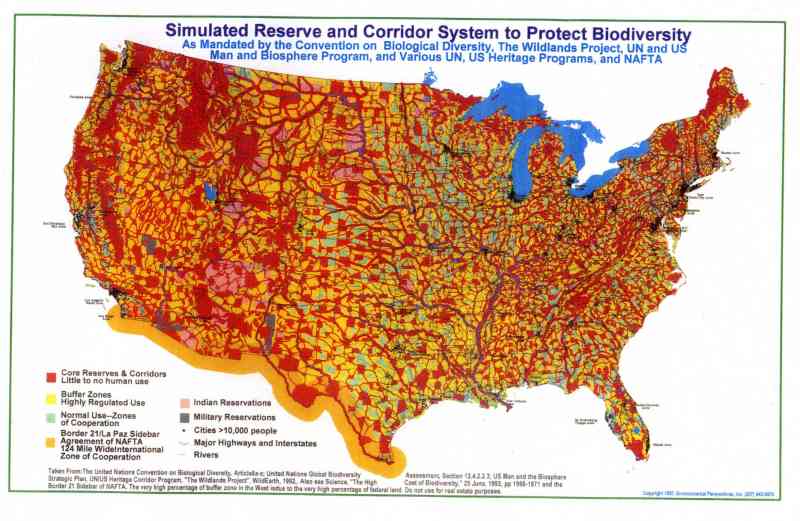
A quick check of the Wildlands Project Map reveals the “simulated reserve and corridor system to protect biodiversity as mandated by the Convention on Biological Diversity, The Wildland Project, U.N. and U.S. Man and Biosphere Program, and Various U.N., U.S. Heritage Programs, and Nafta.” The vast majority of U.S. land is pictured in red, with “little to no human use,” and in yellow, “buffer zones with highly regulated use.” http://www.propertyrightsresearch.org/images/wildlands_map.jpg
The Convention on Biological Diversity passed the Senate Foreign Relation Committee by a vote of 16-3 on June 29, 1994. However, one hour before a scheduled vote by the Senate, “the treaty was pulled from the calendar and a vote on the treaty was never taken.”  But the Clinton administration implemented the treaty anyway through a policy called “Ecosystem Management.”  (A Short Course in Global Governance, Henry Lamb, Sovereignty International, Inc., p. 12, 2010)

David Latham wrote in the Montanian that FWP sent letters to the Amish community in the West Kootenai and had an ‘informational meeting’ to “show them that conservation easements weren’t all that bad,” said Windom. Windom expressed her frustration with the secrecy of FWP, “in my opinion they purposely didn’t disseminate these documents.”
As more and more farmers are voluntarily trapped in conservation easements for years or in perpetuity, they are finding out that the terms of the contract can be draconian, with little recourse or defense from state and local governments.

Few states like Virginia were successful in passing laws to protect farmers from the intrusion of government with U.N. Sustainable Development plans, but these laws do not go far enough. U.N. Agenda 21 goals through its Sustainable Development lynchpin have encroached private property rights like kudzu.

Note

I am grateful to David F. Latham, editor of the Montanian, who had to search his pre-digital archives to accommodate my request on such a short notice.

I am also grateful to Sheila Stanifer, Perry Township Trustee from Ohio , for her valuable research contribution (links).
COPYRIGHT: Ileana Johnson 2015