Showing posts with label Biodiversity. Show all posts

Thursday, November 15, 2018

USMCA Sneaking the Law of the Sea Treaty through the Back Door?

Photo credit: Canada Free Press.com
The legal dictionary defines sovereignty as “the power of a state to do everything necessary to govern itself, such as making, executing, and applying laws; imposing and collecting taxes; making war and peace; and forming treaties or engaging in commerce with foreign nations.”

It is thus quite surprising that the new USMCA (United States-Mexico-Canada) trade agreement which is to replace NAFTA contains a new chapter (24) on Environment which was not in the NAFTA agreement. The three Parties recognize Sustainable Development (SD), the lynchpin of Agenda 21 now morphed into Agenda 2030, as an essential ingredient without which trade cannot exist. https://ustr.gov/sites/default/files/files/agreements/FTA/USMCA/24%20Environment.pdf

Since USMCA dictates that trade cannot exist without sustainable development and a healthy environment with strict guidelines, USMCA then must logically follow the 17 U.N. Sustainable Development Goals (SDGs) which are promoted by U.N. and all its affiliated agencies as follows:

1.      No poverty

2.      Zero hunger

3.      Good health

4.      Quality education

5.      Gender equality

6.      Clean water and sanitation

7.      Affordable and clean energy

8.      Decent work and economic growth

9.      Industry, innovation, and infrastructure

10.  Reduced inequalities

11.  Sustainable cities and communities

12.  Responsible production and consumption

13.  Climate action

14.  Life below water

15.  Life on land

16.  Peace, justice, and strong institutions

17.  Partnerships for sustainable development goals (SDGs).

Sustainable Development and biodiversity are found in the Trans Pacific Partnership (TPP), an agreement which President Trump has denounced. Article 24.15 of USMCA clearly states that “The Parties recognize the importance of conservation and sustainable use of biological diversity, as well as the ecosystem services it provides, and their key role in achieving sustainable development.”

In article 24.18, Sustainable Fisheries Management, regulating “marine wild capture fishing,” USMCA agreement subordinates the United States to U.N.’s international authority and its many organizations.

“Each Party shall base its fisheries management system on the best scientific evidence and on internationally recognized best practices for fisheries management and conservation as reflected in the relevant provisions of international instruments aimed at ensuring the sustainable use and conservation of marine species.” (USMCA, art. 24.18, p. 1)

Sustainable fisheries must abide by the United Nations Convention on Law of the Sea (UNCLOS), the United Nations Agreement for the Implementation of the Provisions of the United Nations Convention on the Law of the Sea of December 1982 relating to the Conservation and Management of Straddling Fish Stocks and Highly Migratory Fish Stocks, the FAO Code of Conduct for Responsible Fisheries, and many others. (USMCA, art. 24.18)

A.J. Cameron stated that the “same people in the Obama Administration who crafted the TPP also crafted USMCA. USMCA back-doors many of the tenets of the reprehensible trade agreements to which we were told by politicians that we would not become a member.”

The Brexit vote was based on issues such as the fishing restrictions placed upon Britain by the European Union. Not only did they destroy the British fishing industry but also any other industry dependent on it. The British fishing industry was forced to cede to the fishing industry of other countries that could not compete with the U.K.

The European Union and 162 countries have joined the Third United Nations Convention on the Law of the Sea (UNCLOS III) which was adopted in 1982 and now called simply The Law of the Sea Treaty (LOST). There were two earlier versions of U.N. treaties with rules that seek to control the oceans: UNCLOS I in 1958 and UNCLOS II in 1960.

President Reagan rejected the treaty in 1982 because it demanded technology and wealth transfer from developed countries to developing nations as well as adopting regulations and laws to control oceanic pollution. Jurisdictional limits on oceans included a 12-mile territorial sea limit and a 200-mile exclusive economic zone limit. The treaty aimed to “regulate economic activity on, over, and beneath the ocean’s surface.”

“Negotiated in the 1970s, the Law of the Sea Treaty was heavily influenced by the New International Economic Order, a set of economic principles first formally advanced by the United Nations Conference on Trade and Development (UNCTAD) in the 1970s and 1980s,” calling for redistribution of wealth to the benefit of third world countries.

Treaties must represent U.S. economic and security interests. According to Sen. Mike Lee (R-Utah), our economic and navigation rights are not going to be affected by the fact that the U.S. Senate has not ratified LOST. He found the loss of national sovereignty and mandatory dispute resolution included in the treaty quite troubling.

The International Seabed Authority (“the Authority”) has the power to distribute “international royalties” to developing and landlocked nations. “So hypothetically, a U.S. company that has invested hundreds of millions of dollars in developing clean and safe deep-sea mining machinery would be forced to give a portion of its profits to countries such as Somalia, Sudan, and Cuba – all considered to be developing nations by ‘the Authority.’”(Sen. Mike Lee in the American Legion Magazine)

The former Democrat Senator and Chairman of the Subcommittee on Oceans, Atmosphere, Fisheries, and Coast Guard, Mark Begich, supported the ratification of the Law of the Sea Treaty (LOST). He believed that it provided rules to handle future underwater minerals, gas, and oil exploration and shipping on new water routes opened by receding Arctic icepack, all under the United Nations aegis. The global warming theorists believed that the icepack melt would be a constant in the future.

According to the Heritage Foundation, innocent passage through an area is already protected under “multiple independent treaties, as well as traditional international maritime law.” Few countries deny passage to the U.S., given its naval superiority.

Under LOST, “intelligence and submarine maneuvers in territorial waters would be restricted and regulated.” It is thus not in the national security interest of the United States to ever ratify this treaty.

LOST requires policies that regulate deep-sea mining, rules and regulations to control and prevent marine pollution, and control of corporations who cannot bring lawsuits independently. They must depend on the country of origin to plead their case in front of the United Nations agency.

President Reagan objected to the Principle of the “Common Heritage of Mankind,” which instructed that marine resources belong to all mankind and cannot be exploited by one nation. https://www.heritage.org/commentary/the-law-the-sea

According to Heritage Foundation, the UN “Authority” must regulate mineral resources by asking companies to pay an application fee and to reserve an extra site for the “Authority” to “utilize its own mining efforts.” https://www.heritage.org/defense/commentary/un-sea-treaty-still-bad-deal-us

A corporation must also pay an annual fee, up to 7 percent of its annual profits, and share its mining and navigational technology. Mining permits are granted or withheld by the “Authority” which is composed of mostly developing countries.

Under LOST, any kind of maritime dispute, fisheries, environmental protection, navigation, and research must be resolved under this treaty through mandatory dispute resolution by the U.N. court or tribunal which limits autonomy. But disputes should be resolved by U.S. courts.

When Congress approves the USMCA agreement, the Law of the Sea Treaty (LOST) will also be ratified through the back-door, by including it in the USMCA.  Which senator is going the read this massive bill?

After less than two years of negotiations, the USMCA was released early on October 1, 2018 on the USTR website for the public to read. It runs for 1,809 pages — 1,572 pages for the treaty chapters, 214 pages for additional annexes, and 23 pages of side letters.” https://www.thenewamerican.com/print-magazine/item/30541-what-s-wrong-with-the-usmca?vsmaid=1929&vcid=11070

Senators like Orrin Hatch (R-UT) are eager to pass USMCA trade agreement. But we must inform our senators that any future “free trade” agreements must be discussed transparently. Those running for office should be forced to go on record whether they will support USMCA or oppose it. We must not pass this massive USMCA trade agreement in order to find out what’s in it as Nancy Pelosi famously said about the not so Affordable Care Act. There is more than just “free trade” in this huge USMCA (United States-Mexico-Canada) document.

Saturday, July 18, 2015

Conservation Easements in Ohio and in Montana 17 Years Ago

Amish Country, Ohio
Photo: Ileana Johnson 2015
United Nations agencies working against the economic needs and wishes of U.S. citizens compiled a blueprint for achieving Sustainable Development called U.N. Agenda 21. This 40-chapter document (about 300 pages) addresses every facet of human life and how Sustainable Development should be implemented through local, state, and federal government.

With its grant-making power (‘visioning grants’ and ‘challenge grants’) and conservation easements, the federal government promoted the Sustainable Development idea and policies to the state and local levels with the creation of an army of new community of Sustainable Development NGOs (non-government organizations) such as the American Planning Association, the Sustainable Resource Center, and the Institute for Sustainable Development.

Conservation easements, known also as conservation covenants, agricultural easements, and conservation restrictions are contracts between a landowner and a conservation organization, giving the conservation trust power over the use of the land for years or in perpetuity. Such easements “run with the land,” and present and future landowners must abide by this conservation contract which is recorded in the local land records as the easement becomes part of the title for the property.

Conservations easements include a laundry list of objectives established by the land trust and agreed to by the farmer:

-          Maintain and improve water quality (this may include onerous conditions to the farmer’s use or collection of water, including rain puddles and snowmelt)

-          Grow healthy forests

-          Maintain and improve wildlife habitat and migration corridors

-          Protect scenic views; anything the farmer may desire to build or plant/grow cannot interfere with the view shed

-          Land must be managed for sustainable agriculture and forestry as determined by the trust that holds the farmer’s conservation easement and is subject to rigorous and frequent inspections.

Real estate development and subdivisions are strictly forbidden in a conservation easement. The decision to place land under conservation easement for tax benefits is voluntary but the land can become locked in perpetuity, no matter who inherits or buys the land in question.  The restrictions placed on the land become permanent and it can reduce the resale value of the property.

In every state, the actual conservation easement contract is kept private between the land owner and the land trust.

The Ohio Department of Agriculture announced its local agricultural easements approved for purchase on June 4, 2015 for “local sponsors to purchase agricultural easements on 54 family farms representing 7,512 acres in 26 counties.”

The local sponsors included land trusts, counties, a township, and local Soil and Water Conservation Districts. They received funds to make the purchase from the Clean Ohio Fund and to manage the Local Agricultural Easement Purchase Program (LAEPP). The easement purchases are advertised as insurance that “farms remain permanently in agricultural production.” The ulterior motives are much divorced from this public statement.

Farmers who want to lock their land in such conservation easement contracts are financially rewarded and must meet certain criteria:

-          Farm must be larger than 40 acres or next to an already “preserved” farm

-          Must actively engage in farming

-          Participate in the Current Agricultural Use Valuation program

-          Prove good stewardship of the land (Farmers already take good care of their land because it represents their livelihood.)

-          Be supported by local government

-          Not be in close proximity to real estate development

-          The money received from the conservation easement purchase can be spent any way the farmer wishes; however, “most reinvest it in their farm operation.”

The Ohio Farmland Preservation program derives its funds from the Clean Ohio Conservation Fund, approved by voters in 2008. The purchase of conservation easements is made through a “competitive process” from “willing sellers.”

According to its website, there are 55,947 acres of land locked in conservation perpetuity, “preserved” under permanent easements. “From 2002-2014, 247 family farms in 53 counties have collectively preserved 45,576 acres in agricultural production.”  A list of counties approved for easements in 2015 is included here. http://www.agri.ohio.gov/public_docs/news/2015/06.04.15%20Local%20Agricultural%20Easements%20Approved%20for%20Purchase.pdf

The Office of Farmland Preservation lists the 2015 Clean Ohio LAEPP recipients by county, the specific local sponsoring land trust, the name of the farmer, Tier I or Tier II, acreage per farm, ODA’s contribution to the purchase offer in dollars, and the actual final offer. Who is supplying the difference? http://www.agri.ohio.gov/divs/FarmLand/docs/Farm_LAEPP_Final2015.pdf

I imagine that it would be hard for a farmer to turn down an offer of $500,000 to “preserve” his farming land, especially if they were strapped for cash. Often, it is difficult to see the bigger picture in the future, beyond one’s farm, and to understand that such conservation easement contracts are not just about being a good steward of your farm and of the environment. They also represent control of private property and its use.

As a matter of fact, the sample deed for the federal government states on page 18, “To HAVE AND TO HOLD the above-described Agricultural Easement to the use, benefit, and behalf of the Grantees, and the United States and their successors and assigns forever.” http://www.agri.ohio.gov/divs/FarmLand/docs/Farm_LAEPP_Approved_Sample_Deed_Federal.pdf

Here is the Local Agricultural Easement Purchase Program (LAEPP) approved sample deed for the state of Ohio. http://www.agri.ohio.gov/divs/FarmLand/docs/Farm_LAEPP_Approved_Sample_Deed_State.pdf

The Ohio Farmland Preservation Map can be found here, including agricultural easements held by ODA and Agricultural Security Areas. http://www.agri.ohio.gov/divs/FarmLand/docs/Farm_ASA_AgMap.pdf

Agricultural Security Areas (ASA) are part of a voluntary program for farmers and landowners, administered at the state level as a tool to protect farmland from the “urbanization of rural areas.” Township supervisors handle the petitions for ASA designation status. http://www.agriculture.state.pa.us/portal/server.pt/gateway/PTARGS_0_2_24476_10297_0_43/AgWebsite/ProgramDetail.aspx?palid=10&

Sheila Stanifer, Perry Township Trustee, has a problem with these conservation easements.  According to the Ohio Revised Code 901-2-01 definitions, “‘local sponsor’ or ‘applicant’ means a municipal corporation, county, township, soil and water conservation district, or charitable organization that applies for a matching grant on behalf of the landowner.” The problem arises from the fact that ‘soil and water’ are taking the place of elected officials; charitable trusts (namely land trusts) are not elected officials either, they are land brokers working for the state government as a so-called ‘sponsor.’”

In the first and second paragraphs of the federal deed contract mentions are made of the Commodity Credit Corporation (CCC), a government-owned and operated organization created to “stabilize, support, and protect farm income and prices, maintain balanced and adequate supplies of agricultural commodities and aids in their orderly distribution.” CCC has no operating personnel; its activity is carried out by the Farm Service Agency (FSA). The Natural Resources Conservation Service administers several conservation programs under the auspices of CCC.

CCC has an authorized capital stock of $100 million, held by the United States, with the authority to have outstanding borrowing of up to $30 billion at any one time. The 1988 Appropriation Act increased the statutory borrowing authority to $30 billion. The funds are borrowed from the U.S. Treasury and from private lending agencies. CCC reserves borrowing authority to purchase at any time all notes and other obligations made by such agencies and others. That is a lot of power over farm activities! http://www.fsa.usda.gov/FSA/newsReleases?area=newsroom&subject=landing&topic=pfs&newstype=prfactsheet&type=detail&item=pf_19991101_comop_en_ccc.html

Many of these land trusts are also staffed with environmental activists who have never farmed in their lives nor have ever entertained the idea. They want the land preserved for wilderness. Additionally, it is much cheaper and easier to control densely populated urban areas than it is to control rural populations spread over vast areas.

Seventeen years ago on July 1, 1998, David F. Latham, editor of The Montanian, published a front page article titled “FWP plans big changes in hunting and rural living, Social engineering is in the works.”  The Department of Fish, Wildlife, and Parks (FWP) in Montana had prepared a document called the Wildlife Program Draft Programmatic Environmental Impact Statement at a cost of $600,000.

Lincoln County commissioner at the time, Rita Windom, said that only seven meetings took place in Montana to inform citizens about the “big changes planned for the way it (FWP) manages wildlife, hunting, and rural living patterns” and she happened to have attended one of these meetings in 1992. Incidentally, 1992 is the year when U.N. Agenda 21 was signed in Rio by 179 countries, including the U.S.

Even though limited public input was permitted during poorly advertised meetings, some of which had only nine people in attendance, the ultimate decision-maker was the FWP. Windom added that the FWP document “includes plans to manipulate human populations in rural areas.”

“They are saying they want social changes. They talk about the increasing importance of environmental concerns nationally, and the increasing reliance on referendums and grass-roots politics for political change. They [FWP] say that social and economic values towards natural resources are becoming less consumptive… nationally. The emergence of the animal rights movement exemplifies national pressure to shift to a less consumptive use at state and local levels,” Windom said, referring to the FWP environmental impact statement plan.

As quoted in the front page article, Windom added that [FWP] “is going to change the use of the land and take the personal property off the land on conservation easements, which would mean ranchers and farmers could no longer use the land the way it is currently being used. That is a big departure to the way we have known conservation easements in the past.” Windom explained that “the plan would in essence tax rural property owners for the wildlife on their property.”
David F. Latham wrote that Commissioner Windom recalled how “one employee of FWP told her the plan is designed to push rural residents into urban areas.” As many residents asked hard questions, the FWP state land manager, Darlene Edge, told Lincoln County commissioner Rita Windom, “Can’t you see we are doing you a favor by forcing people to move from the rural areas into the urban areas. That way you can close roads… Why don’t you work with us and move these people out of the rural areas and into the urban areas so cities can shoulder more of the responsibilities and the county can save money?”

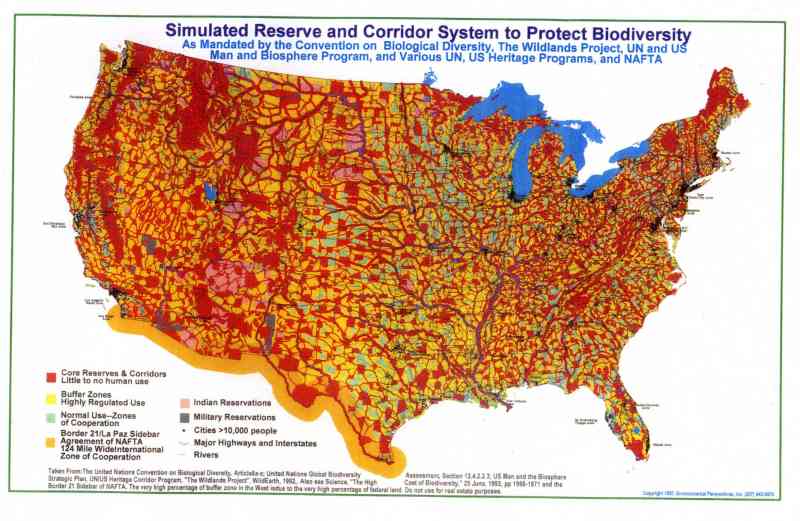
A quick check of the Wildlands Project Map reveals the “simulated reserve and corridor system to protect biodiversity as mandated by the Convention on Biological Diversity, The Wildland Project, U.N. and U.S. Man and Biosphere Program, and Various U.N., U.S. Heritage Programs, and Nafta.” The vast majority of U.S. land is pictured in red, with “little to no human use,” and in yellow, “buffer zones with highly regulated use.” http://www.propertyrightsresearch.org/images/wildlands_map.jpg
The Convention on Biological Diversity passed the Senate Foreign Relation Committee by a vote of 16-3 on June 29, 1994. However, one hour before a scheduled vote by the Senate, “the treaty was pulled from the calendar and a vote on the treaty was never taken.”  But the Clinton administration implemented the treaty anyway through a policy called “Ecosystem Management.”  (A Short Course in Global Governance, Henry Lamb, Sovereignty International, Inc., p. 12, 2010)

David Latham wrote in the Montanian that FWP sent letters to the Amish community in the West Kootenai and had an ‘informational meeting’ to “show them that conservation easements weren’t all that bad,” said Windom. Windom expressed her frustration with the secrecy of FWP, “in my opinion they purposely didn’t disseminate these documents.”
As more and more farmers are voluntarily trapped in conservation easements for years or in perpetuity, they are finding out that the terms of the contract can be draconian, with little recourse or defense from state and local governments.

Few states like Virginia were successful in passing laws to protect farmers from the intrusion of government with U.N. Sustainable Development plans, but these laws do not go far enough. U.N. Agenda 21 goals through its Sustainable Development lynchpin have encroached private property rights like kudzu.

Note

I am grateful to David F. Latham, editor of the Montanian, who had to search his pre-digital archives to accommodate my request on such a short notice.

I am also grateful to Sheila Stanifer, Perry Township Trustee from Ohio , for her valuable research contribution (links).
COPYRIGHT: Ileana Johnson 2015