Showing posts with label Ohio. Show all posts

Wednesday, October 3, 2018

Ray's Road Trip in 1942 America

The roads were “grand” for Ray’s traveling trailer. Driving on January 19, 1942 through Ohio, he was fascinated by the abundance of farms and rolling hills, red painted barns, individual hog pens, and husked corn left on the ground uncovered, easy pickings for any critters or humans passing by. His love of animals was only equaled by his love of nature – his oil landscapes were legendary in the family.

When Ray left the Ohio state line, Kentucky revealed numerous drying tobacco barns and tobacco stalks, and large numbers of stock farms with miles and miles of stone fences. Farther into the state, homes were run down and unpainted. He encountered saw mills from where cut timber was shipped on carts pulled by mules. Ever curious, Ray came upon a large stock sale and stopped to check it out.

The soil was red clay interspersed with pine trees. He noticed that filling stations were very far apart. Homes were poorly constructed and never painted. He was shocked to see toilets separate for “colored people.” Going through Look Out Mountain and Rock City, he drove 7 miles to the top on a slow and gradual incline. The shifting foundation had split the large rocks and fashioned rock crevasses 100 ft. or more deep. Large herds of cattle and hogs were wandering all over the highways, no fences anywhere in sight. Large pine forests flanked the highways.

Crossing into Georgia, he noticed that the soil was hued red, blue, and yellow. Miles and miles of peach trees filled the landscape. The southern Georgia countryside was packed for miles and miles with pecan trees. Mules seemed to be the beast of burden just like in Tennessee and Kentucky.

Georgia homes were built on rock piles or posts with no basements. For the “poorer class,” houses had no windows, only “wooden door flaps.” One dead cow had been hit by a car and the carcass was still in the road.

Stopping in the Okefenokee Swamp, Ray walked out into the swamp for about a mile through the quiet and wild surroundings; the silence was only broken by the occasional hammering of a wood pecker and other bird calls. Moss covered trees abundantly and water lilies bloomed gracefully from the swamp; a large percentage of the tall pines were dead, jutting out of the murky black water.

At the Florida line, the landscape changed to acres and acres of slash pines on both sides of the road. Pines were slashed to gather resin from which turpentine was made. The slashes were made by removing the bark on an area of 12 by 36 inches through which a metal rod was driven at a 45 degree angle ending into a funnel shaped catch for the resin draining from the tree.

Arriving in Jacksonville, Ray remarked that the population was mostly “colored people.” The back of the trailer where they parked for the night was a veritable jungle of palm trees and thick pines covered with Spanish moss. Further down the road he encountered palms, citrus trees, flowers, and a Chinese garden with waterfalls and bridges. On both sides of the highway there were cacti growing everywhere.

In St. Augustine, Ray and his family had a drink from the famous well attended by a man dressed in Spanish clothes. “The grave yard of a vanished race of Indians had uncovered graves, showing the skeletons as these burials were made on top of the ground. At one spot, by looking toward the ocean, I could see through a row of palm trees a distance of 3 miles to the open sea; this is believed to be the spot at which Juan Ponce de Leon had landed in 1513 as it was the spot he first sighted upon sailing into the harbor.” A stone monument in his honor is erected to commemorate the location.

Ray and his wife took a sight-seeing tour through St. Augustine on a horse drawn “surrey” at a charge of $1.50 per hour. The drivers were “colored men wearing a long tail coat and a large plug hat.”

The next stop was a fascinating fort with its heavy ramparts. Ft. Marion, the Guardian of the Spanish City of St. Augustine, was built from “coquina, shells taken from the beach on Anastasia Island and mixed with lime,” cementing walls ten to twelve ft. thick. Ft. Marion was surrounded by a moat of water 40 ft. wide.

The interior court, which crammed 2,500 people inside during a 27-day siege, had a dungeon for prisoners, a Catholic church, and a powder magazine. It was so damp that the powder magazine had a hard time keeping its powder dry. The town was burned to the ground several times by the Spanish, the English, and the French, but the fort never fell. The old wall that surrounded the city is still partially standing. The oldest school and oldest house were also located here. The oldest house had been owned and occupied at one time by Napoleon’s nephew. The beautiful Spanish garden in the back had a wishing well.

The old school house boasted eight “pupils” and upstairs quarters for the teacher. A small dungeon served as punishment for students who did not behave properly. Tuition for this school was $12 per year.

After the alligator and ostrich farms, Ray visited Marineland, with its fish, coral, other marine fauna and porpoises, and the portholes through which the movie industry had shot most of their underwater films of that time.

Across from Marineland was a burial mound for various Indian tribes from counties across Florida. Buried in layers, the bottom uncovered were remains of the “Timucua Indians, the forerunners by a good many years of the Seminole. The skeletons were found in shell mounds, mainly oysters. Vines had grown through all openings of the skulls. The people were buried in a hunched or huddled position.”

Ray passed by the famous speedway in Daytona Beach, on his way to comb the fine white sandy beaches for shells. Parking the trailer in Port Orange for a week, three miles south of Daytona Beach on the Halifax River, Ray, his wife, and three-year old blue-eyed Joan enjoyed the Florida sun and the quartz-white beach.

 
The Paul’s River Land Trailer camp allowed them to park 150 ft. away from the crystal clear waters. The trailer park was enjoyable and only cost $3 per week. Pelicans, white herons, seagulls, and ducks landed in the area quite often. A few boys fishing by speared a small sting ray, about a foot long. The drinking water was none too pleasant, it was full of Sulphur and smelled like rotten eggs. “We had to let water set out overnight in order to get the smell and awful taste out of it.”

Driving through West Palm Beach, Ft. Lauderdale, on to Miami, Ray stopped in Jupiter at Shuey’s Trailer Camp for 75 cents per night, parking about 100 ft. from the government lighthouse. They bought milk for 27 cents with a 5 cent deposit for the glass bottle.

“On the drive to Miami, we went along the ocean and saw the fishing fleets out with their motors, sailing in circles; the waves were so high that in between the crest of the waves, the large fishing boats would be out of sight.”

Ray and his family spent three weeks in the Tall Pines Trailer Camp. Three miles south of Miami was the Rare Bird Farm with coral flamingos and other unusual birds. Of the 350 species, five species of blue, green, and white peacocks were fascinating. Twenty-two miles south of Miami was the Monkey Jungle, where “humans were caged in chicken wire walkways and the monkeys ran wild into the tangle of jungle-like trees.” For 35 cents admission price, they saw up close and personal chimpanzees, black spider monkeys, marmosets, mangabeys, capuchin monkeys, and other primates.

Live sand dollars
Photo: Ileana Johnson
 
In South Miami, after visiting the Floridian Coconut Factory, Ray and his family went swimming twice at Matheson Hammock, a beach protected from sharks but not from the man-of-war - “a large jelly-like transparent globe of a wonderful bright shade of blue.”

Next was window shopping in beautiful Coral Gables where jewelry stores sold their wares for upwards of $3,800, a rich sum for those times. Coral Gables was confusing to Ray as the streets were all names and no numbers, especially when the names were all in Spanish.

For $25 a day and fishing gear provided, Ray broke down and rented a boat to go deep sea fishing and caught his very first sail fish which his wife cooked for supper.

Passing by a Seminole village, Ray marveled at the colored patched clothes. An Indian dressed in full Chieftain’s regalia, posed for pictures with visitors for 15 cents each. Parking in the trailer camps in the area was more expensive, $3.25 per week.

Ray crossed the Everglades, driving on Tamiami Trail, the southernmost 275 miles of U.S. Hwy. 41. The Everglades, thousands of square miles, was a vast tract-less wilderness which could only be negotiated by waterways and the Seminoles were the only persons who could do that at the time. The vast tangle of saw grass was sometimes ten ft. high. One could drive for miles through the big cypress swampland.

“Occasionally through the Everglades, there are small villages of Seminoles. They hunt, fish, and only kill what they need for clothes and food. The main Seminole reservation was deep in the Everglades and could only be reached by their waterway canals. Using large and small boats hewn out of large trees, Seminoles numbered 3,000 at one time, dwindled to 200 and are now increased to about 650. They are the only Indians that are still supposed to be at war with the United States.”


During the rainy season, even the dry spots become swamp land. Of the 16 species of palms in Florida, 13 are found in the Everglades. Forests of bay, live oaks, papayas, and rubber trees grow wild.  In between there are large ferns, gorgeous wild flowers, orchids, air plants, and mosses.

Large burnt out areas could be seen from the road and, as far as the eyes could see there was nothing but swamp and forest, no sign of human life. Houses were miles and miles apart but close to the road. The abundant wild life could be seen from the road – turtles on rocks and logs sunning themselves, turkey vultures, American eagles, wood ibis, blue herons, white herons, egrets, almost extinct sandhill cranes, cougars, alligators, native bears, deer, flamingoes, everglades kite, cape sable, manatees, alligators, snakes, and sea side sparrows. Over 50,000 bird species inhabited the area.

Morning feed
Photo: Ileana Johnson
 
Next stop was beautiful Sanibel Island with its famous sea shell beach. It did not have any camp to park a trailer so Ray drove into Ft. Meyers Beach and stayed there for two days at Don Carlos Trailer and Cottage Court for 75 cents, 300 ft. from the Caloosahatchee River. The wind was blowing fiercely all night, rocking the trailer quite dangerously for comfort.

Next morning they drove across the bridge to the Estero Island where the shells were plentiful on the beach – conchs, whelks (a sea snail), sand dollars (a sea urchin), starfishes (marine invertebrates), sea urchins, and scallops. They had to boil the shells as many were still inhabited by marine mollusks. I cannot imagine anyone today on a road trip disturbing nature in this way. But even collecting an empty shell of a dead marine creature is removing an opportunity for another sea invertebrate to find a home inside.

Last stop of Ray’s road trip was Sarasota with the largest trailer city in the country. The parking fee was $2.25 per week and the camp had everything to keep one occupied and entertained – free movies, dances with attendance of upwards of 300 people, a five-piece orchestra, first aid room, men’s card room, ladies’ card room, its own newspaper, post office, community hall, grocery store, six horse shoe courts, swings, slides, 14 shuffle boards, bingo, a sand box for kids, and a different program every day. The trailer park had 600 trailers laid out in streets, with beautiful landscaped areas. The only charge levied was a government amusement tax of 5 cents.

Sarasota of today, with its Siesta Key, has been voted several times the most beautiful beach in the country. Currently suffering from the worst case of Red Tide in its history, the beach has been less than inviting to tourists for the last three months. Dead fish, brown waters, brown sand, and respiratory distress have dominated reality daily. Mother Nature will take its course and will eventually return the sugar white sands and crystal clear waters to Siesta Key.  


Wednesday, August 24, 2016

Canal Fulton, Ohio, a Historical Role in Transportation and Commerce

Photo: Ileana Johnson 2016
Canal Fulton is a small town in Stark County, Ohio, with a rich history of transportation and commerce. You wouldn’t know it today because Canal Fulton is a sleepy town of 5,479 (2010 census) along the historic Ohio & Erie Canal or what is left of it.

Three small villages developed along the Tuscarawas River. Fulton, originally baptized after a local pioneer, Ben Fulton, changed its name to Canal Fulton in 1832, to include the historic Ohio Canal now a block away from the center of town.

This tiny town is home to 80 buildings and sites listed on the National Historic Register.  Most interestingly, it is home to a mile and a quarter of the original 308 miles of the famous Ohio & Erie Canal. And I had the privilege to take a leisurely ride through history aboard the St. Helena III Canal Boat at the breakneck speed of 3 MPH.  This boat is a concrete replica of the second wooden boat built in 1970 which sits on stilts in dry dock in all its restored former glory.
The original wooden boat had rotted out beyond repair. A sepia photograph still exists of the original St. Helena. The second boat built in 1970 stayed in service for 18 years, pulled by mules. When the mules went to mule heaven, the concrete replica boat was built and Percheron horses have been used ever since to pull the boat along the canal.

Helena II restored
Photo: Ileana Johnson 2016
Surprisingly, concrete does float. For over an hour, time stood still while we were pulled along the canal by two Percheron horses, named Dan and Will, draft horses from the Perche province in western France, owned by a local Amish farmer. We were entertained by the amazing stories and banjo music of our lovely guide Ron, a retired civil engineer.

Ducks, turtles, fish, water snakes, and other critters highlighted the gentle glide on water and on the wings of time while cyclists, runners, walkers, and moms pushing strollers on the right tow path bank passed us laughing. In the old days the bank was only used as a tow path to pull boats.

We experienced life in the slow lane at the cruising speed of 3 MPH as it was for our great  grandfathers. The boat had no oars, no sails, no propellers, no engine, it only floated, as long as it was pulled by ropes. The boat was steered along the canal by a young lady who worked the tiller and the Percheron horses pulled the ropes, guided along the banks by two young Amish men who also helped pull the heavy ropes to allow the boat to turn once we reached the end of the remaining canal which terminated in a water lock.

Tranquility on the Canal Fulton
Photo: Ileana Johnson 2016
 
The four ft. deep canal could accommodate flat bottom boats that carried people and cargo. The boat we floated on was a modified freighter. Back in the days, it would have been really uncomfortable for people to ride in such a boat.  

End of Canal Fulton, Ohio
Photo: Ileana Johnson 2016
 
We floated under a wrought iron bridge built in 1890 for one wagon pulled by horses. It is the only bridge surviving – the rest were made of wood and had rotted out. The bridge is now used solely by pedestrians who cross the canal.

Canal Erie
Photo: Wikipedia
 
The Tuscarawas River flows to the right of the canal bank for over 100 miles before it meets the Ohio River. The Tuscarawas River was never used for navigation because it was too untamed and dangerous and in summer time too dry. But the fearless and experienced Indians floated their canoes along the many rivers in Ohio for centuries before the settlers came.

Dan & Will, Percheron horses
Photo: Ileana Johnson 2016
 
When Ohio became a state in 1803, it was one of the poorest states and last among the states in existence. By 1820 there were 580,000 residents.

In those days people in Ohio had no means of transportation except on foot or horse back. To go on horse, you had to hack away a four ft. wide trail. The dirt trail would turn into a quagmire in spring time and into a dry rocky hill in summer that could easily break a horse’s ankle. Trails meandered through large and dense forests. There were no towns, no stores, no hospitals, very few neighbors, just rivers to navigate on and Lake Erie.

Land was really cheap, $1.25 per acre, but in those days, the average person who lived in the village made $200 a year. Life expectancy was really low, 38 years. One out of five children did not live to see their first birthday. Many died in infancy and few adults lived to be 80. “When you turned 40, you might see an undertaker sneak up on you,” joked Ron.

Canal Fulton
Photo: Wikipedia
 
The State of Ohio looked at five ways to develop the Ohio River and Lake Erie and they chose two. The first one was this artificial canal, the Ohio Erie Canal, from the Ohio River to Lake Erie, 308 miles. It was built by the State of Ohio not the federal government.  Back then if you had the money, you could start digging immediately after the surveys were completed, no permits, applications, and regulations.

Canal Fulton
Photo: Ileana Johnson 2016
 
According to archives, “On July 4, 1825, at Licking Summit south of Newark, work began on the Ohio & Erie Canal.” The canal was built over a seven-year period; by 1827 they were already digging the ditch we were floating on, the following year they filled it up with water, and started to float wooden boats on it, 14 ft. wide, 80 ft. long so they could have two-way traffic  on the 40 ft. wide canal.

“On July 3, 1827, two years after the ground breaking, Governor Trimble and the canal commission boarded a canal boat in Akron and the next day arrived in Cleveland. By 1832 the entire 308 mile route of the Ohio & Erie was open to traffic.”

Immigrants from Ireland dug the canal and the channels and built the tow path. Immigrants from Germany did the stone work for the locks and dams. Five thousand men were working at any one time on the project. These guys worked six days a week, sunrise to sunset, for 30 1/3 cents per day in cash. Cash money did not exist in those days in the State of Ohio. Back in those days everything was done by barter.

Started in 1825, by 1832 the canal was completed to the Ohio River, 308 miles long, at a cost of $16 million. Today, guide Ron told us, “In Columbus, Ohio, we burn through $16 million in two hours.” Because it did not have the money to build the canal system, the State of Ohio floated bonds; it took until 1903 to pay them off, about the time the Wright Brothers “invented the first successful airplane.” https://airandspace.si.edu/exhibitions/wright-brothers/online/fly/1903/

During construction, cholera, dysentery, and typhoid fever made workers sick for a month and a half, with no hospitals, and limited treatment.

The canal was only 40 ft. wide and it was difficult to turn boats around. Every few miles there was a wider area where boats could be turned around or tied to a tree for the night. There was enough room to tie up to fifteen boats. Boats were tied so close to each other that you could walk across their roofs. Many boats were operated by families and children as young as six became part of the crew.

Agricultural products, flour, grain, coal, and other raw materials were ferried across the canals. There were 146 locks on the canal and it took a lot of time to clear a lock. On a busy day, there were 100 boats waiting to go through a lock. Water level was maintained through dams and sluices.

Life on a canal boat that carried passengers was miserable, hot, crowded, and painful. The sanitation buckets were dumped into the water, the very same water they used later boiled to drink and to make tea.

The concrete St. Helena III boat could carry about 80 tons of cargo, no benches, chairs, or anything of comfort, just bunk beds and a pot belly stove. For families who operated the boat, it was an uncomfortable home for 8-9 months of the year.

The Miami & Erie Canal was 250 miles long once and connected Lake Erie with the Ohio River; the state still owns 75 miles of it, the largest watered section is 44 miles and is located along the Loramie Summit. The hydraulics are maintained by the Division of Parks and Recreation employees.

The remaining watered section of the Ohio & Erie Canal is also located on the summit, maintained as a water supply for local industries.

By 1850s the railroads came to the Fulton area at 12 MPH; even jumping off tracks or breaking down, trains were still four times as fast as canal boats and could pull much more than 80 ton of cargo at a time.

 “The canals prospered until 1855, the year revenue receipts were their highest. At its peak, Ohio's canal system consisted of almost 1,000 miles of main line canals, feeders and side cuts. Located in forty-four of Ohio's eighty-eight counties, the canals touched the lives of all the state's citizens. After 1855 the impact of the railroads began to be felt, and by 1903 water sales income from selling canal water to businesses and industries exceeded the income from freight carried on the canal.” http://parks.ohiodnr.gov/canals


Saturday, July 18, 2015

Conservation Easements in Ohio and in Montana 17 Years Ago

Amish Country, Ohio
Photo: Ileana Johnson 2015
United Nations agencies working against the economic needs and wishes of U.S. citizens compiled a blueprint for achieving Sustainable Development called U.N. Agenda 21. This 40-chapter document (about 300 pages) addresses every facet of human life and how Sustainable Development should be implemented through local, state, and federal government.

With its grant-making power (‘visioning grants’ and ‘challenge grants’) and conservation easements, the federal government promoted the Sustainable Development idea and policies to the state and local levels with the creation of an army of new community of Sustainable Development NGOs (non-government organizations) such as the American Planning Association, the Sustainable Resource Center, and the Institute for Sustainable Development.

Conservation easements, known also as conservation covenants, agricultural easements, and conservation restrictions are contracts between a landowner and a conservation organization, giving the conservation trust power over the use of the land for years or in perpetuity. Such easements “run with the land,” and present and future landowners must abide by this conservation contract which is recorded in the local land records as the easement becomes part of the title for the property.

Conservations easements include a laundry list of objectives established by the land trust and agreed to by the farmer:

-          Maintain and improve water quality (this may include onerous conditions to the farmer’s use or collection of water, including rain puddles and snowmelt)

-          Grow healthy forests

-          Maintain and improve wildlife habitat and migration corridors

-          Protect scenic views; anything the farmer may desire to build or plant/grow cannot interfere with the view shed

-          Land must be managed for sustainable agriculture and forestry as determined by the trust that holds the farmer’s conservation easement and is subject to rigorous and frequent inspections.

Real estate development and subdivisions are strictly forbidden in a conservation easement. The decision to place land under conservation easement for tax benefits is voluntary but the land can become locked in perpetuity, no matter who inherits or buys the land in question.  The restrictions placed on the land become permanent and it can reduce the resale value of the property.

In every state, the actual conservation easement contract is kept private between the land owner and the land trust.

The Ohio Department of Agriculture announced its local agricultural easements approved for purchase on June 4, 2015 for “local sponsors to purchase agricultural easements on 54 family farms representing 7,512 acres in 26 counties.”

The local sponsors included land trusts, counties, a township, and local Soil and Water Conservation Districts. They received funds to make the purchase from the Clean Ohio Fund and to manage the Local Agricultural Easement Purchase Program (LAEPP). The easement purchases are advertised as insurance that “farms remain permanently in agricultural production.” The ulterior motives are much divorced from this public statement.

Farmers who want to lock their land in such conservation easement contracts are financially rewarded and must meet certain criteria:

-          Farm must be larger than 40 acres or next to an already “preserved” farm

-          Must actively engage in farming

-          Participate in the Current Agricultural Use Valuation program

-          Prove good stewardship of the land (Farmers already take good care of their land because it represents their livelihood.)

-          Be supported by local government

-          Not be in close proximity to real estate development

-          The money received from the conservation easement purchase can be spent any way the farmer wishes; however, “most reinvest it in their farm operation.”

The Ohio Farmland Preservation program derives its funds from the Clean Ohio Conservation Fund, approved by voters in 2008. The purchase of conservation easements is made through a “competitive process” from “willing sellers.”

According to its website, there are 55,947 acres of land locked in conservation perpetuity, “preserved” under permanent easements. “From 2002-2014, 247 family farms in 53 counties have collectively preserved 45,576 acres in agricultural production.”  A list of counties approved for easements in 2015 is included here. http://www.agri.ohio.gov/public_docs/news/2015/06.04.15%20Local%20Agricultural%20Easements%20Approved%20for%20Purchase.pdf

The Office of Farmland Preservation lists the 2015 Clean Ohio LAEPP recipients by county, the specific local sponsoring land trust, the name of the farmer, Tier I or Tier II, acreage per farm, ODA’s contribution to the purchase offer in dollars, and the actual final offer. Who is supplying the difference? http://www.agri.ohio.gov/divs/FarmLand/docs/Farm_LAEPP_Final2015.pdf

I imagine that it would be hard for a farmer to turn down an offer of $500,000 to “preserve” his farming land, especially if they were strapped for cash. Often, it is difficult to see the bigger picture in the future, beyond one’s farm, and to understand that such conservation easement contracts are not just about being a good steward of your farm and of the environment. They also represent control of private property and its use.

As a matter of fact, the sample deed for the federal government states on page 18, “To HAVE AND TO HOLD the above-described Agricultural Easement to the use, benefit, and behalf of the Grantees, and the United States and their successors and assigns forever.” http://www.agri.ohio.gov/divs/FarmLand/docs/Farm_LAEPP_Approved_Sample_Deed_Federal.pdf

Here is the Local Agricultural Easement Purchase Program (LAEPP) approved sample deed for the state of Ohio. http://www.agri.ohio.gov/divs/FarmLand/docs/Farm_LAEPP_Approved_Sample_Deed_State.pdf

The Ohio Farmland Preservation Map can be found here, including agricultural easements held by ODA and Agricultural Security Areas. http://www.agri.ohio.gov/divs/FarmLand/docs/Farm_ASA_AgMap.pdf

Agricultural Security Areas (ASA) are part of a voluntary program for farmers and landowners, administered at the state level as a tool to protect farmland from the “urbanization of rural areas.” Township supervisors handle the petitions for ASA designation status. http://www.agriculture.state.pa.us/portal/server.pt/gateway/PTARGS_0_2_24476_10297_0_43/AgWebsite/ProgramDetail.aspx?palid=10&

Sheila Stanifer, Perry Township Trustee, has a problem with these conservation easements.  According to the Ohio Revised Code 901-2-01 definitions, “‘local sponsor’ or ‘applicant’ means a municipal corporation, county, township, soil and water conservation district, or charitable organization that applies for a matching grant on behalf of the landowner.” The problem arises from the fact that ‘soil and water’ are taking the place of elected officials; charitable trusts (namely land trusts) are not elected officials either, they are land brokers working for the state government as a so-called ‘sponsor.’”

In the first and second paragraphs of the federal deed contract mentions are made of the Commodity Credit Corporation (CCC), a government-owned and operated organization created to “stabilize, support, and protect farm income and prices, maintain balanced and adequate supplies of agricultural commodities and aids in their orderly distribution.” CCC has no operating personnel; its activity is carried out by the Farm Service Agency (FSA). The Natural Resources Conservation Service administers several conservation programs under the auspices of CCC.

CCC has an authorized capital stock of $100 million, held by the United States, with the authority to have outstanding borrowing of up to $30 billion at any one time. The 1988 Appropriation Act increased the statutory borrowing authority to $30 billion. The funds are borrowed from the U.S. Treasury and from private lending agencies. CCC reserves borrowing authority to purchase at any time all notes and other obligations made by such agencies and others. That is a lot of power over farm activities! http://www.fsa.usda.gov/FSA/newsReleases?area=newsroom&subject=landing&topic=pfs&newstype=prfactsheet&type=detail&item=pf_19991101_comop_en_ccc.html

Many of these land trusts are also staffed with environmental activists who have never farmed in their lives nor have ever entertained the idea. They want the land preserved for wilderness. Additionally, it is much cheaper and easier to control densely populated urban areas than it is to control rural populations spread over vast areas.

Seventeen years ago on July 1, 1998, David F. Latham, editor of The Montanian, published a front page article titled “FWP plans big changes in hunting and rural living, Social engineering is in the works.”  The Department of Fish, Wildlife, and Parks (FWP) in Montana had prepared a document called the Wildlife Program Draft Programmatic Environmental Impact Statement at a cost of $600,000.

Lincoln County commissioner at the time, Rita Windom, said that only seven meetings took place in Montana to inform citizens about the “big changes planned for the way it (FWP) manages wildlife, hunting, and rural living patterns” and she happened to have attended one of these meetings in 1992. Incidentally, 1992 is the year when U.N. Agenda 21 was signed in Rio by 179 countries, including the U.S.

Even though limited public input was permitted during poorly advertised meetings, some of which had only nine people in attendance, the ultimate decision-maker was the FWP. Windom added that the FWP document “includes plans to manipulate human populations in rural areas.”

“They are saying they want social changes. They talk about the increasing importance of environmental concerns nationally, and the increasing reliance on referendums and grass-roots politics for political change. They [FWP] say that social and economic values towards natural resources are becoming less consumptive… nationally. The emergence of the animal rights movement exemplifies national pressure to shift to a less consumptive use at state and local levels,” Windom said, referring to the FWP environmental impact statement plan.

As quoted in the front page article, Windom added that [FWP] “is going to change the use of the land and take the personal property off the land on conservation easements, which would mean ranchers and farmers could no longer use the land the way it is currently being used. That is a big departure to the way we have known conservation easements in the past.” Windom explained that “the plan would in essence tax rural property owners for the wildlife on their property.”
David F. Latham wrote that Commissioner Windom recalled how “one employee of FWP told her the plan is designed to push rural residents into urban areas.” As many residents asked hard questions, the FWP state land manager, Darlene Edge, told Lincoln County commissioner Rita Windom, “Can’t you see we are doing you a favor by forcing people to move from the rural areas into the urban areas. That way you can close roads… Why don’t you work with us and move these people out of the rural areas and into the urban areas so cities can shoulder more of the responsibilities and the county can save money?”

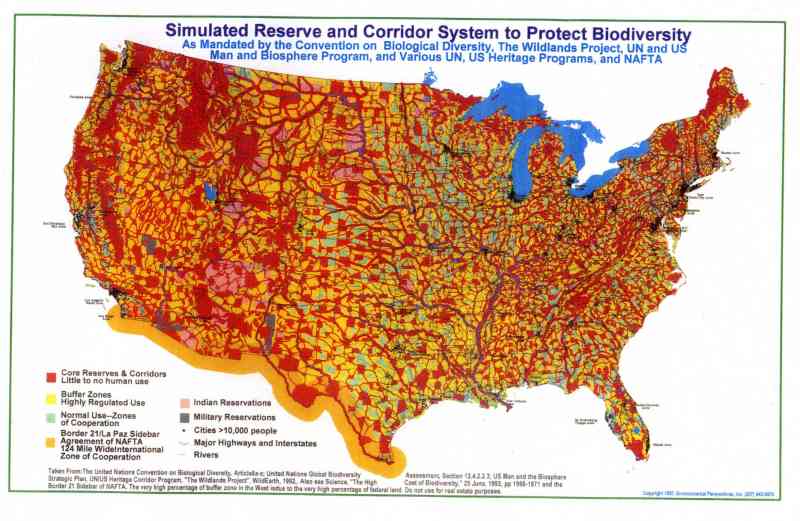
A quick check of the Wildlands Project Map reveals the “simulated reserve and corridor system to protect biodiversity as mandated by the Convention on Biological Diversity, The Wildland Project, U.N. and U.S. Man and Biosphere Program, and Various U.N., U.S. Heritage Programs, and Nafta.” The vast majority of U.S. land is pictured in red, with “little to no human use,” and in yellow, “buffer zones with highly regulated use.” http://www.propertyrightsresearch.org/images/wildlands_map.jpg
The Convention on Biological Diversity passed the Senate Foreign Relation Committee by a vote of 16-3 on June 29, 1994. However, one hour before a scheduled vote by the Senate, “the treaty was pulled from the calendar and a vote on the treaty was never taken.”  But the Clinton administration implemented the treaty anyway through a policy called “Ecosystem Management.”  (A Short Course in Global Governance, Henry Lamb, Sovereignty International, Inc., p. 12, 2010)

David Latham wrote in the Montanian that FWP sent letters to the Amish community in the West Kootenai and had an ‘informational meeting’ to “show them that conservation easements weren’t all that bad,” said Windom. Windom expressed her frustration with the secrecy of FWP, “in my opinion they purposely didn’t disseminate these documents.”
As more and more farmers are voluntarily trapped in conservation easements for years or in perpetuity, they are finding out that the terms of the contract can be draconian, with little recourse or defense from state and local governments.

Few states like Virginia were successful in passing laws to protect farmers from the intrusion of government with U.N. Sustainable Development plans, but these laws do not go far enough. U.N. Agenda 21 goals through its Sustainable Development lynchpin have encroached private property rights like kudzu.

Note

I am grateful to David F. Latham, editor of the Montanian, who had to search his pre-digital archives to accommodate my request on such a short notice.

I am also grateful to Sheila Stanifer, Perry Township Trustee from Ohio , for her valuable research contribution (links).
COPYRIGHT: Ileana Johnson 2015


Wednesday, November 19, 2014

Snow Up to the Waist

Photo: Ileana Johnson 2014
We had crossed the Allegheny Mountains, driving through a rock tunnel, speeding by changing wintry landscapes, bald trees, and still wind turbines dotting the Pennsylvania sky like giant spiders. After seven hours we made it to Scott’s boyhood home.

As huge snowflakes started dancing in the air, Ray opened up his memory bag of childhood stories. The first snow of the year was beginning to stick to the ground and the drab Ohio landscape was turning into a winter wonderland. But this gentle snow blowing from Lake Erie was just a fuss when compared to blizzards past.

It was 1950 and a monster snowstorm had buried the family up to their collective waist in fluffy whiteness. The small Medina Hollow in West Virginia was far from the maddening world of civilization but this time it resembled a lunar white desert. The roads were inaccessible for an entire week before bulldozers from the county showed up to free them from complete and utter isolation.

The feeling of despair never entered the minds of these resilient , intrepid, and self-sufficient country folk who used the Sears and Roebuck catalog as toilet paper and an outhouse dangling over the creek. Sometimes it was washed away by the swollen waters and had to be salvaged from the mud downstream and drug back to its stilts.

The cows were trapped in the shed when huge snow banks slid off the roof and closed off the only possible exit and entrance to feed and water the cows - their source of milk, butter, and cheese. The boys dug a tunnel through the snow to get the Holsteins out to the water.

The fact that they were cut off from the world by miles and tons of snow did not frighten them. They only went to the store in the nearby town of Ripley once a month to buy salt, flour, coffee, and sugar – everything else they grew and canned themselves. They had no refrigeration and electricity; a building dug into the hill, well-insulated with 8 inch walls of sawdust, kept everything cold and well-preserved.  Apples, pears, potatoes, and onions were covered with straw. The milk was kept fresh in the spring. The flowing water was the magical place that sustained life - it was their cooler, fishing hole, the water source for animals and humans, and their Saturday bathtub before church.

In his typical West Virginia brogue, Ray reminisced about the yearly ritual of breaking the soil, planting the garden, weeding it, watering it, and the pig they always butchered on Thanksgiving Day. They stayed up all day and half the night, up to their elbows in blood, meat, and guts. “We saved everything but the squeal and we would have saved it too if we could have caught it. And we cleaned the guts in the river and made sausage sleeves out of them. We even used the pig’s tail to grease the griddle.”

The men dipped the hogs in a barrel to scald the hair off of them and then laid them on a sled, saved the liver, the heart, and other parts to make sausages or fry them.  I wondered  why they did not take a blow torch to singe the pig’s hair like my Grandpa used to do at Christmas time when he butchered the family’s hog. But then again, I always found hairs in the pig’s hide when I was trying to chew Grandpa’s specialty head cheese.

The large family survived during spring and summer by growing vegetables, eating unwashed tomatoes right out of the patch and raising chicken and collecting eggs. When it came time to cook a chicken, they would hang it live on the clothes line and cut its head off to keep it from flopping around and bruising the meat.

“It was not easy then, that’s for sure,” he said pensively. “We did not go to town much, we sold some eggs, we sold cream from Jersey and Holstein cows’ milk, but we did not buy much.”

They made sauerkraut in steeping barrels, stomping salted cabbage with their feet. When the sauerkraut was ready, they washed the salt off. “We did not know any better - that was normal to us.”

Every morning all kids had to get up at 4:30 a.m. and do their chores first before they went to school. Out in the middle of a field, they drank water from the creek and used nature’s bathroom, with special markers for the spot, no sophistication or hygiene worries.

Many kids dropped out of school too soon but Ray’s brothers stayed through 12th grade because their parents stressed the importance of school, “reading, writing, and Route 21.” Route 21 took many kids out of West Virginia to the “promised land” in Ohio in search of jobs. Medina was so small it only had a grocery store and a church, no chance for employment. Ripley was the big city with one traffic light.

Some kids were so poor, they brought raccoon sandwiches to school. Parents sent them to school just to get them out of the house until they got in fights and tried to beat the teacher and the cops took them back home.  

Kids wore overshoes to handle the deep mud. When the school bus would get stuck in spite of the spare gravel on the road, children had to get out in ankle-deep mud and extricate the bus by pushing it out of the ruts. Nowadays there would be a lawsuit if kids pushed the bus.

It’s a wonder Joan married Ray after seeing all the spitting, tobacco and snuff-chewing men in the main square by the Courthouse. People slept with their dogs in bed and the pig underneath the bed because winters were so fierce and cold. Ray’s uncle was considered rich by most area residents because he owned a jewelry store in Ripley, trading watches.

Joan, Ray’s wife, a city girl from Ohio, was appalled how people lived in West Virginia. She must have loved Ray very much to stick around for 55 years. And Ray’s economical lifestyle became their trademark. Living simply, God, and family remained their guiding light.
Copyright: Ileana Johnson 2014