Showing posts with label George Washington. Show all posts

Friday, March 16, 2018

The Hessian Powder Magazine

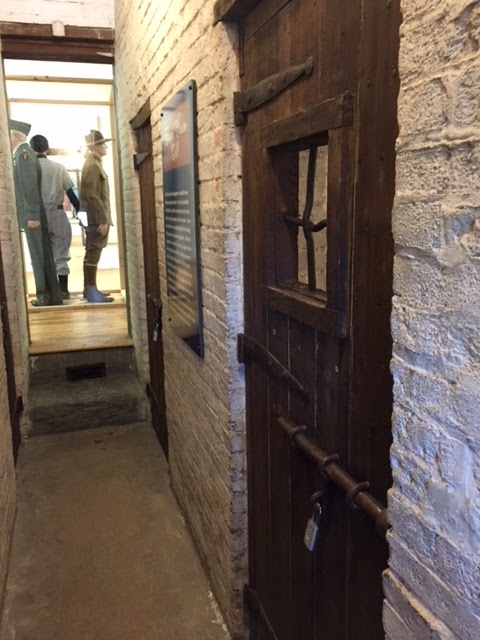
On the Carlisle Barracks grounds in Pennsylvania, a non-descript rectangular stone building was witness to so much of our early American history.  The entrance is in the middle, a heavy and simple wooden door with rusted thick latches. It is now a self-guided museum which opens at daylight and closes at sun-down. It was captivating to step inside and to visit alone the former prison cells and powder storage magazine, now a museum which describes the rich history that surrounds the area.

The Carlisle post was purchased by the federal government in 1801 from the heirs of William Penn for $662.20.  The property had been rented previously.

In 1803 Meriwether Lewis was helped by eight recruits from the Carlisle Barracks in his preparation to explore the Missouri River. These recruits were sent by Lieutenant Colonel Thomas Cushing to help transport supplies and a keelboat from Pittsburgh to St. Louis. When the job was done, the recruits traveled down the Mississippi River and reported to Fort Adams, MS.

 
After a big fire destroyed most of the buildings in 1806, the post was rebuilt as a recruit depot. Even the Navy was authorized to use it. In 1828, the post began training cavalry troops. By 1846, the Carlisle Barracks became the principal cavalry and light artillery training depot for the U.S. Army.

Jail Cells
 
Cavalry School brothers were split and had to take sides as the war broke out between North and South.  Few thought that Confederate soldiers would venture out this far north.  But they did. In June of 1863 Gen. Robert E. Lee’s Confederate Army moved north into Maryland and Pennsylvania, moving along the Cumberland Valley towards Harrisburg, Pa.

 
Interestingly, a former soldier who served in 1840 at the Carlisle Barracks, Lt. Richard S. Ewell, 1st Dragoons, returned to Carlisle in 1863 as Confederate Lieutenant General where he headquartered and staged the area for an attack on Harrisburg. But Gen. Lee ordered him to rendezvous south of South Mountain and he left Carlisle on June 30, 1863.

 
Carlisle Barracks was almost burned to the ground by the shelling of Maj. Gen. J.E.B. Stuart and his Confederate cavalry when U.S. Brigadier General William E. Smith division, who was in possession of Carlisle, refused to surrender. One hundred and thirty-four rounds of ammunition also destroyed the city’s gas works (July 1, 1863).

Ironically, before the Civil War, Carlisle Barracks had been commanded by Stuart’s father-in-law, Gen. Phillip St. George Cooke. The post became smoldering ruins, however, by the end of the Civil War Carlisle Barracks had been rebuilt.

Gen. George Washington’s Continental Army was supported by a growing depot which had been built in 1777 during the American War of Independence from the British government. This Hessian Powder Magazine is the building in which I was standing.  This magazine, far away from the reach of British ships, stored gunpowder, cannon shot and small arms.

It is not documented as such but tradition claims that Hessian soldiers, who were interned at Carlisle after their capture by Washington’s Army during the Battle of Trenton in 1776, had built the powder magazine. It is the second oldest building on post after the 1760 Wilson-Henderson Mill on Route 11.

This building served many functions since its construction. The covered gallery, the chimneys and roof ventilators of the 18th century have long been removed. According to the archives, the iron doors were added in the mid-19th century when the building was used as the Hessian Guard House.

When the Carlisle Barracks were used as a cavalry school, the magazine building was used a guard house. From 1879 to 1918, the building was used by the Carlisle Indian Industrial School as a detention center for students. In the early 20th century, the building was used as storage and in 1948 was converted back to a close approximation of its former appearance. It now houses a museum.

It is highly unusual that powder magazines such as this one survived because generally gun powder was stored in earthen cellars or in highly enforced buildings in which the roof could minimize the blast effect but the rock walls would stand. Vaulted brick ceilings, traversed entrances, ventilation shafts and lightning rods were added to the architecture of buildings in order to enhance their safety. Exposed metal was avoided in order to moderate sparks and copper, wood, and leather were used while handling gunpowder.

To 18th century Americans, a “Hessian” was a generic term given to all six German-speaking states that had sent troops to serve the British government in compliance to treaty obligations. Professional mercenaries of sorts, “Hessians” were unforgiving fighters who took no prisoners and were greatly feared by the Continental Army soldiers.  The few soldiers, who were captured after the Battle of Trenton, were sent to Carlisle and used as free labor.

According to the museum archives, on the night of December 25, 1776, Washington’s army crossed the Delaware River by boats since it had not frozen over as he had hoped, and surprised the Hessians who were quartered in Trenton. On January 3, 1777 his army also defeated the British forces in Princeton, causing both the Hessians and the British to retreat into the interior of New Jersey.

A “Hessian” soldier of the Fusilier Regiment von Lossburg at the Battle of Trenton was equipped with a brass helmet plate with a lion cipher of his fusilier regiment and armed with a standard Prussian pattern flintlock musket and brass hilted short sword.

In 1903 when the post housed the Carlisle Indian Industrial School, the football team invented the hidden ball play in a college game against Harvard.

In 1920 when the post housed the Medical Field Service School, Major John P. Fletcher invented the first complete sterile bandage for individual soldiers. It was called the Carlisle Bandage.

In 1918 General Hospital No. 31 was established in Carlisle Barracks as a pioneering rehab center, treating over 4,000 soldiers in WWI.

In another first, in order to evacuate the wounded, a trial for the auto-gyro was executed in 1935 at the Carlisle Medical Field Service School as the first vertical take-off associated with the Army.

The list of schools located on the post is quite long:

-         Artillery School  (1777)

-         School of Cavalry Practice  (1838)

-         Mounted Light Artillery  (1838)

-         Indian Industrial School  (1879)

-         Medical School  (1920)

-         School of Government of Occupied Areas  (1946)

-         Adjutant General School  (1946)

-         Armed Forces Information Schools  (1946)

-         Chaplain School  (1947)

-         Military Police School  (1947)

-         Army Security Agency School  (1949)

-         U.S. Army War College  (1951)

-         U.S. Army Military History Research Collection  (1967)

-         U.S. Army Military History Institute  (1977)

The Indian School envisioned by Richard Pratt trained Native American youth in industry, trades, and farming. Besides academics, students learned blacksmithing, metalworking, carpentry, and printing. Girls learned cooking, sewing, embroidery, and other forms of stitching.

Some of the best athletes and teams in the nation were instructed by Glenn S. “Pop” Warner:  William Henry “Lone Star” Dietz, Charles “Chief” Bender; Louis Tewanima of the Hopi tribe earned trophies in the 1908 and 1912 Olympics and Jim Thorpe was named All American football halfback in 1911 and 1912 and won the decathlon and pentathlon at the 1912 Olympics. The Associated Press named Thorpe the greatest athlete of the first 50 years of the 20th century.

The athletic field and the cemetery are a testimony to 39 years of existence of the Indian School. Students like Happy Lucy who passed away while studying are buried here.

Captain Johann Ewald, commander of a company of Hessian riflemen, who fought against the American Army of the Revolution had this to say:

“Concerning the American army, one should not think that it can be compared to a motley crowd of farmers. The so-called Continental regiments are under good discipline and drill in the English style as well as the English themselves…  This army consists of handsome… well-built men whose appearance suffers very much indeed from a lack of clothing, hats, and shoes. For I have seen many soldiers of this army without shoes, with tattered breeches and uniforms patched with all sorts of colored cloths, without neckband and only the lid of a hat, who marched and stood their guard as proudly as the best uniformed soldier in the world, despite the raw weather and hard rain… Indeed, very many stood quite proudly under arms without shoes and stockings. Although I shuddered at the distress of these men, it filled me with awe for them. Who would have thought a hundred years ago that out of this multitude of rabble would arise a people who could defy kings and enter into a close alliance with crowned heads?”

The American Patriots stood against the mighty English empire, one of the greatest military powers of all time, spanning the world.  With little prior military experience and learning their craft on the drill field and in battle, the Americans won.

Today the U.S. Army War College produces “graduates who are skilled critical thinkers tasked with solving complex problems in the global application of land power.”

“The Strategic Studies Institute of the U.S. Army War College conducts and publishes national security and strategic research and analysis which serve to influence policy debate and bridge the gap between Military and Academia.” One recent wargame looked at three critical outcomes of the Syrian conflict. (Museum Archives)

At the time of its founding in 1751, the tiny village of Carlisle, Pa, located on the banks of the Letort Creek in the Cumberland Valley was the county seat of Cumberland County, the westernmost county in Pa. The small township of Carlisle has been at the cross roads of American history. Carlisle Barracks played a significant role in the training of the American soldier.

Wednesday, July 17, 2013

Breathtaking Natural Bridge

“So beautiful an arch, so elevated, so light, and springing as it were up to heaven, the rapture of the spectator is really indescribable.  It is the most sublime of Nature’s works.”
- Thomas Jefferson, Note on the State of Virginia

Walking down 147 steps along a tiny creek cascading gradually to a larger bed, huge rocks surround us on both sides. I wondered in anticipation, where is this Natural Wonder? And suddenly, the view opens and a grey mammoth arch covered with lush green vegetation rises out of the wet and moss-covered rock. Rivulets of water flow on all sides of the limestone, constantly carving.

The 215 ft. high arch is 55 ft. taller than Niagara Falls, 40 ft. thick, 100 ft. wide and spans 90 ft. above the massive walls, a bridge made of Ordovician rock, 500 million years old. The tool was water and the master who carved this masterpiece 1160 ft. above sea level was a simple mountain stream, Cedar Creek.

The Monacan Indians, an eastern Siouan nation, who lived in the area for an estimated 10,000 years called the Natural Bridge, “Mohomony,” “The Bridge of God,” or “Great Mystery.” Monacan men, women, and children, chased by enemies, came upon a big chasm between two large boulders and, faced with impending doom, closed their eyes and prayed. When Monacan warriors opened their eyes, a narrow rock bridge had materialized across the gorge and they were able to fight the chasing enemy crossing the Natural Bridge.

Four centuries ago, Monacans could be found in the western and central parts of Virginia, as “far west as the Falls of Richmond, where John Smith and his Jamestown settlers first made contact with the tribe.” There are still 1,400 Monacans living in Virginia in the Bear Mountain region near Lynchburg.

Nobody claimed the 157-acre close to Glasgow, Virginia, because it was not suitable for agriculture.  Following a trail on horseback from Paxson’s Tavern in nearby Glasgow, Thomas Jefferson discovered on August 23, 1767 the massive Natural Bridge.  He purchased the land on July 5, 1774 from King George III for the modest sum of $160.

In 1927 a surveyors cross still visible today was found with the initials “GW” on a stone in Cedar Creek.  The story goes that George Washington, an athletic teenager, had scaled the south face of the Natural Bridge and carved his initials there.

The teen George Washington was working for Colonel Peter Jackson, Thomas Jefferson’s father, who was surveying the Indian trail, called “Big Path” to measure the boundaries of the 157-acre plot. The representative of the King of England, Lord Fairfax of Cameron, ordered the survey in 1750 in order to build a road between Winchester and Buchanan.

George Washington never mentioned this story in his writings, nor is the survey work formally documented. They are mentioned in written descriptions dating back to 1830s.

Jefferson visited his property during annual “rambles;” there are four records of such visits. A two story stone and log cabin was built in 1803 on the present day location of the Natural Bridge Hotel.  Jefferson and his guests would stay in this cabin during his visits, tended by Patrick Henry and his wife Luisa. There was a visitor guest book but was lost in the cabin fire in 1845. According to museum archives, some of the more famous visitors were:  James Monroe (fifth President), Andrew Jackson (seventh President), Martin Van Buren (eighth President), John Marshall (fourth Chief Justice), Henry Clay (Kentucky statesman), Daniel Boone (American pioneer and explorer), and Sam Houston (first Governor of Texas).

Jefferson owned the Natural Bridge until his death in 1826, leaving it to his family. He used the caves around the bridge for the production of ammunition during the war. There is plenty of saltpeter (potassium nitrate) in the caves, the essential ingredient for black gun powder (75% potassium nitrate, 15% charcoal, and 10% sulphur). However, in 1816, Jefferson provided a custodian for its natural preservation, leasing the land to Patrick Henry, a man freed from slavery. With his wife Luisa, Patrick Henry farmed 10 acres, watched for vandals and trespassers, took care of Jefferson’s cabin, and cared for Jefferson’s many guests.

John Sallings, who built a cabin and settled in the area after six years of Indian captivity, was “probably the first white man to see the bridge.”  From his diary, “Colonel John Buchanan preserved the earliest record of the bridge.” (Museum Archives)

In 1834, the second owner of the bridge, Capt. Lackland, devised a hexagonal iron cage, hoisted up and down by strong men working a hand windlass that carried courageous individuals up to view the bridge from the air for the price of $1 per person.

The subterranean waters have carved caves; some were enlarged by human blasting to the size of caverns and to a passable depth of 350 ft. Long time ago, the bridge was actually the ceiling of a large cavern that had collapsed, resulting in the breathtaking bridge that we see today.

In 1812, workmen who extracted nitrate from the Saltpeter Cave heard the water rumblings of the Lost River. They blasted an opening to allow the Lost River to flow outward. Several attempts to locate the source of the underground water have been made with color dyes and flotation devices, all unsuccessful.

I likened the visually arresting and breathtaking experience of seeing the Natural Bridge for the first time to being mesmerized by the thundering Niagara Falls, another majestic monument built by the power of nature and God. As Dr. Norman Vincent Peale said, it “is something like being in a church. It almost brings tears to your eyes.”

Cedar Creek, originating 180 miles away in the Allegheny Mountains, plunging 50 feet in an elegant plume of white water, the Lace Waterfalls, flows under the Natural Bridge and then joins the James River a mile away. The water seems deceptively calm, lazy, and cool on my bare feet. Rev. Andrew Reed described it so poetically in 1835, “Oh, it is sublime – so strong and yet so elegant – springing from earth and bathing its head in heaven.”

The town of Lexington, just north of the Natural Bridge, was the recruiting area for the southern army during the Civil War. One of the nation’s first tourist attractions, during the Civil War both Union and Confederate officers saw the Natural Bridge and recorded their impressions in letters and public documents.

The bridge was so famous that Confederates detoured from their march after the Battle of Lynchburg to see it. Assistant Surgeon Thomas Fanning Wood of the 3rd North Carolina Infantry wrote in his memoirs, “On the 23rd started on the march towards Lexington, and on the same day I got permission to visit or go by the Natural Bridge. … We had pointed out to us the letters G. Washington carved in the stone, which were once quite plain, but time has nearly effaced the last vestige of them. … The story was that George Washington had climbed this ledge to the top. None of us tried this experiment, but we learned that Henry MacRae [of the regiment] … climbed to a very dangerous point, and finding he could not get to the top, had to be rescued by a rope let down from above.” (Museum Archives)

Some of General David Hunter’s Union troops, after burning down the Virginia Military Institute in Lexington, while marching to Lynchburg, detoured to see and cross the famous Bridge.

“We passed within three miles of the Natural Bridge. Officers were much disappointed by not being able to see it. Lieutenant Meigs and some others did go by that road.” (Museum Archives)

The Natural Bridge was also used as a “shot tower” during the Revolutionary War and the War of 1812. To make a “shot,” molten lead was dropped through a copper sieve high above a pool of water, in this case, the Cedar Creek.  Surface tension and the cooling of droplets as they fell created a perfect ball which cooled in the water below. Different size holes in the sieve created different size balls.

Today, the Lee Highway, U.S. Route 11, still crosses over the ultimate natural wonder bridge, painted, drawn, visited, and admired by many, and built by the erosive power of water over millions of years.