Showing posts with label Carlisle. Show all posts

Friday, March 16, 2018

The Hessian Powder Magazine

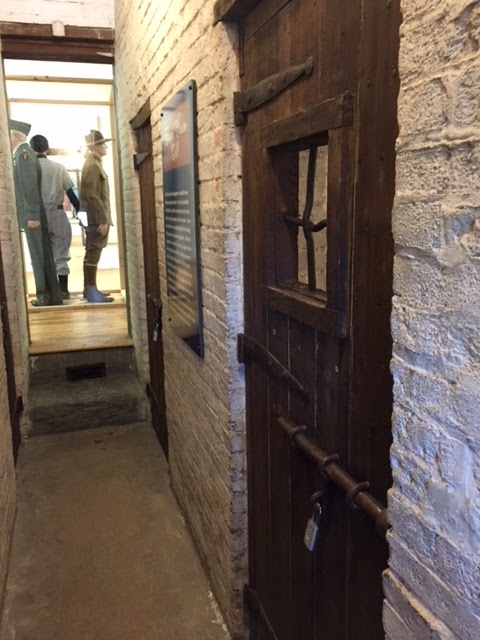
On the Carlisle Barracks grounds in Pennsylvania, a non-descript rectangular stone building was witness to so much of our early American history.  The entrance is in the middle, a heavy and simple wooden door with rusted thick latches. It is now a self-guided museum which opens at daylight and closes at sun-down. It was captivating to step inside and to visit alone the former prison cells and powder storage magazine, now a museum which describes the rich history that surrounds the area.

The Carlisle post was purchased by the federal government in 1801 from the heirs of William Penn for $662.20.  The property had been rented previously.

In 1803 Meriwether Lewis was helped by eight recruits from the Carlisle Barracks in his preparation to explore the Missouri River. These recruits were sent by Lieutenant Colonel Thomas Cushing to help transport supplies and a keelboat from Pittsburgh to St. Louis. When the job was done, the recruits traveled down the Mississippi River and reported to Fort Adams, MS.

 
After a big fire destroyed most of the buildings in 1806, the post was rebuilt as a recruit depot. Even the Navy was authorized to use it. In 1828, the post began training cavalry troops. By 1846, the Carlisle Barracks became the principal cavalry and light artillery training depot for the U.S. Army.

Jail Cells
 
Cavalry School brothers were split and had to take sides as the war broke out between North and South.  Few thought that Confederate soldiers would venture out this far north.  But they did. In June of 1863 Gen. Robert E. Lee’s Confederate Army moved north into Maryland and Pennsylvania, moving along the Cumberland Valley towards Harrisburg, Pa.

 
Interestingly, a former soldier who served in 1840 at the Carlisle Barracks, Lt. Richard S. Ewell, 1st Dragoons, returned to Carlisle in 1863 as Confederate Lieutenant General where he headquartered and staged the area for an attack on Harrisburg. But Gen. Lee ordered him to rendezvous south of South Mountain and he left Carlisle on June 30, 1863.

 
Carlisle Barracks was almost burned to the ground by the shelling of Maj. Gen. J.E.B. Stuart and his Confederate cavalry when U.S. Brigadier General William E. Smith division, who was in possession of Carlisle, refused to surrender. One hundred and thirty-four rounds of ammunition also destroyed the city’s gas works (July 1, 1863).

Ironically, before the Civil War, Carlisle Barracks had been commanded by Stuart’s father-in-law, Gen. Phillip St. George Cooke. The post became smoldering ruins, however, by the end of the Civil War Carlisle Barracks had been rebuilt.

Gen. George Washington’s Continental Army was supported by a growing depot which had been built in 1777 during the American War of Independence from the British government. This Hessian Powder Magazine is the building in which I was standing.  This magazine, far away from the reach of British ships, stored gunpowder, cannon shot and small arms.

It is not documented as such but tradition claims that Hessian soldiers, who were interned at Carlisle after their capture by Washington’s Army during the Battle of Trenton in 1776, had built the powder magazine. It is the second oldest building on post after the 1760 Wilson-Henderson Mill on Route 11.

This building served many functions since its construction. The covered gallery, the chimneys and roof ventilators of the 18th century have long been removed. According to the archives, the iron doors were added in the mid-19th century when the building was used as the Hessian Guard House.

When the Carlisle Barracks were used as a cavalry school, the magazine building was used a guard house. From 1879 to 1918, the building was used by the Carlisle Indian Industrial School as a detention center for students. In the early 20th century, the building was used as storage and in 1948 was converted back to a close approximation of its former appearance. It now houses a museum.

It is highly unusual that powder magazines such as this one survived because generally gun powder was stored in earthen cellars or in highly enforced buildings in which the roof could minimize the blast effect but the rock walls would stand. Vaulted brick ceilings, traversed entrances, ventilation shafts and lightning rods were added to the architecture of buildings in order to enhance their safety. Exposed metal was avoided in order to moderate sparks and copper, wood, and leather were used while handling gunpowder.

To 18th century Americans, a “Hessian” was a generic term given to all six German-speaking states that had sent troops to serve the British government in compliance to treaty obligations. Professional mercenaries of sorts, “Hessians” were unforgiving fighters who took no prisoners and were greatly feared by the Continental Army soldiers.  The few soldiers, who were captured after the Battle of Trenton, were sent to Carlisle and used as free labor.

According to the museum archives, on the night of December 25, 1776, Washington’s army crossed the Delaware River by boats since it had not frozen over as he had hoped, and surprised the Hessians who were quartered in Trenton. On January 3, 1777 his army also defeated the British forces in Princeton, causing both the Hessians and the British to retreat into the interior of New Jersey.

A “Hessian” soldier of the Fusilier Regiment von Lossburg at the Battle of Trenton was equipped with a brass helmet plate with a lion cipher of his fusilier regiment and armed with a standard Prussian pattern flintlock musket and brass hilted short sword.

In 1903 when the post housed the Carlisle Indian Industrial School, the football team invented the hidden ball play in a college game against Harvard.

In 1920 when the post housed the Medical Field Service School, Major John P. Fletcher invented the first complete sterile bandage for individual soldiers. It was called the Carlisle Bandage.

In 1918 General Hospital No. 31 was established in Carlisle Barracks as a pioneering rehab center, treating over 4,000 soldiers in WWI.

In another first, in order to evacuate the wounded, a trial for the auto-gyro was executed in 1935 at the Carlisle Medical Field Service School as the first vertical take-off associated with the Army.

The list of schools located on the post is quite long:

-         Artillery School  (1777)

-         School of Cavalry Practice  (1838)

-         Mounted Light Artillery  (1838)

-         Indian Industrial School  (1879)

-         Medical School  (1920)

-         School of Government of Occupied Areas  (1946)

-         Adjutant General School  (1946)

-         Armed Forces Information Schools  (1946)

-         Chaplain School  (1947)

-         Military Police School  (1947)

-         Army Security Agency School  (1949)

-         U.S. Army War College  (1951)

-         U.S. Army Military History Research Collection  (1967)

-         U.S. Army Military History Institute  (1977)

The Indian School envisioned by Richard Pratt trained Native American youth in industry, trades, and farming. Besides academics, students learned blacksmithing, metalworking, carpentry, and printing. Girls learned cooking, sewing, embroidery, and other forms of stitching.

Some of the best athletes and teams in the nation were instructed by Glenn S. “Pop” Warner:  William Henry “Lone Star” Dietz, Charles “Chief” Bender; Louis Tewanima of the Hopi tribe earned trophies in the 1908 and 1912 Olympics and Jim Thorpe was named All American football halfback in 1911 and 1912 and won the decathlon and pentathlon at the 1912 Olympics. The Associated Press named Thorpe the greatest athlete of the first 50 years of the 20th century.

The athletic field and the cemetery are a testimony to 39 years of existence of the Indian School. Students like Happy Lucy who passed away while studying are buried here.

Captain Johann Ewald, commander of a company of Hessian riflemen, who fought against the American Army of the Revolution had this to say:

“Concerning the American army, one should not think that it can be compared to a motley crowd of farmers. The so-called Continental regiments are under good discipline and drill in the English style as well as the English themselves…  This army consists of handsome… well-built men whose appearance suffers very much indeed from a lack of clothing, hats, and shoes. For I have seen many soldiers of this army without shoes, with tattered breeches and uniforms patched with all sorts of colored cloths, without neckband and only the lid of a hat, who marched and stood their guard as proudly as the best uniformed soldier in the world, despite the raw weather and hard rain… Indeed, very many stood quite proudly under arms without shoes and stockings. Although I shuddered at the distress of these men, it filled me with awe for them. Who would have thought a hundred years ago that out of this multitude of rabble would arise a people who could defy kings and enter into a close alliance with crowned heads?”

The American Patriots stood against the mighty English empire, one of the greatest military powers of all time, spanning the world.  With little prior military experience and learning their craft on the drill field and in battle, the Americans won.

Today the U.S. Army War College produces “graduates who are skilled critical thinkers tasked with solving complex problems in the global application of land power.”

“The Strategic Studies Institute of the U.S. Army War College conducts and publishes national security and strategic research and analysis which serve to influence policy debate and bridge the gap between Military and Academia.” One recent wargame looked at three critical outcomes of the Syrian conflict. (Museum Archives)

At the time of its founding in 1751, the tiny village of Carlisle, Pa, located on the banks of the Letort Creek in the Cumberland Valley was the county seat of Cumberland County, the westernmost county in Pa. The small township of Carlisle has been at the cross roads of American history. Carlisle Barracks played a significant role in the training of the American soldier.

Wednesday, February 28, 2018

Carlisle, a Visit in the Apple Country

Cumberland Valley apple orchard
Photo: Ileana Johnson 2018
Driving through the winding roads of the Cumberland Valley, Pennsylvania felt like riding a roller-coaster sixty miles an hour, with exciting and breathtaking drops. It was a warm February day yet I could only imagine how treacherous it must be when ice and snow cover these roads.

I admired the picturesque apple orchards dotting the landscape and stopped to smell the fresh air, the soil, and to hear birds singing. Even in its dormant state, the sunny day, the stillness, the beauty of the fertile trees as far as the eyes could see, was captivating.

We were bound for Carlisle, Pa, the seat of Cumberland County. Carlisle has a population of 19,162 (2016) excluding the students who attend Dickinson College, a liberal arts college focusing on international education and global education.

Carlisle Barracks is one of the oldest U.S. Army installations and the most senior military educational institutions in the United States Army. The U. S. Army War College is also located on the grounds of Carlisle Barracks.

Cumberland County was crossed by major roads and had an important role in the westward migration. It is interesting to note that the historic district is constantly crossed and clogged by eighteen-wheeler trucks.

Carlisle Square in Historic District
Photo: Ileana Johnson
The settlement of Carlisle was planned in 1751 by John Armstrong Sr. Immigrants from Scotland and Ireland settled in Carlisle and farmed the Cumberland Valley.  They named it after Carlisle, Cumberland, England, and even built the former jail house in the shape of The Citadel in the English city. This jail is now used as general government offices.

Photo: Ileana Johnson
 
Carlisle was a munition depot during the American Revolutionary War which was later developed into the U.S. Army War College. The munitions were kept in a barrack built by Hessians in 1777 which is now a museum located on the Carlisle Barracks grounds next to other historical buildings which have been transformed and modernized through time.

Entrance to Hessian Powder Magazine
Photo: Ileana Johnson 2018
 
A Revolutionary War legend, Molly Pitcher, who died in Carlisle in 1832, is buried in the Old Public Graveyard. There are signs all over Carlisle, reminding visitors of its tumultuous history. For such a small borough, it has found itself often at the crossroads of American history in the 18th century.

When a march was planned in favor of the United States Constitution in 1787, Anti-Federalists initiated a riot in Carlisle. During the Whiskey Rebellion of 1794, Pennsylvania and New Jersey troops assembled in Carlisle under the leadership of President George Washington. The Presbyterian Church in the historic district was the place where President Washington worshipped while in Carlisle.

A local lawyer, Benjamin Rush, one of the signers of the Declaration of Independence, founded Carlisle Grammar School in 1773 and established its charter as Dickinson College, “the first new college founded in the newly recognized United States.” One famous alumnus, who graduated in 1809, was the 15th U.S. president, James Buchanan.

Another prominent lawyer and scholar, James Hamilton (1793-1873), left a $2,000 gift and a 60’ X 60’ lot in his will that would be used to construct in 1881 a two-story brick building that became the Hamilton Library Association, dedicated to housing its collection and eventually a research library about Cumberland County.

According to the Historical Society, another signer of the Declaration of Independence, George Ross (1730-1779), was a prosecutor for the British Crown in Carlisle in the 1750s and 1760s. He had been loyal to King Gorge III, but switched over to the Revolutionary movement. He was the last of the Pennsylvania delegation to sign the Declaration of Independence and the uncle of Betsy Ross.

Photo: Ileana Johnson 2018
 
The Dickinson Law School founded in 1834 is the fifth-oldest law school in the U.S. and the oldest law school in Pennsylvania. The locals were quite upset when the law school ended its affiliation with Dickinson College in 1914 and reorganized as an independent institution, later merging into the Pennsylvania State University in 1997 as Penn State Dickinson School of Law.

Carlisle was a stop for the Underground Railroad, leading up to the American Civil War. As part of the Gettysburg campaign, General Fitzhugh Lee, attacked and shelled the town on July 1, 1863. There is a cannonball dent still visible on one of the columns of the historic county courthouse.

Many of the early settlers of Pennsylvania were Scots-Irish who brought with them their Presbyterian faith. By 1730, they were settling in Cumberland Valley, in the fertile land near the Conodoguinet Creek.

The First Presbyterian Church of Carlisle, the oldest public building in Carlisle, was constructed in 1757. Colonists met there in 1774 to declare their independence from England and President Washington worshipped there in 1794.

In an attempt to force Indians to reject tribal culture and adapt to western society, U.S. Army Lieutenant Richard Henry Pratt established Carlisle Indian Industrial School in 1879, a federally-supported school for American Indians off a reservation. The school was closed in 1918 and the property transferred back to the War Department to be used as a military hospital for soldiers wounded during WWI.

The Indian School memorabilia was packed up and employees helped students return home or transfer to other schools. The school’s 39-year history came to a sad end on September 1, 1918. There was no formal job placement in place and society at large did not rush to hire their graduates.

Additionally, those students who chose to go back to their traditional lives were not accepted back with open arms, they were considered having gone “back to the blanket.” According to the Carlisle Archives, “other Native Americans considered them ‘apple Indians,’ red on the outside and white on the inside.” Some graduates became the reservation’s translators and interpreters.  The trades they had learned in the western school were often useless on the reservation.

The museum archives describe how Asa Daklugie, an Apache, remembers the ‘civilizing’ process which stripped children of all outward signs of traditional life. “We’d lost our hair and we’d lost our clothes: with the two we’d lost our identities as Indians. Greater punishment could hardly have been devised.”

The archives recall, “One by one, the boys’ long hair was cut, a traumatic experience that caused resistance and deep resentment. Their clothing was replaced with military uniforms for the boys and Victorian dresses for the girls. For many students, who had arrived dressed in their finest garments made by family members, losing their familiar regalia was painful.”

The most famous student was Jim Thorpe (1887-1953), a halfback football hero who led its team to upset victories against the powerhouses Harvard, Army, and University of Pennsylvania in 1911-1912. Thorpe was also an Olympic gold medalist and coach, considered and named in 1950 “the greatest athlete in the world” of the first half of the 20th century.

Old Courthouse with Liberty Tree
 
Ten Cumberland County residents received the Medal of Honor. A Liberty Tree stands in the yard of the Old Courthouse (erected in 1766), honoring the Iranian hostages of October 17, 1980.

On the site that had been chosen for Carlisle, there were five major Indian paths that converged, paths of culture, trade, and war. Cumberland valley was settled by Native Americans of the Eastern Woodlands, Susquehannock, Iroquis Confederacy, Lenape, and Shawnee peoples. The Cumberland valley connected Iroquois lands to the Cherokee and Catawba in the Carolinas.

In the 19th century, the Cumberland Valley Railroad opened new ways for goods and people to travel and the speed of life changed. Scientific agriculture was introduced and allowed habitation of legal immigrants who settled in the area. Eventually the railroad system would give way to automobiles, trucking, and to the development of our modern but aging highway system.

Many areas and buildings are listed on the National Register of Historic Places such as the Carlisle Historic District, Carlisle Indian School, Hessian Powder Magazine, Carlisle Armory, and Old West, Dickinson College.

Location of the former Green Tree Inn
Photo: Ileana Johnson
 
The Green Tree Inn had many distinguished guests, among them Benjamin Franklin in 1753, Hamilton and Knox, members of Washington’s cabinet in 1794.

James Wilson (1742-1798), born in Scotland, who rose to the rank of Brigadier General of the Pennsylvania State Militia, cast the deciding vote for independence for Pennsylvania, was one of the six original justices on the Supreme Court, and a founding father of Dickinson College. He was a signer of the Declaration of Independence, and was twice elected to the Continental Congress.

James Smith (1719-1806) was another signer of the Declaration of Independence. He was born in Ireland and studied law at his brother’s office in Pennsylvania.

Daniel Drawbaugh
Historical Society Museum Archives
 
Another fascinating local was Daniel Drawbaugh, expert mechanic and inventor. He held seventy patents, thirty-five related to the telephone. He invented stone pneumatic drills that were used in the building of the Library of Congress, a coin sorting machine, and a charcoal stamping machine. His Great Cumberland County Clock was an interesting electrical invention that could not keep accurate time because of variations in ground current. 

Carlisle made national news when the McClintock Riot took place in 1847. Pennsylvania was a free state but three fugitive slaves were captured and brought to Carlisle on their way south - a girl named Ann, a man named Lloyd Brown, and a woman named Hester Norman, married to a free man, George Norman of Carlisle.

At the time, 300 freed men and women lived in Carlisle. The owners of the three fugitive slaves, Kennedy and Hollingsworth, were seeking certificates from a local justice to transport the fugitive slaves south, and permission to keep them in the county jail while they conducted other business.

Historic Old Courthouse
Photo: Ileana Johnson
 
A crowd gathered at the courthouse and a riot ensued. The judge had reluctantly decided that the escapees could not be jailed but that the certificates of ownership were valid. Kennedy was trampled and broke his knee in the melee; he died of his injuries three weeks later. Thirty-four black and white people and Professor McClintock were charged with inciting a riot. Thirteen people were convicted and eventually imprisoned for this riot.

The faces of immigrants who built Carlisle post office
Museum Archives
Iron furnaces existed in Cumberland County as self-sufficient plantation communities: farms, mills, workers’ homes, school, offices, church, cemetery, and a company store. The labor was composed of free laborers, indentured servants, some of whom were white, slaves, and apprentices. Women mended clothes, farmed, supplied wood, and finished iron casting. A 1800s ironworker made anywhere from 51 to 86 cents a day for 12 hours of work. Most people in this time period worked on farms or in farm-related fields such as milling, blacksmithing, and tanning.

According to the museum archives, due in part to the tanning and iron industries, slavery lingered in Cumberland County even though it was abolished in Pennsylvania on March 1, 1780, one of the first states to do so. “In 1810, half of all the slaves held in Pennsylvania were in Cumberland County… Twenty-four Africans were still in bondage in 1840; 1847 was the first year that the county no longer held slaves.”

The museum archives explain that “Cumberland County was not a stronghold for abolitionists. Many residents had family and friends in slaveholding Maryland, southern born soldiers were in training at the Cavalry School at Carlisle Barracks, and nearly half of Dickinson’s students were from the south. Newspapers in the area were anti-abolitionist and slave catcher gangs roamed the county. After 1945, local churches forbade abolitionist meetings in their establishments.”

New Courthouse
Photo: Ileana Johnson
 
The new courthouse is located on the grounds of the former Market House Square. The Penn family, in their 1751 plan for Carlisle, had designated a portion of the square to be used as a market. Consequently, a market was held continuously on that spot from 1751 until 1952 when it was demolished to make way for the new courthouse, to the protests of many local conservationists.

Twice a week markets were held here and overseen by the Clerk of the Market who used scales to validate the weight of the goods and produce sold. Three different buildings were erected to hold these markets, two open-air ones and one elaborate Victorian building.

Photo: Ileana Johnson 2018
 
On a quaint side street in the historical district, dotted with whimsically bright and colorful mom and pop stores, one particular shop displays in a large bay window numerous “progressive” signs of PEACE and COEXIST just in case you missed one. 

Et tu, Flamingo!
Photo: Ileana Johnson 2018
 
 
Throughout downtown businesses posted flyers announcing its 15th annual food dinner on March 31 sponsored by the Dickinson College, celebrating local agriculture, with a keynote speaker, a fourth generation grocer with a conscience and a political message. She runs “an all-local grocery, deli, and craft beer bar that exists specifically to make climate change progress through responsible sourcing practices, resource-conscious equipment, power and packaging decisions, and the realization of a no-food-waste mandate. This market empowers shoppers to make incremental progress at a time when large-scale legislative change seems unlikely.”

The food will be delicious and expensive ($30) but the dinner sounds like a political drive in support of the debunked man-made climate change scheme rather than just an opportunity to sample locally grown and prepared food and to meet other like-minded progressive neighbors.