|
Vaporetto stop on Grand Canal
Photo: Ileana Johnson 2016 |
We explored the maze of narrow labyrinthine streets (calli) and covered passageways (sottoporteghi) away from San Marco’s
Square, took some wrong turns, crossed many small bridges, walked on narrow
paths along the canals, and stopped to admire the windows of some shops. I took
so many pictures and I thanked my patient husband with a Venetian silk tie and a
leather briefcase. I was surprised how much of the service industry had been
taken over by foreigners, especially Chinese and African Muslims. Some stores
had signs in the window, stating that the business was not Chinese-run or
owned. Never saw this development in all my previous visits. Usually it was
obvious which businesses were owned by Italians because they were spotless and
tastefully decorated with the traditional Italian flair.
Venice has 350 bridges, but her most famous and oldest stone
bridge, Rialto Bridge, built in 1588-1591, spans the Grand Canal at its
narrowest point and is the dividing line between sestieri San Marco and San Polo. Our destination, Ponte di Rialto,
was under repairs since November 2015, with the traditional cloth draping the
construction.
 |
Ponte Rialto
Photo: Ileana Johnson 2016 |
The first bridge in Rialto was a pontoon bridge built in
1181 by Nicolo Barattieri and was called Ponte della Moneta (the bridge of money). As the Rialto market developed
nearby, the bridge was replaced in 1255 with a wooden version which had inclined
ramps to allow the passage of tall ships. Two rows of shops were built along
the sides of the bridge during the first half of the 15th century.
The money from rent was used to maintain the bridge. This “ponte” was partially
burned during a revolt in 1310, collapsed in 1444 from the weight of people
watching a boat parade on the Grand Canal, and collapsed yet again in 1524. It
was time to rebuild it in stone. Famous architects like Sansovino, Palladio,
and even Michelangelo proposed designs for a stone bridge that would replace
the more precarious wooden construction. The winning design was that of Antonio
da Ponte. The Rialto bridge remained the only means of crossing the Grand Canal
until 1854.
Grand Canal
Photo: Ileana Johnson 2016
The Grand Canal winds on the same course of an ancient river
bed of nearly 4 km long and as wide as 230 ft., through six city districts (sestieri), is spanned by four bridges,
and is lined by 10 churches and more than 200 palazzos. Gondolas, food and
trash barges, vaporettos, police boats, small boats, water taxis, and water
buses cross the Grand Canal so often, it causes a constant wake. The waves lap
against the buildings and the changing tides show the decay of the lower levels
of the fastidious palaces. In its heyday, the Grand Canal was traveled by
larger ships, past the opulent palazzos with facades so opulent and intricately
designed like a table cloth of Burano lace. Palazzos displayed the wealth and
social status of important Venetian nobility.
Canal Grande
Photo: Ileana Johnson 2016
Today, any newly minted billionaire with 35 million euros to
burn can own such a palazzo connected to the aristocratic families such as
Mocenigo, Corner, Giustiniani, Grimani, Pesaro, and Pisani. Some Venetians
still live in the ancestral home that belonged to their families for centuries
but may or may not bear their name. Others have been turned into luxurious
hotels, textile and glass manufacturing companies, or museums like Peggy
Guggenheim’s art collection (Palazzo Venier).
Ponte dei Sospiri
Photo: Ileana Johnson 2005
A Venetian palazzo has two entrances, a water one and a land
one, with the water entrance being the main façade. The front has pergolas (balconies). The canal
side level of the palazzo is seldom inhabited because of constant dampness.
There is a water line with green slime, mold, and salt, showing the ravages
caused by the ocean. Tiny spaces between palazzos on the land side are hidden
gardens with Mediterranean flowers and wisteria. An occasional stray cat is
perched on the top of the wall, looking skittishly at pedestrians.
Narrow and short passageway in San Marco's district
Photo: Ileana Johnson
From the vaporetto
stop at San Toma, there is a cluster of palaces that belonged to the Mocenigo
family, Ca’ Mocenigo. Seven doges came from this family. The poet Byron wrote
his poem Don Juan while staying in Ca’
Mocenigo (1819-1824) and is said to have had an affair with the baker’s wife, “wild
as a witch and fierce as a demon.”
Another palazzo on the Grand Canal, Ca’ Foscari, is famous
for having hosted King Henri III of France, and is now part of Venice
University.
Gondola stop with gondoliers
Photo: Ileana Johnson 2016
One the more storied palazzos is Ca’ Dario, not because of
its architecture but because it seems cursed. The owners, over five centuries,
have been plagued by scandals, murder, suicide, bankruptcies, death by broken
heart, and expulsion from Venice. The palazzo was, until recently, empty, as no
prospective buyer would dare tempt fate and imminent calamity.
Ca’ d’Oro, which was bequeathed by the last owner, Baron
Franchetti, to the city, houses now the Franchetti Gallery. Baron Franchetti committed suicide in 1922
rather than facing an incurable disease. He had restored the palace to its
original glory. Because the outside friezes were originally picked in gold, the
name, Palace of Gold, stuck.
Stone Church in Erberia, Rialto
Photo: Ileana Johnson 2016
Ponte Rialto is my favorite bridge to watch pedestrians from
and to admire the gondola traffic. I have bought small souvenirs on the bridge
for 22 years and walked down to the Pescheria,
the famous fish market. I have picked fresh grapes before from the local vendors
in Erberia and calendars from the
foreign ones. I can always find a Romanian somewhere selling cheap souvenirs
and t-shirts and Ponte Rialto is no exception.
Ponte Rialto Erberia
Photo: Ileana Johnson 2016
Rialto is derived from “rivo
alto” (high bank); it is Venice’s cosmopolitan center where banking and
commercial exchanges took place for centuries. Even though Rialto burned to the
ground in 1514 (the fire spared the stone church), it came back from the ashes
like the proverbial Phoenix. The spot were Banco di Giro (1157) existed is now
a bar called Al Bancogiro. Giro was a
written transfer from one account to another, with no receipt issued because
the bank’s register was the official record.
Armed escort moved the money at night to the mint.
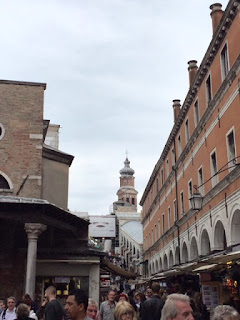 |
Rialto's Erberia
Photo: Ileana Johnson 2016 |
Rialto Bridge divides the city into two parts, the right
bank is the San Marco side, Rialto di qua
(this side) and the left bank is known as Rialto
di la (that side). Vendor booths of every type crowd the banks and the
bridge, a sort of “insect life” as Henry James described it.
The stone church, in the middle of Erberia (the fruit and vegetable stalls), San Giacomo di Rialto, is
dedicated to St. James, the patron saint of goldsmiths and pilgrims. Going up
the inclined cobbled-stoned street and up the bridge steps, there are many tiny
gold and leather shops. The Erberia,
the fruit and vegetable market, would overlook the Grand Canal if the view was
unimpeded by other buildings.
Our favorite by-the-slice pizzeria is on the right bank of
Ponte Rialto and the best jewelry store is at the top of Ponte Rialto. I have
bought Venetian gold from the grandfather, the father, and now the two sons who
own the tiny shop. We always have animated conversations in Italian and haggle
over prices. This time we talked about politics and the invasion of “refugees,”
occasioned by a lovely gold bracelet that featured charms with symbols of every
religion. Next to the pizza shop is a
very busy gelateria with delicious assortments, an outdoor landscape painter
who was selling his oil paints for 25 euros and a gondola station.
Ponte Rialto, right side
Photo: Ileana Johnson
I tried to buy Dave a hat from the Hard Rock Café on the
bridge, a new addition since last time we visited, but he refused on account
that the word Venice was printed in English instead of Italian, Venezia. It
could be Venice, Florida or Venice, California, he said. As if the Hard Rock Café
was authentic Italian, so out of place surrounded by history and medieval beauty.
But then he did not want a gondolier’s straw hat either.
Gondolas
Photo: Ileana Johnson 2016
Gondolas are as old as Venice, able to navigate the
shallowest waters and the narrowest of canals. Turkish in origin, Thomas Mann
described them as “visions of death itself,” made of eight different types of
woods and covered with ten coats of black paint. The ornamental bow of steel
represents the doge’s cap with the six prongs representing the six districts of
Venice. Each gondolier decorates the interior according to their own tastes. In
the 16th century there were 10,000 gondoliers, now there are only
400 and, for the first time, a woman gondolier. The license is issued after a
test, is passed from father to son, and is only available to native Venetians. Gondoliers
have their own shop with typical navy-striped marine-themed attire and round
straw hats with a navy or red ribbon. A half hour ride can set you back 100 euros
but, if you are lucky, the gondolier will serenade you. Their English is very
good and some are college-educated who prefer the life of a gondolier and the much
higher earnings.

Rialto, left side of Grand Canal
Photo: Ileana Johnson 2016
A famous son of Venice was composer, teacher, priest, and
violin virtuoso, Antonio Vivaldi, son of a barber, Giovanni Battista, who
played in the orchestra of San Mark’s Basilica. Antonio would stand in for his
father from time to time even though he was very young. In the western world,
everybody recognizes his masterful composition, The Four Seasons. In adulthood, fame found Vivaldi, but, as a
priest, his image was tainted by the affair with Anna Giro, a local soprano.
When he died, La Pieta, his church base in Venice, was restored, and his
chamber music is played to this day. His home next door became the expensive Vivaldi
Hotel.
The gondolier specialty shop
Photo: Ileana Johnson 2016
Vivaldi’s church, La Pieta, is located in the Castello
district, with the city’s best-known waterfront. Arsenale shipyards, with its
walls and towers and the Naval Museum, is visible in the eastern part of
Castello.
Arsenale with the lion
Photo credit: Wikipedia commons
The Arsenale is a naval school and shipyards today, and officers and
sailors can be seen from ferries passing through. Arsenale, founded in 1104 as
the Venetian military power, was Europe largest medieval shipyard. As the
Arabic term of origin implies, darsina’a
(house of industry), the arsenal was an industrial production line, 3 km of
walled compound with dry and wet docks. The vaporetto
line that used to go between the towers of the water entrance has been
taken out of service. During Biennale, Arsenale is used for display space and
visitors can see the inside unimpeded. Biennale is an exhibition of eccentric
modern art which overloads the senses, an event that occurs every two years. A beautiful 6th century B.C. lion
seems to guard Arsenale in perpetuity.

Canal gondola waiting for hire
Photo: Ileana Johnson 2016
Life on the water seems glamorous to tourists, but it’s not
an easy life. Water buses, the famous
vaporetti, ferry Venetians everywhere they want to go. Everything is transported on water, trash
pickup, supplies, food, police, firemen, ambulance help, even the dead. The
speed limit cannot exceed 5 mph, with the exception of emergency services, but
for Italians, legal limits are just mere suggestions. Gondoliers complain to no
avail.
 |
| Rialto Photo credit: Wikipedia |
High-water sirens mean that the stormy sirocco winds are
blowing. When tidal flooding occurs, the garbage remains piled on the canal
banks – the trash boats cannot pass under bridges to carry the refuse to ships
to be incinerated. Shop keepers place merchandise on higher shelves, locals put
on rubber boots, and temporary boardwalks are put down immediately for
pedestrians. The lagoon water gives character and uniqueness to Venice but at a
price of constant flooding. The many projects to save Venice from sinking,
including heavy concrete barriers that are raised far out at sea, have not
saved the Serenissima yet.
Church of the Redentore designed by Palladio
Photo credit: Wikipedia
When we got tired of walking, we boarded the vaporetto to
San Giorgio Maggiore, an island east of Giudecca. Part of the district of San
Marco, the island is surrounded by Canale della Grazia, Canale della Giudecca,
Saint Mark Basin, Canale di San Marco, and the southern lagoon.
Giudecca Island
Photo: Ileana Johnson 2016
The island was owned by the Memmo family. The island’s
church, San Giorgio Maggiore was consecrated in 829 A.D. and a monastery by the
same name was established in 982. The church was designed by Palladio; the nine
bells of the bell tower ring in C sharp.
 |
| San Giorgio Maggiore Photo credit: Wikipedia |
The island was donated by the Memmo family specifically to
build the monastery. When the Venetian Republic fell, the monastery was
suppressed and the island became a harbor built in 1812 and home to Venice’s
artillery. Today it houses the headquarters of the Cini Foundation Arts Center,
with its library; the open-air Teatro
Verde finds its home here as well.
Next stop was the district Dorsoduro with Giudecca island
and Isola Sacca Fisola. It has the highest land areas of the city. Dorsoduro
has many landmarks such as Ca’ Foscari, Gallerie dell’Academia, Peggy
Guggenheim Collection, many churches, ospedale Giustinian, and palazzo Ariani.
Dorsoduro has a world-famous Gelato Nico. As we sat under umbrellas
on the golf side, a huge cruise ship, Celebrity Constellation, was towed so
close to the shore by two tugboats, practically in front of our eyes. Thousands
of people were lined up on the deck to see the sights of Venice.
We strolled on the island for a while, perusing a miniature
boat shop, an antique store, and taking pictures of beautiful facades that are
so uniquely Venetian, I felt transported into another time and another life.
Giudecca island had beautiful palaces with gardens but in
the early 20th century it became an industrial area with factories,
shipyards, and a film studio. After WWII, the industry declined and the area
has returned to middle class status with some expensive homes. The
Palladio-designed Il Redentore church is located here. The former Molino Stucky
flour mill has been converted into a luxury hotel and apartments. At the
opposite end of Giudecca is the famous five-star Cipriani hotel with gardens
and a salt-water pool.
Dorsoduro antique shop
Photo: Ileana Johnson 2016
After strolling around Dorsoduro for a while, we took the
water bus back to Lido island. At the end of the street from our hotel were
cozy restaurants and shops. A huge monument dedicated to Italian fallen heroes
of various wars was closed and under repairs. Everything around Venice needs
constant repair and restoration due to the corrosive elements.
We picked a nice restaurant for dinner, Gran Viale, and feasted
on the best menu turistico we’ve had
so far. The atmosphere was cozy, the space tastefully decorated, and everything
was spotlessly clean. We returned to our hotel, tired and in pain, ready for
the next day’s adventure, Murano and Burano islands.
TO BE CONTINUED