Showing posts with label glass. Show all posts

Saturday, November 19, 2016

Our Disposable Society

Photo: Ileana Johnson
In our throwaway society, where nothing is sacred anymore and is discarded with the speed of an unwanted darkening banana peel or a lit cigarette butt out the window of a moving car, the miser in me keeps coming out periodically.

Animals, love, life, family, relationships, marriages, appliances, trash, things recyclable, valuables, and trash are thrown out or disposed of mostly on purpose with no remorse and with a faster speed than you can say “I do.”

I sheepishly admit that I was washing Styrofoam containers and plastic forks from McDonald’s back in 1978. Why throw away perfectly reusable items, I thought, when I just landed from the land of poverty, misery, and long lines for food? We had rusty flatware on our table and chipped mismatched plates. My Grandpa used to wash her plates in a little tub of hot water boiled on the gas stove. And sometimes they still had dried food stuck to them from the previous meal. I tried to scrape it off and wipe it with a towel when she was not watching. I could not afford to be choosy or hurt her feelings.

My husband at the time made fun of my miser side because he could not possibly understand even though he visited my childhood home. No matter how many times he took me to the grocery store to see the laden shelves of abundance, my miser inner self could not comprehend so much food and I was certain, it would be gone the next day.

To this day, I wonder when we might have to be without food, water, and electricity, or things that everyone takes for granted, like toilet paper and vitamins. So I used to go from room to room and turn the lights off that my husband had left on and I still do today. Why waste energy? What if we had to be in the dark again like we were often under the socialist/communist regime that planned enough for them while the rest of us had to struggle hungry, cold, and in the dark after sunset?

I recycle today every piece of paper, plastic, glass, and aluminum that crosses my kitchen and my pantry. I even cut the plastic circles that hold bottles in place for fear that some wild animal might get stuck in them if the plastic winds up in a dumpster.

It pains me greatly and I do not understand how someone can throw a live human being or puppy tied in a garbage bag on the side of a deserted road, miles and miles away from a city, and leaves them there like trash, to suffocate and die? Isn’t the way we treat our helpless, animals, children, and old people, an indication of how civilized our society is?

We discard aborted fetuses, humans who are perfect and want to live because progressive society views that as a “choice.” We dump the elderly in nursing homes and seldom visit them. We depend on strangers to be good to them. We visit at holidays out of sheer guilt. There’s an influx of visitors at the nursing home around holidays, I suppose they don’t want to be left out of grandma or grandpa’s will.

We dispose of marriage quicker than we planned the lavish weddings – we get divorced at the drop of a hat. Nobody tries hard to get along anymore; everyone seeks instant gratification and personal happiness. If you ask, nobody is able to give a cohesive definition of what that personal happiness is. But rest assured, it revolves around the “me, myself, and I.”

The “selfish-me generation” throws away everything that is old, including their country, their citizenship, their culture, and their Constitution. Anything they do not understand but has been drilled into their heads by socialist teachers as evil must be discarded. If it is repeated enough times, it becomes their “social justice and equality” playbook.

We discard and abandon children to foster care like a used-up toy because we are too busy or too unable to care for our own offspring.

We euthanize those among us we do not wish to bother with anymore, and we abort the result of loveless hookups because nobody wants to be inconvenienced by a human breathing inside them.

We dump our friends on a whim – they just don’t share the same politics and ideology of the moment and are therefore no good. People we disagree with are suddenly poisonous snakes.

Yet grown Americans keep that one collegiate t-shirt from years ago, with holes everywhere, or that ratty disintegrating blanket one used to drag around for comfort as a toddler, or a favorite dog’s or cat’s toy. Those are holy objects that cannot be thrown away.

We keep that first car, often on cinder blocks, rusted out, and covered with weeds, spiders, and cobwebs. Sometimes rabbits, coons, and the occasional rattlesnake make their nests inside.

We keep that old moldy dresser that belonged to great-grandma because it’s an antique and it might be really valuable someday and fetch a big penny at auction.

We could feed an entire small country daily with the amount of food thrown away in locked dumpsters around the country, perhaps composted, incinerated, or buried later in the landfill.

Beautiful books of wisdom are recycled or buried all the time, in the drive to become a paperless society and to save the trees and the planet from progressive Armageddon. Who has time to read and learn something useful when there is the Internet?

Electronics are discarded as well, perhaps recycled and some buried in the city landfill. Valuable metals, plastics, and glass tubes get buried with them as well.

We throwaway a perfectly running TV that nobody wants in order to make room for a flat screen and top of the line smart TV, so smart, it can report anything you do to the mother ship.

And nobody has landline rotary dial or key punch phones anymore. They worked even when power went out. Those are dinosaurs, thrown away long time ago with the trash, not even recycled. They are buried somewhere in the city dump. When the smart grid goes out and it will eventually do, nobody will have a phone to communicate and answer that 3 a.m. call.

This disposable society mirrors the trashing of our culture in general, of our borders, our language, and our national identity. “We went through darkness so you can find the light." Why are you extinguishing it?


Thursday, September 29, 2016

The Islands of Burano, Murano, and San Michele

Doge's Palace, the view from our window in the morning
Photo: Ileana Johnson 2016
We woke up early, determined to get an early start for more island hopping and to avoid the four noisy Brits bashing America. We were not successful on the last part, but we did board the vaporetto by nine a.m., bound for the famous fisherman village called Burano, 4 miles from Venice, where houses were so colorful, it seemed that there was a quick sale at their local paint shop on bright hues of purple, green, pink, blue, yellow, and orange. When I asked, a local told me that they did it to attract attention from the sea in the often foggy surroundings. The ride took about 45 minutes on a beautiful clear and sunny morning. It was exhilarating to stand on the deck and enjoy the wind blowing salty mist into our faces. I felt like a child again, holding a much desired toy in my arms. I breathed in the air, the sights and sounds surrounding the boat, painting the indescribable greenish-blue waters of the lagoon and the island into my mind.

The picture of the Venetian lagoon off the water bus
Photo: Ileana Johnson 2016
Mazzorbo is an island in the northern Venetian lagoon with orchards and vineyards. Linked to Mazzorbo by a bridge, the island of Burano boasts a population of 2,800 inhabitants, an astonishing population density of 13,000 per square kilometer, more than twenty times the density of Mazzorbo. It has few green areas and is almost entirely covered by homes, tiny shops of hand-made lace linens, tapestry, silk scarves, souvenirs, a few restaurants, and canals with fishing boats tethered to the canal banks.

 
Burano cat
Photo: Ileana Johnson 2016
 
A pampered kitty was curled up in a colorful plastic tub placed on the window sill of a tiny green home with white lace curtains. The cat was photographed by the occasional tourist wondering on the narrow streets. Clothes lines were peeking from alleys less traveled by tourists.

Deserted Burano early in the morning
Photo: Ileana Johnson 2016
 
The locals went about the business of life, hanging out their dirty linen for the world to see, oblivious to the tourists from distant lands, who came by many means of transportation, to visit their famous island.

A deserted street in Burano
Photo: Ileana Johnson 2016
 
If locals wish to paint their home, they must submit a request to the government; it sounded so much like our local HOAs; the government then responds by telling the homeowner what colors are allowed for that residence, based on a long-ago established color scheme. I am certainly not an artist and thus I cannot see the painting scheme, but to me, the carefully watched by design scheme looked like a giant had decided to throw up a color pallet over the entire island.

Cloudy day in Burano
Photo: Ileana Johnson 2016
 
Initially settled by the Romans, Burano was occupied by the 6th century by people from Altino who either named it after the Burina family or after the first settlers who came from the island of Buranello, 5 miles to the south.

The tourist area in the middle of Burano
Photo: Ileana Johnson 2016
 
Altinum (Altino) was an old town in Veneto, 15 km south east of the modern day Treviso. Destroyed by Atilla in 452, Altinum was abandoned and the inhabitants moved to the islands of the lagoon to seek protection from terrestrial invaders. Altino today is said to have 100 inhabitants.

On a sunny day, the colors of Burano really pop
Photo credit: Wikipedia
 
Leaning Tower of Burano in the morning haze
Photo: Ileana Johnson 2016
 
Burano vaporetto dock with sea gull
Photo: Ileana Johnson 2016
 
Undergarments drying in the wind on Burano
Photo: Ileana Johnson 2016
 
Boats are tethered to the banks on Burano
Photo: Ileana Johnson 2016
 
Lacemaking in a dream of beauty
Photo: Ileana Johnson 2016
 
The women of Burano learned how to make lace with needles from artisans in Cyprus. Leonardo da Vinci, who visited the town of Lefkara in Cyprus, is said to have bought a hand-made lace cloth in 1481 for the altar of the Milanese Duomo. Lacemaking flourished for a while, and it was on its way to die out until a school of lacemaking was opened in 1872 on Burano.

 
On a typical street - the sun came out
Photo: Ileana Johnson 2016
 
Even today, few actually understand the amount of work and the tedious craftsmanship required to make one table cloth and are shocked how expensive it can be, depending on the intricate design. The Museum and School of Lacemaking are an eye-opener to a lost art in the rest of the world.

The Church of Martino in Burano has its own leaning tower, although not as famous as the Leaning Tower of Pisa, and a beautiful 1727 painting by Giambattista Tiepolo, entitled Crucifixion.

More lace shops
Photo: Ileana Johnson 2016
 
Abandoned farmhouse on the way to Murano
Photo: Ileana Johnson 2016
 
For tourists, life on the 100 islands of the Venetian lagoon can only be described like an enchanted slow water ride in a medieval setting. But for Venetians, it is a life like no other, few roads on some islands, just canals, waterways, boats, foot bridges, water buses, water taxis, firemen boats, police boats, garbage boats, and the ferry.


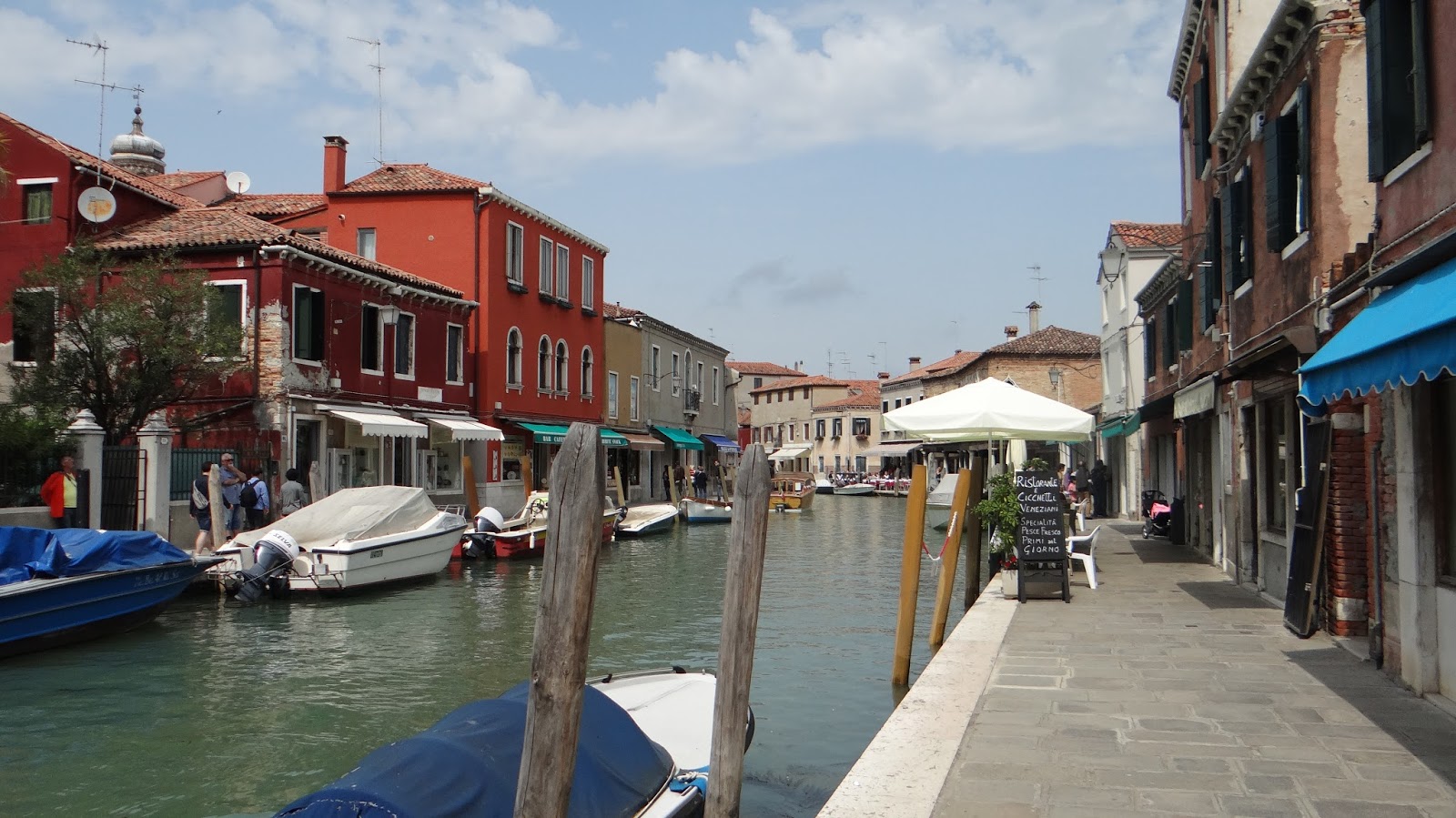
Grand Canal in Murano
Photo: Ileana Johnson 2016
The richer cousin of Burano, Murano, is another vaporetto ride away. Vic Stefanu posted an abbreviated video of the reverse boat ride from Murano to Burano. The sights and sounds, the wakes from boats, the archipelago’s mysterious blue color, and the bluish/grey haze express the pictorial essence of Venice. https://www.youtube.com/watch?v=TsENPCwtsFA

Murano is formed by seven islands linked by bridges and crossed by eight channels. With a population of 5,000 people and a surface of 0.9 miles across, Murano is the center of inimitable glass making.
View from a bridge in Murano
 
Pretty house on our way to Murano
Photo: Ileana Johnson 2016
 
Settled by the Romans and later by the people of Altino and Oderzo, Murano became a fishing port and a producer of salt and center of trade that minted its own coins, unlike the other islands.

Murano
Photo: Ileana Johnson 2016
 
Monks established the St. Michael monastery which quickly became a center of learning and printing. Fra. Mauro, the famous cartographer and a monk at this monastery, drew maps that were essential in the European exploration of the world. But Napoleon’s expelled the monks from their monastery in 1814 and the grounds became Venice’s main cemetery.


Murano's narrow streets
Photo: Ileana Johnson 2016
 
Murano became a center of glassmaking by necessity as they were expelled from Venice in 1291 by the fear and danger of fires. Aventurine glass was invented on the island. Glass beads and mirrors were at first the main creations, expanded later into chandeliers.  Pauly & C. Compagnia Venezia Murano is the oldest glass factory that was founded in 1866 and is still operational today. There is a Murano Glass Museum in the Palazzo Giustinian.

There are palazzos on the island as Murano was a popular resort for Venetians in the 15th century. The countryside had orchards and vegetable gardens until the 19th century when housing construction expanded.


Blue glass sculpture in Murano
Photo: Ileana Johnson 2016
Glassmaking is a very serious craft. The trademark, Vetro Artistico Murano, is filed and registered with the European Office for Harmonization in Alicante. Being a glassmaker afforded the citizens of Murano a special status in the Venetian Republic. They could wear swords, were immune from prosecution by the state, their children married into prominent nobility, but were not allowed to leave Venice. Some took risks and fled to neighboring cities, even England and the Netherlands, to establish furnaces (vetrerias).

Murano had a monopoly over expensive glassmaking for centuries. The types of glass they developed included optically clear glass, enameled glass (smalto), gold threaded glass (aventurine), multicolored glass (millefiori), milk glass (lattimo), and imitation gemstones made from expensive glass.

Hand-painted boat in the Burano Island dock
Photo: Ileana Johnson 2016
 
Those who dared leave Murano shared the secret of glassmaking and crystal with others and Venice lost the monopoly at the end of the 16th century. But their craftsmanship is most admired in the world and people spend a small fortune on intricate chandeliers, mirrors that are prized works of art, beautiful vases, fluted wine glasses, creative collectibles, and other rare objects that a collector desires.

Museo del Vetro (glass museum), located in Palazzo Giustinian, displays artifacts through history, including objects from Egyptian time to today. Glass making companies like Venini, Ferro Murano, Barovier & Toso, Simone Cendese and Seguso guarantee through their trademark that the glass objects are made on Murano island and nowhere else.

The Church of Santa Maria e San Donato is famous for its 12th century Byzantine mosaic pavement and is said to hold the bones of the dragon slain by Saint Donatus.

As lunch neared, we settled for a restaurant overlooking the Grand Canal on Murano. Most things were pricier to reflect the more expensive surroundings. A beautiful opaque blue outdoor glass sculpture decorated one of the canals. Tiny shops sold Murano jewelry, intricately made by master craftsmen in silver and aventurine glass with threads of gold and silver which could set the prospective buyer back around 80-100 euros.

San Michele Island cemetery
Photo: Ileana Johnson 2016
 
We boarded the water bus for Fondamente Nuove as we planned to walk from there back to Ponte Rialto. As the vaporetto chugged on the blue waters, a peaceful and green island appeared, San Michele, dotted with old Cyprus trees. A large bronze statue was rising from the lagoon waters, facing the island with wide-stretched arms.

San Michele bronze statue rising out of the lagoon
Photo: Ileana Johnson 2016
 
San Michele is a cemetery, paradoxically, a temporary resting place for Venetians as they are only allowed to remain there twelve years. Where they are moved to after twelve years, is a mystery to me. But the few wealthy and famous like Ezra Pound and Igor Stravinsky remain there in perpetuity. Signs in the cemetery remind some families that it is time for their loved ones earthly remains to be moved somewhere else. The cemetery is divided by faith, Orthodox, Catholic, Protestant, etc.

Isola di San Michele became a cemetery in 1837 when the government decided that the customary burial under church floors, in church walls, and in crypts was not so salubrious, was smelly, and “illegal.” In a place where flooding (Aqua Alta, high water) happens several times a year, it seems reasonable to bury the dead away from the living.

After we disembarked the water bus at Fondamente Nuove, it became obvious that all funeral homes were located in the immediate area, an ideal location across the water from the cemetery on Isola di San Michele. The photo of a 93 year old man who had recently passed away was posted in one window. I cannot imagine living on these islands but living for 93 years! For Venetians, it may be the highest honor to live and die in the middle of so much history and such romantic surroundings. But the daily life seems very complicated and tedious.

Even though the island was serene and green, it was unsettling. Venetians are born, live, marry, have children, die, and are buried on this island in the middle of the sea.

TO BE CONTINUED