Showing posts with label Siesta Key. Show all posts

Wednesday, October 16, 2024

Paradise Lost and Two Hurricanes, Two Weeks Apart

We flew to Sarasota a week after hurricane Helene flooded Siesta Key to check on our family’s vacation home. We landed on a sunny day and, as we exited the airport, as always, the stifling humidity hit us like a tropical jungle. The beauty around us was undisturbed and we were hoping against all odds that our home somehow survived the 3-4 feet of water that flooded from the nearby canal. 


The windows were thrown open by friends and neighbors but the smell and the mold growing on the walls to the flood line caused our hearts to sink. Everything was soaked and damaged except things set high above that had not molded yet, including the TV sets. The electrical wiring was shot. We were told that it would cost upwards of $100,000 to rebuild this very modest beach house to its original state. There was no flood insurance; it is expensive in Florida and most people cannot afford it. They took their chances as this part of the island has not flooded in 80 years.

Patriot Pier in Siesta Key one week after Hurricane Helene

The island’s streets were lined on both sides by mountains of debris, furniture, mattresses, lamps, refrigerators, washers, dryers, splintered wood, doors, lamps, anything a person had in their household that was not completely waterlogged and smelly.

Stores in the village were boarded up and empty, others, built much higher, had survived and re-opened, waiting for the tourists that were not coming. We were just two of the few who dared to fly here.

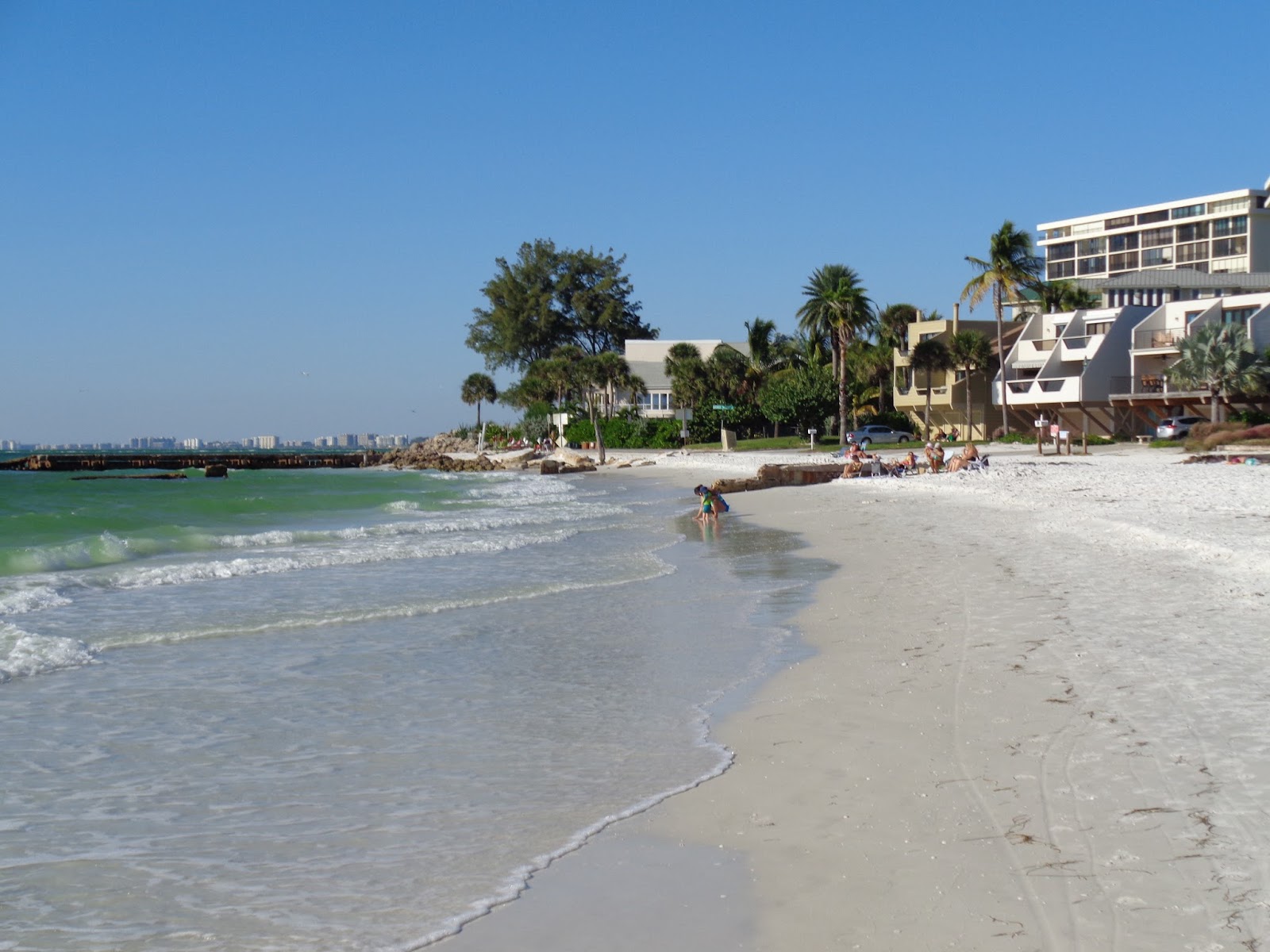
The beach was flat as a pancake, as far as the eye could see and quite smelly from the sewer that rose up and mixed in with the ocean water. The lifeguard towers were placed back in their original locations, standing guard, lonely and shuttered.

We managed to get two hours of beach time with some of the workers taking a reprieve from the unpleasant task of ripping apart someone’s flooded home. The ocean water was a sickly greenish yellow, no doubt not fit to swim. Few dared to enter it.

We drove to St. Armand Key - the devastation there was just as bad. The Circle that used to house fashionable businesses and restaurants looked like a war zone. Longboat Key was flooded as well.

The Marina in Sarasota was flooded, and debris was piled high. Very few of the piles of debris had been removed anywhere – the county, the city government, and the local help were organized but overwhelmed by the massive amount, tons and tons of discarded stuff that had to be hauled away.

We spent three nights in a hotel at the foot of one of the bridges entering Siesta Key. By Monday morning, the order came to evacuate the area, so we decided to drive to Miami as advised by the hotel clerk.


When hurricane Milton finally made landfall, it was in the exact area where our Spark hotel was. Siesta Key was again flooded. The mountains of debris on each street were disturbed and items destroyed by hurricane Helene floated away; new ripped roofs, shanties, and other dangerous materials were added to the already gutted flotsam and jetsam suffocating streets and canals. If the first hurricane did not do a good enough job to destroy, Milton made sure that few things remained untouched. The beach was again washed flat and clean but infused with the perfume of overflowing sewers.


Elderly people who had saved their entire lives to retire in a modest old dwelling were suddenly homeless, having to fend for themselves, sometimes without families. Some had to make heartbreaking decisions to sell the property because they could not afford to rebuild with the new codes of safety. Real estate brokers from Miami were suddenly hit with a bonanza of new and cheap properties on the market which they had salivated for years to acquire.

We took the scenic tour to Miami, through modest neighborhoods and small towns, not the interstate where we knew, we would be overwhelmed by traffic of other absconders from the incoming hurricane Milton which promised to be, according to the media, a category 5 unlike any other hurricane.


We stopped on U.S. Hwy. 27 in Palmdale, Florida at Gatorama, which was closed for a few days. They had been in business since 1957. As we started to leave, a truck pulled up with a jovial driver named Allen. He turned out to be the owner and we had a fun and interesting thirty-minute conversation with him.

Allen closed the attraction for a few days because Hurricane Helene flooded everything and the resident crocs in the creek had escaped, and he was trying to wrangle them safely back in and secure his gators’ enclosures before he could reopen.

I watched his right hand as he was gesturing and noticed his missing middle finger and deep scars on the remaining ones. I asked him if a croc took his finger off and he answered yes. As he was spending time in the hospital healing from surgery, his son produced the motto of the attraction, “Fast hands, or no hands.” My favorite motto would have been, "too slow, lose a toe." Gators and crocodiles are fast runners for their shape and size and can easily outrun a human. They can also jump up seven feet out of the water. Scary scenarios! Thanks to prior hurricanes that released crocodiles and pythons from a zoo into the wild, we now have a sizable population of crocs and pythons in the Everglades.


We made it to Miami and took refuge in a hotel in Miami Beach filled with other people like us and the lucky ones who were going on cruises. By Tuesday, all the cruise ships docked in the Miami harbor disappeared at sea, away from the oncoming hurricane.


The Atlantic Ocean was serene and placid, the color of emerald green, a balmy temperature perfect for swimming and bathing. By Tuesday, the ocean became furious with large waves. But we managed to get two days of beach time before we left.

We did enter the water which dropped precipitously with every other step, two to three feet at a time while our legs were sinking to our ankles in the shifting sand. Within a few mere feet from the edge of the water, we were in 10 feet of water, unable to touch the bottom. To say that I was uneasy about it, it is an understatement – the water was opaque, and I could not see my fingers below three inches from the water’s surface. My mind was conjuring up sharks, jelly fish, and sting rays circling to bite. Fighting to stay afloat, swim, or tread water, the current was trying to pull us out to sea. I was glad that the lifeguard was watching us intently. The waves were more suited for surfing than ocean frolicking.


We enjoyed the Cuban cuisine, and, thanks to our friend Craig, we took an airboat ride on the Everglades, watched gators in their habitat, and even saw the captain of the boat feed one large gator who kept following the boat. A thirty-minute show of gators raised in the park completed our tour. They did not seem to mind their captivity as they were well fed and slept peacefully.

We were going to visit next the Big Cypress National Reserve which was established in 1974 to protect the fresh water’s natural flow from the Big Cypress Swamp into the Everglades and Ten Thousand Islands, but access was flooded by the two back-to-back hurricanes and the accompanying huge rainfall.


Next, we decided to visit Coral Castle, an unusual oolite limestone park located between Homestead and Leisure City, Florida. It was built by a Latvian American, Edward Leedskalnin (1887-1951). He had moved to America from Latvia at the age of 26 after having been rejected by his sixteen-year-old fiancé, Agnes Skuvst, one day before their wedding. The “castle” is built from large stones in difference shapes, each weighing several tons, stones with a specific significance to Ed - slab walls, tables, chairs, a crescent moon, a water fountain, a grill, and a sundial.


The claim is that the structures were built over 28 years by Ed alone, using reverse magnetism and move and carve the stones; another theory was that he used hydrogen balloons and Ed’s advanced tool called a ‘perpetual motion holder.’


It is alleged that Ed had tuberculosis when he arrived in the U.S. but was healed by magnets. How he passed the Ellis Island quarantine with active tuberculosis, is a mystery to me.


The Coral Castle remained in Florida City until 1936, but Ed decided to move it to 28655 South Dixie Highway, an unincorporated area of Miami-Dade County, where he would have more privacy on South Dixie Highway. He left when “discussion about developing land in the original area of the castle started.” It took him three years to move everything 10 miles north of Florida City to its current location outside Homestead, Florida.


The next drive was on the Star Island where a few rich Cuban Americans lived in their gated mansions, away from the masses. A guard house protected the entrance into the Star Island but allowed drivers to make the circle if they did not stop.


Photo by Craig Brand on a sunnier day


Ft. Lauderdale Beach and A1A Highway

Craig B. drove us another day to the Seminole Hard Rock Casino in Hollywood, Florida and to Ft. Lauderdale to admire the famous spring break beach which was now deserted. The blue beach chairs were stacked along the narrow strip. I wondered how much room there is during spring break when all the chairs and towels are deployed on the narrow sand patch between the ocean and the A1A highway. A few die-hard beach goers were fleeing from the imminent rain blowing from the ocean.


We took refuge from the rain at the infamous Elbow Room bar where we were entertained with live music to the delight of the sing-along regulars who were drinking margaritas and beer.


We dined with Craig and Alba on Cuban food at Havana 1957 on Lincoln Road and the next day at Versailles in Little Havana and drove through the neighborhood of old homes, all windows covered in metal bars, allegedly to protect the windows from hurricane projectiles, a cheaper alternative than boarding the windows each time, I was told.

The day before our flight back home, we were crossing the pedestrian crosswalk, we had the right of way, and an SUV turned and clipped my husband’s left side, arm, and leg. Luckily, it did not run over his foot but it caused a lot of bruising and pain. The car sped away, and although there were many witnesses, none of them stayed until the police came, they all disappeared.

I asked one of the two police officers to look at CCTV footage to identify the vehicle and he said, since there were not two cars involved with a crash, and my husband was not dead, there was nothing they could do. In addition to taking them half hour to get there, I was appalled at how little they cared about my husband’s injuries.

We will never return to Miami or Miami Beach that’s for sure. One of my irritating take-aways, and there were many, was that few locals spoke English, why would they, they do not need to because they have little meaningful or no contact with English-speaking Americans. “No English” were the two words I heard many times when we visited places. Ethnicity, diverse culture, good Cuban food and sandwiches set aside, it made us feel like we were in a foreign country.


Sunday, November 4, 2018

Politics at the Beach

Beach road to the left
Photo: Ileana Johnson 2018
I was hoping that I could get away from politics during our vacation and just enjoy the beach, the white sand, the sea gulls, the dolphins, and the Floridian sunshine. But politics hit me in the face in one form or another in this area overflowing with snow-bird Democrats from New York, New Jersey, and Ohio.

Last year NGOs used young, beautiful, and half-clad women on the beach to advocate for legalizing marijuana.  This year we were assaulted by greens urging naïve pedestrians in affluent areas to fill out questionnaires to save marine life. Tugging at their heart strings, it was an easy sell for donations to various environmental and conservation groups. 

Waiters and restaurant owners had replaced plastic straws with paper straws – glossy and expensive signs “educated” us at each table that drinking without a straw each time saved a turtle.

One day a mature and well-preserved lady with her husband was high-fiving an elderly New Yorker wearing a blue t-shirt with her favorite candidate for Florida governor. They told her, they were very eager to vote early as well for the same candidate.

I muttered under my breath the word “commies;” the couple heard me and replied that they hoped I could not vote. Tangling with total strangers who have no idea what communism is or how awful it was to live under the communism they yearn to bring to this country was not my idea of fun on vacation. But I am not one to back down from an argument with useful idiots who argue and vote for their own demise. The rich ones think that the scourge of communism will somehow bypass them only because they are “enlightened-thinking” Democrats who deplore their opponents with divergent opinions as Neanderthals with pea brains.

As Project Veritas latest video release revealed, there is nothing American about this particular campaign, just a run of the mill progressive (read communist) assault on a “cracker” state as one of the campaign staffers said in the video. https://www.youtube.com/watch?v=di3WRRHRWlE&feature=player_embedded&fbclid=IwAR20L4DZ4j11AVtvISueOJx6wTl6MONZ5zIum4AAYNjrsNUWNzZPcCvw4-w

Often the longest and most protracted political battles are the local ones. One determined resident managed to get on the ballot the three-year long battle over access to a beach road that had been opened to the public for decades but one hurricane had blocked one small section and that gave the city planners the idea to give that section to a rich developer who was planning on building high-rise condos that could sell for mega-bucks. He mentioned that one nearby condo had sold recently for $4.5 million.

The locals had been up in arms fighting to keep this beach road open to the public. Beach-goers contribute large amounts of revenue to the local economy in the form of tourist taxes, hotels, restaurant meals, and other vacation amenities.

 
Mike's rocky strip where he plans a wooden pier for walkers
Photo: Ileana Johnson 2018
 
A local man, who, by his admission, cannot even afford to live near this beach, had bought a small rocky strip of land jutting out into the ocean. Mike flies the American flag proudly and lowers it every afternoon at sunset in a moving ceremony.  A carpenter by trade, he told me that he had spent close to half a million dollars in legal fees to defend everybody’s right of access to the beach, but especially the handicapped. This particular access is very close to the beach, a few steps to be exact.

 
Mike lowering the flag at sunset with Dave
Photo: Ileana Johnson 2018
 
One single handicapped parking spot is now covered by a mound of sand. That is another minor battle as the mound had been sitting there for a while. The plan was to spread the sand on the eroded beach but turtle nesting season was in full swing and the county was waiting, irritating the nearby condo-owners who wanted an unobstructed view of the ocean.

On October 31, the top layers was spread but the bottom part of the mound would have to be taken away to be used in construction since the scraping of the bucket would contaminate the sand with asphalt thus rendering it unusable for the beach.

In a soft but determined voice, he told me that he used to bring his mother to the beach in a wheelchair every sunset until she passed away. Not having children and a family of his own, he wants to leave this strip of land to the public trust in perpetuity so that people could enjoy the ocean. He plans on building a wooden platform on the rocks to allow wheelchair access to the handicapped and to our veterans. He hopes that on Tuesday, the voters will resolve the fate of the beach road in their favor.

The voters will decide on the charter amendment to preserve county-owned parks, preserves, beach and water access and waterfront vistas (ordinance no. 2018-036). Currently the Board of Commissioners has the authority to sell any county-owned property and to vacate roads and rights of way.

“The amendment would prohibit the county from selling or giving away any county-owned parks and preserves, and prevent the county from vacating any road segments or rights of way along any beach, river, creek, canal, lake, bay, gulf access or waterfront vistas." https://www.scgov.net/government/communications/county-charter-amendment-summary

 
Scooter of the Beach
Photo: Ileana Johnson 2018
 
A local celebrity resident, Scooter of the Beach, has been giving video reports on social media daily for the last three months about the status of the red tide bacteria which killed so much marine life, turning water brown, red, or dark green, and causing respiratory irritation and cough on the beach, affecting tourism this summer on a 100-mile stretch.

“Red tide is a common name for a worldwide phenomenon known as an algae bloom (large concentrations of aquatic microorganisms—protozoans or unicellular algae) when it is caused by species of dinoflagellates and other algae. The upwelling of nutrients from the sea floor from massive storms is most likely the cause of these events.”

But locals blame red tide on individual fertilizer use and others on the discharges into the ocean of byproducts from a sugar plant.


Friday, October 27, 2017

Edison and Ford Estates in Fort Myers, Florida

Seminole Lodge, Edison's house
Photo: Ileana Johnson

Hurricane Irma hit Florida with a vengeance six weeks ago, the island had to be evacuated, and the ocean receded from its bay. Siesta Key was spared severe devastation but its neighbors to the south, Naples, San Marco, and Fort Myers did not fare as well. Irma hit them as a strong category 3 hurricane. The evidence is painful to see in the mounds of chopped up uprooted trees and torn vegetation yet to be picked up in front of every home.
The Edison/Ford Estate lost 100 old trees, shrubs, and other tropical vegetation that used to shade almost 20 acres of property, now fully exposed to the sun. Vegetation grows fast in Florida but 100-year trees are hard to replace. The estate museum opened on October 14, 2017 for the first time since the severe winds devastated the once shady and lush green gardens, still beautiful but showing signs of distress.

Edison's 90-year old Banyan tree
Photo: Ileana Johnson
Edison’s beloved 90-year old Banyan tree survived the hurricane onslaught. This Banyan tree was among the more than 17,000 samples that Edison tested for his research effort to find a natural source of rubber. It is documented that the tree was planted in 1927 and is one of the largest in the continental U.S. The Banyan tree (Ficus benghalensis) produces a milky sap (latex) that can be used as rubber. The Edison and Ford estates have more than thirteen types of ficus trees.

Fort Myers is known as the City of Palms; it is a tradition started by Edison – he planted 1.5 miles of royal palms along McGregor Boulevard in front of his winter home.

Edison’s botanical research laboratory eventually found a source of rubber in the plant called goldenrod. He was worried that the source of rubber domestically would dry up in the case of a shortage in the foreign supply. The lab, which was built in 1928, remained operational until 1936, five years after Edison’s death.

                                                             Sanibel Island Beach
                                                             Photo: Ileana Johnson

Nearby Sanibel Island, lush with jungle-like vegetation seemed to have fared better.  Off the fishing pier, the sugary-white quartz sand shell beach was sparkling in the noon sun. The ocean had a greenish-rusty brown hue. Wading in the surf to find more shells on the bottom was fun even in leather sandals. Sanibel Island’s lighthouse had an unusual iron skeleton appearance; it was first lit in 1884.

Sanibel Island Fishing Pier
Photo: Ileana Johnson
 
Sanibel Island Lighthouse
Photo: Ileana Johnson
 
The bay in Siesta Key was flooded by jelly fish and hundreds of bathers and swimmers were stung daily; nobody could resist the balmy 83 degree Fahrenheit waters with small and gentle waves. The life guards were flying the purple caution flag for dangerous marine life. People took a careless attitude to the jelly fish.  How much can they possibly hurt? We are going in for a swim.

As clouds gathered for a rainy afternoon, it was a perfect time to visit Thomas Edison’s estate in Fort Myers, Florida.  One of Edison’s famous inventions, the incandescent bulb, inexpensive and reliable,  is now becoming extinct as the environmental scaremongers are blaming inexistent global warming on everything man-made despite evidence to the contrary.

Thomas Alva Edison (1847-1931) was a prodigious inventor, newspaper printer/publisher, telegrapher, and businessman.  Edison’s research lab in Florida focused on finding a domestic source of rubber. He was the only person who was awarded consecutive patents every year for 65 years, a total of 1,093. His favorite invention was the phonograph, but his work improved the telegraph, generators, motors, batteries, movie-making, and cement.

Thomas Edison, Henry Ford, John Burroughs and families camped often in the Florida Everglades. His famous remark, “There is only one Fort Myers and soon 90 million Americans will discover it,” certainly rings true today.

River view from the porch
Photo: Ileana Johnson
 
Edison found a 14 acre property along the Caloosahatchee River countryside, one mile south of the city of Fort Myers. The land was mostly scrub and wild vegetation with Giant Green Bamboo, a natural fiber with which Edison experimented as filament for his incandescent bulb. Among hundreds of exotic plants growing on the island, mango trees and orchids, there are many species of green bamboo.

The Edison estate pier
Photo: Ileana Johnson
 
Edison and his family were trying to evade the cold winters of West Orange, New Jersey and found a mild paradise in Fort Myers.

Pergola which connects the main house with the guest house
Photo: Ileana Johnson
 
The riverside buildings were built in 1886 and remodeled through the years. The large Seminole Lodge is composed of a family home, a connecting pergola, and a guest house. His little office, a pool, a teahouse, the Caretaker’s house, seawall recreation area, and Moonlight Garden were added later. In 1911 the pool constructed by W.R. Wallace and Company cost $1,000.

Edison living room
Photo: Ileana Johnson
 
Edison bedroom
Photo: Ileana Johnson
 
The Guest House was built for Edison’s good friends Ezra and Lillian Gilliland as their winter retreat.  They owned the home for three years and, in 1891 sold it to Ambrose McGregor who lived with his family year-around in the house until 1902. In his honor, the boulevard that runs along the Guest House was named McGregor in 1914. Edison bought the home in 1906 and turned it into a guest house with a dining room, kitchen/pantry, and servants quarters. “Visitors included Henry Ford and Harvey Firestone who stayed for days and Charles Lindbergh who came for dinner. They received reminders of a Florida visit when mangoes, grapefruit, guava, and orange marmalade would arrive at their northern homes.”

The Caretaker’s House is an example of early “Cracker” architecture and is one of the oldest standing buildings in Fort Myers. The lumber for all buildings on the property was pre-cut in Maine and transported by ship to the pier.

In 1947 Madeleine wrote to her mother, “We did enjoy the lazy days at Fort Myers – I couldn’t have borne it not to see the place again as it always was – and I’m glad it was warm enough for a farewell swim in the pool.”

Mina and Thomas Edison's swimming pool
Photo: Ileana Johnson
 
Until 1929 when city water was hooked to the riverside property, Edison provided water to its own property by ingenious ways such as a windmill which pumped water from a well, a 40,000 gallon cistern which captured rainwater, and two artesian wells. Today he might have been imprisoned by environmental agencies for capturing rainwater on his property.

The pier which stretches 1,500 feet into the Caloosahatchee River was initially called the wharf and was used to load and unload boats of supplies for the family and for the lab. Later, it was used mostly for recreational activities such as boating and fishing.

Mina, Edison’s wife, wrote to the family in 1909, “Thomas caught a trout, snapper and I think a small tarpon which he did land, right off the pier… We may supper there this evening, I am not sure.”

At first Fort Myers was isolated from the rest of the state; the railroad connected to the city by 1904; then a wooden bridge was built in 1924; and the roadway now known as the Tamiami Trail, connecting Tampa to Miami, which allowed the Edisons to visit their friends, the Firestones, at their winter home in Miami Beach.  The Tamiami Trail cost $8 million, took twelve years to complete, and 3 million sticks of dynamite. The Edison Bridge which spans the Caloosahatchee River was built in 1928 and dedicated on Edison’s last birthday, February 11, 1931. (Museum Archives)

When completed, Edison’s bridge had no electric lights. A nationwide cartoon satirized the irony of the bridge for its lack of lights and, in 1937, the city added over fifty lampposts, work completed by the Florida Power & Light.

In 1910 Edison had developed a commercial iron-nickel alkaline battery for use in electric cars which he considered the future of mass transportation. Because of the internal combustion engine, Edison sold his battery for industrial use instead, thus becoming Edison’s most lucrative invention.

His miner’s cap lamp battery (1930) saved thousands of miners from flammable gases igniting an explosion if a bulb broke. His secondary battery was encased in a steel case, an electric lamp connected with a flexible cable, and a safety measure preventing ignition.

Another important invention was the carbonaire primary battery used for railroad applications (1950); it replaced prior primary batteries. Edison’s primary battery emerged during 1880s, providing power to telephone systems, fire alarms, doorbells, sewing machines, electric fans, and phonographs.

Edison’s research on secondary batteries (1899), which could be recharged, “was an alternative to existing lead-acid secondary batteries, which were heavy and difficult to recharge.”  His portable unit from 1925, the 6 volt Edison Radio Filament battery which could recharge radio batteries, was on display. So were the Edison-Lalande batteries from 1890, named to recognize the French scientist, Felix de Lalande, who had the first patent for the copper-oxide-zinc-caustic soda battery.

The first movie camera was called a kinetograph. Edison worked with George Eastman. Edison announced in 1888 that he would manufacture a machine called a kinetoscope that would “do for the eye what the phonograph does for the ear.” (kineto, Greek for “motion,” and scope for “view”) Edison modified Eastman’s flexible film and “adapted it for his own motion picture products.” (Museum Archives)

Edison’s system of lighting with Direct Current (DC) was first used on Pearl Street Station in New York. The area included Wall Street from which Edison attracted investors and several New York newspapers from which Edison gained publicity. The system was most efficient within a square mile of the station. The station burned in 1890 but the standard for an electrical utility was set.

But the alternating current (AC) proved more practical because it continually reverses direction, can be conducted at high voltage over long distances, and can be transformed to lower voltages to power many devices.  The direct current (DC) runs in a single direction, is conducted at low voltage with a lower risk of injury, and can only be conducted a short distance.  Direct current (DC) powers today cell phones and electric cars.

Nikola Tesla worked briefly for Edison in 1884 before he went to work for competitors. They were not really bitter rivals as the media portrayed them. The museum archives evidence the fact that years after the “war of the currents,” Edison appeared in public to hear Tesla address the American Institute of Electrical Engineers and Tesla graciously “asked the crowd to give Edison a standing ovation.”

By December 1878 Edison had designed numerous generators and an electric meter. The electric lighting was so much cheaper than gas yet he had not yet devised the incandescent light bulb.

Edison’s laboratory held equipment to perform chemical and mechanical experiments (1886). Edison had spent $12,000 to build and furnish each of his homes but he spent $16,000 on the lab. It had a dynamo powered by a coal-fired steam boiler which provided electricity for the entire estate in 1887, eleven years before the City of Fort Myers was electrified. The original lab was sold to Henry Ford who moved it to Dearborn, Michigan, where it became base of operations of The Edison Institute, still open to visitors today.

The New York Times reported in February 1886 that “one of the ships carrying supplies for the lab was hit by lightning and sunk.” The insured cargo ($3,000) held “chemicals, machinery, and furniture.” (Museum Archives)

TO BE CONTINUED

Sunday, October 23, 2016

Beach Politics and Siesta Key

Siesta Key
Photo: Ileana Johnson 2016
The ocean surf, the blue waves crashing onto the sugary white quartz sand, and the lush vegetation and marine life make this beach the most beautiful in the world. Silver streaks sparkle in the crystal clear water carrying crushed sea shells to the shore. A pod of dolphins are playing close to shore at sun rise, to the delight of walkers.

The water is teeming with life, from algae, to sand sharks, to jelly fish, stingrays, sharks, star fish, sea gulls, pelicans, and amazing sea urchins we call sand dollars.

A sudden wind gust picks up a few kites and speeds sail boats gliding on the surface. Fine white sand, skimming like a shimmering shallow river over the ground, covers everything. A brave girl is paddling a board past the sand bars.  The sea gulls are diving for fish in the surf, resurfacing with a squiggly silver morsel.

Photo: Ileana Johnson 2016
 
The wind just picked up my umbrella, resting momentarily at the edge of the ocean. I’ve never seen my hubby get up so fast to stop its rolling into the water.

An elderly man is pushing his wife through the shallow water in a wheelchair with large tires. The occasional wave crashes and splashes salty water onto her face; she giggles like a little girl. That sound is the sigh of sheer joy and devoted love.

An Indian family has already brought their mom to the edge of the beach. Her slow gait with the help of a cane is steadied by her daughter who settles her into a folding chair and rolls up her pant legs so she can feel the water lapping at her feet. The daughter brings out a large hat to shield her eyes from the sun.

Siesta Key beach
Photo: Ileana Johnson
 
I seldom see American families bringing their elderly and handicapped parents to the beach; they must be at home or in a nursing home. I feel ashamed and sad.

Clear water and white sand
Photo: Ileana Johnson 2016
 
The beach seems more culturally alive this year. I hear many languages around me, Russian, Italian, Polish, German, Dutch, and French. For the first time in 37 years I see a woman clad in a full beige burka, accompanied by a man in cool and comfortable swim trunks.

Jose Jimenez
Photo: Ileana Johnson 2016
 
I pass every morning by a homeless man, nicely tanned, reading his paper on a picnic table, surrounded by gallons of water, his worldly possessions in a backpack and a couple of garbage bags; his blue beach bike is leaning nearby. He is always smiling from above his readers, makes eye contact, and says good morning to me.

People pass him by as if he is invisible and part of the landscape. A squirrel jumps on the table. There is a short wooden fence behind him, with heavy vegetation and shady trees between the walkway and the beach, and the squirrel runs along the top tier, within inches of his head, as if he is a familiar fixture of the environment, totally unafraid of him.

I make a point to talk to this man and to find out more about him. He is tanned and looks healthy. His name is Jose Jimenez and has been a resident of Florida for 36 years, 20 years in Siesta Key. His English is very good and speaks with a lovely Colombian accent. He greets me every morning with, “every day is a holiday.” This middle-aged man has touched my heart in so many ways; it is hard to put into words. I did not dare ask him if he was homeless by choice or by the vicissitudes of life. He posed for a picture and smiled with his eyes and happy heart.

Live urchins (sand dollars)
Photo: Ileana Johnson 2016
 
A few pelicans have flown further down the beach, closer to the rocky pier.  The large boulders flanking the pier have disappeared one day, moved by a construction company, eager to start building more private condos despite the local voters’ vociferous pleas to keep the road and the beach public. The issue will be voted on this November 8.

Siesta Key beach sunset
Photo: Ileana Johnson 2016
 
Sarasota across the bay from Siesta Key
Photo: Ileana Johnson 2016
 
Paradise on Siesta Key beach
Photo: Ileana Johnson 2016
 
The beach is relaxing and soothing, problems and politics seem to fall by the wayside, but do they? There is always an emergency that needs saving humanity from its own demise, or saving nature from the destruction of all powerful humans. Thank God for the anointed few who know what is best for the rest of us and keep the crony government machine well-oiled and running.

Polar bear sculpture that took a man 3 1/2 hours to complete (Siesta Key beach)
Photo: Ileana Johnson
 
This sign appeared all over Siesta Key
Photo: Ileana Johnson 2016
 
I bumped into the “Save the Siesta Sand” project by chance and curiosity led me further.

A barrier island located on the west coast of Florida in Sarasota, Siesta Key was named the number one beach in 2011 and number one in the U.S. in 2016. “With 99 percent quartz as its sand, it truly is the finest, whitest sand in the world. It does not heat in the summer and it feels like talcum powder on your feet.”

The Army Corps of Engineers and the City of Sarasota have produced a dredge plan which “proposes to remove initially almost 1 million cubic yards of sands from the protective ebb shoal of Siesta Key located in Big Sarasota Pass.” The entire plan calls for “the removal of almost 5 million cubic yards of sand. It is so much sand that it could completely bury about four Empire State buildings laid on their sides. Alternatively, imagine 27 large dump trucks removing sand, running every day for 50 years.”

The sand will be used to re-nourish Lido Key beaches and to build a 5’ berm of sand along its shores, which are private beaches. According to Save our Siesta Sand, “A berm made of sand on a coastal beach and only one side of an island will be useless and will not protect St. Armand’s from flooding. In a little more than a year after the dredge, the North Lido beach has almost been lost and no mitigation is planned.” https://www.youtube.com/watch?v=sdwmVatfkYc

“Consider the planned dredge of the protective ebb shoal off Siesta Key. No one can predict whether this same amount of erosion will occur on Siesta beach but it certainly seems likely. Observable facts speak louder than models.”

Following their modeling, the Army Corps is moving on with their plan, ignoring the “repeated requests by environmental organizations and the County Commission to generate an Environment Impact Statement before proceeding any further with their proposal to dredge Big Pass, New Pass, and Longboat Pass. Instead, they are issuing a FONSI (Finding of No Significant Impact) by this massive project of navigation, the environment, and Siesta Key.” http://www.soss2.com/

To protect the Siesta Key beaches after this massive dredging of sand, the government is proposing the construction of “beach erosion groins,” but don’t worry, they will be tastefully decorated to disguise their ugliness.

In the meantime, as I enjoy the lovely Siesta Beach, I worry that in the future, our children and grandchildren will no longer be able to see the beauty of this island, a paradise on earth threatened by a 50-year government project of “unprecedented scale that has had no public hearings and where the proposer cannot show any similar projects that have met their goals. One independent review that was held stated that they were unable to verify the claims of the proposer.”

Politics at the beach are complicated in the best of times. For now the ordinary beach goer and modest business and home owner on Siesta Key are afraid that they may lose their white sand, spectacular beaches, perhaps the beach flora, and their paradise to the Army Corps of Engineers and City of Sarasota dredge plan.