Showing posts with label Medici. Show all posts

Wednesday, August 3, 2016

Day Trip to Volterra and Siena

Volterra Photo: Ileana Johnson 2016
After a morning of twists and turns, hair pin curves in which speeding motorcyclists taking terrifying chances would dangerously zigzag with death-defying speed between the lanes of traffic, we got closer to Volterra. As the road got narrower and narrower, Volterra rose from the hills like a medieval clay-tiled gem surrounded by intensely green trees, yellow tiled roofs, and dizzying drops. With much fewer visitors than San Gimignano, Volterra was a tranquil place with a well-preserved Roman theater dating back to the first century B.C., excavated in 1950, columns, and Etruscan ruins.

Considered one of the “twelve cities” of the Etruscan League, Volterra was known as Velathri. It is believed that the surrounding area has been inhabited since the end of the 8th century B.C.  There are excavations of Etruscan tombs in Valle Bona. The Etruscan City Walls have two well preserved gates, Porta all’Arco (3rd-2nd centuries B.C.) and Porta Diana.

Volterra
Photo: Ileana Johnson 2016
 
The Guarnacci Etruscan Museum displayed thousands of funeral urns dating back to Archaic periods, a bronze statue, “Ombra della sera,” (Shadow of the Evening), and “Urna degli Sposi” (Urn of the spouses), an Etruscan couple’s effigy sculpted in terra cota.

Photo: Wikipedia
 
Piazza dei Priori is a well-preserved medieval Tuscan town square; the Palazzo dei Priori is the town hall built in 1208-1257.

The Volterra Cathedral, enlarged in the 13th century, had a ciborium, a free-standing baldachin in the sanctuary. It was used at times to emphasize the altar and other times to hide it.

Volterra Roman Theater
Photo: Ileana Johnson 2016
 
Walking through the narrow cobbled stoned alleys, with the sun barely peeking through buildings erected too close to each other, casting shadows and cool air on a sunny early May day, I compared the surroundings with the images of Volterra cast in Luchino Visconti’s 1965 movie Sandra.

Medici Fortress Prison with famous restaurant
Photo credit: Wikipedia
 
The Fortezza Medicea (Medici Fortress), built in 1474, is a prison and houses the famous restaurant by the same name where the meals are prepared by inmates. I was not sold on the idea of eating a meal prepared by people who did not just broke the law but committed murder by various means, poison coming to mind. I did not say a word about its existence to my husband who would never miss an opportunity to eat an Italian meal, even one prepared by inmates.

The Renaissance era fortress is a high-security prison for criminals who serve at least seven year sentences. Even though customers must pass a background check, several checkpoints, and eat with plastic forks and knives, since the prison administrators started operating the restaurant in 2006-2007 as a rehabilitation effort, the tables in the Medici fortress are booked weeks in advance. I find it peculiar that people are willingly subjecting themselves to such scrutiny just to eat a meal prepared and served by criminals.

Not far from Volterra is Lajatico, home town of the Italian tenor Andrea Bocelli. He gives annual concerts in Teatro del Silenzio, concerts that are attended by people from all over the world.

Peering from the upper road down to the Roman theater, I imagined the majestic Greek tragedies played on stage for the entertainment of the Romans long ago. Behind me I found Fabula Etrusca, a tiny gold showroom with unique Etruscan pieces, one of a kind. The tiny display windows were stylishly decorated but contrasting oddly with the rock walls and stony building carved into the rock with a heavy iron gate, steps going down into a dungeon with an electronically locked metal door with grates that slid like a prison cell door. The limited lighting focused mostly on the pieces displayed on dark blue velvet. It was somewhat spooky funereal and the prices were steep. A lady appeared out of nowhere and seemed very unfriendly and stiff, almost like a jailer. I could not find the exit fast enough and some fresh air.

On the way back to the underground parking garage, we found a store famous for its alabaster works of art. Preoccupied with the beauty of mushrooms, I bought one carved in clear alabaster and three inexpensive elastic bracelets faceted from real stones and polished into geometrical shapes.

I was ready to move on to the next stop, Siena. I really wanted to see the fan-shaped piazza called Campo where the famous Palio is held each year.

Tuscany Hills
Photo: Ileana Johnson 2016
 
We backtracked most of the slopes and dangerous curves of Tuscany on the way to Siena. The GPS kept taking us on one-way streets which were impossible to escape. Italians were honking at us, shaking their fists, and some even stopped their cars in the middle of the one-way road, got out, and started yelling obscenities and making not so nice hand gestures in our direction.  We laughed at them and continued on our way. Somehow I think there is a picture of us somewhere in the traffic department in Siena, the poster of stupid American drivers who do not know what a one-way street is.

Streets of old Siena
Photo credit: Wikipedia
 
We finally found a parking spot about .7 km from the Piazza del Campo, the shell-shaped square. We walked very slowly as my knees have had enough and I was in excruciating pain. The streets were narrow and dark with a distinct medieval look.

Siena Cathedral
Photo credit: Wikipedia
 
On the Siena Cathedral (Duomo), a Capitoline Wolf reminds the visitors of the legend that Siena was founded by Senius and Aschius, sons of Remus who was murdered by his brother Romulus. Fleeing Rome, the two sons took with them to Siena the statue of the famous she-wolf who nursed the abandoned twins Romulus and Remus. Senius and Aschius rode white and black horses on their journey from Rome, a source of inspiration for the coat of arms of Siena with a white band on top of a dark band.

Capitoline Wolf statue
Photo credit: Wikipedia
 
Etymological scholars argue about the origin of the name Siena. Some say that it comes from Senius, others from the Etruscan family name Saina, the Roman family Saenii, or even the Latin word senex (old), or from the Latin verb, seneo (I am old).

Sarcophagus of St. Catherine
Photo: Wikipedia
 
Siena was first inhabited by Etruscans (900-400 B.C.) and then by a tribe called Saina. Etruscans were good planners; their settlements were built in forts on top of hills that could be easily defended against invaders.  Etruscans were outstanding farmers who used irrigation to grow food on terrain sometimes less suitable for agriculture. During Emperor Augustus’s reign a town called Saena Julia was founded on the same location as documented in 70 A.D.

An Italian Romanesque-Gothic masterpiece, the Duomo, built on top of an existing church which in turn was built on top of a pagan temple dedicated to Minerva, was meant to be massive when the construction began in the 12th century, but lack of funds because of wars and the plague forced the Sienese to reduce its size by the time the façade was completed in 1380. The inlaid marble floors are among the most intricate in Italy, the artistic work of many master craftsmen. The pulpit was sculpted by Nicola Pisano. Frescoes were painted by Ghirlandaio and Pinturicchio. Donatello, Lorenzo Ghiberti and other famous sculptors left their imprint on the cathedral.  

The famous Campo in Siena
Photo credit: Wikipedia
 
Suddenly, the narrow streets ended in a gate with downwards stairs which opened into Piazza del Campo, the famous shell-shaped town square in front of the Palazzo Pubblico with the tall tower, Torre del Mangia. The sloping square was a disappointment for me because I imagined it so much larger. The photos I had seen are always taken from the air, making the square look deceptively much larger.

A view from above of the Campo square
Photo Credit: Wikipedia
 
We found a comfortable outdoor restaurant of the many encircling the square and had an early dinner while watching young people have a celebratory fight with pillows in the middle of the square, egged on by a female DJ from the local radio station.

The Palio (horse race) is held in this cobbled square twice a year, on July 2 and August 16, a competition reflecting the medieval rivalry of wards (Contrada), and a significant part of the culture of the town.

Each of the seventeen wards has a mascot representing a city neighborhood that was formed originally as battalions for defending the city. The trophy is a painted banner or Palio with the image of the Blessed Virgin Mary. Each race commissions a new Palio by famous artists and then is retired in the Contrade museum. During the Palio, the entire town is festively decorated with lamps and flags with the colors of the teams. I had to purchase such a Contrade scarf which locals wear during the festivities.

A Sienese takes Palio very seriously; they are baptized twice, once in the Catholic Church and a second time in the fountain of their own Contrade. A dangerous competition, the Palio is surrounded by celebrations and banquets before the event. The city pretty much closes many roads in order to accommodate banquets in excess of 1,000 people.

With pomp and circumstance, drummers and flag twirlers dressed in traditional medieval costumes accompany the horses and the riders on the day of the event, first to the Contrade parish church for prayers and dedications and then in a procession along the route, in the streets, and ending in the Piazza del Campo, a traditional parade called Corteo Storico.

Each Palio can only accommodate ten of the seventeen Contrades. Seven teams run who had not run in the previous year’s Palio, and three are drawn from the remaining ten. The bare back riding race that lasts three minutes is dangerous for both the horse and the rider. Practice races take place three days before the actual race. Horses on their way to practice are cheered by crowds as the stars of the show. Emotional Italians take the race and winning very seriously. Vets are available during the race and cushions have been placed at the most dangerous corners of the course to protect both horses and riders in case of falls.

I counted at least six beautiful churches and a historic Siena synagogue. Most notable was the sanctuary of Santa Caterina, with the old house of St. Catherine of Siena. The miraculous Crucifix of the late 12th century from which the saint received her stigmata is housed here, including a 15th century statue of St. Catherine.

Palazzo Salimbeni was the original headquarters of the Monte dei Paschi di Siena, one of the oldest banks in continuous existence in Europe. The Palazzo remains in their possession to this day.

The city’s beautiful botanical gardens are cared for by the University of Siena. The Siena Jazz School, Enoteca Italiana in the Medici Fortress, and patrician villas that display the artistry of Baldassarre Peruzzi contribute to the unusual charm of Sienna.

We limped back to our car which, surprisingly, was still there and had not been issued a ticket even though we far exceeded the posted 60 minutes. At that moment in time, Siena looked to us much more beautiful in our rear view mirror and we were elated to get back to Florence.


Thursday, July 7, 2016

Next Stop in Tuscany, Florence


View from our hotel of Florence
Photo: Ileana Johnson 2016
We made it to the ultra-modern four-star Hilton Hotel on the outskirts of Florence which was no small feat in the slow rush hour traffic.  The roads and ramps are so much narrower in Italy, that I am positive an 18-wheeler would not be able to maneuver the turns and the exits. We were assigned a room on the 8th floor with a gorgeous view of downtown Florence and the Duomo. 

The bed was maddening, the joining of two twin beds on the same frame which worked fine as long as neither one of us fell in the crack in the middle. The fancy marble shower leaked copiously through the glass enclosure. The bathroom had a bizarre feature; I am not talking about the ever-present and annoying bidet but a sliding partial wall that revealed a glassed window from the bedroom into the shower. It was a peeping Tom meets modernity for the sake of adding more glass into the décor and perhaps an illusion of spaciousness.

To make matters worse, that night we got bitten by mosquitoes while sleeping. Who would have thought that mosquitoes could fly that high up? Perhaps we would not have cracked the window to get some fresh air and much-needed coolness as the A/C was tied-to a smart meter tightly controlled from the reception, a balmy 26 degrees Celsius.

Interior of the gorgeous ceilings in Palazzo Vecchio seen through a window
Photo: Ileana 2016
 
An elegant and smiling reception clerk apologized the next day and brought up delicious chocolate and a plug-in with a chemical repellent. An elegant note suggested that we should keep the windows closed at all times.  Apparently Florence was built on a swamp and mosquitoes have been a problem through the centuries. Some of the Medici members who were reputed to have been poisoned actually died of malaria; scientists found out through DNA analysis of the remains of two of the Medicis entombed in a church.

David Wikipedia
That evening we took the 6:30 p.m. hotel shuttle to downtown with numerous magpies who talked incessantly like children who escaped parental supervision.  They were dressed up to the nines in their tightest clothes possible. They were in town for a conference on May 5-7, the State of the Union, Women in Europe and the World, and were going to dinner together. One lady nearby told me that Prime Minister Rienzi was going to address them the next day at 7 p.m. in Palazzo Vecchio in Piazza della Signoria.

As I spoke to three young men whom I stopped later in the piazza, I found out that one talk did address the problem of European women raped by the influx of Middle Eastern refugees allowed into the country by their own government who were willing to change the face of Europe and Islamize it. The speech was allegedly posted to the website.

The bus dropped us and picked us up at the train station, a bustling sea of travelers from around Europe who were taking fast trains in various directions. We had to walk a good distance from the train station to the old downtown, past the beautiful marbled and well-lit Duomo. The EU tourists had thickened even though it was early evening.  

Via dei Calzaiuoli  Photo: Wikipedia
I could tell the locals by the way they walked, hurriedly and with a purpose, on the edge of the street, in perfectly matched and artsy designer clothes, carrying a fashionable Italian leather briefcase, and wearing uncomfortable-looking but beautifully crafted shoes meant to be showy, not utilitarian.

A self-respecting Italian would never be caught in a pair of Nike tennis shoes. Clownish-looking shoes resembling our bowling shoes were an aesthetic expression only fashionistas could understand.

The ever-present Italian silk scarf was elegantly tied around their necks even though sometimes it was not cold enough to justify wearing a scarf. If you wanted to look Italian, you could not possibly leave home without a scarf or a shawl, it was an essential accessory, especially around Milan and Venice where the weather could turn on a dime.

My silk scarf shop that looked like a prison on the outside
Photo: Ileana Johnson 2016
 
Our favorite gelateria on Via dei Calzoiuoli
Photo: Ileana 2016
 
Piazza della Signoria at dusk
Photo: Ileana 2016
 
The street to the left of Palazzo Vecchio with the three gentlemen I interviewed
Photo: Ileana 2016
 
The Piazza with the Duomo at night
Photo: Ileana Johnson 2016
 
Shops were closed, the streets are rolled up early in Florence too, save for gelaterias and a few restaurants that catered to tourists. The locals eat in out of the way places where tourists seldom venture and the owners charge a cover if they agree magnanimously to serve you. If they don’t, the chef with hairy arms and starched white coat and hat may get upset. Our favorite gelateria, on Via dei Calzaiuoli still served the best gelato in oversized cups.

 Photo: Wikipedia
Via dei Calzaiuoli connects the famous piazza del Duomo with the Piazza della Signoria.

We found the tiny silk scarf shop I discovered twenty years ago called Evangelisti but it was closed. Italians workday is much shorter than our traditional eight-hour day. Italians know rest and take pride in their two-hour siesta, riposare dopo pranzo.

The evening ended at the outdoor restaurant Il David, by the heating lamps casting a glow on the Loggia with its beautiful statues, right across from the replica of the famous statue of David, currently housed in the Galleria dell’ Accademia.  Michelangelo’s original statue of David was placed initially outside the Palazzo Vecchio as a symbol of the Republic’s defiance of the tyrannical Medici family.

Turtle and Rider statue in Piazza della Signoria
Photo: Ileana Johnson 2016
In the center of Piazza della Signoria, was a gaudy temporary piece of art made of shiny rose metal, a man riding a turtle.  The piece was a strident expression of modern art meets tasteless, in sharp contrast to the beauty surrounding it.

Giambologna’s equestrian statue of Duke Cosimo I (1595), celebrates the man who brought the entire Tuscany under Medici military rule, while Ammannati’s Nettuno (1575) revels in the Medici’s maritime successes.

Loggia dei Lanzi
Photo: Ileana Johnson 2016
 
Photo: Wikipedia
 
Loggia della Signoria (Loggia dei Lanzi), with wide arches designed by Benci di Cione and Simone di Francesco Talenti (1376-1382), is an open air art gallery of antique and Renaissance art with beautiful original sculptures and copies. It is told that Michelangelo had proposed the construction of such arches all around Piazza della Signoria. The terrace was used by Medici princes to watch public ceremonies in the square and to watch Gonfaloniers and Priors being sworn into office.

The name Loggia dei Lanzi goes back to the rule of Grand Duke Cosimo I. His landknechts (lanzichenecchi, short lanzi) were German mercenary pikemen who were housed in the Loggia.

Photo: Wikipedia
One of the statues by Cellini which took almost ten years to complete (1554), Perseus, is holding in one hand Medusa’s head dripping blood and a lance in another, an alleged reminder of what could have happened to those who crossed the Medici family and its rule. The intricately carved marble pedestal displays bronze statuettes of Jupiter, Mercury, Minerva, and Danae.  In his autobiography, Cellini described how the melting furnace got overheated while he was casting the bronze, spoiling the process. Cellini fed the furnace with his own household furniture and with 200 pewter dishes, plates, pots, and pans, successfully restarting the bronze flow.  When the bronze cooled, the statue was finished except for three toes on the right foot which were added later.

Neptune Fountain
Photo: Ileana 2016
Palazzo Vecchio façade
Photo: Ileana 2016
 
 
The Medici lion
Photo: Ileana 2016
 
On the right side of David, the Medici family appropriated and placed Bandinelli’s Hercules and Cacus (1534) to demonstrate their power upon return from exile. A Medici lion and Giambologna’s Rape of the Sabines completes the statuary of the Loggia. It was carved from an “imperfect block of white marble, the largest block ever transported to Florence.” The beautiful statue placed in the Loggia since 1583, can be admired from all sides. The marble pedestal is also decorated by bronze bas-reliefs with the same theme.

Michelangelo's David outside Palazzo Vecchio
Photo: Ileana 2016
 
Giambologna’s marble statue, Hercules beating the Centaur Nessus (1599), was placed in the Loggia in 1841.  Menelaus supporting the body of Patroclus, discovered in Rome, stood originally at the southern end of Ponte Vecchio.

Corner of Palazzo Vecchio Photo: Ileana 2016
 
The back of the Loggia has five marble female statues and the statue of a barbarian prisoner from the Hadrian or Trajan’s era, discovered in Rome in 1541 and housed at the Medici villa in Rome since 1584 until brought to the Loggia in 1789.

Uffizi middle courtyard that separates the two wings
Photo: Ileana 2016
 
On the left side of the Loggia, crowded very close to the Palazzo Vecchio, leaving just a narrow street in the middle, is the Uffizi palace, harder to see in the low lit surroundings.

Utterly exhausted, we trudged our way back to the train station for the 10:45 p.m. shuttle pick up for Hilton hotel.  I will continue the exploration of Florence after a good night’s rest.


Thursday, June 30, 2016

Next Stop on Our Italian Trip, Pisa

 
Portofino Harbor Photo: Wikipedia
We said a regretful good-bye to Rapallo, the heaven God built for a few lucky Italians who passed their homes and apartments to subsequent generations, and for those with serious money who could buy the very expensive apartments, condos and villas, upwards of millions of euros. As the last narrow street with beautiful hanging gardens disappeared from view and the blue azure of the Ligurian Sea was no longer visible, we found our well-paved and expensive traveling friend, the Autostrada.

No sooner than we could say, “we are on our way to Pisa in Tuscany,” the state of Liguria had more surprises for us in the form of endless tunnels, the longest one being almost 6 miles long. I thought that we would re-emerge on the other side in another country. By my count, and I could be wrong, given that I was slightly concerned that the GPS did not recognize this new section of the Autostrada and there were no other cars with us in the longest, quite tall and well-lit tunnel, we crossed at least 36 tunnels between Rapallo, Liguria and Pisa, Tuscany.  The constant thump-thump of lights inside the tunnel made me feel slightly dizzy as well and I had to close my eyes a few times. I was glad that my wonderful husband is such a good driver!

This tunnel reminded me of another tunnel we crossed by train into Austria or Switzerland years ago. It was so long that, by the time we emerged on the other side of the mountain, the weather changed from 72 degrees F and sunshine, to blinding snow.
 
Pisa from the Leaning Tower Photo: Ileana
We finally arrived in Pisa, a seemingly non-descript town of almost 90,000 residents called Pisani. Pisa, a former maritime republic, is well known for its famous Leaning Tower, the bell tower of the city’s cathedral, but Pisa has at least 20 more historic churches, medieval palaces, and bridges across the River Arno.   

Nobody knows how Pisa got its name but it was founded by Pelops, the king of the Pisaeans, thirteen centuries before the common era. As the only other port on the western coast besides Genoa and Ostia, Pisa became a jumping point for Roman naval expeditions against Ligurians, Gauls, and Carthaginians. Ancient Pisani are said to have invented the naval ram. Portus Pisanus became a Roman colony in 180 B.C. and a municipium in 89 B.C., fortified by Emperor Augustus.

In its long history, Pisa received supremacy over the islands of Corsica and Sardinia from Pope Urban II in 1092. Pisa took part in the First Crusade and Pisani were instrumental in taking Jerusalem in 1099. As they advanced towards the Holy Land, Pisani ships sacked some Byzantine islands. The Pisani crusaders were led by archbishop Daibert, the future patriarch of Jerusalem.
 
Pisani founded colonies in Antiochia, Acre, Jaffa, Tripoli, Tyre, Latakia, and Accone and trading posts in Levant. When compared to Venice, Pisa was a more prominent maritime republic in the 12th century. After centuries of dominance, Pisa eventually lost its role of major port in Tuscany to Livorno.

University of Pisa, which was founded in 1343, is one of the oldest universities in Italy, founded through an edict by Pope Clement VI. Lectures on law had been held in Pisa since the 11th century. The oldest European academic botanical garden, Orto Botanico di Pisa, was founded here in 1544. In 1810, Scuola Normale Superiore di Pisa was established by Napoleonic decree. Pisa is now a light industrial and railway hub. The U.S. Army has a base between Pisa and Livorno, Camp Darby.
I'm really anxious to climb this elusive Leaning Tower
 
Pisa is the birthplace of Galileo Galilei, the physicist who uttered the famous words, “Eppur si muove” (And yet it moves) when asked by the Catholic Church to recant his stance that the Earth moves around the Sun. He recanted, but, by stating his famous phrase, he was in essence saying, it does not matter what the church believed, these were the facts.

Among many famous Pisani several stand out:  tenor Andrea Bocelli, sculptor Andrea Pisano, physicists and Nobel Prize winners Enrico Fermi and Carlo Rubbia, poet and philosopher Giacomo Leopardi, physicist and inventor of the dynamo Antonio Pacinotti, and mathematician Alessio Corti.

Sixteen churches are dedicated to various saints, including the famous Baptistery with its pitch perfect resonance construction.  The oldest appears to be San Paolo a Ripa d’Arno, having been founded in 952. An 11thc century crypt is located in San Pietro in Vinculis (St. Peter in Chains). The San Frediano church, built in 1061, exhibits a crucifix from the 12th century.
St. Ranieri tomb Photo: Ileana
 
Palazzo Reale (The Royal Palace) was the Caetani family home where Galileo Galilei is said to have shown to Grand Duke of Tuscany the planets he had discovered with his telescope.

Located in the Knights’ Square, Palazzo della Carovana has a façade designed by Giorgio Vasari. The Santo Stefano dei Cavalieri church in the same square is also designed by Vasari, with a bust by Donatello and paintings by Vasari.

St. Sixtus church, consecrated in 1133, contained the most important notary deeds of the town of Pisa and hosted the Council of Elders. It is the best preserved early Romanesque constructions in town.

Carved pulpit of the Cathedral in Pisa Photo: Wikipedia
 
Other famous churches are San Nicola (1097) and San Michele in Borgo (990). The Leaning Tower of Pisa is not the only leaning tower in town. On the southern end of Via Santa Maria there is another leaning tower and then another mid-way through the Piagge promenade. The Borgo Stretto is a medieval neighborhood with strolling arcades and the Lungarno, avenues along the River Arno. The Medici Palace bought by the Medici in 1400 and the Palazzo Agostini are fascinating places to visit.

Pisa Campo Santo Photo: Wikipedia
 
If one is interested in original sculptures by Nicola Pisano, Giovanni Pisano, and treasures of the cathedral, Museo dell’Opera del Duomo is a must stop. The San Mateo National Museum displays sculptures and paintings of 12th-15th centuries with masterpieces by Giovanni and Andrea Pisano, Nino Pisano, and Masaccio.
 
Dave is really brave
 
Museo Nazionale degli Strumenti per il Calcolo exhibits collections of scientific instruments such as the pneumatic machine and the compass that allegedly belonged to Galileo Galilei. The largest cetacean skeleton collection in Europe is housed on the campus of the University of Pisa. And the Cantiere delle Navi di Pisa contains Roman ships, 3,500 archeological excavations, 1,700 labs, and one restoration center.
The Cathedral and Baptistery from the Leaning Tower Photo: Ileana
Pisa City Hall is located in Palazzo Gambacorti, a 14th century Gothic building with frescoes depicting Pisa’s victories at sea.


The Leaning Tower of Pisa Photo: Wikipedia
 
Nothing matches the majestic but leaning bell tower of the Duomo (the Cathedral) in the Piazza del Duomo, north of the old town center, better known since the 20th century as Piazza dei Miracoli (Square of Miracles).  In the same piazza there is a Baptistery where the resonance of the building rivals any opera house in the world, and Campo Santo (the Sacred Cemetery).  The entire complex is maintained since 1063 by the Opera (fabbrica ecclesiae). The medieval walls that surround the four edifices are maintained by the city.

Pisa's Cathedral façade Photo: Wikipedia
The Duomo is a Romanesque medieval masterpiece dedicated to Santa Maria Assunta (St. Mary of Assumption) whose construction started in 1064 by architect Buscheto. Byzantine style mosaics decorate the interior. It is safe to say that even the cathedral is leaning but not as much as the bell tower and it is not obvious to the naked eye, given its lesser height and larger surface.

Baptistery Photo: Wikipedia
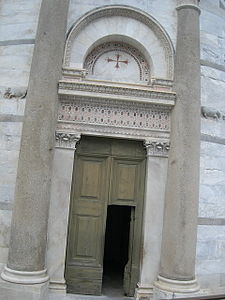
Rainaldo built the façade of grey marble and white stone with discs of colored marble. Some of the stone blocks have been taken from other sites as indicated by Roman numerals and partial Latin inscriptions which were upside down. The façade on the left also contains the tomb of architect Buscheto.

The massive bronze doors were made by Giambologna to replace those burned in a 1595 fire. Worshippers never used this façade door to enter; instead they used the Porta di San Ranieri (St. Ranieri’s Door) located in front of the Leaning Tower. A beautifully carved pulpit (1302-1310) by Giovanni Pisano, a highly intricate medieval sculpture, survived the devastating fire.
 
Galileo's incense lamp Photo: Wikipedia
There is an incense lamp hanging from the ceiling of the nave with an interesting significance. It is believed that Galileo formulated his pendulum movement theory by watching this incense lamp swing. The original lamp is preserved in Campo Santo, in the Aulla chapel.
 
Relics which were brought back from the Crusades can be found in the Cathedral such as the alleged remains of St. Abibo, St. Gamaliel, and St. Nicodemus, and a vase said to be one of the jars of Cana from the wedding when Jesus turned water into wine.

Pisa’s patron saint and the saint of travelers, St. Ranieri, is buried in this church and his preserved body is on display in a golden coffin on the altar, guarded by three men in security uniforms.

Politics intervened and the tomb of the Holy Roman Emperor Henry VII, carved in 1315 by Tino da Camaino, was moved many times over the centuries from its original location behind the main altar. The Holy Roman Empire was not holy, not an empire, and certainly not Roman. The sarcophagus is still in the Cathedral but the statues were placed in the Museum of the Opera del Duomo.

Pisa Griffin Wikipedia
One element rarely seen and out of place on a church stood out, “high on a column rising from the gable,” a modern replica of Pisa Griffin, the largest Islamic metal sculpture known. The original is located in the Cathedral Museum. Pisa Griffin is an 11th century bronze zoomorphic sculpture of a mythical beast, more than three feet tall, “probably created in the 11th century in Al-Andaluz (Islamic Spain).”

As we entered one of the wall gates, after having walked through a maze of narrow streets from the parking lot, suddenly the gleaming white Tower of Pisa (Torre Pendente di Pisa) came into view.  After one’s senses are overwhelmed by its size, the first reaction is amazement that it is still standing and how. 

The construction of the white marble 8-story campanile (bell tower) began on August 9, 1173 and it actually stood upright for over five years, however, just after the completion of the third floor in 1178, it began to lean. The foundation was “inadequate and the ground too soft on one side to properly support the structure’s weight.”  Apparently the foundation was only three meters deep and was set in weak, unstable subsoil.

Lead counterweights 1998 Photo: Wikipedia
 
It is estimated that the tower weighs 14,500 metric tons. The tilt increased over time until partially corrected in 1990-2001. This correction was done with tons of lead which were buried in the ground. During several visits, I witnessed the steel cables holding the tower and the very large lead counterweights.  Before restoration, the tower leaned 5.5 degrees but now leans 3.97 degrees, meaning that the top of the tower is “displaced horizontally 3.9 m (12 ft. 10 in) from the center” with a total height of 183 feet and 3 inches.

Assunta Bell Photo: Wikipedia
 
Nobody is really sure who designed this beautiful bell tower. Evidence pointed in the direction of Guglielmo and Bonanno Pisano because a piece of bronze cast with his name was found at the foot of the tower in 1820. Recent studies seem to point to Diotisalvi as the original architect based on the time period of construction and his other works, however, he usually signed his masterpieces and there is no signature in the bell tower.

Leaning Tower staircase Photo: Wikipedia
 
When the Allies discovered during WWII that the German troops were using the bell tower as an observation post, it is said that a U.S. Army sergeant, sent to confirm the location of German soldiers, was so impressed by the beauty of the tower that an artillery strike was not ordered to destroy such magnificence.

There is a plaque commemorating Galileo Galilei’s dropping “two cannon balls of different masses from the tower to demonstrate that their speed of descent was independent of their mass.”  According to various sources, Vincenzo Viviani, Galileo’s secretary, wrote about this experiment in Racconto istorico della vita di Galileo, book published in 1717, long after Viviani’s death.

Leaning Tower Entrance Photo: Wikipedia
 
After the metal detector wand check, as soon as we entered the tower, the leaning floor made it impossible to stand upright without great difficulty. We climbed with extreme care the narrow and slippery marble steps, uneven and worn out by the passage of time. I was out of breath and had to stop several times. As we got closer to the top, my sense of balance began to be affected by the pressure in my inner ear. I counted 296 steps to the top but experts say that the seventh floor has two fewer steps on the north-facing staircase, with a total of 294.

External Loggia of the Leaning Tower
 
“Because the Civic Tower of Pavia suddenly collapsed in 1989, the Leaning Tower was closed to the public and a serious salvage effort was underway. Bells were removed to make it lighter and cables were cinched around the third level and anchored hundreds of meters away. Apartments were vacated for safety.  Seventy metric tons of dirt were removed and replaced with lead counterweights.” Once the salvage operation ended, engineers declared the tower stable for at least 200 years.

Aerial View of Pisa from the Leaning Tower
Photo: Wikipedia
We walked around the wire balcony and took pictures of the area while buffeted by strong winds. And there were more steps to the higher level where the bells were. Once we got there, I became dizzier and was unsteady on my feet as if I was drunk. I held on to my husband for dear life and hugged the wall; even when I closed my eyes I felt that I was going to pass out and topple over the flimsy barrier. I took more pictures and we decided to climb down in the nick of time.  As we reached solid and level ground, a heavy downpour followed the light raindrops we felt while descending. As the rain came down harder and harder, it got suddenly very cold.

We were more than happy to find our car parked somewhere through the maze of Pisa streets. We drove to the nearest gas station and filled the rental BMW with middle grade Diesel for $6 a gallon. We had a quarter of a tank and it still cost 55 euros to fill it; that was $67 dollars for three-fourths of a tank of Diesel. There were higher grades of bio-Diesel but we did not bother.
I really was scared in the Leaning Tower and leaning against the wall for safety
 
We took the road to Florence, our next stop, through many turns, and many roundabouts, some useful, some nonsensical, in rush hour traffic.