Showing posts with label tunnels. Show all posts

Thursday, June 30, 2016

Next Stop on Our Italian Trip, Pisa

 
Portofino Harbor Photo: Wikipedia
We said a regretful good-bye to Rapallo, the heaven God built for a few lucky Italians who passed their homes and apartments to subsequent generations, and for those with serious money who could buy the very expensive apartments, condos and villas, upwards of millions of euros. As the last narrow street with beautiful hanging gardens disappeared from view and the blue azure of the Ligurian Sea was no longer visible, we found our well-paved and expensive traveling friend, the Autostrada.

No sooner than we could say, “we are on our way to Pisa in Tuscany,” the state of Liguria had more surprises for us in the form of endless tunnels, the longest one being almost 6 miles long. I thought that we would re-emerge on the other side in another country. By my count, and I could be wrong, given that I was slightly concerned that the GPS did not recognize this new section of the Autostrada and there were no other cars with us in the longest, quite tall and well-lit tunnel, we crossed at least 36 tunnels between Rapallo, Liguria and Pisa, Tuscany.  The constant thump-thump of lights inside the tunnel made me feel slightly dizzy as well and I had to close my eyes a few times. I was glad that my wonderful husband is such a good driver!

This tunnel reminded me of another tunnel we crossed by train into Austria or Switzerland years ago. It was so long that, by the time we emerged on the other side of the mountain, the weather changed from 72 degrees F and sunshine, to blinding snow.
 
Pisa from the Leaning Tower Photo: Ileana
We finally arrived in Pisa, a seemingly non-descript town of almost 90,000 residents called Pisani. Pisa, a former maritime republic, is well known for its famous Leaning Tower, the bell tower of the city’s cathedral, but Pisa has at least 20 more historic churches, medieval palaces, and bridges across the River Arno.   

Nobody knows how Pisa got its name but it was founded by Pelops, the king of the Pisaeans, thirteen centuries before the common era. As the only other port on the western coast besides Genoa and Ostia, Pisa became a jumping point for Roman naval expeditions against Ligurians, Gauls, and Carthaginians. Ancient Pisani are said to have invented the naval ram. Portus Pisanus became a Roman colony in 180 B.C. and a municipium in 89 B.C., fortified by Emperor Augustus.

In its long history, Pisa received supremacy over the islands of Corsica and Sardinia from Pope Urban II in 1092. Pisa took part in the First Crusade and Pisani were instrumental in taking Jerusalem in 1099. As they advanced towards the Holy Land, Pisani ships sacked some Byzantine islands. The Pisani crusaders were led by archbishop Daibert, the future patriarch of Jerusalem.
 
Pisani founded colonies in Antiochia, Acre, Jaffa, Tripoli, Tyre, Latakia, and Accone and trading posts in Levant. When compared to Venice, Pisa was a more prominent maritime republic in the 12th century. After centuries of dominance, Pisa eventually lost its role of major port in Tuscany to Livorno.

University of Pisa, which was founded in 1343, is one of the oldest universities in Italy, founded through an edict by Pope Clement VI. Lectures on law had been held in Pisa since the 11th century. The oldest European academic botanical garden, Orto Botanico di Pisa, was founded here in 1544. In 1810, Scuola Normale Superiore di Pisa was established by Napoleonic decree. Pisa is now a light industrial and railway hub. The U.S. Army has a base between Pisa and Livorno, Camp Darby.
I'm really anxious to climb this elusive Leaning Tower
 
Pisa is the birthplace of Galileo Galilei, the physicist who uttered the famous words, “Eppur si muove” (And yet it moves) when asked by the Catholic Church to recant his stance that the Earth moves around the Sun. He recanted, but, by stating his famous phrase, he was in essence saying, it does not matter what the church believed, these were the facts.

Among many famous Pisani several stand out:  tenor Andrea Bocelli, sculptor Andrea Pisano, physicists and Nobel Prize winners Enrico Fermi and Carlo Rubbia, poet and philosopher Giacomo Leopardi, physicist and inventor of the dynamo Antonio Pacinotti, and mathematician Alessio Corti.

Sixteen churches are dedicated to various saints, including the famous Baptistery with its pitch perfect resonance construction.  The oldest appears to be San Paolo a Ripa d’Arno, having been founded in 952. An 11thc century crypt is located in San Pietro in Vinculis (St. Peter in Chains). The San Frediano church, built in 1061, exhibits a crucifix from the 12th century.
St. Ranieri tomb Photo: Ileana
 
Palazzo Reale (The Royal Palace) was the Caetani family home where Galileo Galilei is said to have shown to Grand Duke of Tuscany the planets he had discovered with his telescope.

Located in the Knights’ Square, Palazzo della Carovana has a façade designed by Giorgio Vasari. The Santo Stefano dei Cavalieri church in the same square is also designed by Vasari, with a bust by Donatello and paintings by Vasari.

St. Sixtus church, consecrated in 1133, contained the most important notary deeds of the town of Pisa and hosted the Council of Elders. It is the best preserved early Romanesque constructions in town.

Carved pulpit of the Cathedral in Pisa Photo: Wikipedia
 
Other famous churches are San Nicola (1097) and San Michele in Borgo (990). The Leaning Tower of Pisa is not the only leaning tower in town. On the southern end of Via Santa Maria there is another leaning tower and then another mid-way through the Piagge promenade. The Borgo Stretto is a medieval neighborhood with strolling arcades and the Lungarno, avenues along the River Arno. The Medici Palace bought by the Medici in 1400 and the Palazzo Agostini are fascinating places to visit.

Pisa Campo Santo Photo: Wikipedia
 
If one is interested in original sculptures by Nicola Pisano, Giovanni Pisano, and treasures of the cathedral, Museo dell’Opera del Duomo is a must stop. The San Mateo National Museum displays sculptures and paintings of 12th-15th centuries with masterpieces by Giovanni and Andrea Pisano, Nino Pisano, and Masaccio.
 
Dave is really brave
 
Museo Nazionale degli Strumenti per il Calcolo exhibits collections of scientific instruments such as the pneumatic machine and the compass that allegedly belonged to Galileo Galilei. The largest cetacean skeleton collection in Europe is housed on the campus of the University of Pisa. And the Cantiere delle Navi di Pisa contains Roman ships, 3,500 archeological excavations, 1,700 labs, and one restoration center.
The Cathedral and Baptistery from the Leaning Tower Photo: Ileana
Pisa City Hall is located in Palazzo Gambacorti, a 14th century Gothic building with frescoes depicting Pisa’s victories at sea.


The Leaning Tower of Pisa Photo: Wikipedia
 
Nothing matches the majestic but leaning bell tower of the Duomo (the Cathedral) in the Piazza del Duomo, north of the old town center, better known since the 20th century as Piazza dei Miracoli (Square of Miracles).  In the same piazza there is a Baptistery where the resonance of the building rivals any opera house in the world, and Campo Santo (the Sacred Cemetery).  The entire complex is maintained since 1063 by the Opera (fabbrica ecclesiae). The medieval walls that surround the four edifices are maintained by the city.

Pisa's Cathedral façade Photo: Wikipedia
The Duomo is a Romanesque medieval masterpiece dedicated to Santa Maria Assunta (St. Mary of Assumption) whose construction started in 1064 by architect Buscheto. Byzantine style mosaics decorate the interior. It is safe to say that even the cathedral is leaning but not as much as the bell tower and it is not obvious to the naked eye, given its lesser height and larger surface.

Baptistery Photo: Wikipedia
Rainaldo built the façade of grey marble and white stone with discs of colored marble. Some of the stone blocks have been taken from other sites as indicated by Roman numerals and partial Latin inscriptions which were upside down. The façade on the left also contains the tomb of architect Buscheto.

The massive bronze doors were made by Giambologna to replace those burned in a 1595 fire. Worshippers never used this façade door to enter; instead they used the Porta di San Ranieri (St. Ranieri’s Door) located in front of the Leaning Tower. A beautifully carved pulpit (1302-1310) by Giovanni Pisano, a highly intricate medieval sculpture, survived the devastating fire.
 
Galileo's incense lamp Photo: Wikipedia
There is an incense lamp hanging from the ceiling of the nave with an interesting significance. It is believed that Galileo formulated his pendulum movement theory by watching this incense lamp swing. The original lamp is preserved in Campo Santo, in the Aulla chapel.
 
Relics which were brought back from the Crusades can be found in the Cathedral such as the alleged remains of St. Abibo, St. Gamaliel, and St. Nicodemus, and a vase said to be one of the jars of Cana from the wedding when Jesus turned water into wine.

Pisa’s patron saint and the saint of travelers, St. Ranieri, is buried in this church and his preserved body is on display in a golden coffin on the altar, guarded by three men in security uniforms.

Politics intervened and the tomb of the Holy Roman Emperor Henry VII, carved in 1315 by Tino da Camaino, was moved many times over the centuries from its original location behind the main altar. The Holy Roman Empire was not holy, not an empire, and certainly not Roman. The sarcophagus is still in the Cathedral but the statues were placed in the Museum of the Opera del Duomo.

Pisa Griffin Wikipedia
One element rarely seen and out of place on a church stood out, “high on a column rising from the gable,” a modern replica of Pisa Griffin, the largest Islamic metal sculpture known. The original is located in the Cathedral Museum. Pisa Griffin is an 11th century bronze zoomorphic sculpture of a mythical beast, more than three feet tall, “probably created in the 11th century in Al-Andaluz (Islamic Spain).”

As we entered one of the wall gates, after having walked through a maze of narrow streets from the parking lot, suddenly the gleaming white Tower of Pisa (Torre Pendente di Pisa) came into view.  After one’s senses are overwhelmed by its size, the first reaction is amazement that it is still standing and how. 

The construction of the white marble 8-story campanile (bell tower) began on August 9, 1173 and it actually stood upright for over five years, however, just after the completion of the third floor in 1178, it began to lean. The foundation was “inadequate and the ground too soft on one side to properly support the structure’s weight.”  Apparently the foundation was only three meters deep and was set in weak, unstable subsoil.

Lead counterweights 1998 Photo: Wikipedia
 
It is estimated that the tower weighs 14,500 metric tons. The tilt increased over time until partially corrected in 1990-2001. This correction was done with tons of lead which were buried in the ground. During several visits, I witnessed the steel cables holding the tower and the very large lead counterweights.  Before restoration, the tower leaned 5.5 degrees but now leans 3.97 degrees, meaning that the top of the tower is “displaced horizontally 3.9 m (12 ft. 10 in) from the center” with a total height of 183 feet and 3 inches.

Assunta Bell Photo: Wikipedia
 
Nobody is really sure who designed this beautiful bell tower. Evidence pointed in the direction of Guglielmo and Bonanno Pisano because a piece of bronze cast with his name was found at the foot of the tower in 1820. Recent studies seem to point to Diotisalvi as the original architect based on the time period of construction and his other works, however, he usually signed his masterpieces and there is no signature in the bell tower.

Leaning Tower staircase Photo: Wikipedia
 
When the Allies discovered during WWII that the German troops were using the bell tower as an observation post, it is said that a U.S. Army sergeant, sent to confirm the location of German soldiers, was so impressed by the beauty of the tower that an artillery strike was not ordered to destroy such magnificence.

There is a plaque commemorating Galileo Galilei’s dropping “two cannon balls of different masses from the tower to demonstrate that their speed of descent was independent of their mass.”  According to various sources, Vincenzo Viviani, Galileo’s secretary, wrote about this experiment in Racconto istorico della vita di Galileo, book published in 1717, long after Viviani’s death.
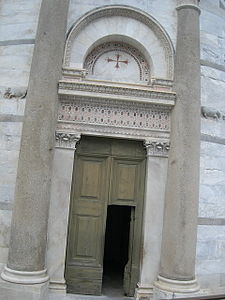
Leaning Tower Entrance Photo: Wikipedia
 
After the metal detector wand check, as soon as we entered the tower, the leaning floor made it impossible to stand upright without great difficulty. We climbed with extreme care the narrow and slippery marble steps, uneven and worn out by the passage of time. I was out of breath and had to stop several times. As we got closer to the top, my sense of balance began to be affected by the pressure in my inner ear. I counted 296 steps to the top but experts say that the seventh floor has two fewer steps on the north-facing staircase, with a total of 294.

External Loggia of the Leaning Tower
 
“Because the Civic Tower of Pavia suddenly collapsed in 1989, the Leaning Tower was closed to the public and a serious salvage effort was underway. Bells were removed to make it lighter and cables were cinched around the third level and anchored hundreds of meters away. Apartments were vacated for safety.  Seventy metric tons of dirt were removed and replaced with lead counterweights.” Once the salvage operation ended, engineers declared the tower stable for at least 200 years.

Aerial View of Pisa from the Leaning Tower
Photo: Wikipedia
We walked around the wire balcony and took pictures of the area while buffeted by strong winds. And there were more steps to the higher level where the bells were. Once we got there, I became dizzier and was unsteady on my feet as if I was drunk. I held on to my husband for dear life and hugged the wall; even when I closed my eyes I felt that I was going to pass out and topple over the flimsy barrier. I took more pictures and we decided to climb down in the nick of time.  As we reached solid and level ground, a heavy downpour followed the light raindrops we felt while descending. As the rain came down harder and harder, it got suddenly very cold.

We were more than happy to find our car parked somewhere through the maze of Pisa streets. We drove to the nearest gas station and filled the rental BMW with middle grade Diesel for $6 a gallon. We had a quarter of a tank and it still cost 55 euros to fill it; that was $67 dollars for three-fourths of a tank of Diesel. There were higher grades of bio-Diesel but we did not bother.
I really was scared in the Leaning Tower and leaning against the wall for safety
 
We took the road to Florence, our next stop, through many turns, and many roundabouts, some useful, some nonsensical, in rush hour traffic.

Sunday, June 26, 2016

Liguria, Rapallo, and Portofino Bay

Rapallo Castle Wikipedia photo
I was not too terribly sad to leave Turin after a good breakfast in the artsy Holiday Inn restaurant. I was excited to begin our journey to Portofino Bay, Liguria. I was not prepared for the ride, entering and emerging briefly out of endless tunnels which I failed to count accurately.

The narrow strip of land called Liguria is bordered by the sea, the Alps, and the Apennine mountains. It is home to one national reserve, six large parks, two smaller parks, and three nature reserves.  It is comprised of 65 percent mountains and 35 percent hills, extending to the highest summit of 2,201 m called Monte Saccarello.

There are very small beaches but no deep bays and natural harbors except for Genoa. The water plunges deeply along the 350-km coastline. The hills and the sea provide a mild climate with abundant rainfall.

What fascinated me was the fact that Neanderthals lived in the area and were discovered in Loano. Evidence of Cro Magnon habitation was found in the grotto of Balzi Rossi. My husband joked that he felt right at home surrounded by the land of his ancestors, the Neanderthals.

Ancient Ligurians once occupied larger territories as evidenced in the Greek colony of Massalia, the modern day Marseille. During Augustus’ reign, Liguria was a region of Italy (Regio IX Liguria). The Roman ruins of Albenga, Ventimiglia, and Luni prove that Roman roads such as Aurelia and Julia Augusta helped Liguria develop towns on the coast.

Boticelli's The Birth of Venus Wikipedia photo
One Ligurian, Simonetta Vespucci, is said to have been the beautiful model for Botticelli’s famous painting, The Birth of Venus, a masterpiece located in the Uffizi Gallery in Florence.

Ships from Genoa ferried for hire knights and troops to the Middle East during the first crusade against the invading Muslims. One of the most famous citizens of Genoa is Christopher Columbus, who, on his quest to reach the East Indies for spice trade, managed to sail west and landed in 1492 in the Bahamas archipelago.

The ride from Piedmont to Liguria was one of the most interesting I’ve experienced and not for the faint of heart. From the Piedmont line into the state of Liguria, we passed through one tunnel after another, the shortest one, 150 meters long, to the longest, over two miles. I stopped counting them at thirty; there were way too many and my husband was driving fast. I was distracted by the gorgeous landscapes that emerged in-between the tunnels.
Some of the tunnels in Genoa were simply steel and plastic over sloped terrain; I could not understand their function; perhaps it prevented small rock slides onto the road. The rest were actually carved into the mountain.  One tunnel would end and, for fifty feet or more, light would blind us momentarily with a brief sight of metallic green olive groves, dizzying drops to the azure sea, and then another tunnel would start. Before these tunnels were carved, we wondered how people traveled across this treacherous and seemingly inaccessible terrain to the Italian Riviera which hugs the Ligurian Sea.
Eventually Rapallo, our destination for the day, came into view. Its first settlement dates back to 8th century B.C. The streets were so narrow in some places, it was almost claustrophobic because the buildings seemed disproportionately tall when compared to the narrow streets and sidewalks. Yet there was enough room to drive small cars and to even park or conduct business.

Cinque Terre, Liguria
Wikipedia photo
Many beautiful villas are built in the hills behind the city, offering them protection from the strong northern winds. The town itself has only a 10 ft. elevation from the sea.

As we made our way up the hill on the winding road, we reached our destination, the five-star Excelsior Palace Hotel, one of the top fifty best hotels in the world, perched on the hill overlooking both Portofino Bay and Rapallo Bay.

We settled in after the porter brought our luggage up to the room. The balcony opened to a spectacular view of the Portofino Bay, the infinity pools, the gym, the large indoor pool, and the lower gardens. The hotel stretched over four levels down the mountain through mysterious passageways, gardens, walkways, and stairways with beautiful potted plants and shrubs. Ornate turn of the century antique furniture in brocaded yellows, burgundy, and blue, and a large museum-quality collection of paintings were inviting and comfortable. Marbled floors and amenities that anybody can possibly want, completed the dreamy atmosphere. Dating back to 1901, the hotel hosted many famous people.

Domingo Ghirardelli, founder of the Ghirardelli Chocolate Company, was born in Rapallo in 1817 and died there during a visit in 1894. Ezra Pound, the famous poet, lived in Rapallo between 1924 and 1945 and wrote most of his Cantos there. Max Beerbohm, famous essayist and caricaturist, lived in Rapallo from 1910 until his death in 1956. Friedrich Nietzsche is said to have created the mental idea of Thus Spoke Zarathustra while walking on two roads surrounding Rapallo. Rapallo was even the setting of a crime novel, Elmore Leonard’s Pronto.

 
I could feel with intensity how the mild climate and the beautiful vistas were conducive to creative writing, painting, and music.

 
The luxurious vegetation and majestic palm trees shaded the spiral driveway and the stairs leading down the mountain to the Rapallo Marina, the beach, the castle ruins, and the boulevard facing the sea. Splendid yachts were docked in the Bay of Rapallo. Every morning charter boats took tourists on a day-tour of Cinque Terre.

House in Rapallo Photo: Ileana 2016
The bright sun warmed the pink, the white, and the ochre-painted villas, architectural jewels that only an artist with an eye for flair and beauty could create, the lush-green vegetation, and the white marble statues. It was a symphony of color unmatched by the previous slate grey and dark burgundy of castles and churches in areas where fog and rain dominated. We explored the beautiful surroundings and the breathtaking vistas.


We walked to the port down the rocky stairwell and to the Centro of Rapallo instead of taking the car down the winding road and to a possible parking headache. Locals were busy docking boats and yachts. A few girls were sunning themselves on the yellow sand and uncomfortable-looking rocky beach by the old Castello. Parallel to the sea promenade, a few streets behind the Castello was the train station dating back to 1868 and the pedestrian area downtown, with narrow streets reminiscent of Venice. All the gelaterias and pizzerias were clustered in the front of the Bay of Rapallo by the boulevard al Mare. Nettuno Ristorante offered us delicious pizza and pasta with a view.

 
To counter frequent pirate attacks, the Castello sul Mare (Castle-on-the-Sea) was built in 1551. It contains a small chapel built in 1688 and dedicated to St. Cajetan, a priest and religious reformer born in Vicenza, Italy.

Another famous castle, Castello di Punta Pagana, the seat of the Sovereign Military Order of Malta, was completed in 1631. The order of Malta, established in 1099, has 13,500 Knights, Dames, and auxiliary members, and employs doctors, nurses, and paramedics in 120 countries, providing medical care to lepers, natural disaster victims, children, homeless, handicapped, refugees, elders, and terminally ill.

Basilica of Saints Gervasius and Protasius, which was consecrated in 1118 and restored in the 17th century, had a leaning bell tower. We prayed and lit a few candles there in memory of my father, who died several months after the communists beat him severely.

Other historical points of interest included the Tower of the Fieschi, Torre Civica (1473), and Porta delle Saline, the remaining gate from the Roman fortification walls.

We slept like babies in the luxurious bed, with the balcony door open, the sound of the crashing waves and the occasional sea gull lulling us to sleep.

The hills of Rapallo Photo: Ileana 2016
 
After a wonderful breakfast fit for a king, we descended the steep hills, via cobbled roads with hairpin turns and stairs cut into the rock, to the port and to downtown. I was on a quest to take more pictures for my book and to visit more churches. We stopped at Porto Napoleone, a tiny costume jewelry shop with beautiful designs created locally. My 20 year-old earrings had broken that morning (how convenient, said my husband) and I had to replace them for the duration of the trip. The proprietor, Gabriella, was happy to see us, she liked talking to me in Italian and, we were, for the time being, the only American tourists in the tiny city of 30,700.

Shopping in Rapallo
After returning to the hotel, we mapped our next two stops in Pisa and Florence. My husband attempted to purchase tickets for the Leaning Tower of Pisa on line. Like everything else in Italy, technology works intermittently and people take long hours for lunch. Everything takes time to happen unless they are extracting money from credit cards – that happens with the speed of lightning. Italians give a new meaning to the phrase, “Hurry slowly.” But then everything they do create, lasts a long time, and it is always a work of art.

A luxurious spa massage later and a dip in three different pools made the 82 degrees F water feel divine. The infinity pool was 9 ft. deep around the edges, with a spectacular view of the Bay of Portofino. Supper was at Vesuvio, by far the best meal we’ve had in Italy on this trip. The lights were enchanting, casting sparkles on the dark water.

We climbed back to the hotel, careful to avoid the fast driving Italians who could appear out of nowhere. The many lounge areas in the hotel welcomed us back with comfortable chairs and couches; the antique furnishings were bathed in a glowing light, and the music was soothing. We sat on the balcony listening to the sounds of the bay and watching the lights on the few yachts anchored far out in the bay.

We were falling asleep in the comfortable balcony lounge chairs, no mosquitoes to worry about. The full moon cast a white glow on all surroundings.


Sunday, August 17, 2014

How Many Gaza Homes for a Tunnel?


Photo: Israeli Defense Forces
Rational and objective human beings ask themselves many questions, research non-revisionist history, interview survivors of wars, or search authentic and official documents before they form an opinion or take sides. Liberal progressives seem to view the world, knowledge, and revisionist history through the tinted glasses of government doctrine promoted by the main stream media. 

Denis MacEoin calls the western pro-Hamas supporters the new Romantics. They chanted by the thousands in London recently in support of this terrorist organization, in support of the “myth of Islam as the path to peace.” http://israelseen.com/2014/08/16/denis-maceoin-the-new-romantics-being-fair-to-terrorist-groups/

Thousands of deranged individuals harboring anti-Semitic hatred were demonstrating against Israel and chanting, “Hamas, Hamas, Jews to the Gas.” What history have they studied in school?

People have forgotten or deny what happened to 6 million Jews, gypsies, homosexuals, the handicapped, the not-so-perfect humans who were dehumanized, maligned, cartooned, mistreated, tortured, gassed, burned, and buried in mass graves while the world witnessed the atrocities from afar, turning a blind eye. The music got louder in homes and churches to drown out the wailing from the passing cattle trains filled to capacity with suffering humans.

The Office of the Historian at the U.S. Department of State describes the establishment of the State of Israel on May 14, 1948, recognized by President Harry S. Truman on the same day.

“Although the United States supported the Balfour Declaration of 1917, which favored the establishment of a Jewish national home in Palestine, President Franklin D. Roosevelt had assured the Arabs in 1945 that the United States would not intervene without consulting both the Jews and the Arabs in that region. The British, who held a colonial mandate for Palestine until May 1948, opposed both the creation of a Jewish state and an Arab state in Palestine as well as unlimited immigration of Jewish refugees to the region.” https://history.state.gov/milestones/1945-1952/creation-israel

What was Palestine exactly? Was it ever a country? Why would the Jews claim the land of Israel as their own? Was it because God promised them the land to Abraham? Was it because the Jewish people settled and developed the land? Was it because the land was captured in defensive wars? Was it because political sovereignty was granted by international decision to the Jewish people in Palestine? How many lands and territories have been redrawn, granted, and resettled around the world as the result of war, conquest, and reparations?

The Twelve Tribes of Israel founded the first constitutional monarchy in Palestine around 1000 B.C. King David made Jerusalem the nation’s capital. Jewish independence lasted 212 years then it was split into two separate kingdoms.

Linguistically, “Palestine” is thought to have derived from Philistines, an Aegean people who settled around the Mediterranean coast in the area known today as Israel and the Gaza strip. The Arabic word “Filastin” is believed to have derived from the Latin name. The Romans applied the name “Palaestina” to Judea, the southern portion of today’s West Bank, in the second century after crushing the last Jewish revolt in an “attempt to minimize the Jewish identification with the land of Israel.”

The Jewish people did not just disappear in the year 70 A.D. after the destruction of the Second Temple and reappeared in the 20th century demanding their lands back. They have kept strong connections to their homeland for 3,700 years, a national language, and a distinct civilization. Jewish life and presence continued and flourished even after the destruction of the temple in the form of communities in Jerusalem and Tiberias through the 9th century and in the 11th century in Rafah, Gaza, Ashkelon, Jaffa, and Caesarea.

For centuries, in spite of the fact that Jewish people were forced off their lands or massacred, rabbis and Jewish pilgrims immigrated to Jerusalem and the Galilee and established communities in Safed and Jerusalem for hundreds of years. By 19th century more than 10,000 Jews lived throughout what is considered Israel of today.

“When Jews began to immigrate to Palestine in large numbers in 1882, fewer than 250,000 Arabs lived there, and the majority of them had arrived in recent decades. Palestine was never an exclusively Arab country, although Arabic gradually became the language of most the population after the Muslim invasions of the seventh century. No independent Arab or Palestinian state ever existed in Palestine. When the distinguished Arab-American historian, Princeton University Prof. Philip Hitti, testified against partition before the Anglo-American Committee in 1946, he said: "There is no such thing as 'Palestine' in history, absolutely not." In fact, Palestine is never explicitly mentioned in the Koran, rather it is called "the holy land" (al-Arad al-Muqaddash).”
http://www.jewishvirtuallibrary.org/jsource/History/The_Jewish_Claim_To_The_Land_Of_Israel.html

Palestinian Arabs did not view themselves as a separate identity. The first Congress of Muslim-Christian Association which met in February 1919 to elect a Palestinian representative for the Paris Peace Conference adopted this resolution:
“We consider Palestine as part of Arab Syria, as it has never been separated from it at any time. We are connected with it by national, religious, linguistic, natural, economic and geographical bonds.”

Auni Bey Abdul-Hadi, a local Arab leader told the Peel Commission in 1937, which suggested the partition of Palestine: "There is no such country [as Palestine]! 'Palestine' is a term the Zionists invented! There is no Palestine in the Bible. Our country was for century’s part of Syria." https://www.jewishvirtuallibrary.org/jsource/History/peel.html
Who were the Zionists and what is Zionism? It is a nationalist movement that promoted the formation of a Jewish homeland. Theodor Herzl is believed to be the founder of the Zionist movement in his 1896 book, Der Judenstaat in which he envisioned the formation of a Jewish state. The common denominator of Zionists is thought to be the claim to Eretz Israel as the national homeland of the Jewish people.

Zionists defend their national liberation movement for the repatriation of a dispersed socio-religious group. Its members have been forcibly converted, exiled, oppressed, forced into generations of Diaspora, and invaded and occupied by the Ottoman Empire in Judea and Samaria.
Anti-Zionists criticize Zionism as a “colonialist and racist ideology” that caused the denial of rights and expulsion of the “indigenous population of Palestine.”

There are many myths circulating among anti-Semites who cover their hatred with the phrase, “We respect Judaism but are against Zionism.” One such myth is that “Israel discriminates against its Arab citizens.” That is hardly the case when, in a population of 6.7 million, 1.1 million are Muslims, 130,000 are Christians, and 100,000 are Druze. Arab women can vote and Arabs hold 14 seats in the Knesset, the unicameral lawmaking body in Israel. http://www.americanthinker.com/2012/02/there_was_never_a_country_called_palestine.html

There is the myth that “Jews are building settlements on Palestinian land.” There is no Palestinian land, and the statement, “Palestine, the country, goes back through most of recorded  history” is convenient propaganda. Yashiko Sagamori asked very pertinent questions to elucidate the mystery of this non-existent country, and I added a few of my own:

-          When and by whom was Palestine founded as a country?

-          What were its borders, capital, official language, and major cities?

-          What were its economy, major industries, and GDP?

-          What was its form of government and leaders prior to Arafat and his PLO?

-          What was the name of its currency and exchange rate against other currencies?

-          With whom did it engage in international trade?

-          What were its famous places, museums, universities, operas?

-          Who were its famous scholars and inventors, painters, sculptors, musicians, architects, engineers?

-          Since Palestine no longer exists, presumably because of the Jews, what caused its demise and when exactly did it occur?
If you look at a map of Israel, it is a tiny nation surrounded by vast Arab lands, Saudi Arabia, Yemen, Jordan, Iraq, Syria, Turkey, Afghanistan, Egypt, Libya, etc. Sagamori wonders “if the people you mistakenly call ‘Palestinians’ are anything but generic Arabs collected from all over—or thrown out of –the Arab world, if they really have a genuine ethnic identity that gives them right for self-determination, why did they never try to become independent until Arabs suffered their devastating defeat in the Six Day War?”

Jerrold L. Sobel eloquently destroys the myth that “The Palestinian Authority protects Jewish holy sites.” “Forget about protecting these sites – in textbooks, speech, and daily life, the Palestinians and their supporters absurdly deny any Jewish connection at all to these ancient landmarks.” (Jerrold L. Sobel, There Was Never a Country Called Palestine, February 12, 2012)
While the western world is donating billions each year to help build a prosperous society on the Gaza strip, develop an economy, and elevate citizens from poverty, Hamas has been busy over the last four years building very expensive and intricate tunnels, an underground city in which bizarre weddings take place side by side with military operations aimed at ultimately destroying Israel and wiping it off the face of the earth.

Israel Defense Forces (IDF) found 30 such tunnels. Their construction was estimated at $3 million each. Hamas could have invested in the people of Gaza. For each tunnel, it could have built 86 homes, 7 mosques, 6 schools, and 19 medical clinics. Instead it invested in terrorism.
http://www.idfblog.com/blog/2014/07/26/price-hamas-underground-terror-network/