Sunday, October 2, 2016

Venice, Lido Island, and Padova

Fondamente Nuove street
Photo: Ileana Johnson 2016
We lost our way through narrow and dark streets, barely big enough for a tall person to walk through. The streets were old, decayed with time, yet sturdy and lasting. I was worried that someone would decide to throw their bath water out the window into the narrow alleys. It was possible, given the patina and stench we encountered from time to time. Generally, Italians are very clean with their surroundings, fastidiously sweeping the street in front of their homes and shops, but the arrivals from third world countries are not so kind to their environment.

One of the narrow passageways in Venice
Photo: Ileana Johnson 2016

We finally reached Rialto and had our slice of pizza at the foot of the bridge while people and boat watching, sitting on the cold steps. Dave bought an oil painting for 20 euros, a good size to pack in the suitcase, the same painting we could have bought further away for 15 euros. The painter said, it will rain tomorrow and he will not get customers at all, as he cannot display his canvasses in the rain. We bought one from him as well.

One of the Venetian churches, Chiesa di San Vidal, was advertising on the door a free lecture by Fausto Bertinotti, pushing the Pope's global warming platform with his encyclical, Laudato Si.

Poster on Church of San Vidal's door
Photo: Ileana Johnson 2016
 
Shop window
Photo: Ileana Johnson 2016
 
Narrow walkway to a church
Photo: Ileana Johnson 2016
 
My favorite jewelry store in Rialto
Photo: Ileana Johnson 2016
 
One of two oil paintings we bought in Venice
Photo: Ileana Johnson 2016
 
We went back to my favorite jewel shop and found two pairs of cuff links for Dave. A gorgeous turquoise ring in 18k gold was calling my name. I don’t know why the color of turquoise makes me happy, unlike any other stone, including diamonds. We walked alongside the Grand Canal, watching a portly sea gull come very close to us, begging for food, a German couple eating stuff out of a vending machine, probably traveling on a budget or just plain stingy.

Lido Island and hotel Panorama on the right
Photo: Ileana Johnson 2016
 
Lido Island on a sunny day
Photo credit: Wikipedia Commons
 
Water lines on buildings in Venice
Photo: Ileana Johnson 2016
 
Gondolas were floating by; the dusk is a lovely and romantic time to take a ride in the black, seemingly flimsy but very sturdy boats. To my surprise, three Muslim women I saw earlier dining alone on the left bank in an outdoor restaurant we happened to walk by, their colorful burkas were hard to miss, boarded a gondola for a ride. There was no Muslim male in sight to accompany them.

Very narrow canal near Ponte Rialto
Photo: Ileana Johnson 2016
 
Grand Canal near water bus stop
Photo: Ileana Johnson 2016
 
The famous Ponte dei Sospiri
Photo: Ileana Johnson 2016
 
We took the water bus the long way back to our hotel on Lido Island, a total of 13 stops. It was a marvelous opportunity to see more palazzos on the Grand Canal and take more pictures. We made it by 8 p.m., dropped off the paintings, and headed for the last cozy dinner at Gran Viale. The table for two was outside, but it was covered by plastic, a typical way to keep the cold Mediterranean night winds at bay. My favorite dish was the appetizer comprised of polenta mixed with pureed fish – it was divine, tiny, and expensive, 16 euros.

One last image on the Grand Canal on the way back to Lido
Photo: Ileana Johnson 2016
 
We woke up on Lido Island the following morning to the sound of rain drumming on the tiled roof and to foggy air, just like the street painter had told us. We had our leisurely breakfast in a comfortable but tiny solarium overlooking the lagoon. The Panorama Hotel had its pluses but I still thought it was three stars, pretending to be four. We were too exhausted every night to care about the number of stars as long as the bed was comfortable, with clean and pressed sheets.

Lido Island of Venice is a 7-mile long sandbar which is home to 20,000 residents. It is where the Venice Film Festival takes place every September in the northern part of the island.  There is a public airport, Venezia Lido, on the north east end of the island that brings in wealthy foreigners who own small planes that can land on the 1,000 mile grass runaway.

There are three settlements: the Lido in the north where the film festival takes place and the Venice Casino and the Grand Hotel Excelsior are located; the center part called Malamocco is where the Doge of Venice used to have a home; the southern end is called Alberoni and has a golf course. Rich people must have their golf no matter where they are. Buses run alongside the island on Main Street.

On the Adriatic side of Lido there are sandy beaches belonging to various hotels and they are private. There are large public beaches too on the northern and the southern ends of the island. The famous Excelsior and the Des Bains hotels are located here. Thomas Mann’s classic novel, Death in Venice, took place here. The water is clean save for the occasional jelly fish that disturb the swimmers. The water is still pretty cold in April-May.

The clock tower from the lagoon
Photo: Ileana Johnson 2016
 
But the heart of the island is Gran Viale Santa Maria Elisabetta, a wide street 700 m long that runs from the lagoon and vaporetto stop on one side across to the sea on the other. There are many hotels, small shops, a modern grocery store, the first I have seen in Venice, and touristy restaurants that also cater to locals in a much more caring and special way as I observed on many occasions.

We packed our suitcases again and lined up the car at 11 a.m. for our 11:40 ferry ride back to terra firma. The ferry pass for the car was 21 euros but our passes were still valid until 8:30 p.m. The ferry ride was quite different from four nights ago. I took some spectacular photos of San Marco square, the Campanile, the Bridge of Sighs, and other Venetian landmarks.

We saw Lido Island and our Panorama hotel one last time before we crossed the bridge to the main highway heading west. It made leaving Venice a lot easier as the lagoon was encased into a foggy mist and it was cold and damp.

Last view of the Port of Venice
Photo: Ileana Johnson 2016
 
Dave drove west in the pouring rain for 49 km. We took the exit to Padova after we stopped at an Autogrill to refuel. Padova was, in many ways, a decision we quickly regretted. The city appeared very much industrial and modern, peppered with several old churches, villas, and the oldest square in Italy.

Almost too dark for photos in the rainy Venice
Photo: Ileana Johnson 2016
A young motorcyclist who drove fast like a maniac wiped out in the driving rain, his motorcycle skidded sideways and he laid it down scraping the ground in a sickening metal screech. He was unhurt, thank God. We decided right away that we did not want to stay very long in Padova. Our decision was confirmed by the extended wait at a rail road crossing where three freight trains were struggling to chug along.

Padova’s most important claim to fame is the University of Padova, founded in 1222, where Galileo Galilei was a lecturer. The dense arcaded streets opening into “piazze” and the bridges crossing various branches of the river Bacchiglione made the city picturesque in sunny weather, but it is hard to appreciate beauty in driving rain. Bacchiglione River used to circle the ancient walls like a moat.

The Euganaean hills in the south west were praised by poets like Lucan, Martial, Petrarch, and Shelley. Even Shakespeare’s The Taming of the Shrew is set in Padova.

Historians date the founding of the city by the Trojan prince Antenor around 1183 B.C. Padovani believe that their city is the oldest in northern Italy.  In 1274 bones were found in a large excavated ancient sarcophagus and officials declared them to be the bones of Antenor. The scholar Lovato dei Lovati wrote:

“This sepulcher excavated from marble contains the body of the noble Antenor who left his country, guided the Eneti and Trojans, banished the Euganeans and founded Padua.”

More recent tests reveal the date of the tomb to be 4th-3rd centuries B.C. Other archeological finds confirm the date of the town’s founding to be 11th-10th centuries B.C.

Saint Prosdocimus, the first Bishop of the city, introduced Christianity to Padova and to the region of Veneto. His deacon, Daniel, a Jewish convert, was another patron saint of the city.

Padova has been ruled by the Venetian Republic, by Austrians, and finally by Italians. During WWI Padova was central command for the Italian army and the king and the commander in chief lived here for the duration of the war.

During WWII, Padova was bombed repeatedly by Allied planes. The worst hits were the railway station and the Church of the Eremitani that was decorated with priceless frescoes by Andrea Mantegna. The destruction of this church is considered to be “Italy’s biggest wartime cultural loss.”

There is a Commonwealth War Cemetery in the western part of the city that commemorates the sacrifice of the troops. Since its liberation on April 28, 1945 by the British Eighth Army, Padova grew and became a successful part of one of the richest regions of modern Italy, Veneto.

There are more than twelve churches, dating from 10th-16th centuries, and seven villas of renown in Padova. The Scrovegni Chapel is the most interesting, with frescoes completed in 1305 by Giotto, frescoes detailing the life of the Virgin Mary and commissioned by a banker, Enrico degli Scrovegni. It stands on a former Roman arena, hence its nickname, “Arena Chapel.” Entering the sanctuary means spending 15 minutes in an air lock in order to control climate inside the church and preserve the frescoes.

Basilica di Sant’Antonio da Padova contains the bones of the saint in a chapel carved in marble by many sculptors and architects, including Sansovino. There is a Donatello equestrian statue of the Venetian general Gattamelata in front of the basilica.

Prato della Valle
Photo: Wikipedia Commons
 
The most famous landmark of Padova is Prato della Valle, an elliptical piazza of 90,000 square meters with a center garden surrounded by 78 statues of famous citizens of Padova.

The Abbey of Santa Giustina houses the tombs of many saints, Justine, Prosdocimus, Maximus, Urius, Felicita, Julianus, and relics of the Apostle St. Matthias and the Evangelist St. Luke.

Café Pedrocchi
Photo credit: Wikipedia Commons
The city’s downtown is encircled by 7-mile long city walls built in the 16th century. What is left are the ruins and two gates. Coffee lovers can indulge their tastes in Café Pedrocchi, built in 1831, and still fashionable today with a flare from faraway lands.

French novelist Stendhal and Lord Byron were some of the more famous patrons of this coffee shop located near the University, town hall, markets, and the post office.

In the heavy rain, we set out to drive to Verona, our beloved city where Dave and I spent a lot of time years ago.

TO BE CONTINUED


Thursday, September 29, 2016

Mocking Reality as Conspiracy Theory

Photo credit: Wikipedia
The globalists are steam rolling their way to a November victory at all costs. Nobody is standing in their way. As the brilliant late comedian George Carlin said, the real owners of this country will not let us make any important decisions. He told his audience that politicians are elected to give us a false sense that we have a choice but in reality we don’t because, he told us, “they own you.”  http://www.bing.com/videos/search?q=George+Carlin+standup+comedy+on+who+own+the+country&view=detail&mid=0C1DCE650D64467241CD0C1DCE650D64467241CD&FORM=VIRE

“They own all the important land; they own and control the corporations, they control the Senate, the House, the city hall; they have the judges in their pockets; they own the media companies so they control just about all of the news and information you get to hear; they got you by the balls, they spend billions of dollars every year lobbying to get what they want; we know what they want, they want more for themselves and less for everybody else.”

They don’t want a population that can think, that can engage in critical thinking, that is well-informed, well-educated.  They want people who don’t have logical conversations at the kitchen table, who might understand how the system left them behind decades ago.

“They want obedient workers, people who are just smart enough to run the machines and do the paperwork and just dumb enough to passively accept all these increasingly shittier jobs with lower pay, longer hours, reduced benefits, the end of overtime, and the vanishing pensions that disappear the moment you go to collect it.”

Isn’t the level of ignorance and misinformation painful to see and hear in all “man on the street” interviews? Aren’t these interviewed Americans so dumb, it makes one wince and wonder how could they’ve been so brainwashed since the invention of the Department of Education?

It’s a big club, George Carlin said, “and you ain’t in it.” You are just the hapless low information voters who support  the very bloated government machine that rules over you and is “stealing your social security money” to give it to their cronies and to illegal aliens who are brought here to vote Democrat.

“They tell you what to believe all day long, what to think, what to buy.  The table is tilted, folks, the game is rigged. And nobody seems to notice and nobody seems to care. Good, honest, hard-working people, blue collar, white collar, it does not matter what color shirt you have on. Hard-working people continue to elect these rich [expletive], who don’t give a flip [expletive] about them.”

It is sold as the American Dream, but, Carlin said, “You have to be asleep to believe it.” This American Dream has turned into the globalists’ dream for you and the Illegals’ welfare dream leading to the destruction of a formerly great country that is turning into the hell hole they came from.

“The owners count on Americans remaining willfully ignorant because the owners of this country know the truth,” Carlin said. No matter how they spin the truth, it is globalism that only benefits their crony capitalist friends who are adept at pretending to vilify the rich who “do not pay their fair share” while taking the “greedy rich” money to run corrupt political campaigns to continue to keep the poor on the poverty and dependency plantation of globalism.

The level of disinformation in the media and in Hollywood has reached an unparalleled crescendo. Back in 1981, Hollywood produced an episode of Barney Miller in which globalism and discussions about it were derided as a conspiracy theory.

Barney Miller was a “sensible” cop. He maintained order over his gambling detectives who chased women, went to “renaissance philosophy conventions for fun,” were aspiring writers, and never seemed to leave the squad room. The show ran from 1975-1982.

The perpetrator in this 1981 episode, William Kline, was arrested for breaking and entering into the offices of the Trilateral Commission because he “wanted them to admit to what they were doing.” Barney Miller is told by one of his detectives that the Trilateral Commission is an organization founded by David Rockefeller in 1973 to bring together the global interests for “better economic cooperation.”  

But the perpetrator is adamant that “it is just a scheme to bring their own loyal members in positions of power in this country, to work to erase national boundaries, to create an international community, and, in time, to bring about a one world government, with David Rockefeller calling the shots.”

The canned laughter makes an even bigger idiot out of Kline who apparently destroyed a globe and some UNICEF artwork. “They are on it too,” he claims. Kline, the accidental “criminal,” tells Barney Miller with a lot of passion and conviction that “our whole way of life as we know it, is in jeopardy.”

Barney Miller is not persuaded and mocks Kline as a lunatic in dire need of meds. Even though Barney Miller is not interested in hearing anything else about the Trilateral Commission, Kline cites names of those he believes are members of this organization:  James Earl Carter, Henry Kissinger, Walter Mondale, John Anderson, and George Bush. “No matter who won in November, they had their man in the White House,” Kline said. http://www.bing.com/videos/search?q=Barney+Miller+episode+about+Trilateral+Commission+1981&view=detail&mid=B5D0716AFBA8951B2E67B5D0716AFBA8951B2E67&FORM=VIRE

It’s not that the producers were trying to warn us of the coming globalism which is now fully implemented; it was a not-so-subtle “psychological control of the masses,” said Livia B., and “it looks like it worked. It made those who chattered about the Trilateral Commission seem crazy. The potheads of the time ate up everything on primetime television.”


The Islands of Burano, Murano, and San Michele

Doge's Palace, the view from our window in the morning
Photo: Ileana Johnson 2016
We woke up early, determined to get an early start for more island hopping and to avoid the four noisy Brits bashing America. We were not successful on the last part, but we did board the vaporetto by nine a.m., bound for the famous fisherman village called Burano, 4 miles from Venice, where houses were so colorful, it seemed that there was a quick sale at their local paint shop on bright hues of purple, green, pink, blue, yellow, and orange. When I asked, a local told me that they did it to attract attention from the sea in the often foggy surroundings. The ride took about 45 minutes on a beautiful clear and sunny morning. It was exhilarating to stand on the deck and enjoy the wind blowing salty mist into our faces. I felt like a child again, holding a much desired toy in my arms. I breathed in the air, the sights and sounds surrounding the boat, painting the indescribable greenish-blue waters of the lagoon and the island into my mind.

The picture of the Venetian lagoon off the water bus
Photo: Ileana Johnson 2016
Mazzorbo is an island in the northern Venetian lagoon with orchards and vineyards. Linked to Mazzorbo by a bridge, the island of Burano boasts a population of 2,800 inhabitants, an astonishing population density of 13,000 per square kilometer, more than twenty times the density of Mazzorbo. It has few green areas and is almost entirely covered by homes, tiny shops of hand-made lace linens, tapestry, silk scarves, souvenirs, a few restaurants, and canals with fishing boats tethered to the canal banks.

 
Burano cat
Photo: Ileana Johnson 2016
 
A pampered kitty was curled up in a colorful plastic tub placed on the window sill of a tiny green home with white lace curtains. The cat was photographed by the occasional tourist wondering on the narrow streets. Clothes lines were peeking from alleys less traveled by tourists.

Deserted Burano early in the morning
Photo: Ileana Johnson 2016
 
The locals went about the business of life, hanging out their dirty linen for the world to see, oblivious to the tourists from distant lands, who came by many means of transportation, to visit their famous island.

A deserted street in Burano
Photo: Ileana Johnson 2016
 
If locals wish to paint their home, they must submit a request to the government; it sounded so much like our local HOAs; the government then responds by telling the homeowner what colors are allowed for that residence, based on a long-ago established color scheme. I am certainly not an artist and thus I cannot see the painting scheme, but to me, the carefully watched by design scheme looked like a giant had decided to throw up a color pallet over the entire island.

Cloudy day in Burano
Photo: Ileana Johnson 2016
 
Initially settled by the Romans, Burano was occupied by the 6th century by people from Altino who either named it after the Burina family or after the first settlers who came from the island of Buranello, 5 miles to the south.

The tourist area in the middle of Burano
Photo: Ileana Johnson 2016
 
Altinum (Altino) was an old town in Veneto, 15 km south east of the modern day Treviso. Destroyed by Atilla in 452, Altinum was abandoned and the inhabitants moved to the islands of the lagoon to seek protection from terrestrial invaders. Altino today is said to have 100 inhabitants.

On a sunny day, the colors of Burano really pop
Photo credit: Wikipedia
 
Leaning Tower of Burano in the morning haze
Photo: Ileana Johnson 2016
 
Burano vaporetto dock with sea gull
Photo: Ileana Johnson 2016
 
Undergarments drying in the wind on Burano
Photo: Ileana Johnson 2016
 
Boats are tethered to the banks on Burano
Photo: Ileana Johnson 2016
 
Lacemaking in a dream of beauty
Photo: Ileana Johnson 2016
 
The women of Burano learned how to make lace with needles from artisans in Cyprus. Leonardo da Vinci, who visited the town of Lefkara in Cyprus, is said to have bought a hand-made lace cloth in 1481 for the altar of the Milanese Duomo. Lacemaking flourished for a while, and it was on its way to die out until a school of lacemaking was opened in 1872 on Burano.

 
On a typical street - the sun came out
Photo: Ileana Johnson 2016
 
Even today, few actually understand the amount of work and the tedious craftsmanship required to make one table cloth and are shocked how expensive it can be, depending on the intricate design. The Museum and School of Lacemaking are an eye-opener to a lost art in the rest of the world.

The Church of Martino in Burano has its own leaning tower, although not as famous as the Leaning Tower of Pisa, and a beautiful 1727 painting by Giambattista Tiepolo, entitled Crucifixion.

More lace shops
Photo: Ileana Johnson 2016
 
Abandoned farmhouse on the way to Murano
Photo: Ileana Johnson 2016
 
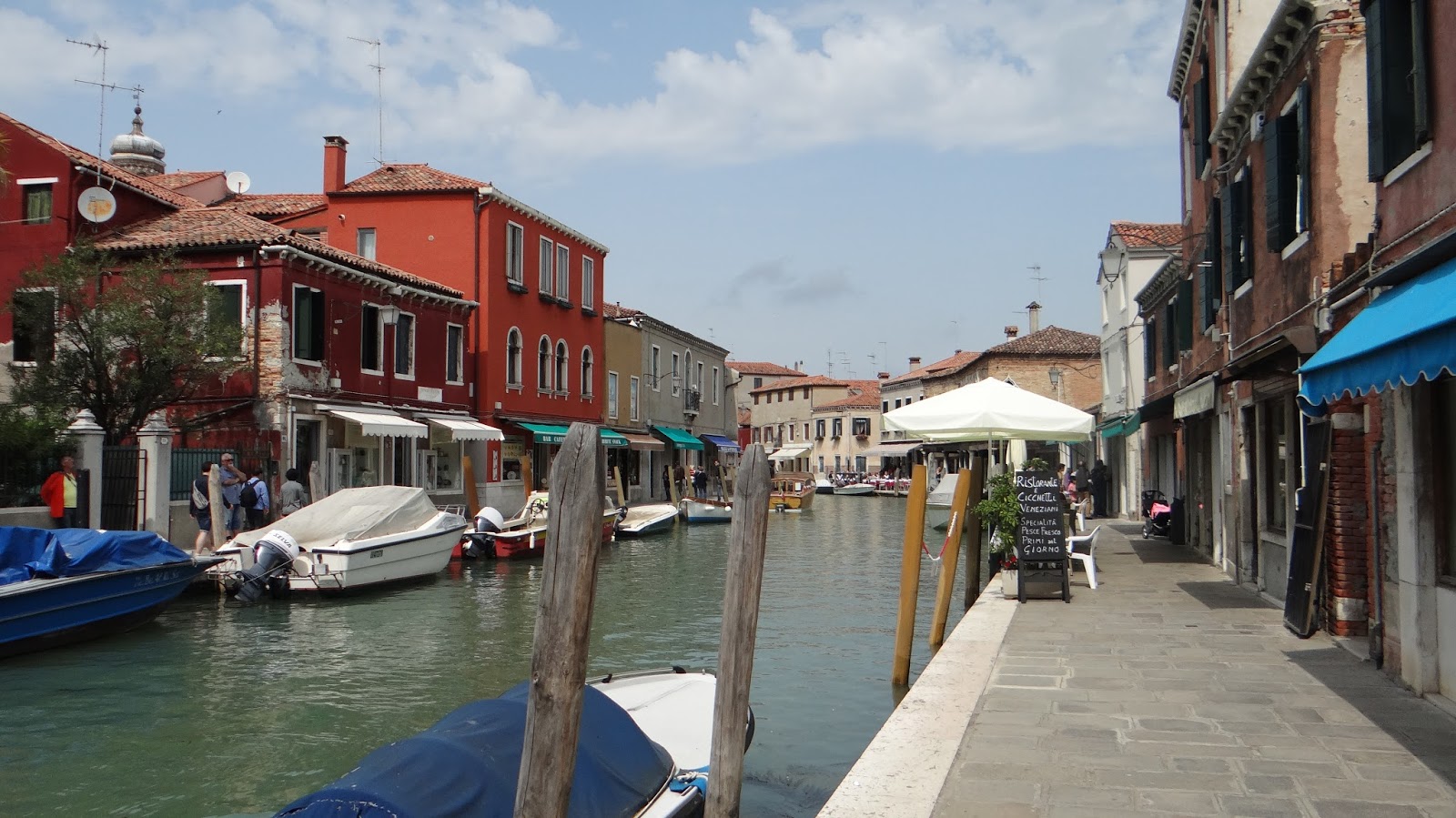
For tourists, life on the 100 islands of the Venetian lagoon can only be described like an enchanted slow water ride in a medieval setting. But for Venetians, it is a life like no other, few roads on some islands, just canals, waterways, boats, foot bridges, water buses, water taxis, firemen boats, police boats, garbage boats, and the ferry.


Grand Canal in Murano
Photo: Ileana Johnson 2016
The richer cousin of Burano, Murano, is another vaporetto ride away. Vic Stefanu posted an abbreviated video of the reverse boat ride from Murano to Burano. The sights and sounds, the wakes from boats, the archipelago’s mysterious blue color, and the bluish/grey haze express the pictorial essence of Venice. https://www.youtube.com/watch?v=TsENPCwtsFA

Murano is formed by seven islands linked by bridges and crossed by eight channels. With a population of 5,000 people and a surface of 0.9 miles across, Murano is the center of inimitable glass making.
View from a bridge in Murano
 
Pretty house on our way to Murano
Photo: Ileana Johnson 2016
 
Settled by the Romans and later by the people of Altino and Oderzo, Murano became a fishing port and a producer of salt and center of trade that minted its own coins, unlike the other islands.

Murano
Photo: Ileana Johnson 2016
 
Monks established the St. Michael monastery which quickly became a center of learning and printing. Fra. Mauro, the famous cartographer and a monk at this monastery, drew maps that were essential in the European exploration of the world. But Napoleon’s expelled the monks from their monastery in 1814 and the grounds became Venice’s main cemetery.


Murano's narrow streets
Photo: Ileana Johnson 2016
 
Murano became a center of glassmaking by necessity as they were expelled from Venice in 1291 by the fear and danger of fires. Aventurine glass was invented on the island. Glass beads and mirrors were at first the main creations, expanded later into chandeliers.  Pauly & C. Compagnia Venezia Murano is the oldest glass factory that was founded in 1866 and is still operational today. There is a Murano Glass Museum in the Palazzo Giustinian.

There are palazzos on the island as Murano was a popular resort for Venetians in the 15th century. The countryside had orchards and vegetable gardens until the 19th century when housing construction expanded.


Blue glass sculpture in Murano
Photo: Ileana Johnson 2016
Glassmaking is a very serious craft. The trademark, Vetro Artistico Murano, is filed and registered with the European Office for Harmonization in Alicante. Being a glassmaker afforded the citizens of Murano a special status in the Venetian Republic. They could wear swords, were immune from prosecution by the state, their children married into prominent nobility, but were not allowed to leave Venice. Some took risks and fled to neighboring cities, even England and the Netherlands, to establish furnaces (vetrerias).

Murano had a monopoly over expensive glassmaking for centuries. The types of glass they developed included optically clear glass, enameled glass (smalto), gold threaded glass (aventurine), multicolored glass (millefiori), milk glass (lattimo), and imitation gemstones made from expensive glass.

Hand-painted boat in the Burano Island dock
Photo: Ileana Johnson 2016
 
Those who dared leave Murano shared the secret of glassmaking and crystal with others and Venice lost the monopoly at the end of the 16th century. But their craftsmanship is most admired in the world and people spend a small fortune on intricate chandeliers, mirrors that are prized works of art, beautiful vases, fluted wine glasses, creative collectibles, and other rare objects that a collector desires.

Museo del Vetro (glass museum), located in Palazzo Giustinian, displays artifacts through history, including objects from Egyptian time to today. Glass making companies like Venini, Ferro Murano, Barovier & Toso, Simone Cendese and Seguso guarantee through their trademark that the glass objects are made on Murano island and nowhere else.

The Church of Santa Maria e San Donato is famous for its 12th century Byzantine mosaic pavement and is said to hold the bones of the dragon slain by Saint Donatus.

As lunch neared, we settled for a restaurant overlooking the Grand Canal on Murano. Most things were pricier to reflect the more expensive surroundings. A beautiful opaque blue outdoor glass sculpture decorated one of the canals. Tiny shops sold Murano jewelry, intricately made by master craftsmen in silver and aventurine glass with threads of gold and silver which could set the prospective buyer back around 80-100 euros.

San Michele Island cemetery
Photo: Ileana Johnson 2016
 
We boarded the water bus for Fondamente Nuove as we planned to walk from there back to Ponte Rialto. As the vaporetto chugged on the blue waters, a peaceful and green island appeared, San Michele, dotted with old Cyprus trees. A large bronze statue was rising from the lagoon waters, facing the island with wide-stretched arms.

San Michele bronze statue rising out of the lagoon
Photo: Ileana Johnson 2016
 
San Michele is a cemetery, paradoxically, a temporary resting place for Venetians as they are only allowed to remain there twelve years. Where they are moved to after twelve years, is a mystery to me. But the few wealthy and famous like Ezra Pound and Igor Stravinsky remain there in perpetuity. Signs in the cemetery remind some families that it is time for their loved ones earthly remains to be moved somewhere else. The cemetery is divided by faith, Orthodox, Catholic, Protestant, etc.

Isola di San Michele became a cemetery in 1837 when the government decided that the customary burial under church floors, in church walls, and in crypts was not so salubrious, was smelly, and “illegal.” In a place where flooding (Aqua Alta, high water) happens several times a year, it seems reasonable to bury the dead away from the living.

After we disembarked the water bus at Fondamente Nuove, it became obvious that all funeral homes were located in the immediate area, an ideal location across the water from the cemetery on Isola di San Michele. The photo of a 93 year old man who had recently passed away was posted in one window. I cannot imagine living on these islands but living for 93 years! For Venetians, it may be the highest honor to live and die in the middle of so much history and such romantic surroundings. But the daily life seems very complicated and tedious.

Even though the island was serene and green, it was unsettling. Venetians are born, live, marry, have children, die, and are buried on this island in the middle of the sea.

TO BE CONTINUED


Sunday, September 25, 2016

Ponte Rialto and Canal Grande

Vaporetto stop on Grand Canal
Photo: Ileana Johnson 2016
We explored the maze of narrow labyrinthine streets (calli) and covered passageways (sottoporteghi) away from San Marco’s Square, took some wrong turns, crossed many small bridges, walked on narrow paths along the canals, and stopped to admire the windows of some shops. I took so many pictures and I thanked my patient husband with a Venetian silk tie and a leather briefcase. I was surprised how much of the service industry had been taken over by foreigners, especially Chinese and African Muslims. Some stores had signs in the window, stating that the business was not Chinese-run or owned. Never saw this development in all my previous visits. Usually it was obvious which businesses were owned by Italians because they were spotless and tastefully decorated with the traditional Italian flair.

Venice has 350 bridges, but her most famous and oldest stone bridge, Rialto Bridge, built in 1588-1591, spans the Grand Canal at its narrowest point and is the dividing line between sestieri San Marco and San Polo. Our destination, Ponte di Rialto, was under repairs since November 2015, with the traditional cloth draping the construction.

Ponte Rialto
Photo: Ileana Johnson 2016
The first bridge in Rialto was a pontoon bridge built in 1181 by Nicolo Barattieri and was called Ponte della Moneta (the bridge of money). As the Rialto market developed nearby, the bridge was replaced in 1255 with a wooden version which had inclined ramps to allow the passage of tall ships. Two rows of shops were built along the sides of the bridge during the first half of the 15th century. The money from rent was used to maintain the bridge. This “ponte” was partially burned during a revolt in 1310, collapsed in 1444 from the weight of people watching a boat parade on the Grand Canal, and collapsed yet again in 1524. It was time to rebuild it in stone. Famous architects like Sansovino, Palladio, and even Michelangelo proposed designs for a stone bridge that would replace the more precarious wooden construction. The winning design was that of Antonio da Ponte. The Rialto bridge remained the only means of crossing the Grand Canal until 1854.

Grand Canal
Photo: Ileana Johnson 2016
 
The Grand Canal winds on the same course of an ancient river bed of nearly 4 km long and as wide as 230 ft., through six city districts (sestieri), is spanned by four bridges, and is lined by 10 churches and more than 200 palazzos. Gondolas, food and trash barges, vaporettos, police boats, small boats, water taxis, and water buses cross the Grand Canal so often, it causes a constant wake. The waves lap against the buildings and the changing tides show the decay of the lower levels of the fastidious palaces. In its heyday, the Grand Canal was traveled by larger ships, past the opulent palazzos with facades so opulent and intricately designed like a table cloth of Burano lace. Palazzos displayed the wealth and social status of important Venetian nobility.

Canal Grande
Photo: Ileana Johnson 2016
 
Today, any newly minted billionaire with 35 million euros to burn can own such a palazzo connected to the aristocratic families such as Mocenigo, Corner, Giustiniani, Grimani, Pesaro, and Pisani. Some Venetians still live in the ancestral home that belonged to their families for centuries but may or may not bear their name. Others have been turned into luxurious hotels, textile and glass manufacturing companies, or museums like Peggy Guggenheim’s art collection (Palazzo Venier).

Ponte dei Sospiri
Photo: Ileana Johnson 2005
A Venetian palazzo has two entrances, a water one and a land one, with the water entrance being the main façade.  The front has pergolas (balconies). The canal side level of the palazzo is seldom inhabited because of constant dampness. There is a water line with green slime, mold, and salt, showing the ravages caused by the ocean. Tiny spaces between palazzos on the land side are hidden gardens with Mediterranean flowers and wisteria. An occasional stray cat is perched on the top of the wall, looking skittishly at pedestrians.

Narrow and short passageway in San Marco's district
Photo: Ileana Johnson
 
From the vaporetto stop at San Toma, there is a cluster of palaces that belonged to the Mocenigo family, Ca’ Mocenigo. Seven doges came from this family. The poet Byron wrote his poem Don Juan while staying in Ca’ Mocenigo (1819-1824) and is said to have had an affair with the baker’s wife, “wild as a witch and fierce as a demon.” 

Another palazzo on the Grand Canal, Ca’ Foscari, is famous for having hosted King Henri III of France, and is now part of Venice University.

Gondola stop with gondoliers
Photo: Ileana Johnson 2016
 
One the more storied palazzos is Ca’ Dario, not because of its architecture but because it seems cursed. The owners, over five centuries, have been plagued by scandals, murder, suicide, bankruptcies, death by broken heart, and expulsion from Venice. The palazzo was, until recently, empty, as no prospective buyer would dare tempt fate and imminent calamity.

Ca’ d’Oro, which was bequeathed by the last owner, Baron Franchetti, to the city, houses now the Franchetti Gallery.  Baron Franchetti committed suicide in 1922 rather than facing an incurable disease. He had restored the palace to its original glory. Because the outside friezes were originally picked in gold, the name, Palace of Gold, stuck.

Stone Church in Erberia, Rialto
Photo: Ileana Johnson 2016
 
Ponte Rialto is my favorite bridge to watch pedestrians from and to admire the gondola traffic. I have bought small souvenirs on the bridge for 22 years and walked down to the Pescheria, the famous fish market. I have picked fresh grapes before from the local vendors in Erberia and calendars from the foreign ones. I can always find a Romanian somewhere selling cheap souvenirs and t-shirts and Ponte Rialto is no exception.

Ponte Rialto Erberia
Photo: Ileana Johnson 2016
 
Rialto is derived from “rivo alto” (high bank); it is Venice’s cosmopolitan center where banking and commercial exchanges took place for centuries. Even though Rialto burned to the ground in 1514 (the fire spared the stone church), it came back from the ashes like the proverbial Phoenix. The spot were Banco di Giro (1157) existed is now a bar called Al Bancogiro. Giro was a written transfer from one account to another, with no receipt issued because the bank’s register was the official record.  Armed escort moved the money at night to the mint.

Rialto's Erberia
Photo: Ileana Johnson 2016
Rialto Bridge divides the city into two parts, the right bank is the San Marco side, Rialto di qua (this side) and the left bank is known as Rialto di la (that side). Vendor booths of every type crowd the banks and the bridge, a sort of “insect life” as Henry James described it.

The stone church, in the middle of Erberia (the fruit and vegetable stalls), San Giacomo di Rialto, is dedicated to St. James, the patron saint of goldsmiths and pilgrims. Going up the inclined cobbled-stoned street and up the bridge steps, there are many tiny gold and leather shops. The Erberia, the fruit and vegetable market, would overlook the Grand Canal if the view was unimpeded by other buildings.

Our favorite by-the-slice pizzeria is on the right bank of Ponte Rialto and the best jewelry store is at the top of Ponte Rialto. I have bought Venetian gold from the grandfather, the father, and now the two sons who own the tiny shop. We always have animated conversations in Italian and haggle over prices. This time we talked about politics and the invasion of “refugees,” occasioned by a lovely gold bracelet that featured charms with symbols of every religion.  Next to the pizza shop is a very busy gelateria with delicious assortments, an outdoor landscape painter who was selling his oil paints for 25 euros and a gondola station.

Ponte Rialto, right side
Photo: Ileana Johnson
 
I tried to buy Dave a hat from the Hard Rock Café on the bridge, a new addition since last time we visited, but he refused on account that the word Venice was printed in English instead of Italian, Venezia. It could be Venice, Florida or Venice, California, he said. As if the Hard Rock Café was authentic Italian, so out of place surrounded by history and medieval beauty. But then he did not want a gondolier’s straw hat either.

Gondolas
Photo: Ileana Johnson 2016
 
Gondolas are as old as Venice, able to navigate the shallowest waters and the narrowest of canals. Turkish in origin, Thomas Mann described them as “visions of death itself,” made of eight different types of woods and covered with ten coats of black paint. The ornamental bow of steel represents the doge’s cap with the six prongs representing the six districts of Venice. Each gondolier decorates the interior according to their own tastes. In the 16th century there were 10,000 gondoliers, now there are only 400 and, for the first time, a woman gondolier. The license is issued after a test, is passed from father to son, and is only available to native Venetians. Gondoliers have their own shop with typical navy-striped marine-themed attire and round straw hats with a navy or red ribbon. A half hour ride can set you back 100 euros but, if you are lucky, the gondolier will serenade you. Their English is very good and some are college-educated who prefer the life of a gondolier and the much higher earnings.

Rialto, left side of Grand Canal
Photo: Ileana Johnson 2016
 
A famous son of Venice was composer, teacher, priest, and violin virtuoso, Antonio Vivaldi, son of a barber, Giovanni Battista, who played in the orchestra of San Mark’s Basilica. Antonio would stand in for his father from time to time even though he was very young. In the western world, everybody recognizes his masterful composition, The Four Seasons. In adulthood, fame found Vivaldi, but, as a priest, his image was tainted by the affair with Anna Giro, a local soprano. When he died, La Pieta, his church base in Venice, was restored, and his chamber music is played to this day. His home next door became the expensive Vivaldi Hotel.

The gondolier specialty shop
Photo: Ileana Johnson 2016
 
Vivaldi’s church, La Pieta, is located in the Castello district, with the city’s best-known waterfront. Arsenale shipyards, with its walls and towers and the Naval Museum, is visible in the eastern part of Castello.

Arsenale with the lion
Photo credit: Wikipedia commons
 
The Arsenale is a naval school and shipyards today, and officers and sailors can be seen from ferries passing through. Arsenale, founded in 1104 as the Venetian military power, was Europe largest medieval shipyard. As the Arabic term of origin implies, darsina’a (house of industry), the arsenal was an industrial production line, 3 km of walled compound with dry and wet docks. The vaporetto line that used to go between the towers of the water entrance has been taken out of service. During Biennale, Arsenale is used for display space and visitors can see the inside unimpeded. Biennale is an exhibition of eccentric modern art which overloads the senses, an event that occurs every two years.  A beautiful 6th century B.C. lion seems to guard Arsenale in perpetuity.

Canal gondola waiting for hire
Photo: Ileana Johnson 2016
 
Life on the water seems glamorous to tourists, but it’s not an easy life.  Water buses, the famous vaporetti, ferry Venetians everywhere they want to go.  Everything is transported on water, trash pickup, supplies, food, police, firemen, ambulance help, even the dead. The speed limit cannot exceed 5 mph, with the exception of emergency services, but for Italians, legal limits are just mere suggestions. Gondoliers complain to no avail. 

Rialto Photo credit: Wikipedia
High-water sirens mean that the stormy sirocco winds are blowing. When tidal flooding occurs, the garbage remains piled on the canal banks – the trash boats cannot pass under bridges to carry the refuse to ships to be incinerated. Shop keepers place merchandise on higher shelves, locals put on rubber boots, and temporary boardwalks are put down immediately for pedestrians. The lagoon water gives character and uniqueness to Venice but at a price of constant flooding. The many projects to save Venice from sinking, including heavy concrete barriers that are raised far out at sea, have not saved the Serenissima yet.

Church of the Redentore designed by Palladio
Photo credit: Wikipedia
 
When we got tired of walking, we boarded the vaporetto to San Giorgio Maggiore, an island east of Giudecca. Part of the district of San Marco, the island is surrounded by Canale della Grazia, Canale della Giudecca, Saint Mark Basin, Canale di San Marco, and the southern lagoon.

Giudecca Island
Photo: Ileana Johnson 2016
 
The island was owned by the Memmo family. The island’s church, San Giorgio Maggiore was consecrated in 829 A.D. and a monastery by the same name was established in 982. The church was designed by Palladio; the nine bells of the bell tower ring in C sharp.

San Giorgio Maggiore Photo credit: Wikipedia

The island was donated by the Memmo family specifically to build the monastery. When the Venetian Republic fell, the monastery was suppressed and the island became a harbor built in 1812 and home to Venice’s artillery. Today it houses the headquarters of the Cini Foundation Arts Center, with its library; the open-air Teatro Verde finds its home here as well.

Next stop was the district Dorsoduro with Giudecca island and Isola Sacca Fisola. It has the highest land areas of the city. Dorsoduro has many landmarks such as Ca’ Foscari, Gallerie dell’Academia, Peggy Guggenheim Collection, many churches, ospedale Giustinian, and palazzo Ariani.

Dorsoduro has a world-famous Gelato Nico. As we sat under umbrellas on the golf side, a huge cruise ship, Celebrity Constellation, was towed so close to the shore by two tugboats, practically in front of our eyes. Thousands of people were lined up on the deck to see the sights of Venice.

We strolled on the island for a while, perusing a miniature boat shop, an antique store, and taking pictures of beautiful facades that are so uniquely Venetian, I felt transported into another time and another life.

Giudecca island had beautiful palaces with gardens but in the early 20th century it became an industrial area with factories, shipyards, and a film studio. After WWII, the industry declined and the area has returned to middle class status with some expensive homes. The Palladio-designed Il Redentore church is located here. The former Molino Stucky flour mill has been converted into a luxury hotel and apartments. At the opposite end of Giudecca is the famous five-star Cipriani hotel with gardens and a salt-water pool.

Dorsoduro antique shop
Photo: Ileana Johnson 2016
 
After strolling around Dorsoduro for a while, we took the water bus back to Lido island. At the end of the street from our hotel were cozy restaurants and shops. A huge monument dedicated to Italian fallen heroes of various wars was closed and under repairs. Everything around Venice needs constant repair and restoration due to the corrosive elements.

We picked a nice restaurant for dinner, Gran Viale, and feasted on the best menu turistico we’ve had so far. The atmosphere was cozy, the space tastefully decorated, and everything was spotlessly clean. We returned to our hotel, tired and in pain, ready for the next day’s adventure, Murano and Burano islands.

TO BE CONTINUED