Wednesday, August 10, 2016

The Sleepy Historical Ravenna

Ravenna street
Photo: Ileana Johnson 2016
On the ninth day of our trip, we finally said good-bye to our beloved Florence and embarked on our journey to Ravenna, via Bologna. The drive through Tuscany was gorgeous, punctuated by crossing endless tunnels connected by short views of rocky landscapes and trees, at least one mile long and one over six miles long. Even though the tunnels were well lit, we took a new variant to the autostrada and it made us wonder if we would ever escape this very long tunnel in which we seemed to be the only travelers. We were becoming quite anxious to emerge at the other end of the tunnel and making bets what the weather would be like. We felt like moles trying to dig our way out of one rocky mountain after another. We reached Ravenna in about two hours after the brief stop at an Autogrill to recharge our human batteries with a sandwich and a glass of freshly squeezed blood orange juice.

Ravenna turned out to be a breath of fresh air, very few tourists, and a sleepy and semi-closed town because of Mother’s Day. Few restaurants were open, museums, and churches. Even the Basilica of San Francesco was closed for siesta. Italians love their lengthy siesta; I don’t know how they get anything accomplished when they work so few hours every day in the service sector.
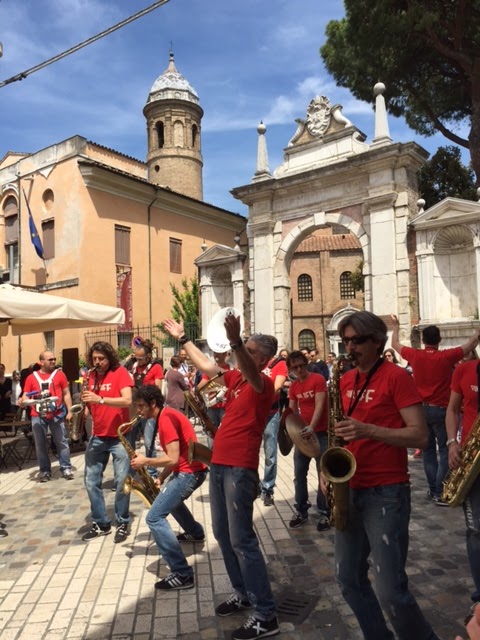
Jazz band in front of San Vitale
Photo: Ileana Johnson 2016
As soon as we turned the corner for Basilica of San Vitale, a jazz band was entertaining people on the street right in front of it. The saxophone players clad in red shirts and blue jeans were part of the 2016 Ravenna Jazz Festival, the 43rd edition, May 2-14.

Ravenna is an inland city in the state of Emilia-Romagna, northern Italy, connected to the Adriatic Sea by the Candiano Canal. Although small, its significance to Western Civilization is evident in its rich history.

Ravenna was the capital of the Western Roman Empire from 402 A.D. until 476 A.D. when the Roman Empire of the West collapsed under the siege of barbarian king Odoacer who “proclaimed himself king of Italy.”

Italians consider the origins of Ravenna as “lost in legend,” probably inhabited by Umbrians and then Etruscans. Evidence shows that in the second century B.C., the Po Valley was colonized by Rome and Ravenna became part of the Roman Republic in 89 B.C.

Back then Ravenna had houses built on piles on several sandy islands in a lagoon. Julius Caesar is believed to have assembled his soldiers in Ravenna in 49 B.C. before crossing the Rubicon.

Emperor Augustus established the military port at Classe in 31 B.C. Classe was 4 km east south-east of Ravenna, near the head of the Adriatic coast. It maintained its strategic location for almost 500 years as a military and commercial port. Classe probably derived its name from the Latin word classis, fleet.

Emperor Trajan built a 70 km long aqueduct in Ravenna at the beginning of the second century. According to Birley, when Germanic settlers took possession of Ravenna during a revolt, Marcus Aurelius stopped bringing any more barbarians into Italy and banished those who had previously been brought there.

Ravenna had 50,000 inhabitants when Emperor Honorius transferred the capital of the Western Empire from Milan to Ravenna in 402 A.D. The transfer took place because Ravenna was seen as easily defensible since it was surrounded by swamps, and it had Porto di Classe connection to the Eastern Roman Empire.

The Visigoths did not care about Ravenna’s defensible location, King Alaric bypassed it and sacked Rome in 410 and took Galla Placidia, daughter of Emperor Theodosius I, hostage.

When Theodoric conquered Ravenna in 493 A.D., he is said to have killed Odoacer with his own hands. Theodoric built not just his palace church Sant’Apollinare Nuovo and the Arian cathedral now named Santo Spirito and Baptistery, but also his own Mausoleum outside the walls.

Theodoric and Odoacer were Arian Christians who co-existed in peace with the Latins who were Orthodox. Orthodox bishops made their mark on Ravenna but only Capella Arcivescovile survived.

Roman citizens in Theodoric’s kingdom could follow Roman law and judicial system, while the Goths lived under their own laws and customs. When a throng burned down the synagogues of Ravenna in 519, Theodoric forced the town to rebuild at its own expense.

Theodoric died in 526 and the last representative of his line was a woman. The subsequent gothic rulers in Italy were not as successful as Theodoric. The Orthodox Christian Byzantine Emperor Justinian opposed the Ostrogoth rule and their brand of Arian Christianity. His general, Belisarius, invaded Italy in 540 and conquered Ravenna which became the seat of the Byzantine government in Italy in 554.

Monuments were built during this period for sixty years around Ravenna and Classe; the Basilica of San Vitale, the Basilica of Sant’Apollinare in Classe, and parts of San Michele in Africisco still survive today.

It is believed that Pope Adrian I had authorized Charlemagne to take anything portable from Ravenna that he liked, such as Roman columns, mosaics, statues, and other treasures that were then shipped to his capital in Aachen.

Dante's Tomb exterior
Photo: Ileana Johnson 2016
 
The famous poet Dante was exiled in Ravenna and died there in 1321. His Neo-Classical tomb is located on the side of the garden of Basilica di San Francesco. The elaborate tomb is facing a paved street. It almost seems out of place as if it was dropped there by mistake.

Ravenna continued to be ruled by many, including Venice and various legates of the Pope as part of the Papal States. It was even sacked by the French in 1512 during the Holy League wars.

The former port became covered with silt and returned to its marshy state until modern era reconstruction when the Candiano Canal was widened and trade was brought back to the city.

“The city was damaged in a tremendous flood in May 1636. Over the next 300 years, a network of canals diverted nearby rivers and drained nearby swamps, thus reducing the possibility of flooding and creating a large belt of agricultural land around the city.”

With eight UNESCO World Heritage Sites, Ravenna has many well-preserved late Roman and Byzantine architectural gems. 

San Vitale Photo: Ileana Johnson 2016 
The Basilica di San Vitale was founded by Bishop Ecclesio (522-532) after his trip to Constantinople with Pope John I in 525, a year before Theodoric’s death. Legend has it that San Vitale was a “Roman soldier martyred during the early Christian persecutions.” It is considered “The most glorious example of Byzantine art in the west.” Giuliano Argentario, a wealthy banker living in Ravenna, financed the basilica’s construction.

The eastern influence is so strong, the basilica is octagon shaped, with a dome, eight columns and arches, without the traditional three naves.  Bishop Maximian, who consecrated the basilica in April 548, appears in one of the mosaics. The splendor of the mosaics, the marbled mosaic floors, the intricate columns, the beautiful greens, the stories depicted on the ceiling and the walls, the glittery gold, the light shining down onto the marbled floors transported me into that time for a brief moment.

San Vitale interior Photo: Ileana Johnson 2016
San Vitale mosaic Photo: Ileana Johnson 2016
San Vitale mosaics Photo: Ileana Johnson 2016
 
Mosaic of Justinian I in San Vitale Photo: Wikipedia
 
Galla Placidia empty sarcophagus
Photo: Ileana Johnson 2016
Across the courtyard from San Vitale is the Mausoleum of Galla Placidia. It is said that she had commissioned its construction. Built in the second quarter of the 5th century, this extremely well-preserved monument in the shape of a Latin cross, never housed the mortal remains of Galla Placidia. According to the museum archives, she was buried in Rome in 450 A.D. in the Theodosian Mausoleum near St. Peter’s.

The dark interior of the mausoleum has vaults and lunettes covered in mosaics with ancient Roman traditions, no eastern influence here. The motif and the atmosphere seem more spiritual with its midnight blue sky on the ceiling. There is some diffused light flowing through the alabaster windows. The dominant theme is Christian redemption hence the belief that the building was intended as a mausoleum.

According to the museum archives, “The dome is decorated with concentric circles of golden stars on an indigo background, and the cross in the center symbolizes Christ’s triumph over death and a promise of salvation to the faithful. The long arm of the cross points towards east (Salvation will come from the East).” Golden angels, the four Evangelists (Matthew, Mark, Luke, and John) and some of the Apostles like Peter and Paul are recognizable, dressed in white togas like Roman senators.

Galla Placidia Mausoleum ceiling
Photo: Ileana Johnson 2016
 
A pair of doves and a pair of deer are drinking from a vase of crystal clear water and from blue waters, a symbol of “souls who drink from the waters of true faith and eternal life.”

There are three Greek marble tombs which some scholars believe, were not placed in the mausoleum until the 14th century.

The central tomb is known as Galla Placidia’s; it looks unfinished, and has no decorations or inscriptions.
The left arm has a 5th century tomb believed to be Galla Placidia’s second husband, Constantinus III.
On the right arm of the mausoleum is the 6th century tomb believed to belong to Galla Placidia’s son, Valentinian III.

Theodoric Mausoleum Photo: Wikipedia
 
Theodoric’s Mausoleum is an interesting monument he built to himself in 520 on the site of a former Gothic cemetery. Theodoric, who never knew how to read or write, remained an Ostrogoth even though he was educated at the court of Constantinople.

The two story ten-sided structure was built from large, square blocks of Istrian stone secured with iron cramps. The roof is a circular cover made from one block of Istrian stone, 11 meters in diameter, one meter thick, and weighing 500 tons.

There is a porphyritic urn in the middle of the room once thought to contain the remains of Theodoric. However, the archivists believe that “his body was probably removed when the city fell into Byzantine hands, and the churches were taken over by the orthodox Catholics.”

The ceiling is slanted on one side; legend says that Theodoric knew of the prediction that he would be struck by lighting and, during a heavy storm he hid beneath the great stone roof to protect himself. He was killed by lightning and the flash cracked the roof. The crack, however, was likely caused during renovations.

Galla Placidia, while at sea with her children during a terrible storm, returning from Constantinople to Ravenna, made a vow to Saint Giovanni Evangelista that she would build a church bearing his name if God spared them during the ferocious storm. Thus San Giovanni Evangelista was begun in 425. The church was renovated many times and was almost destroyed in a bombing raid in 1944.

The Battistero degli Ariani (the Baptistery of the Arians) was built in the late 5th century in front of the church of Spirito Santo (formerly known as Cattedrale degli Ariani) during Theodoric’s rule when Arianism had become the court religion. The octagonal building sunk more than two meters and no longer displays the original mosaics except on the dome. The Catholics turned the baptistery into an oratory during the second half of the 6th century.

An Alexandrian presbyter named Arius, condemned by the Council of Nicaea (325), advocated Arianism, a heretical doctrine. “Arius disputed the Christian doctrine over the divine nature of the son of God, who was generated and therefore not equal to the Father, thus denying the divinity of Christ.”

Neonian Baptistery Photo: Ileana Johnson 2016
 
Neonian Baptistery Font
Photo: Ileana Johnson 2016
 
The Battistero degli Ortodossi (the Baptistery of the Orthodox) or Neonian Baptistery is Ravenna’s oldest ancient monuments. The simple, octagonal brick building dates its construction in the late 4th or early 5th century. The original entrance is actually three meters below the current surface. The beautiful mosaics inside were made at the request of Bishop Neone during the mid-fifth century, hence its name. In the middle, there is an octagonal Greek marble and porphyry font, rebuilt in 1500.
Sant'Apollinare Nuovo Photo: Ileana Johnson 2016
 
Another late 5th century and early 6th century basilica, built at the behest of Theodoric, as a place of worship for Arians and dedicated to Christ the Redeemer, is Sant’ Apollinare Nuovo. When the relics of Sant’Apollinare were allegedly transferred here from the basilica in Classe, the church took its current name. The interior has three naves and is richly decorated with mosaics.

Sant'Apollinare Nuovo interior Photo: Ileana Johnson 2016
 
Mosaics on the left depict episodes from the life of Christ: Jesus multiplying the loaves and the fishes; Jesus at the wedding Cana; Jesus heals the blind man of Jericho; Jesus heals the sick; Jesus and the Good Samaritan at the well; the raising of Lazarus; the widow’s mite; Jesus divides the sheep from the goats; Jesus heals the palsied man at Capernaum; the healing of the madman; and the healing of the palsied man at Bethesda.

Mosaics on the right display scenes about the passion and resurrection of Christ (without the crucifixion): Jesus and the Apostles at the Last Supper; Jesus on the Mount of Olives; Judas betrays Jesus with a kiss; Christ taken for judgment; Christ before the synedrium; the announcement of Peter’s denial; Peter denies Christ; Judas repents; Christ before Pontius Pilate; Christ ascend Calvary with Simon the Cyrenian; the resurrection of Christ; the disciples of Emmaus; and the doubting Thomas.
Sant’Apollinare in Classe is a magnificent red brick monument consecrated by Bishop Maximian in 549, but built at the behest of Bishop Ursicino. Like San Vitale, the building was financed by the rich banker with a very fitting name, Giuliano Argentario. The basilica “remains one of the most expressive examples of Byzantine art, a veritable ‘house of prayer,’ the purest form of ancient Christian basilica.” The mosaics and the paintings are magnificent for the time period. There is a crypt that was built in the 9th century.  Below the high altar there is a “Greek marble sarcophagus which was restructured in 1511 and which originally contained the mortal remains of Sant’Apollinare before these were transferred to the high altar.”

Ten Greek marble sarcophagi line the lateral naves – these are the bishops of Ravenna. The sarcophagi offer an interesting lesson in sculpture development from 5th-8th century.

Ravenna's Duomo Photo: Ileana Johnson 2016
 
The Duomo is Ravenna’s first cathedral known as basilica ursiana, built by Bishop Orso at the beginning of the 5th century, dedicated to the resurrection of the Lord. The only fragments left of the original building are the transenae which are preserved in the archiepiscopal museum. There are two urns preserved inside; one was used in 1321 as the tomb of Archbishop Rinaldo da Concorreggio and the other as the tomb of San Barbaziano, Galla Placidia confessor and advisor, whose “mortal remains were placed here in 1658 but he died in the second half of the 5th century.

Chapel of San Andrea mosaic ceiling
Photo: Ileana Johnson
 
Bishop Maximian's Ivory Throne
Photo: Ileana Johnson 2016
 
The Archiepiscopal Museum and Chapel of San Andrea contains, among many collections, the ivory throne used as a liturgical seat of Bishop Maximian who consecrated both basilicas of San Vitale and Sant’Apollinare in Classe. He served as Bishop of Ravenna around the middle of the 6th century. It is considered a “masterpiece of early Christian sculpture.”

Dante's Tomb
Photo: Ileana Johnson 2016
The monument erected to Dante is a small temple in neo-classical style, built at the order of the Legate Luigi Valenti Gonzaga who commissioned it in 1780 from the architect Camillo Morigia.  According to archives, Dante Alighieri was buried under a small portico in the church of San Francesco located now behind the monument.

Guido Novello da Polenta had every intention of building a monument for the poet but his rule ended a few months after Dante’s death. Captain Bernardo Bembo commissioned the urn and asked Pietro Lombardo to add a portrait to the tomb which is still found inside. Bembo had the tomb inscribed with the following Latin epitaph coined by Bernardo Canaccio in 1327:

“I sang of the rights of the monarchy, of the heavens and of the waters of Flegetonte, until I met my mortal destiny. But my soul was welcomed in better places and more blessed still reached the stars and the Creator. Here in this urn lies Dante, exiled from his native land, born to Florence, an unloving mother.”

According to archives, there was a bizarre fight in 1519 over Dante’s remains. Pope Leo X gave Florentines permission to take Dante’s body back to Florence.  When they got to Ravenna, “they found an empty burial chamber. During the night, the Franciscan Friars had made a hole in the wall from the monastery and had carried the body away, hiding it in another monastery nearby. Later, in 1677, Padre Antonio Santi had Dante’s body placed in a wooden casket engraved with the poet’s name and the date of his death. When the friars had to leave the monastery in 1810, as a result of the Napoleonic laws, the small box was hidden beneath an old gateway near Branccioforte (not far from the site of the present tomb).” The casket was found in 1865 during excavations and Dante’s remains were placed in the original urn.

San Francesco courtyard
Photo: Ileana Johnson 2016
Basilica di San Francesco sign
Photo: Ileana Johnson 2016
The last stop was a visit to San Francesco. This ancient church was built in the 5th century by Bishop Neone and dedicated to the Apostles Peter and Paul. According to archivists, nothing remains of the original church which was rebuilt in 10th-11th century and renamed San Pietro Maggiore. When the church was handed over to Franciscan friars, it was renamed St. Francis in 1261.

San Francesco Basilica façade
Photo: Wikipedia
 
The austere wooden ceiling is shaped like the hull of a ship. The church is divided into three naves and receives light from windows in the semi-circular apse. Close to the bell tower there are fragments of sculptures dating back to the 6th century. On the left side there are two sarcophagi from the 4th century. There is another sarcophagus in the apse from the 4th century. It is Bishop Liberio’s tomb and it serves as the high altar.

San Francesco crypt with swimming fish
Photo: Ileana Johnson
Side view of crypt below the high altar
Photo: Ileana Johnson
The most curious feature of this church is its 10th century crypt which is clearly visible through a center window and two side windows below the high altar. The archives describe the crypt as having been designed like an “oratory and held up by small pillars. The floor is covered in mosaic fragments from the original church. The crypt is situated much lower than ground level and is consequently subject to flooding.”

I found it strange that the flooded crypt is stocked with fish who are swimming over the preserved mosaics in the darkness. The only light comes from the occasional tourist like me who might put one euro in the vending machine and the flooded crypt with crystal clear water, the mosaics, and the columns would light up for three minutes, enough for all the nearby visitors to take photographs.

I left the church with a feeling of loss and sadness and I could not explain why. The beautiful garden to the left of the church was covered in greenery, in stark contrast to the centuries-old aged brick.

Passatori grill feast fit for a king
Photo: Ileana Johnson 2016
 
We were really hungry but everything seemed closed. On the way to the car, we found a mom and pop restaurant called Passatori with faded pictures of plates of grilled meats and vegetables in the window. We went inside; the restaurant was full of loud Italians and Germans from two separate groups, no sign of any American but us. They were closing soon and I asked them in Italian if they would feed us since we were so hungry. They agreed with a frown, charged us each four euros cover because the area was not touristy enough, and seated us at the worst table in the restaurant, in a corner, by the only opened window. As it turned out, it was a blessing in disguise as the window provided much needed cool air – there was no air conditioning running yet.

I speak fluent Italian and my husband and I must look German because on several occasions German tourists approached us for directions speaking German, but Dave’s red baseball cap with his college logo gave us away. The cap came in handy when it connected us briefly with other Ohio State fans who were visiting Venice.

No matter how much we smiled, we could not endear ourselves to the serving staff at Passatori who did not say a word to us after we ordered, treating us like dirt under their feet. The other customers around looked at us as if we had landed from the planet Mars. But the food was divine, just like the discolored pictures showed in the window; the table was covered with crisp and clean linens, and the local beer was delicious. Dave was in grilled meat and vegetables heaven!

We left Ravenna after we hobbled back to our free parking, certainly unusual for Italy where nothing is free. It felt good to sit down in the car and rest my very painful knees. We just did not know how long we would have to drive to get to our next destination, Venice.


Thursday, August 4, 2016

Clexit and the "Parasitical" Climate Change Industry

“The big threat to the planet is people: there are too many, doing too well economically, and burning too much oil.”    -  Sir James Lovelock, BBC Interview

Photo taken in the Nashville Airport
Ileana Johnson October 2015
Viv Forbes, in a media release on August 1, 2016, announced the founding of Clexit, Climate Exit, by“over 60 well-informed science, business and economic leaders from 16 countries.”

Forbes announced in his press release that ratification of the Paris accord will suppress the developed world with “pointless carbon taxes and costly climate and energy policies” that have no rational basis and are based on consensus. Such green and destructive polices are destroying real industries while “enriching the huge and parasitical climate-change industry that thrives on bureaucracy, misdirected government research, law books of costly regulations, never-ending conferences and subsidies for promoters of the failing technologies of renewable energy.”

He continues that if the EU ratified the Paris accord, it will spell the end of low-cost hydrocarbon electricity and transportation and the “end of manufacturing, processing and refining industries.” Developing countries will be denied low-cost energy and be forced to continue their dependency on “international handouts.”

“Perhaps the most insidious feature of the UN climate plan is the ‘Green Climate Fund’. Under this scheme, selected nations (“The rich”) are marked to pour billions of dollars into a green slush fund. The funds will then be used to bribe other countries (“developing and emerging nations”) into adopting silly green energy policies.” http://clexit.net/wp-content/uploads/2016/07/clexit.pdf

Bloomberg reported that “Environmentalists who once championed biofuels as a way to cut pollution are now turning against a U.S. program that puts renewable fuels in cars, citing higher-than-expected carbon dioxide emission and reduced wildlife habitat.”
http://www.bloomberg.com/politics/articles/2016-07-27/as-corn-devours-u-s-prairies-greens-reconsider-biofuel-mandate

Car manufacturers announced that they are not standing behind warranties if car owners use the EPA approved E15 (15% ethanol) fuel in their cars. http://www.consumerreports.org/cro/news/2011/07/warranties-void-on-cars-burning-e15-say-automakers/index.htm

Klaus Kaiser, a professional scientist with a Ph.D. in chemistry and an extensive resume in research, wrote recently that the 2004 report, “Growing Energy,” claiming that “biofuels can clean up the environment,” is not true.” “Instead,” Kaiser wrote, “the few studies by independent investigators all showed the opposite to be true. Between sowing and reaping the harvest, converting, distilling, and distributing the product(s), no energy was ‘saved,’ the environment was not ‘cleaned up’ but rather destroyed, and the economy did not improve either.” Kaiser calls the biofuel claims a “boondoggle and a Biofuel Curse.” http://fairfaxfreecitizen.com/2016/08/03/sanity-may-prevail-after-all/

Despite scientific evidence to the contrary, this administration has made global warming/climate change a priority, seen as a biggest threat facing the nation. The administration wants to “fill U.S. roadways with electric vehicles.” It also ruled that “greenhouse gas emissions from aircraft endanger human health and welfare.” Another goal is to “phase out super-polluting HFCs (hydro-fluorocarbons), chemicals in refrigerants and other industrial substances that warm the climate.” https://www.washingtonpost.com/news/energy-environment/wp/2016/08/02/from-now-on-every-government-agency-will-have-to-consider-climate-change/?utm_term=.33f6731f2a62

On August 2, 2016, the White House Council on Environmental Quality released “final guidance on considering climate change in environmental reviews.” The ‘guidance’ is telling federal agencies that they must quantify the impacts of their actions on climate change when they produce greenhouse gas emissions. Their actions must be spelled out in the NEPA reviews. https://www.whitehouse.gov/the-press-office/2016/08/02/fact-sheet-white-house-council-environmental-quality-releases-final

NEPA is the 1969 law, the National Environmental Policy Act, which requires federal agencies to take into account and disclose environmental consequences of their activities such as permits to drill on public lands, mining, building roads, bridges, etc. Agencies are asked to look at alternatives in order “to mitigate the impacts of climate change.” The administration stated that in 2015 the federal government penned 563 such NEPA reports. https://www.fws.gov/r9esnepa/RelatedLegislativeAuthorities/nepa1969.PDF

NEPA was originally intended to “encourage productive and enjoyable harmony between man and his environment; to promote efforts which will prevent or eliminate damage to the environment and biosphere and stimulate the health and welfare of man; to enrich the understanding of the ecological systems and natural resources important to the Nation; and to establish a Council on Environmental Quality” and not to restrict human activities through such severe, often draconian rules and regulations.

In the U.S. Eastern District Court of California, a judge found that John Duarte, a farmer, “plowed wetlands, four to six inches deep, and therefore violated the Clean Water Act. According to the Jefferson Policy Journal, the Court wrote, “In sum, soil is a pollutant. And here, plaintiffs instructed [a contractor] to till and loosen soil on the property. Plowing caused … the material in this case soil, to move horizontally, creating furrows and ridges. This movement of the soil resulted in its being redeposited into waters of the United States at least in areas of the wetlands as delineated.” http://www.jeffersonpolicyjournal.com/court-rules-soil-is-a-pollutant/
According to the Congressional Research Service, President Obama’s major goal is to reduce U.S. emissions of greenhouse gases (GHGs). He pledged at a conference in Copenhagen in 2009 that U.S. will reduce emissions of GHGs 17 percent by 2020 below 2005 levels and 80 percent by 2050. In November 2014 he set a new goal, 26-28 percent by 2025, while China announced its emissions to peak by 2030.

According to the Congressional Research Service report, “EPA’s Clean Power Plan for Existing Power Plants: Frequently Asked Questions,” (R44341, June 15, 2016), “President Obama made the pledge in the context of U.S. commitments under a [1992] international treaty, the United Nations Framework Convention on Climate Change (UNFCCC). http://unfccc.int/resource/docs/convkp/conveng.pdf

The 1992 U.N. Conference on Environment and Development in Rio de Janeiro produced three documents:

-          The Framework  Convention on Climate Change

-          The Convention on Biological Diversity

-          Agenda 21 (which has now morphed into Agenda 2030)

 
President George H. W. Bush signed the Framework Convention on Climate Change and Agenda 21 but refused to sign the Convention on Biological Diversity. According to the late Henry Lamb, “The Convention on Biological Diversity was not ratified, but because the Clinton administration believed so strongly in its provisions, the treaty recommendations were implemented administratively.”

Agenda 21 is not a treaty but a “soft law” document which “means that its recommendations are not legally binding, but nations that endorsed the document are morally obligated to implement them,” according to the United Nations. Agenda 21 and its sister on steroids, Agenda 2030, have never been debated or adopted in Congress but its provisions, including its lynchpin, Sustainable Development, have been included in legislation and administratively through “visioning grants” at the state and local levels thanks to non-governmental organizations’ (NGOs) constant brainwashing around the globe.

The Obama administration also released a “Climate Action Plan and directed the EPA to propose standards for ‘carbon pollution’ [carbon dioxide, the gas of plant life] from power plants by June 2014 and to finalize the standards a year later.” The rule, however, is under ongoing litigation initiated by several states and other entities who have challenged the rule. On February 9, 2016, the Supreme Court stayed the rule for the duration of the litigation.  The EPA claims that it has the authority for such a rule in Section 111(d) of the Clean Air Act. http://www.fas.org/sgp/crs/misc/R44341.pdf

Our Secretary of State, John Kerry, confessed at the COP-21 climate conference in Paris that emissions cuts by U.S. and other developed nations will make no difference in the global climate.

“The fact is that even if every American citizen biked to work, carpooled to school, used only solar panels to power their homes, if we each planted a dozen trees, if we somehow eliminated all of our domestic greenhouse gas emissions, guess what – that still wouldn’t be enough to offset the carbon pollution coming from the rest of the world.

If all the industrial nations went down to zero emissions—remember what I just said, all the industrial emission went down to zero emissions—it wouldn’t be enough, not when more than 65 percent of the world’s carbon pollution comes from the developing world.”http://www.globalclimatescam.com/cop21/why-bother-john-kerry-admits-american-co2-cuts-would-be-pointless/


Wednesday, August 3, 2016

Day Trip to Volterra and Siena

Volterra Photo: Ileana Johnson 2016
After a morning of twists and turns, hair pin curves in which speeding motorcyclists taking terrifying chances would dangerously zigzag with death-defying speed between the lanes of traffic, we got closer to Volterra. As the road got narrower and narrower, Volterra rose from the hills like a medieval clay-tiled gem surrounded by intensely green trees, yellow tiled roofs, and dizzying drops. With much fewer visitors than San Gimignano, Volterra was a tranquil place with a well-preserved Roman theater dating back to the first century B.C., excavated in 1950, columns, and Etruscan ruins.

Considered one of the “twelve cities” of the Etruscan League, Volterra was known as Velathri. It is believed that the surrounding area has been inhabited since the end of the 8th century B.C.  There are excavations of Etruscan tombs in Valle Bona. The Etruscan City Walls have two well preserved gates, Porta all’Arco (3rd-2nd centuries B.C.) and Porta Diana.

Volterra
Photo: Ileana Johnson 2016
 
The Guarnacci Etruscan Museum displayed thousands of funeral urns dating back to Archaic periods, a bronze statue, “Ombra della sera,” (Shadow of the Evening), and “Urna degli Sposi” (Urn of the spouses), an Etruscan couple’s effigy sculpted in terra cota.

Photo: Wikipedia
 
Piazza dei Priori is a well-preserved medieval Tuscan town square; the Palazzo dei Priori is the town hall built in 1208-1257.

The Volterra Cathedral, enlarged in the 13th century, had a ciborium, a free-standing baldachin in the sanctuary. It was used at times to emphasize the altar and other times to hide it.

Volterra Roman Theater
Photo: Ileana Johnson 2016
 
Walking through the narrow cobbled stoned alleys, with the sun barely peeking through buildings erected too close to each other, casting shadows and cool air on a sunny early May day, I compared the surroundings with the images of Volterra cast in Luchino Visconti’s 1965 movie Sandra.

Medici Fortress Prison with famous restaurant
Photo credit: Wikipedia
 
The Fortezza Medicea (Medici Fortress), built in 1474, is a prison and houses the famous restaurant by the same name where the meals are prepared by inmates. I was not sold on the idea of eating a meal prepared by people who did not just broke the law but committed murder by various means, poison coming to mind. I did not say a word about its existence to my husband who would never miss an opportunity to eat an Italian meal, even one prepared by inmates.

The Renaissance era fortress is a high-security prison for criminals who serve at least seven year sentences. Even though customers must pass a background check, several checkpoints, and eat with plastic forks and knives, since the prison administrators started operating the restaurant in 2006-2007 as a rehabilitation effort, the tables in the Medici fortress are booked weeks in advance. I find it peculiar that people are willingly subjecting themselves to such scrutiny just to eat a meal prepared and served by criminals.

Not far from Volterra is Lajatico, home town of the Italian tenor Andrea Bocelli. He gives annual concerts in Teatro del Silenzio, concerts that are attended by people from all over the world.

Peering from the upper road down to the Roman theater, I imagined the majestic Greek tragedies played on stage for the entertainment of the Romans long ago. Behind me I found Fabula Etrusca, a tiny gold showroom with unique Etruscan pieces, one of a kind. The tiny display windows were stylishly decorated but contrasting oddly with the rock walls and stony building carved into the rock with a heavy iron gate, steps going down into a dungeon with an electronically locked metal door with grates that slid like a prison cell door. The limited lighting focused mostly on the pieces displayed on dark blue velvet. It was somewhat spooky funereal and the prices were steep. A lady appeared out of nowhere and seemed very unfriendly and stiff, almost like a jailer. I could not find the exit fast enough and some fresh air.

On the way back to the underground parking garage, we found a store famous for its alabaster works of art. Preoccupied with the beauty of mushrooms, I bought one carved in clear alabaster and three inexpensive elastic bracelets faceted from real stones and polished into geometrical shapes.

I was ready to move on to the next stop, Siena. I really wanted to see the fan-shaped piazza called Campo where the famous Palio is held each year.

Tuscany Hills
Photo: Ileana Johnson 2016
 
We backtracked most of the slopes and dangerous curves of Tuscany on the way to Siena. The GPS kept taking us on one-way streets which were impossible to escape. Italians were honking at us, shaking their fists, and some even stopped their cars in the middle of the one-way road, got out, and started yelling obscenities and making not so nice hand gestures in our direction.  We laughed at them and continued on our way. Somehow I think there is a picture of us somewhere in the traffic department in Siena, the poster of stupid American drivers who do not know what a one-way street is.

Streets of old Siena
Photo credit: Wikipedia
 
We finally found a parking spot about .7 km from the Piazza del Campo, the shell-shaped square. We walked very slowly as my knees have had enough and I was in excruciating pain. The streets were narrow and dark with a distinct medieval look.

Siena Cathedral
Photo credit: Wikipedia
 
On the Siena Cathedral (Duomo), a Capitoline Wolf reminds the visitors of the legend that Siena was founded by Senius and Aschius, sons of Remus who was murdered by his brother Romulus. Fleeing Rome, the two sons took with them to Siena the statue of the famous she-wolf who nursed the abandoned twins Romulus and Remus. Senius and Aschius rode white and black horses on their journey from Rome, a source of inspiration for the coat of arms of Siena with a white band on top of a dark band.

Capitoline Wolf statue
Photo credit: Wikipedia
 
Etymological scholars argue about the origin of the name Siena. Some say that it comes from Senius, others from the Etruscan family name Saina, the Roman family Saenii, or even the Latin word senex (old), or from the Latin verb, seneo (I am old).

Sarcophagus of St. Catherine
Photo: Wikipedia
 
Siena was first inhabited by Etruscans (900-400 B.C.) and then by a tribe called Saina. Etruscans were good planners; their settlements were built in forts on top of hills that could be easily defended against invaders.  Etruscans were outstanding farmers who used irrigation to grow food on terrain sometimes less suitable for agriculture. During Emperor Augustus’s reign a town called Saena Julia was founded on the same location as documented in 70 A.D.

An Italian Romanesque-Gothic masterpiece, the Duomo, built on top of an existing church which in turn was built on top of a pagan temple dedicated to Minerva, was meant to be massive when the construction began in the 12th century, but lack of funds because of wars and the plague forced the Sienese to reduce its size by the time the façade was completed in 1380. The inlaid marble floors are among the most intricate in Italy, the artistic work of many master craftsmen. The pulpit was sculpted by Nicola Pisano. Frescoes were painted by Ghirlandaio and Pinturicchio. Donatello, Lorenzo Ghiberti and other famous sculptors left their imprint on the cathedral.  

The famous Campo in Siena
Photo credit: Wikipedia
 
Suddenly, the narrow streets ended in a gate with downwards stairs which opened into Piazza del Campo, the famous shell-shaped town square in front of the Palazzo Pubblico with the tall tower, Torre del Mangia. The sloping square was a disappointment for me because I imagined it so much larger. The photos I had seen are always taken from the air, making the square look deceptively much larger.

A view from above of the Campo square
Photo Credit: Wikipedia
 
We found a comfortable outdoor restaurant of the many encircling the square and had an early dinner while watching young people have a celebratory fight with pillows in the middle of the square, egged on by a female DJ from the local radio station.

The Palio (horse race) is held in this cobbled square twice a year, on July 2 and August 16, a competition reflecting the medieval rivalry of wards (Contrada), and a significant part of the culture of the town.

Each of the seventeen wards has a mascot representing a city neighborhood that was formed originally as battalions for defending the city. The trophy is a painted banner or Palio with the image of the Blessed Virgin Mary. Each race commissions a new Palio by famous artists and then is retired in the Contrade museum. During the Palio, the entire town is festively decorated with lamps and flags with the colors of the teams. I had to purchase such a Contrade scarf which locals wear during the festivities.

A Sienese takes Palio very seriously; they are baptized twice, once in the Catholic Church and a second time in the fountain of their own Contrade. A dangerous competition, the Palio is surrounded by celebrations and banquets before the event. The city pretty much closes many roads in order to accommodate banquets in excess of 1,000 people.

With pomp and circumstance, drummers and flag twirlers dressed in traditional medieval costumes accompany the horses and the riders on the day of the event, first to the Contrade parish church for prayers and dedications and then in a procession along the route, in the streets, and ending in the Piazza del Campo, a traditional parade called Corteo Storico.

Each Palio can only accommodate ten of the seventeen Contrades. Seven teams run who had not run in the previous year’s Palio, and three are drawn from the remaining ten. The bare back riding race that lasts three minutes is dangerous for both the horse and the rider. Practice races take place three days before the actual race. Horses on their way to practice are cheered by crowds as the stars of the show. Emotional Italians take the race and winning very seriously. Vets are available during the race and cushions have been placed at the most dangerous corners of the course to protect both horses and riders in case of falls.

I counted at least six beautiful churches and a historic Siena synagogue. Most notable was the sanctuary of Santa Caterina, with the old house of St. Catherine of Siena. The miraculous Crucifix of the late 12th century from which the saint received her stigmata is housed here, including a 15th century statue of St. Catherine.

Palazzo Salimbeni was the original headquarters of the Monte dei Paschi di Siena, one of the oldest banks in continuous existence in Europe. The Palazzo remains in their possession to this day.

The city’s beautiful botanical gardens are cared for by the University of Siena. The Siena Jazz School, Enoteca Italiana in the Medici Fortress, and patrician villas that display the artistry of Baldassarre Peruzzi contribute to the unusual charm of Sienna.

We limped back to our car which, surprisingly, was still there and had not been issued a ticket even though we far exceeded the posted 60 minutes. At that moment in time, Siena looked to us much more beautiful in our rear view mirror and we were elated to get back to Florence.