Showing posts with label gold. Show all posts

Friday, April 3, 2026

How Useful is Gold

Gold is useful or useless, depending on who you ask. Gold serves its purpose for coinage, store of value, portability, collectors, medicine, chemistry, electronics, and on the finger of every engaged or married couple around the globe as a symbol of the circle of life and forever love.

Gold used to be a universal yardstick of coinage value in market exchanges. Gold was helpful because it did not die on the way to the market, held its relative value in any amounts, did not tarnish, and it was the gold standard around the globe since 2500 B.C., relatively speaking.

Gold stopped being the universal yardstick behind the value of every currency after 1971, when the U.S. discontinued redeeming its paper currency with gold. That is when money became valued by government fiat (Latin for ‘let it be’).

Major trading nations had a fixed, official rate of exchange (1944-1971) tied to the U.S. dollar. Each dollar could be redeemed for gold at $35 per ounce. In 1971, the Nixon administration abandoned the gold standard and, since then, currencies have floated daily in value against each other, influenced by supply and demand, and by the monetary policies of various governments in their efforts to ‘manage’ their specific currencies. Some countries pegged (linked) their currencies to the value of the U.S. dollar or used the U.S. dollar.

Brics countries (Brazil, Russia, China, India, and South Africa) have agreed to trade in their own currencies and crypto currencies, via a payment called BRICS Pay.

There are countries that experience wild and rapid changes in the value of their currencies for various reasons, i.e., they cannot issue their own currencies, their economies are in turmoil, runaway inflation, deflation, defaults on loan agreements, huge balance of trade deficits, and bad economic policies that exacerbate the situation.

Gold reserves and a strong currency have always been stability goals. The value of gold has exploded to the highest level of $5,500 and recently to $4,600 per troy ounce (31.103 grams).

The spot price of gold represents the real-time market value for immediate delivery of 0.999+ pure gold. The global trading of exchanges COMEX in New York and the London Bullion Market Association (LBMA) determine the price.

Price factors are supply and demand of gold, economic uncertainty, inflation rates, currency strength (especially the U.S. dollar), central bank policies, and geopolitical events such as wars.

Gold has always been a sign of wealth, a store of value, and a metal traded as gold bullion. According to Ed Conway, “Great Britain has no goldmining, no significant gold reserves, but is one of its biggest producers. That is because much of the world’s physical gold passes through London on its way somewhere else.”

How useful is gold in our modern society? Aside from store of value in the bank vaults of the Federal Reserve Bank of New York, wedding bands, engagement rings with precious stones, and shiny jewelry, there are not many applications for gold.

One could say that we could live comfortably if there was no gold unearthed from mountains, a very toxic process with cyanide and mercury that hurts the environment, especially the rivers and soil.

A wedding ring required long ago one third or less of a ton of ore extracted from the earth in the traditional mining way, with a pickaxe. Experts say that today it takes 4-20 tons of rock blasted from a mountain to make one gold band.

After rocks are blasted from the side of a mountain in massive quantities, they are crushed and ground into a powder, then mixed with a cyanide solution which separates the gold from the rest of the dust. Do cyanide and mercury used in the process leech into the environment? Sometimes they do and low fines are levied.

John Maynard Keynes once called gold “a barbarous relic.”  Gold does play a small role in electronics and chemistry, about ten percent of demand.

There are so many other materials in the world besides gold, without which life would be much more difficult, but simpler as judged by minimalists, environmentalists, and conservationists - sand, salt, coal, iron, gas, fossil fuels, lithium, bauxite, and copper.


Sunday, February 22, 2026

Gold Shines

“Everything has its limit – iron ore cannot be educated into gold.” – Mark Twain

People have chased gold since they realized that keeping a barter economy was not always feasible because commodity money like grain rotted, salt scattered, and cows were tough to take to the market. So, they invented money: stone money (Yap Island), salt (China and Roman Empire), ivory (Fiji), elephant hair (Africa), tobacco (Solomon Islands), brick tea money (Siberia), East Indian Money Tree (Malay Peninsula), Copper money (Alaskan Indian), to name a few.

The history of precious metals shows that as early as 2500 B.C. gold, silver, and copper were used in Egypt and Asia Minor to pay for goods and services. The kingdom of Lydia was minting coins in 700 B.C. made of electrum, a pale-yellow alloy of gold and silver.

People minted coins. Silver and gold coins had high value, portability, and payments by tale were made, counting out the right amount rather than weighing it. Even though animals did not die on the way to market, and perishable commodities did not spoil, there was always the possibility of being robbed of commodity money and coins.

Ridges were added to coins made of precious metals because humans filed the edges of coins to get gold or silver dust which they then sold as bullion or bartered for goods.

The next step was storing wealth in gold and silver bars. Bars held value over time and were easier to store as wealth. Most nations store their gold bars with the Federal Reserve Bank of New York. From this location, nations can request payments to other countries and the respective gold amounts are moved from the safe shelves of the payor to the shelves of the payee.

The one troy ounce ingot today sells for around $5,200, while the 3 kg bar sells for around $167,000. The price of gold has increased dramatically in the last ten years by 700 percent.

If a currency was not made of gold and silver, its value was measured in gold and silver. This gold standard held for a while. After 1971 the gold standard became outdated as countries no longer backed the value of their currency with gold. Inflation exploded as countries printed money without any backing of gold or backing by goods and services. Fiat currency was born. Our U.S. fiat currency, the “greenbacks,” date back to 1862.

According to reports by the World Gold Council, the top 10 countries with the most gold reserves as of January 2025 are: U.S. (8,133.5 tons), Germany (3,355.1 tons), Italy (2,451.8 tons), France (2,436 tons), Russia (2,299.9 tons), China (2,068.8 tons), Switzerland (1,040 tons), Japan (846 tons), India (760.4 tons), and Netherlands (612.5 tons). U.S. gold reserves are kept in Fort Knox, Kentucky, but nobody has seen them in decades.

John Maynard Keynes, the famous Keynesian economist, wrote that gold is a “barbarous relic.”  Used somewhat in electronics and chemistry, gold has major uses in jewelry and as a store of value in ingots and collectible coins.

According to Ed Conway, the typical gold wedding band requires the removal “between 4 and 20 tons of rock” from the top of a mountain while traditional mining methods required “0.3 tons of ore” to make a wedding band.

Conway wrote that, in a single day, three-story tall trucks remove rocks from the top of a mountain, or the hole dug up into a mountain, the weight of the Empire State Building. “For a standard gold bar (400 troy ounces) they would have to dig out about 5,000 tons of earth.” It is thus no surprise that whole mountains have been torn down to produce gold. Nobody knows the exact amount of pure gold ever extracted.

And how do they produce gold? The rocks blasted out of the mountain are ground into a fine powder which is then mixed with a cyanide solution to separate the gold, quite a toxic method for the earth, humans, and animals.

It is not surprising that humans have tried for ages to turn other metals into gold. Enter medieval alchemists, scientists, and charlatans, trying to find the “philosopher’s stone or the great elixir” that would change lead or other common metals into gold and silver. The most famous alchemist, Nicolas Flamel, a Frenchman, claimed in 1382 that he was able to change lead into silver and mercury into gold.

Even though Nicolas Flamel claimed that he had found the “philosopher stone and the great elixir,” there is no evidence that gold and silver could be transmuted from other metals unless particle accelerators and nuclear reactors were used.

Although unsuccessful, medieval alchemists promoted unknowingly the advancement of chemistry, optics, mathematics, and astronomy. History is full of gold stories which point to human ingenuity and greed.

The medieval ruler of Mali, Mansa Musa (1312-1337), lived in spectacular splendor and largesse thanks to the gold mined in massive quantities by slaves.

Archimedes found the solution to a gold problem when he was hired by Hiero, the king of Syracuse, to detect if his crown was pure gold or was adulterated with silver. Archimedes found the solution while sitting in his bath and ran into the street shouting the infamous “Eureka,” I found it (the solution).

Gold is denser than silver and displaces more water in a tub when a gold crown is submerged than a crown made of both gold and silver. Silver is lighter so less water is displaced when such a crown is submerged.

Very few treasures in Mexico, Peru, and Colombia survived the European melting pot of the Conquistadores who looted temples like the Temple of the Sun at Cuzco.

Pizzaro and his men captured Atahualpa, the emperor of the Incas. Atahualpa offered to fill his prison apartments with gold in exchange for his freedom. He filled one room with gold and two rooms with silver. He kept his word, but Pizzaro not so much. Gold Inca treasures were melted for coins.

In 1492 Christopher Columbus and his men found gold jewelry on Arawak chiefs in the West Indies and, in the next 40 years, the fiercest gold rush ensued and “the majority of the known gold-producing regions of the New World were theirs.”

“The natives of pre-Columbian America prized the gold for its beauty, presuming that the shiny yellow metal had a divine origin. In Mexico, the Aztecs called it the excrement of the gods, while the Incas of Peru thought it to be the sweat of the sun.” Gold was not valued as a major metal for currency. Because it did not corrode, it was used for fishing hooks and other tools, or it was just admired for its beauty in decorative arts. All the gold confiscated by the Spaniards enabled them to fund their fearsome armada.

Not long ago, grave-robbers in Panama sold ancient gold objects to dentists to be melted down for use in dental fillings.

Never forget, “all that glitter is not gold.”

NOTEMedieval alchemists were somewhat proven correct that lead can be turned into gold, if the CERN Large Hadron Collider from Switzerland is used. During high energy particle collisions, the lead nuclei pass near each other at near-light speeds and generate intense electro-magnetic fields. These fields can trigger photons to knock out protons from the lead atoms, turning them into gold.

Gold has 79 protons while lead has 82.

During Run 2 (2015-2018) 86 billion gold nuclei were created this way, amounting to just 29 picograms, too little to make a gold coin, but it was gold. So, the medieval alchemists' idea of transmuting lead into gold was valid as long as a particle accelerator was used.

Thursday, July 8, 2021

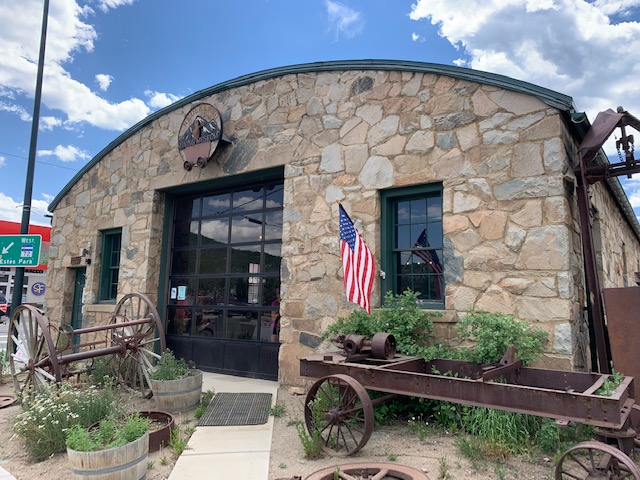
The Mining Museum in Nederland, Colorado

On a dry but hot Colorado June day, we drove to Nederland, one of Boulder County’s mountain jewels, past the Barker Meadow Reservoir with its deep blue waters.

The winding road carved between rock peaks and the Boulder Creek eventually took us to the tiny hamlet of less than 1,500 inhabitants. I could only imagine how cold, slippery, and right down impassable the road must be at times in wintertime. 

We were on a quest to visit the Mining Museum and the century-old carousel with its beautiful figures carved by hand by a Vietnam veteran. 


The one room museum had displays inside and out, rusting in the elements, a close-up look at the lives and history of the miners who lived, worked, and died in this area. Opened by the Nederland Area Historical Society, the museum was purchased by the county in the fall of 2012.


The hard rock mining days in Boulder County during the 19th and the early 20th centuries were brought home by the huge boulders lining the modern highway, at times perched seemingly precarious above our heads, cutting through the mountains. 

Boulder County’s history for the first 75 years was tied to mining, the leading industry in a barely populated area. The first gold strike in 1859 on Gold Hill brought more explorers and more discoveries of gold and silver. The boom-and-bust cycles of mining through the early 20th century opened newly discovered strikes, followed by abandonment when the ores were exhausted. It took one ton of rock and back breaking work to deliver one ounce of pure gold. 

Prospectors, working under unimaginably harsh conditions, would take their ore to the assay office whose employees would determine if individual prospectors “struck it rich.” Using heat and chemicals to test the ore, the assayer would deliver the good or the bad news to the prospector about the percentage of precious minerals found in the miner’s rock finds. These miners had migrated to the Wild West to become part of the 19th century hard rock mining boom. 

Museum Archives photo

Among the rusting equipment sitting inside and outside the building, one can see one of the few surviving Panama Canal steam shovels. Miners used tools like helmets with lamps, bells, trams, and rare mining claim maps to find their “gold.” But the real gold crown jewel was the steam-powered shovel, one of the largest in the world at the time. It scooped tons of dirt while helping canal workers in Panama to build bridges, roads, and drains close to the waterway.

The museum displays blacksmithing tools, maps and documents, ore samples, hand, and pneumatic drills, mine trams, maps, and documents from the 1860s to the present.

The Mining Museum is home to a 1923 Bucyrus 50-B steam shovel whose epic move was chronicled on The History Channel's Mega Movers. Of the 25 steam shovels that helped build the Panama Canal, only this one survives, and it is fully operational, weighing at 130,000 pounds and rated at 75 tons. The 1923 Bucyrus Model 50-B was returned to California, then Denver, and finally was donated to the town of Nederland in 2005. The rest were scrapped for metal in Panama.

According to historical records, 534 Bucyrus and Bucyrus-Erie 50-B shovels were built between 1923 and 1939. “They were among the largest tracked steam shovels in the world at that time. Until 1932, most were steam powered and moved on railroad tracks. In 1923, crawler tracks were added to the 50-B model, creating the first heavy duty, 360-degree rotation mobile shovels.”

The shovel was donated by Steve and Laurel Higgins to the Nederland Mining Museum on October 21, 2005. “This national treasure links a historic engineering achievement, the industrial revolution of the United States, local history of Colorado mining, and good old fashioned hard work by two brothers trying to achieve the American dream. Today it is one of the largest operating shovels in the United States.” Nederland Area Historical Society (nederlandmuseums.org)

Transported to Rollinsville by Roy and Russell Durand, this amazing steam shovel was used at the Lump Gulch Placer, six miles south of Nederland, until 1978.

Hard rock mining is extremely difficult. The rock was blasted with dynamite, the smaller pieces shoveled into buckets and carts, hauled out of the mine, then processed by a mill, ground into a powder, then chemicals were used to separate the valuable ore, usually gold and silver, from the waste rock, and then smelted into bars. These chemicals were poisonous for the environment. One troy ounce of gold was usually extracted from a ton of rock.

The miners used single- or double-jacking methods, holding a steel drill in one hand and a hammer in the other. After each strike, “the miner turned the drill a quarter turn to reposition the cutting edge.” In competitions, a miner could swing a hammer 90 times a minute, that is how strong they were. In double-jacking, one miner would hold and turn the drill and the other swung the hammer.

According to the Mining Museum, the following ores were mined/found in Boulder County:

-          Galena (lead ore)

-          Chalcopyrite (copper ore)

-          Lepidolite (lithium ore)

-          Barite (barium ore)

-          Petzite/Coloradoite/Hessite (gold/mercury/silver ore)

-          Mica

-          Sphalerite (zinc ore)

-          Gold (old ore)

-          Molybdenite (molybdenum ore)

Tungsten (“heavy stone” in Swedish), a rare metal with the highest melting point of all metallic elements, was mined in Nederland, at the time considered the tungsten capital of the world in the early 1900s. Tungsten is used for lightbulbs, TV tubes, steel alloys; tungsten carbide is used in drill bits, high-speed cutting tools, and mining equipment. 

WWI required a lot of tungsten which raised its price from $5 per unit to $105 and the town of Tungsten grew to 3,000 people in a sparsely populated area, and it became the richest town of its size in Colorado. According to the archives, “peak production in 1916 generated $4 million in revenue. Barker Dam had been built to provide power to the mills.  The end of WWI put a stop to the tungsten mining.”

Gold mining in the area took place from the mid-1800s to mid -1900s. Clear Creek was dredged with Eleanor #1 and Eleanor #2 on the historic Arapahoe Bar between 1904 and 1907 by the National Dredging Company (led by Herman J. Reiling); it was environmentally disastrous as the dredges left behind ruined fertile bottom soils forever.  The dredges scooped the rich soil from the riverbed and sifted out the “flour gold.” The “flour gold” was too fine for the technology of that time to be able to recover all gold from the soil of Arapahoe Bar. Golden, Colorado farmers refused to sell any more land to the company.

Silver was found with gold, copper, lead, or zinc and was a major operation in the Mines. But the market crashed in 1893 and the silver boom ended. Silver is used for jewelry, electronics, silverware, photography, finance, and investment.

The assay office took the miner’s rock finds to determine how much precious gold and silver were mixed in with other metals. The entire process, described by the museum archives, was quite complicated:

-          Crushing (the rock was pulverized like salt; a “chipmunk crusher” transformed the rock to pea-size, then a muller ground it to rock flour)

-          Splitting (separated the sample with a riffle splitter)

-          Weighing (a precision balance weighed exactly 29.167 grams of the sample)

-          Firing (the sample was poured and melted at 2000 degrees into a ceramic cup called a “crucible” to create certain chemical reactions, i.e., lead fuses with gold and silver)

-          Pouring into a mold (the lead dropped at the tip of the mold and the “slag” sat on top; the mold looked like a cornbread baking tray)

-          Cupellation (the lead button was put into a “cupel,” a small cup made of bone ash, and heated; during heating, the molten lead oxidized back to litharge and was absorbed by the bone ash; a small bead of molten gold and silver were left)

-          Parting (silver was dissolved using nitric acid, and only gold was left)

-          Final weighing (gold was weighed and converted into ounces per ton, thus determining the value of the ore find)

Miners spent most of their days underground, away from precious sunlight, and it was essential that they had good lighting in the tunnels. They used oil wick cap lamps, carbide lamps (invented in 1900, they burned acetylene gas produced by mixing water and calcium carbide), candlesticks, safety lamps, and electric lights. Safety lamps, invented in 1815 in England, reduced gas explosions. The electric lights were the safest. Thomas Edison invented a battery-powered electric light in 1914 which gave the miners 12 hours of lighting and could be recharged at the end of each shift.

Driving by the closed mines, one wonders what became of the families whose livelihoods depended on such hard and dangerous labor, devoid of sunlight, with fathers and sons toiling underground like moles to extract metals from the rocks. We could never genuinely appreciate the sacrifice these men made to provide society with metals like tungsten, silver, and gold.


Wednesday, November 4, 2020

Gold and Silver Coins Stored as Bullion in India During Roman Times


Gold and silver have a tremendous store of value and portability and it can increase value over time; a small amount can purchase anything during any period. Paper currency, on the other hand, can fall victim to corrupt governments, the lack of faith in them, and the disastrous monetary policy governments engage in such as printing money continuously, causing runaway inflation.

Gold and silver prices have fluctuated in the upward direction lately, responding to the economic uncertainty, the out-of-control printing of money to defray the economic losses due to the unnecessary and panicked COVID-19 -19 lockdowns around the world, and the political instability and violence in the U.S. ginned up by the radical left for the last four years.

In 1775 Roman gold and silver coins were found buried in southern India. Since Indians could not spend these monies in their respective economies, it was assumed that the buried cache of coins was derived from trade.  But what would the Indians do with such Roman coins since they could not be spent in their economy? Historians assumed that the only possible explanation would be that the Indian merchants were storing the gold coins as bullion.

Alexander the Great (336-323 B.C.) first connected the Mediterranean world with India. The usual land routes used before were prevented by the Parthian Empire of Persia. The merchants started using the sea to avoid the harsher land crossing and those who would stand in the way of their trade, including highway robbers.

Hippalus, a Greek merchant, is alleged to have discovered in the first century B.C. how to use the southwest monsoon to sail to and from India. For forty days in July and August, merchants who knew how the monsoon winds blew, sailed from Arabian ports to the Malabar ports in India’s southwestern coast. In December and January, having completed their trades, merchants returned via the Red Sea or the Persian Gulf to the Mediterranean Sea. According to historians, trade links were made with Sri Lanka, Burma, Malaya, Vietnam, and perhaps China.  https://timesofindia.indiatimes.com/city/chennai/A-glimpse-of-rare-Roman-coins-at-Museum/articleshow/7315542.cms

The coins, weighing the same amount regardless of which emperor’s head was depicted on the coin, made it convenient for the Indians to collect the coins as bullion. I am not sure if the practice of shaving coin edges for gold dust was in place during those times. Such a practice, of course, would have made coins weigh differently if the scales were sensitive enough to pick up the slight change in weight.

“The scholar Pliny reported that it was the unvarying quality of Roman coins – which were all the same weight and of the same gold and silver content despite the heads of successive emperors imprinted upon them - which impressed the King of Sri Lanka and inclined him favorably toward the honest traders of Rome.” (The Classical World, p. 153)

Even though Indian merchants did not use Roman coins as a direct exchange, they liked the designs on them and made cheap imitations of terracotta coins which were worn around on a leather chain as jewelry.

When export restrictions were imposed and Nero debased silver coins during his reign, the Indian merchants lost faith in the bullion value of Roman coins and refused to accept any more in trade.

As a substitute, Indian merchants accepted high-quality tableware, glass, linen, coral, lamps, worked gems, and wine. Evidence of pottery fragments was found in 1940 at Arikamedu near Pondicherry, a Roman trading station.

As demonstrated by archeological digs, Arikamedu stored Roman pots and dishes, fine wines, and tableware. Jewels were fashioned in Arikamedu’s workshops which also dyed muslin cloth. Arretine ware (made in today’s Arezzo, Italy) was found, including an intact bowl with molded decorations.

Ships were said to arrive from India with wonders such as a “large river turtle, snakes, and a partridge ‘as big as a vulture.’” Pearls and precious stones were brought into Rome.  “Imports flooded into Rome as 120 monsoon-borne ships sailed each year from Roman-controlled Egypt to India, to pick up their precious cargoes.” A mural found in Ostia, Italy, depicts a Roman trading ship from the second to third century A.D. being loaded with goods.

According to historians, the trading agents for this commerce were the Greeks from Alexandria. They dealt in spices, pepper, muslin cloth, perfumes, ivory, gemstones, and pearls.

During the third century AD, when direct trade with India stopped, reflecting the overall commercial decline in the Roman Empire, Arabs and Persians took over the trade.

Thursday, July 23, 2020

War on Cash and One World Currency

Money greases the wheels of exchange, and thus makes the whole economy more productive. The idea that everything should be cashless is problematic for so many reasons. Bartering is a good under certain circumstances and societies, but it relies on what Keynesian economists call a “double coincidence of wants,” making it less desirable than cash.

Cash is easier because it is a convenient medium of exchange, sometimes free from government prying eyes, a unit of account for quoting prices, and a store of value as long as the trust in government is not eroded and inflation is low.

Cash is lightweight, can have large denominational value, does not spoil, and is thus better than commodity money, i.e., cigarettes, bullets, chocolate, jewelry, gold coins, pelts, furs, soap, etc.

From the government’s perspective, it is easy to see why they would want a cashless society. Banning cash under the guise of it being infected by disease, of controlling money laundering of criminals and drug lords, and routing all of our income, every last penny through the banking system helps them better control everything we do, freezing accounts at will, while taxation becomes so much easier, including payments to Obamacare insurance and any financial penalties an individual is required to pay. It enables governments to track with 100 percent accuracy everything we buy and sell, everything we own, and everything we do.

From the people’s perspective, cash is freedom, but the leftist main stream media is attacking it with pathetic excuses such as cash is physically dirty, expensive, potentially criminal, and obsolete 19th century technology, happily promoting the “war on cash.”

The media’s opposition sees the “war on cash” as another form of population control when people’s accounts can be raided and their owners classified as potential domestic terrorists, or denied healthcare, travel, education, and other services if they are marked with a “digital star.”

The issues with a cashless society are too many to mention them all:

-          Total control by the state or its proxy

-          Savings could result from not using special paper, printing, ink, labor, and metal alloys but then those in the trade would become unemployed

-          If an attack occurs on the Smart Grid and there is no power, there are no financial transactions possible without some cash, a substitute, or barter

-          In the event of a national disaster, i.e., earthquake, tsunami, hurricane, tornado, power outages, transactions can be made by cash, commodity money, or barter

-          An EMP attack or intense solar flares would make cash or one world currency worthless and people will resort to theft

-          A cashless or global currency would give banks extraordinary power with no cap on interest rates or their control

-          Cashless transaction will always be traceable and thus the person’s location

-          One world currency in a cashless market would eliminate exchange rates, currency trading futures, eliminate a substantial sector of the job market and thus revenues

-          Black markets and illegal activities would be eliminated, and everyone will be forced to pay taxes on every penny

-          Children under 18 would be excluded from holding credit cards and thus excluded from financial transactions without cash; no more grandma cash gifts, lawn mowing money, or rainy-day cash savings in a jar

-          Prostitution will have to be legalized and client’s names become public record

-          Billions of Muslims would lose hawala transactions which are based on cash

-          Conducting monetary policy about money stock will be altered as cash disappears and one world government such as the U.N. would have to do it

-          Labor will be purchased and sold with electronic credits and debits

-          How would the value of one world currency be decided? Will it be tied to gold, silver, platinum, or some other precious metal or decided arbitrarily by the United Nations?

-          The destabilization of economies via counterfeit currency between countries would be eliminated as a tactic of war if only one currency exists

-          What would cyber attacks do to a single grid of digital money?

-          What would happen to third world nations that are not so electronically wired and depend heavily on cash and barter? How could they possibly make transactions in digital money?

-          Would there be electronic counterfeit of digital currency across the globe and who would police it? http://canadafreepress.com/article/what-would-the-world-be-like-without-cash-or-with-one-currency

Yet “The Bank of International Settlements is getting headlines again because of its direction of central banks to go cashless.” https://www.technocracy.news/the-dark-past-of-the-bank-for-international-settlements/


Wednesday, December 18, 2019

The Bureau of Engraving and Printing

Wikipedia photo
The next stop on our cold day D.C. tour was the Bureau of Engraving and Printing, the place where billions of banknotes, without any backing of gold, or even sufficient goods and services, are printed at the request of the Federal Reserve (the Fed) which engages in fractional reserve banking and controls our money supply and interest rates.

The Fed, despite the name, is not really associated with the federal government as people think, it is a private corporation composed of twelve federal reserve banking regions with individual member-banks which are also corporations with shareholders. The Chairman of the Federal Reserve does inform Congress periodically about interest rates and whether the price of lending and borrowing money is going to change.

For a long time, banks in various towns printed their own currency which could only be used as a medium of exchange in that town. The currency was worth something only so long as the bank stayed solvent, was not robbed, or experienced a run-on-the-bank when all depositors withdrew their money at the same time.

On August 29, 1862, six employees, two men and four women, started operating in a one-room attic out of the main Treasury Building which is located near the White House.  They separated and sealed one and two-dollar notes made by private printing companies which were under contract with the federal government. For fifteen years, bonds, notes, and other valuable paper was engraved and printed in this part of the Treasury.

By 1880, the larger production had outgrown the facility and Congress appropriated $300,000 to build the first location of the Bureau. In 1894 the Bureau of Engraving and Printing expanded operations to postage stamps printing and the Bureau moved to a $3-million location in 1914. Today, with the added annex, the Bureau occupies 27 acres. In 1991 the Bureau opened the Western currency facility in Fort Worth, Texas, the first outside of Washington, D.C.

The vast spread employs 2,500 people, manufacturing 28 million banknotes a day in both facilities.

The Federal Reserve (the Fed) is considered the Bureau’s customer and the nation’s central bank. The Federal Reserve, a private corporation with shareholders not tied to the federal government, gives an annual order of currency printing (new notes and notes to replace old and worn out currency) and the order is divided between the two facilities.

Every 7-10 years the currency is changed in order to deter counterfeiting. Color shifting, security metal threading, microprinting, and watermarks on the cotton/linen paper have been added to various dollar denominations. Three colors are printed simultaneously on both sides of the currency, adding more security. The printing presses can produce 14 colors simultaneously. The Secretary of the Treasury has the final decision-making power as to what changes are made to our currency.

Prior to 1929, the size of the currency was much larger than that in use today. The bureau printed demand notes, U.S. notes, national bank notes, gold certificates, treasury coin notes, silver certificates, Federal Reserve Bank notes. Printers produced sheets of four notes and sent them to the Treasury Department where they were signed, separated, and trimmed by hand before issuance.

U.S. Notes (Greenbacks) were issued in denominations of $1, $2, $5, $10, $20, $50, $100, $500, $1,000, $5,000, and $10,000 and used well into the 20th century (1862-1994). After 1994, they were no longer issued.

Fractional currency  (notes with values less than a dollar) was authorized and issued during the Civil War due to a shortage of coins.

Gold certificates were issued 1865-1935 whereby people deposited gold in the Treasury and received gold certificates in exchange.  But later the U.S. government moved to own the gold that backed the certificates. Denominations were the same as Greenbacks plus a certificate of $100,000.

Demand notes were only issued 1861-1862 in denominations of $5, $10, and $20. They were authorized by Congress in order to pay for the Civil War. Demand notes were redeemable “on demand” for gold coin at certain Treasury facilities.

Some financial instruments issued by the bureau involved war savings certificate stamps and thrift stamps. The War Savings Certificate stamps were offered during 1918-1921 and it consisted of $5 stamp purchased for $4 at the beginning of the year of issuance; it increased in value each month and reached face value after five years. The stamps could be affixed in a War Savings Certificate pamphlet. The certificate held 20 stamps, totaling $100. If the bearer had one complete certificate, he could exchange it for a $100 Liberty Loan.

The thrift stamps were offered in 1918 to those who could not afford to buy war savings certificate stamps. The 25-cent thrift stamp was popular with elementary schools, community groups, and places of employment; they organized thrift stamp sales. A thrift card held 16 stamps, equaling $4. A complete card booklet could then be exchanged for a War Savings Certificate stamp.

Gold coins were produced by the U.S. mint from 1795 until 1933. The Great Depression and the financial crisis forced the U.S. to end gold circulation. The Gold Reserve Act of 1934 prohibited most private possession of gold. The restriction ended by Executive Order in 1974. The Mint produces today a limited number of gold coins for collectors.

Looking at some foreign currencies that are quite colorful, one can understand how they would be hard to counterfeit with modern printers as it would be impossible to match every color exactly without disturbing the hues of others.

Adding three-dimensional holographic features to currencies does not work well as the holograms cannot survive the multiple-folding and rolling-tight test. The American dollar can survive intact after multiple days of baking in the sun and multiple laundry tests since the paper is made from a combination of cotton and linen. The famous green ink of the “greenback” is produced by the same company. Computers monitor the ink levels and its quality.

The 32-notes per sheet require 72 hours of curing time between the printing with the green and then the black ink. Intaglio printing is achieved with presses that can create ten tons of pressure without cutting the paper, creating the raised surface feel. After each 32-note sheet is examined by computers and by humans against previous ones, the sheet is cut into two 16-notes sheets.

Currency overprinting adds the Treasury seal, the Federal Reserve seal, and serial numbers. The 16-subject sheets are then cut into notes and packaged into bundles of 4,000.  One large shrink wrap contains 16,000 notes. Every currency is numerically sequenced and accounted for in terms of date, time, and year, and where it was shipped to.

The bundle is sent to the Federal Reserve vault where the money is “monetized,” it is now real money because the Federal Reserve says so. In terms of intrinsic value, the banknote is only worth the paper, the ink, and the labor that was put into it to design, print, and inspect it.

Our currency is nothing but a medium of exchange, fiat (Latin for “let it be”) money, deemed so by the government. It has no value as a commodity, but it has value only because people have faith that the issuer will stand behind every piece of printed paper and limit their production.

The question is, do they only replace worn out bills? Obviously, the Federal Reserve has the power to “monetize the deficit,” printing money in excess of goods and services produced in a year in the U.S. If they didn’t print more, how else would we have such a huge national budget and national debt in the trillions of dollars, over $23 trillion at the writing of this article? And that does not even include all the unfunded liabilities such as Social Security, Medicare, Medicaid, unfunded pensions, or unfunded debt. https://usdebtclock.org/

To get a more-dimensional idea of how truly unpayable our national debt is, consider this: 233 of $100-notes make one inch for a total of $23,300. If you are 5’ 10” tall, your height represents $1,631,000 in currency.

Look at the Weimar Republic and what happened to their out of control printing of money – runaway hyperinflation which required an entire wheelbarrow of money to buy a loaf of bread - an opening for a two-bit dictator called Adolf Hitler to come to power by promising a good economy and prosperity.

Can we accurately measure the supply of money, coins, paper money, and checkable deposits? Not because we have no idea how much illegal cash circulates in the underground economy. We can measure well what banks hold in deposits and in the vault in their fractional reserves if their books are kept accurately.

Every dollar kept in the bank’s vault has the potential to eventually create several dollars’ worth of bank deposits once loans are paid back in full.

Bankers’ decisions on how much to hold in reserves in the vaults influence the supply of money. But there are banks that do not belong to the Federal Reserve System and do not follow the Fed dictates.


Friday, May 5, 2017

My Box of Random Memories

I opened the box carefully. I have not seen its contents since May of 1989 after my Daddy’s passing.  The round Pobeda watch with a blue dial and a brown leather band was the first object I picked up. It was Dad’s watch. He was wearing it the day they threw him off the refinery crane into a pit of metal shavings. I think uncle Ion had replaced the leather band because it looked too new. I was surprised that there was no scratch or evidence of the severe fall that cracked Dad’s skull but this delicate glass did not even have a visible scrape. The winding mechanism still runs; I am not sure if it keeps good time. 

There is a small wooden spoon I painted in the tenth grade with the head of a typical peasant girl dressed in Romanian ethnic scarf. I saved it in memory of my grandmother whom I used to watch prepare food for our family with such a simple wooden spoon decorated with chiseled burns onto the handle.

I pulled out an intricately hand-made leather wallet. I opened the folds and the smell of leather wafted like a fine perfume.  Dad gave it to my husband as a wedding present 40 years ago; it looks as it did the day my Dad purchased it. Bill never wore it because it was too big, it did not fit American dollars but I saved it. There are no slots for credit cards; back then, credit cards were unheard of. We conducted business with cash, personal checks, and traveler’s checks. Farmers used the old system of barter. People strapped for cash paid for the doctor’s visit with chicken or a dozen fresh eggs.

Dad used to order hand-made fine wool suits for his son-in-law but a gentleman farmer did not need such fancy clothes. We always gave them away to a Chinese friend who wore the same size. Dad never knew and he continued to order one new suit each year. I am sure, it cost him a pretty penny. I did not have the heart to tell him to stop; it made him happy to keep my ex well-suited. Dad’s cousin was a cobbler who made fine leather shoes to order. They were beautiful but very uncomfortable. Bill never wore those either. We gave those away too but we did tell Dad the truth about the shoes.

A delicate ladies watch, well-worn, was my gold watch I bought when I first started to work in the U.S. I am not sure why I bought a real gold Swiss watch for the grand sum of $150, my weekly pay. I wanted something that would last a long time, which it did, but also something valuable that no communist would ever confiscate just because they were in power. I was told Wyler Swiss watches  are no longer made.

At the bottom of the box is an album which Mom assembled when Dad passed away. I opened a few pages and I realized that they are all photos from his funeral. So painful to look at his casket, the mourners, the flowers, his frozen face in death, barely recognizable after the long suffering in a hospital that gave him no food or fluid infusions for three weeks prior to his death.  Aunt Marcella fed him droppers of liquid and kept him alive until he lost so much weight that his organs began to fail.

Aunt Marcella, now 92 years old, is still alive and, following a successful broken hip repair surgery, has been moved to a nursing home that caters to the elderly with special medical needs who have no immediate relatives. Such places did not exist under communism, families took care of the elderly. But families have split up all over the world now.

A sterling broach, now tarnished black, is my 1977 wedding present from Dad. He bought it in the Omnia department store in our home town for 900 lei, literally more than his entire month’s salary. He had seen me admire it in the window every time we strolled past the department store on weekends. It was such an extravagant gift! I cleaned it and the delicately woven silver looked brand new again. Tiny amethysts cabochons decorated the round surface. It must have been made in China because it was the only trading partner for fine jewelry during the communist era.

A silver fish pendant, covered in delicate cloisonné scales, was a gift which Mom brought back when she traveled to the home country in the mid-nineties. There is an old silver violin and a frog pin I collected from the early 1980s. They have oxidized as well, not having been touched in decades.

A beaded flower necklace I painstakingly strung bead by bead added color to the Memory Box. I was so homesick and lonely in 1978, I picked up the hobby from a craft book. An experimental artist at heart, I could not afford to paint or draw, materials were hard to find in the backwoods where we lived and probably expensive, way out of reach for our $200 per month income. But beads, a needle, scissors, and fishing nylon thread were cheap. And my eyes were sharp as an eagle’s back then. One solitaire gold earring, still shining, was stuck in the red velvet lining in the corner. I wondered who lost the other one.

A black-beaded and quite heavy evening bag, with its brass snaps and chain turned green from the passage of time, was not missing any of the intricate design opaque beads. Daddy gave it to me before my high school prom to match the red woven polyester dress. I have worn this black bag many times since to parties and held it close to my heart and wrist. It was something tangible from the Old World that I missed so much. And Daddy worked really hard to buy me this special gift.

The brass key to the Memory Box is still held by a red and white silk tassel. The beautiful mother of pearl inlay swirled delicate cranes. The box came all the way from Korea in our friend’s luggage who was assigned there on military duty.  He had expensive taste and knew how to pick lasting gifts. The dark wood and lacquer stood the test of time quite well despite the humidity in the South.  

What will happen to this box one day, who will throw its contents away and replace them with her cherished memories?

Thursday, May 7, 2015

Dacian Gold's Heavy Price

Dacian bracelet from Sarmizegetusa
Photo: Wikipedia
Historians agree that some of the Roman military campaigns were motivated by the need to find and control ore reserves required for coinage. Monetary payments were made for a while using un-coined bronze called aes rude and cast bronze ingots called aes signatum.

Rome eventually built its own mint and coined silver denarii and smaller coins of bronze. During Emperor Augustus’ reign, a gold coin called aureus was minted, which could be exchanged into silver denarii. Because the Greeks kept their silver drahms as a basis for their monetary system, money exchangers of various currencies were found in large cities. Constantine introduced the gold solidus as a counter measure to the diminished weight and metal content of coins of the third century A.D.

A treasure trove of Roman coins, imperial aurei and denarii, was found in India, proof of the trade in spices and pearls, but also evidence that Indian merchants were collectors who may have prized the Roman gold and silver coins enough to horde them. According to Strabo, 120 ships “sailed every year to India from the Red Sea” and each cargo was extremely valuable.

Coins were not just a medium of exchange and store of value, but important means to advertise legendary figures, military campaigns and victories, buildings, roads, construction projects, and the image of the emperor. Julius Caesar was the first emperor to use his own visage on coins instead of the portraits of previous rulers as it was the custom.

It was thus of great importance for Rome to find new gold and silver reserves in order to feed the need for precious ore to mint coins for the Roman Empire.

Emperor Trajan, during his 19-year rule, managed to defeat in 105 A.D. the Dacians, a thriving civilization, the ancestors of the Romanians of today. Located north of the Danube River, the Dacians were a constant irritation, attacking and raiding the outskirts of the Roman Empire.

Following two years of Dacians Wars after Trajan’s 101 A.D. invasion of Dacia and a negotiated peace which the Dacians immediately broke, the Romans attacked again in 105 A.D., crushed them with tens of thousands of troops, and returned victorious to Rome, bringing back a half million pounds of Dacian gold and one million pounds of Dacian silver, including a very fertile new province with massive fields of grain necessary to feed an imperial army.

In May 2000, treasure hunters with metal detectors and exploratory knowledge found Dacian reddish solid gold bracelets and thousands of silver and gold coins buried at Sarmizegetusa, the former capital of the Dacian civilization. The stolen coins and 13 hammered bracelets weighing 27.5 pounds have been since recovered but Lot 26 is still missing. Individual coins have appeared for sale at various auction houses and online, ranging in price from $300 to $10,000.

The exploration for gold and silver took place after the fall of the communist regime in 1989 when digging permits and necessary materials became easy to obtain and the freedom to roam about undisturbed was returned to the population. For generations, the locals told stories about the buried Dacian gold, some of which was found in a rock chamber inside a 75 degree incline. The locals were unable to dig or explore around the area due to the stringent control of the communist regime over all natural resources, land, water, and any kind of human activity or movement.  http://news.nationalgeographic.com/2015/03/150320-romanian-dacian-sarmizegetusa-gold-looted-recovered/

Learning from the recovered coins interesting aspects of the Dacians’ life and religion, archeologists also determined that the coins were crude copies of Greek coins and were never in circulation. Likewise, the bracelets were never worn; they were made from local gold and buried into the ground for safekeeping.

Cassius Dio wrote that Decebalus diverted a river in order to hide silver and gold in the riverbed from the Romans. Dacian prisoners told their captors about the location of the treasure. However, Dr. Barbara Deppert-Lippitz argued that the burial of crudely made gold and silver coins and bracelets was not hoarding, they were sacrificial offers to the gods in caves and riverbeds because they believed caves and water were portals to the other world. https://www.facebook.com/media/set/?set=a.178024582360956.1073741832.167633503400064&type=3

It is perhaps because of Trajan’s conquest and the subsequent colonization of Dacia by the Roman Empire that Romanians, surrounded by Slavic-rooted countries, speak a beautiful and complicated language that is closest to Latin of all six Romance languages and their numerous dialects: Italian, French, Portuguese, Spanish, Romanian, and Romansch (spoken in one of Switzerland’s cantons).

When Sarmizegetusa, the capital of Dacia, fell and it was looted and burned to the ground by the Romans, its ruler, Decebalus, did not wait for the Romans to humiliate him into surrender; he committed suicide under an oak tree, as depicted by the top freeze of Trajan’s Column.

Andrew Curry describes for National Geographic how archeological digs in the area of Sarmizegetusa revealed the devastation left behind, the iron ore furnaces, tons of iron chunks ready for smelting, evidence of the fortress’ role in metal production of weapons and tools which were then exchanged for gold and grain. (Trajan’s Amazing Column, Andrew Curry, National Geographic, April 2015)

Curry said that “gold coins with Roman images and bracelets weighing up to two pounds each were looted from the ruins of Sarmizegetusa,” including jewelry and art, such as a gold and silver drinking vessel, “a wealth of ‘barbarian’ art.” They were not so barbarian after all, as the archeological finds reveal a sophisticated and thriving civilization wiped from “the face of Europe” by Trajan who “crossed the Danube River on two of the largest bridges the ancient world had ever seen, defeated a mighty barbarian empire on its mountainous home turf twice.”

Romanians analyze today the 126 feet stone column in Rome, topped with a bronze statue of the emperor who destroyed a thriving civilization. Like a boa constricting its prey, base-reliefs spiral to the heavens around Trajan’s Column, carved for eternity, telling the story of “Romans and Dacians who march, build, fight, sail, sneak, negotiate, plead, and perish in 155 scenes.”

The column is valuable historical evidence that has survived the fall of the Western Roman Empire in 476 A.D. It offers clues about uniforms, weapons, equipment, and tactical warfare, portraying Trajan as the victor and Decebalus as a worthy opponent but a vanquished leader.

Andrew Curry explained that the column was revered by tourists, writers, painters, sculptors, and archeologists. Goethe, the famous German poet, “climbed the 185 internal steps in 1787 to ‘enjoy that incomparable view.”’

If you ever visit Italy, the number one pastime of tourists is to climb stairs of towers, churches, and edifices left from generations of builders who always tried to outdo each other’s life work in height and majesty. The fact that Trajan’s column and many other buildings have survived the numerous earthquakes of time, fires, and plundering is a miracle in itself.

Filippo Coarelli, archeologist and art historian, described the dramatic scenes such as “The Dacian women torturing Roman soldiers” with flaming torches and “The weeping Dacians poisoning themselves to avoid capture” or perhaps drinking water. He compared the carving with a scroll (volumen) built on 17 drums of “the finest Carrara marble.”

Ernest Oberlaender-Tarnoveanu, director of the National History Museum of Romania, disagrees on the interpretation of the women’s freeze. He said, “They’re definitely Dacian prisoners being tortured by the angry widows of slain Roman soldiers.”

The victorious emperor is carved 58 times, his legionaries are depicted building forts, bridges, clearing roads, harvesting crops, and African cavalrymen are shown with dreadlocks, “Iberians slinging stones, Levantine archers wearing pointy helmets, and bare-chested Germans in pants.” (National Geographic, April 2015)

Tacitus called the Dacians “a people which never can be trusted.” They accepted protection money from Rome while sending their fighters to raid Roman frontier towns. Roberto Meneghini, as quoted by Andrew Curry, said, “Look at the Romans fighting with cutoff heads in their mouths. War is war. The Roman legions were known to be quite violent and fierce.”

The defeated Dacian fighters became a favorite subject for sculptors, said Curry. “Trajan’s Forum had dozens of statues of handsome, bearded Dacian warriors, a proud marble army in the very heart of Rome.”

The column was not built for Dacians, it became a monument to display the power of the imperial war machine, “capable of conquering such a noble and fierce people,” said Meneghini. The Dacians who had survived were captured and sold into slavery.

Given their tumultuous history and numerous occupations, including centuries of bloody battles, tribute to and plunder by the Ottoman Empire, and modern-day political corruption, it is easy to understand why Romanians today are so circumspect of any investors who are considering exploring and mining the gold reserves left in Roșia Montană and the potentially damaging environmental effects.

Mineral resources and gold have been extracted from the Apuseni Mountains in western Transylvania since Roman times. Concerns over cyanide pollution like the 2000 cyanide spill in the Someș River at Baia Mare (the worst environmental disaster in Eastern Europe since the Chernobyl disaster) by the mining company Aurul (Gold), and worries over the preservation of the remains of the Roman mining site, added to the controversy surrounding the opening of new mining operations under Gabriel Resources of Canada. http://en.wikipedia.org/wiki/2000_Baia_Mare_cyanide_spill

Ileana Johnson 2015