Showing posts with label Grand Canyon. Show all posts

Friday, April 24, 2026

Invisible Force of the Grand Canyon

Two years ago, Dave and I visited the Grand Canyon, the South Rim. When the colossal chasm of rock and chaos, colored in purple, orange, pink, beige, and brown opened to my view I was overcome by a feeling of dizziness that I could not explain.

I was nowhere near the lip of the gorge, yet some invisible force was drawing me to it into this spell bounding rocky miracle and promising to slide me into the tranquility and silence of the sharp-edged gorge, pulling me with an invisible power.

While Dave, with his sandaled feet scampered below the rocks, a very dangerous move, I stayed as far away from the lip as possible. I got vertigo and could not explain why.

I learned since then that thousands of visitors experience a destabilizing force and adjustment when gazing inside the canyon for the first time. A number of them have become so dizzy that they actually toppled over the edge.

One example is a 1989 visitor from Japan, Yuri Nagata, who, when she was admonished that a German woman lost her balance and fell to her death three days earlier when she was watching the sunset, Yuri became wobbly and plunged over into the slope below, rolled several yards and then skidded over a 360-foot cliff. Yuri screamed all the way down to the horror of onlookers.


Friday, October 3, 2025

Bacon, Beans, and Moldy Flour

John Wesley Powell's expedition floating down the Colorado River in the Grand Canyon in 1869 was running low on food rations; the storage had flour, smoked bacon, and beans but they were becoming increasingly moldy from the frequent dunking by the large waves and rapids. Every member of the expedition was dreaming about real food with each moldy meal they consumed. Hunting was eluding them and so was fishing. If they spotted a deer or a goat, it disappeared before they got closer to it. One day, one of the expedition's adventurers, Hawkins, was seen carrying the sextant up a hill. Not being known as a scientific mind, Powell asked him what he was doing with the sextant. Hawkins replied, "I am measuring the latitude and longitude of the closest pie."

Monday, September 29, 2025

Desolation Canyon and A Pair of Well-Worn Drawers

On July 8, 1869, the famous expedition of John Wesley Powell down the Green and Colorado Rivers through the Grand Canyon took an almost deadly turn. 

It was not an exaggeration that, up to that point, they all survived on borrowed time, given all the accidents and close calls that they encountered along the way while running the rapids, rowing, portaging the four heavy boats with all their food, utensils, instruments, and clothes, and other needed supplies. 

The raid of a Native American garden left unattended, not far from the Uinta Indian Agency, from which they stole potatoes, vines and all, almost killed them. Sick of dried beans, bacon, and hard tack, they decided to eat the greenery too. How bad could it be, they wondered? Unbeknownst to them, a ragtag of ten Civil War veterans and adventurers, potato greens are a relative of the deadly nightshade. Both plants contain the hallucinogen solanine.  

To say that they were deadly sick in the middle of nowhere, far from any civilization and medical remedies, is an understatement. As they all recovered, there is no doubt that they were quite tough and resilient. A mile down the river from the garden, the thieving gang must have regretted their crime. Sumner wrote, "such a gang of sick men I never saw before or since." Hall wrote that "he had coughed up a potato vine a foot long, with a potato on it as big as a goose egg." Even the tough Powell was in bad shape. 

The boats pulled to shore and "we tumbled under the trees, groaning in pain, and I feel a little alarmed, lest our poisoning be severe," wrote Hall. By supper time, most of them recovered and Sumner wrote that he "didn't think potato tops made good greens for the sixth day of July." Bradley comically remarked on the poisoning incident, "we shan't eat any more potato-tops this season."

Two days later the expedition found itself in such a bleak canyon that they named it Desolation Canyon. Grey and brown rocks surrounded them everywhere and shut up hundreds of feet. Not having any ropes, safety gear, and missing one arm which he had lost in the Civil War, Powell decided to climb up with Bradley and a barometer to measure the elevation. 

They started from a gulch, passing broken rocks, crevices, benches, until they ascended six or eight hundred feet and then suddenly found themselves in front of sheer precipice. 

Inching their way up a couple of feet at a time and passing the barometer back and forth, the pair found themselves suddenly in dire straits. Powell wrote, "I gain a foothold in a little crevice and grasp an angle of the rock overhead. I find I can get up no further and cannot step back." 

Powell had no choice and called Bradley for help. Bradley was on a ledge above Powell but could not reach him nor could he stretch any stick to haul him up. If the one-arm Powell let go, he would fall. As it was, he was standing on his toes and his muscles began to tremble, an involuntary spasming called today "sewing machine leg." 

Powell wrote, "If I lose my hold, I shall fall to the bottom, and then perhaps roll over the bench, and tumble still further down the cliff." The top of the cliff was at about 1,000 feet altitude. One cannot imagine that today anyone would attempt climbing such a sheer cliff without ropes and gear, especially while missing one arm.

Bradly devised a "desperate scheme." He stripped his tattered drawers and dangled them for Powell to catch from below. The problem was that the rock was hanging above Powell's head and the drawers dangled behind him. 

To grab this unusual lifeline, the one-arm Major Powell had to let go of his handhold, lean back into empty space, grab the drawers with his left arm, and pray that he would not lose his grip and tumble hundreds of feet below to his death. 

Bradley, weighing in at 150 pounds, was able to hold onto his drawers from which 120-pound Powell was dangling with all his might. 

The pair continued their climb as if nothing had happened and once they reached the summit at 1,000 feet above the river, they were rewarded with a view of "wild and desolate outlook, with sharp, jagged peaks in all directions." 

Bradley and Powell lived another day and their three-boat expedition on the Colorado River inside the Grand Canyon continued. 

NOTE: The two stories were told in the 2001 book, Down the Great Unknown, by Edward Dolnick.


Sunday, August 4, 2024

Feeling the Silence of the Grand Canyon


Of all the magnificent places I have seen around the world in my lifetime, nothing had ever prepared me for the surreal moment when my eyes were filled by an otherworldly sight, with an ethereal light, rock spires, cathedral rock buttresses, and indescribable colors of the most beautiful and dangerous gorge God has ever created.

Colin Fletcher called it the “soft, luminous light of a desert crevasse.” I found it to be a luminous Chasm painted in a fusion of pastel hues of blue, lavender, pink, yellow, and orange. Even looking at the canyon from afar, safely away from the rim, my eyes could not fix on any magical feature and my head was spinning in vertigo that continued even after I closed my eyes.

From the lip of the South rim, the depth, the distances, the sharpness of the sculpted and dangerous rocks were dizzying – cliffs, buttes, terraces, boulders hanging by a thread suspended in the air, hidden crevasses, hidden fatal cracks in what appears as a solid boulder, swirling dust picked up by the updraft currents, the suffocatingly hot temperatures going down, and the rain of rocks dislodged accidentally by the occasional hiker making his/her way down.

The Void is carved randomly through the rocky plateau of northern Arizona, more than 277 miles long and over a mile deep in the center. Its width is ten miles in some places, 21 miles via a well-beaten trail, and in others, thirty, and even forty miles wide depending on where and how one hikes across.

The silence of the canyon in day time is like a silent movie from long ago and at night it becomes dark silence that swallows even the sound of the drumming of rain.

Utter silence, seldom punctuated by the screeching sound of an occasional bird flying above, dominated this colossal amalgamation of rocks, allegedly cut through by the Colorado River. Watching the random lacy shapes, I could not help but think of Noah’s flood when perhaps this massive canyon, a dangerous and massive Wonder of the Natural World, was under water.

I could feel with every fiber of my being the utter silence of the Grand Canyon affecting all my senses with its primordial rocky loudness.

Thursday, June 20, 2024

Why the Grand Canyon is Meant to be Admired from Afar

In July 2009, Bryce Lee Gillies of McLean, Virginia, a physics student at Arizona State University, decided to celebrate his 20th birthday by hiking solo in the Grand Canyon.

The 5' 3", 130-pound young man decided to traverse the most stunningly beautiful loop from the North Rim down to Surprise Valley.  All his attempts to find a friend to hike with him had failed so he decided to go alone.

He parked his Subaru at the Bill Hall Trailhead and hiked without sufficient water and experience for an entire week. After getting lost, he collapsed on a boulder, face-down, dead from heatstroke and dehydration. By the time intense searches were launched and he was found, his body had turned black and bloated from the intense heat.

The 27.6-mile hike he attempted, which Backpacker Magazine had described, "This could very well be the toughest long weekend hike in Grand Canyon National Park, but you won't regret a single sunny mile," ended Gillies' life.

He typed on his Blackberry while he was dying, "Life is good whether it is long or short. I was fortunate to see more than most, and for that good fortune I am most thankful." He also typed that he believed in God but was not sure what the afterlife was like, "but I hope there is water."

He was glad that he had a Blackberry with him, otherwise it would have been hard to carve words in the rocks surrounding him, he typed. His final sentence was, "I feel like going into the wild is a calling all feel, some answer, and some die for."

One of the park rangers named Sueanne Kubicek was assigned the painful and difficult task of driving his white Subaru from the Bill Hall Trailhead and of gathering soil in a small bag, which his family had requested -- soil from where he had lived his last dream before taking his last breath.

When Sueanne opened the car door, inside was a plastic gallon jug of water, awaiting Gillies's return from the hike.

His death was among the 125 known and recorded deaths classified as "environmental." Many others who have died of environmental factors, i.e., heat stroke, dehydration, and hyponatremia (low salt in the blood due to overdrinking liquids) are not known nor recorded since the park opened in 1919. Five people were established to have died before the opening and their deaths were also included in the 125 fatalities due to environmental factors.

Note: Yet millions of unsuspected hikers were lucky to have made it alive from the Grand Canyon, some carrying their toddler children in their backpacks and lived to talk about it.

Monday, June 17, 2024

Thoughts on Hiking in the Grand Canyon

I am reading a book I purchased in Grand Canyon village, "Over the Edge: Death in Grand Canyon." Had I read this book before our visit, I would have NEVER gotten anywhere near the South Rim or North Rim for that matter.

I am so glad we did not choose to hike down on any trail! My adrenaline junkie husband did go down on two trails totally unprepared but not far, relatively speaking. He had a tough time climbing back, a really tough time. And he is not in the worst shape for his age. 

One of the lessons I learned from the wise and seasoned guide, Michael P. Ghiglieri, is that "canyoneering is not mountaineering." Hiking on flat ground, hiking on mountains, and hiking in canyons are quite different.

Hiking on flat ground is obvious unless you are hiking in the desert with shifting sands, sink holes, intense heat, rattlesnakes, scorpions, or alligator-infested swamps.

Speaking of scorpions, one of our guides, Derrick, told us that he rented a house cheaply in Phoenix and, upon moving in, he realized that the house, while empty, had been colonized by scorpions. He was in the process of trapping them and using up a lot of glue traps until he realized that scorpions are cannibals. So, he left the traps in place longer until they were quite full.

Hiking in the mountains you learn early on how unfit you are, and that realization weeds the unfit out in the early game and you can return to the staging area, your life is spared.

Hiking down into the Grand Canyon, the trail appears easy, the air may be cool, there is often a breeze, and you are making good time going down. Then the unfit and unprepared must hike back up.

Ghiglieri wrote that "it is often a hot, dry, hard, agonizing, and often torturous physiological contrast to the descent, the unfit get weeded out late in the game and get weeded out brutally. Sometimes fatally."

The levels of heat and thirst in the Grand Canyon are unforgiving. And in wintertime you can get buried alive and freeze to death from sudden snows. And you can get trapped in rock crevasses. And during the monsoon season you can drown from floods coming from miles away.

Ghiglieri wrote, ...."many of us hiking in Grand Canyon seem more like bizarre medical experiments tossed into an alien landscape of hostile, temperatures, desiccating winds, and fierce solar radiation to see how long we can walk before we collapse."

It is an alien landscape filled with sharp edges, huge boulders, crumbling rocks, slippery rocks, sheer cliffs, huge walls, desert climate, intense solar radiation, dry heat sucking all electrolytes out of your body, and danger at every turn.

If the Inner Canyon temperatures are as bad (and they are) as the temperatures in Phoenix, Arizona in 2017 when 155 construction workers died of heat stroke, it is a no-brainer to stay away from such dangerous hikes. 

Hundreds of hikers made it back safely while others died, and the ratio seems in favor of those who survived. Just because the pull of the wild and dangerous is there, should we answer yes, I am coming no matter what?

Be careful if you decide to hike solo or in a small group! Better yet, hire mules, hire guides, and go hiking in large groups. Stay together and do not deviate from the detailed map and carry plenty of food and especially water. Most people need two gallons per day, others more.

P.S. I am not sure now which subject I am going to have more nightmares about, hiking down into the Grand Canyon and running out of water, stranded on a trail with no escape, or sharks on the loose, swimming unseen and close to us in the ocean while the Jaws song is playing in my brain.


NOTE:

I met a 51-year-old very athletic woman, Army high-ranking officer, who had hiked the Grand Canyon all the way down to the Colorado River from the South Rim when she was 34 years old, with her then 3year old son and her husband. She carried her son in her backpack while her husband carried the gallons of water needed to survive and food. They hiked down at daybreak and came back up the same day. She remarked that her son, an adult today, still has some memories of that hike.

I am not sure why adults put their children's lives in danger, i.e., infants, toddlers, and elementary school age ones. I understand that some adults are adrenaline junkies, others have a need to challenge themselves against the most desolate and dangerous places Mother Nature has to offer, for bragging rights, but to me, life is more precious than gambling it away to prove that you can do it, you came back alive and now have temporary or permanent injuries to prove it.

But my friend Laura did it for her faith, to be closer to God and that is an amazing reason.

Of the more than six million people who visit the Grand Canyon annually, most of whom only spend 90 minutes inside the park which is a World Heritage Site and one of the most amazing of the World’s Seven Natural Wonders, fly or drive from near and far to this massive void because it is a large area of wilderness unlike anywhere else on the planet. It is not a safe place but people are overcome with such an adrenaline rush of awe and wonder that it shuts off the rational part of their brains.


Wednesday, June 12, 2024

The Grand Canyon (Part III)

Two hours after we left Sedona in our rearview mirror, taking the 114-mile route through Williams on I-40 and Highway 64, we finally reached the South Rim of the Grand Canyon.

We parked in the Grand Canyon Village (elevation 6,800 feet) and began exploring the various cabins and sites made famous since the official opening of the national park in 1919.

I was not planning to hike the easy 12.8-mile Rim Trail which skirts the edge of Grand Canyon between South Kaibab Trailhead and Hermits Rest. Taking this trail would have given any hiker the opportunity to pass by more than a dozen amazing and “jaw-dropping” viewpoints.

We stopped by the Yavapai Geology Museum and Verkamp’s Visitor Center which happened to be near our parking spot.


Nothing had prepared me for what I experienced when I first laid eyes on the majestic and enormous Grand Canyon - I was absolutely speechless, breathless, afraid that if I blinked, this magnificent otherworldly beauty before my dizzy eyes might disappear. I was choking with emotion, tearing up in amazement, and experiencing absolute joy to be alive in that moment.

It was unlike anything I had ever imagined it would be! Was it really all carved by the Colorado River and fractured into 600 tributary canyons? Was it part of the Biblical Flood? Was it once an ocean?  God’s creation, volcanic activity, hardened lava, the Colorado River, water erosion, and Ancient Aliens must have been busy to create this gigantic “hole in the ground” stretching for 277 miles.

The Canyon’s South Rim extends for 1,373 miles. The North Rim stretches 1,384 miles, a total of 2,757 miles of rim. If one was to build guardrails for it all, it would need to encircle the equivalent of half the planet, according to Michael P. Ghiglieri. 

Colorado River seen through 40x optical zoom

It looked like a strange spatial gorge filled with monoliths of unfriendly and sharp rocks rising out of the mantle of the earth like pyramids and impaling torture devices. The rusty, ochre, orange, pearl, and even violet hues gave the rocks the appearance of an immense dessert that was waiting to be carved for someone’s birthday.


The closer I got to the rim, the dizzier I got. I was grasping for support from branches of small juniper trees growing here and there. The feeling of immense permanence of these rocks vis-a-vis my fleeting and tiny existence in time was overwhelming.


I really felt that, if I blinked, the huge chasm would disappear and I would find myself sitting in my chair comfortably at home, daydreaming about climbing into a caldera in which the volcanic rock had cooled into magnificent shapes. Except these rocks were not all volcanic, and it was not a caldera.

My husband standing by 1,000-year-old juniper tree on the left

We are told by geologists that the Grand Canyon is a mile-deep gorge in northern Arizona which had formed about 6 million years ago when the Colorado River started to carve a channel through layers of sedimentary and other types of rocks.

Sunset on the South Rim

Spanish explorers were the first Europeans to make their way into this gorge in the 1540s. But humans have lived in the canyon since the last Ice Age. We have found evidence of such even though most of the Canyon has never been explored.

Since Cortez, and then the 26-year-old Francisco Vasquez de Coronado’s exploration of the Canyon in the 1540s, the Spanish looked for the fabled seven cities of Cibola in search of gold but found nothing. Subsequent attempts to go down in the Grand Canyon such as Captain Mendosa, Juan Galeras, and one other man, also failed but they were at least able to go down one third of the way to the Red Wall Limestone cliff. That is when they realized that the tiny boulders, they saw from the rim were actually bigger than the 300-foot Tower of Seville. Trying to go down further looked like suicide so they turned back.

What miners found centuries later resulted in a sort of mineral rush by 1890: copper, uranium, arsenic, cobalt, nickel, molybdenum, zinc, lead, and silver. The quantities were never very large, and it was difficult to bring them out of the canyon.

Sunset on the South Rim

We certainly owe a debt of gratitude to President Benjamin Harrison who declared the Grand Canyon protected in 1893 as a forest reserve. It became an official U.S. National Park in 1919 for endless generations to visit and marvel at God’s creations.


Located northwest of Flagstaff, the Grand Canyon is over 277 miles long, 18 miles wide, and one mile deep, one-tenth the length of the continental U.S., containing the oldest exposed rock on Earth with a cross-section of the Earth’s crust dating back two billion years. What a magnificent opportunity for geologists to study evolution through time!


I walked the Trail of Time in awe. James Kaiser wrote in his book that, when walking the Trail of Time, with each meter, you are walking one million years. “So, the 1.3-mile trail, which stretches between Yavapai Geology Museum and Verkamp’s Visitor Center, represents 2.1 billion years of Earth history.”


At the west end of the Trail of Time is Verkamp’s visitor center named after John G. Verkamp, a pioneer who began selling “curious” to visitors in 1905. His family ran the bookstore, the early pioneer historical exhibits, and information desk for 103 years, the longest family-owned business in all parks. The National Park Service bought it in 2008.

Hopi House seen from El Tovar porch

The Vishnu Basement Rocks at the bottom of the Inner Gorge formed 1.7 billion years ago “when magma hardened and joined this region (once a volcanic ocean chain) to the North American continent.” Rising to 7,533 feet, the Vishnu Temple is a pyramid named by geologist Clarence Dutton after the Hindu’s four-armed Supreme Being. This geological formation can be admired from many viewpoints along Desert View Drive. (Museum Archives)

View of the South Rim from El Tovar Lodge

The Havasupai, according to their tribal history, have lived in and around the canyon for more than 800 years. The Paiute, Navajo, Zuni, and Hopi tribes, preceded by ancestral Pueblo people have one time or another inhabited the Grand Canyon. But when the Grand Canyon land was taken and turned into a reserve and later into a national park, the tribal lands became public lands.

The Havasupai received in 1975 a substantial portion of their land back from the federal government once their cause was pleaded publicly. The tribe capitalized on tourism; the cerulean blue pools and red rocks of Havasu Falls are a great attraction for 20,000 visitors each year.

Mary Colter, a famous architect, designed eight buildings at the Grand Canyon, among them the Hopi House, Bright Angel Lodge, Hermit’s Nest, Lookout Studio, Phantom Ranch, and Desert View Watchtower.

The Hopi House was built in 1904 as a concessioner facility for the historic inhabitants, the Hopis, featuring their artisan crafts. Colter designed it to resemble a traditional Hopi pueblo with its low hanging door frames. It opened on January 1, 1905, two weeks before the El Tovar Hotel across from the Hopi House.

El Tovar Hotel, “the Ritz of the Divine Abyss,” built before the area became a national park, was designed as a destination resort by the Santa Fe Railway. The tradition to name places after Spanish names resulted in this hotel being named El Tovar after Pedro de Tovar, who spread the rumors of a large river in the area, inspiring the Garcia Lopez de Cardenas expedition in 1540, the first European to have glimpsed the canyon. They used Hopi guides. The expedition did not go far when they ran out of provisions. They decided that the Colorado River was small, only six feet wide when the river is 300 feet wide in places.

During those times, a destination resort provided an elevated level of luxury and comfort at “the edge of wilderness,” twenty feet from the South Rim of the Grand Canyon. Other such destination resorts were later built in Yellowstone and Glacier National Parks. The same design was used in similar parks, superficially rustic but offering quite comfortable visits. Roosevelt stayed at El Tovar in 1911 and 1913 and even authored a book about his 1913 trip.

The sunset (the Hopi Point is the most famous view, but Mather Point is the most popular due to its proximity to the visitor center) over the Grand Canyon filled our eyes with an amazing painter’s pallet of dark blue shadows over the rock formations, with hues of orange, red, purple, and pink. Our left side cheeks and bodies were illuminated at just the right moment before the sun disappeared in the west.

The Abyss’s sheer cliffs drop from the canyon’s edge almost 3,000 feet. Here you can glimpse the top six rock layers which showcase 80 million years of our planet’s history.

The Grand Canyon is a shocking abyss, its geology is millions of years old, made up of cooled lava (basalt), limestone, sandstone, shale, dolomite, quartzite, granite, and other rocks. One mile down, the Colorado River shines a beautiful green. If one falls from the top of the South Rim, one will never reach the very bottom. He/she would disappear in the rocky and sharp chasm.

I viewed the ledge, whether with a retaining wall, a metal grate, or a chicken wire barely reaching my thigh, or nothing at all, as extremely dangerous, one eye blink away from a fatal misstep, dizziness, vertigo, or fainting.

Dee Dee Johnson, a stunning fashion designer, attempted to model “pedal pushers” on September 15, 1946, on the parapet wall of the South Rim while photographers were recording the moments with blinding flashes. In a split second, she fell off the wall and disappeared into the chasm below.

How many people fall off the rim is a frequently asked question. Nobody can give an exact number, but the rangers know for sure that falling off the rim almost always equals death. Dee Dee got lucky, and her fall was arrested temporarily by debris. She was saved by a swift ranger who was able to rope her to a Pinyon Tree and stop her falling into the rocky void.

Michael P. Ghiglieri lists 67 names of people who fatally fell from the Grand Canyon rims since the establishment of the park in 1919. (Over the Edge: Death in Grand Canyon, pp. 33-42, second edition, June 2022)

The immense vista has a magnetic pull on all visitors. Adrenaline junkies fall into a bizarre category of humans who take stupid chances for reasons that the rest of us fail to understand.

Other humans add alcohol into the mix and the results are deadly. Some commit suicide, others play foolish pranks on their families and fall over, some pass out, some have heart attacks, others die of heat stroke (it is increasingly hotter as hikers descend into the canyon, a 30 degree F temperature difference from the rim), or hypothermia, lack of water; others disappear forever, their bodies never to be found. Fatal errors inside the Grand Canyon since its opening as a park resulted in 750 known victims who perished in various parts, for similar reasons.

My husband sat on a blanket watching the sunset over the canyon one evening but I was too spooked to even sit down close to the fenceless rim. I stood the entire time, took pictures, but kept my distance from the edge. I fought hard the dizzying magnetic pull of the void.

Young couples had brought their toddlers, babies, and infants, and while holding them in their arms or by their hands, they stepped at the very edge of the void. One couple had brought their two dogs. How can they not have any sense of danger for themselves and their babies, standing unguarded and unprotected on the rim of a mile-deep gorge? Are pictures and leaning over for a better look or a better selfie worth dying for?

Through the years, hundreds of people have fallen to their deaths, some were lucky enough to survive and be rescued, and lived to talk about it.

I would never understand the fascination of being at the edge of death, toying with one’s life for the sake of a better view or a better selfie, but I left the enormous gorge with a better understanding of my justified and rational fear of the dangers of Mother Nature. I felt the magnetic pull towards the edge; I stepped on the occasional loose gravel at the edge, and experienced dizziness and vertigo, the closer I got to the South Rim. I was painfully aware that one wrong step or slip would mean the difference between survival and disaster. Like my husband aptly said, we were “canyon-ed out” and were ready to leave the fierce and dangerous Mother Nature behind. Just because you can hike down the gorge, on foot or with mules, no matter how prepared, does not mean that you should. Mother Nature always has the last word.

The ride back to Phoenix was uneventful, we were jarred by the many cracks and potholes on the highways and on the interstate and the driver’s love of speed. You would think that, given the number of close to seven million visitors per year, the roads to the Grand Canyon and their maintenance would be stellar.

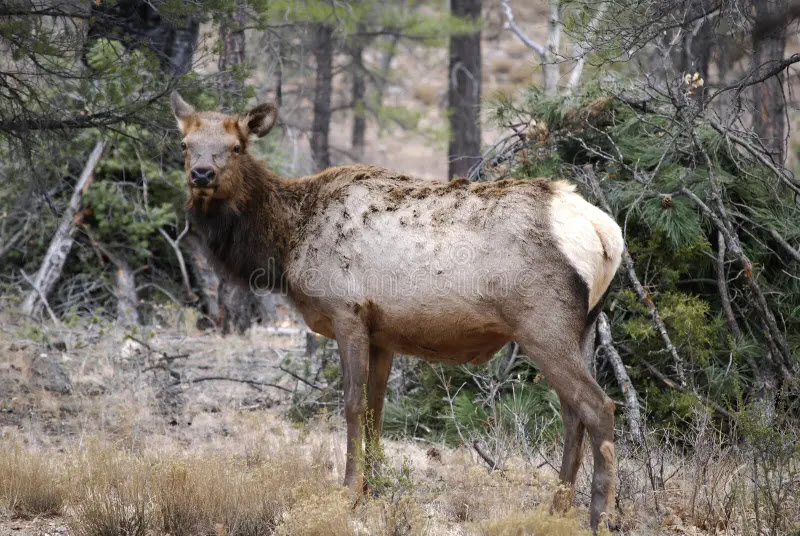
Free stock photo (author unknown)

I spotted a female elk grazing at the edge of the ponderosa pine forest and a male elk further in, standing majestically between the trees, with its huge rack visible from afar.

My photo of the female elk

Miles and miles down the road, below the 3,000 elevations, the forests were replaced by low desert brush and large Saguaro cacti. Once we made it to Phoenix, the pleasant cool air and temperatures were replaced by infernal dry heat, upwards of 103 F.

Would I go back to visit the Grand Canyon? I would visit the Western Rim with its Sky Walk but I am in no hurry. I would rather hike in our local forests, 45 feet above sea level, where the only dangers are the occasional snakes and recently seen bears pushed increasingly by northern Virginia deforestation from their habitat, to make room for more ugly apartments and condominiums.


Copyrighted photos: Ileana Johnson, June 2024 (except the female elk stock photo)