Showing posts with label vineyards. Show all posts

Wednesday, January 11, 2023

Maita's Grapes

Maita's Grapes
My grandmother Maita had a small vineyard and an orchard on the slopes of the steep hills surrounding her village home where she had and raised eight children. After grandpa died at a young age, she was left at 32 with eight mouths to feed.

They eked a survival living from the orchard and vineyard until one day, the entire slope came crashing down, the fertile terrain with the orchard, vineyard, and her home sliding on top of a thick layer of salt all the way down to the bottom of the ravine.

Luckily her children were grown, they had moved on to their own homes in the village or to the city to make a living in the factories dotting the landscape.

Maita bought a house with a small piece of land and moved to the middle of the village on a more level ground, no more climbing, and close to the only asphalted road where the bus would stop once a day. That home is still standing today, empty and abandoned as her last son passed away three years ago. She no longer had to climb steep inclines to get water in buckets balanced on a heavy stick on her tiny shoulders, to go to church, or to visit her neighbors.

This new home had a few fruit trees and two small grapevines flanking the short walkway from the metal gate to her front door. She made tzuica liquor out of prunes, jams, preserves, and marmalade out of fragrant quinces, apples, pears, and peaches from her orchard, and table wine from the black grapes, nothing fancy.

Her eight children took turns supporting her financial needs the best they could. She was never high maintenance – she ate a lot of beans and soup during lent, and occasionally she cooked an entire chicken outdoors on the spit, in a cast iron pot. Maita made her own bread and canned vegetables for the winter months. She was so healthy that she never took one pill and never set foot in a hospital. We really saw her as invincible and believed that she would live to be 100 just like all of her siblings. But God called her to Heaven when she was 90.

Maita was such a stoic in her simplicity, and seldom complained. Her conversations were brief but her eyes bore through your soul.  I don’t think I ever appreciated the hardships she must’ve gone through to raise her four daughters and four sons and to feed them all on her own. We just took her petite and wiry frame with her piercing sky-blue eyes for granted.

Her simplicity in life and strong determination must have rubbed off on my dad. No matter how dire our financial and living circumstances were, my dad never gave up.  He was as generous as Maita, with a tendency to spend his last dime on family if he saw the need.

I never fully understood the hardships my mom and dad had to endure to help our family survive under the boot of communism until I became a parent myself. Granted that life and parenting in capitalist America was so much easier, still, good parents everywhere must struggle and grapple with dilemmas and choices daily.  

What seems hard and insurmountable in some societies, it is easy in America because people have plenty of food, running water, indoor plumbing, a roof over their heads, and a bed to sleep in peacefully. America has not experienced starvation since the Great Depression when soup kitchens helped many survive.

We take for granted the fact that we can walk into any grocery store and find full shelves every day and all we have to do is check off the list, fill the cart, pay, and take it home.  Some people pay with their hard-earned money, others use government welfare credit cards, paid for by the largesse of other Americans who work and pay taxes. That was not the case under true socialism. If you did not work, your family did not eat.

During flu season in winter, many children got sick in school and had to stay home to recover. We did not have medicines or vitamins, so we had to suffer with high fever for days until such time that we recovered.

Daddy was always afraid that his only child would die, so he always asked me in between my feverish delirium, what I wanted to eat. I could not eat, of course, I had no appetite and mom had precious little in the pantry, but I always dreamed for something extraordinary which I knew, daddy could not find – grapes and cherry compote.

Daddy would kiss my feverish forehead and leave the apartment. He would be gone all day and, by night fall, he would come back with a small bag of withered grapes, almost to the point of raisins, and a small jar of cherry compote. I never questioned how he found these, how much it cost in cash and his time. I could not even eat them, but my eyes lit up momentarily with happiness and that was enough for daddy. He prayed silently that I would survive the bad bout with the flu (gripa).

I was in the grocery store yesterday and even though it is January and winter, I saw an abundance of grapes, white and red, seedless of course, coming from far away Peru. They looked beautiful and unblemished but tasted very sour.

It must be the composition of the soil or the variety of grapes, because they are never tasty like the American grape varieties. Yet it is still an abundance for January, coming all the way from South America and provided by free markets, something we never had under the socialist economy run by the Communist Party. We had to eat whatever it provided us, or we starved.

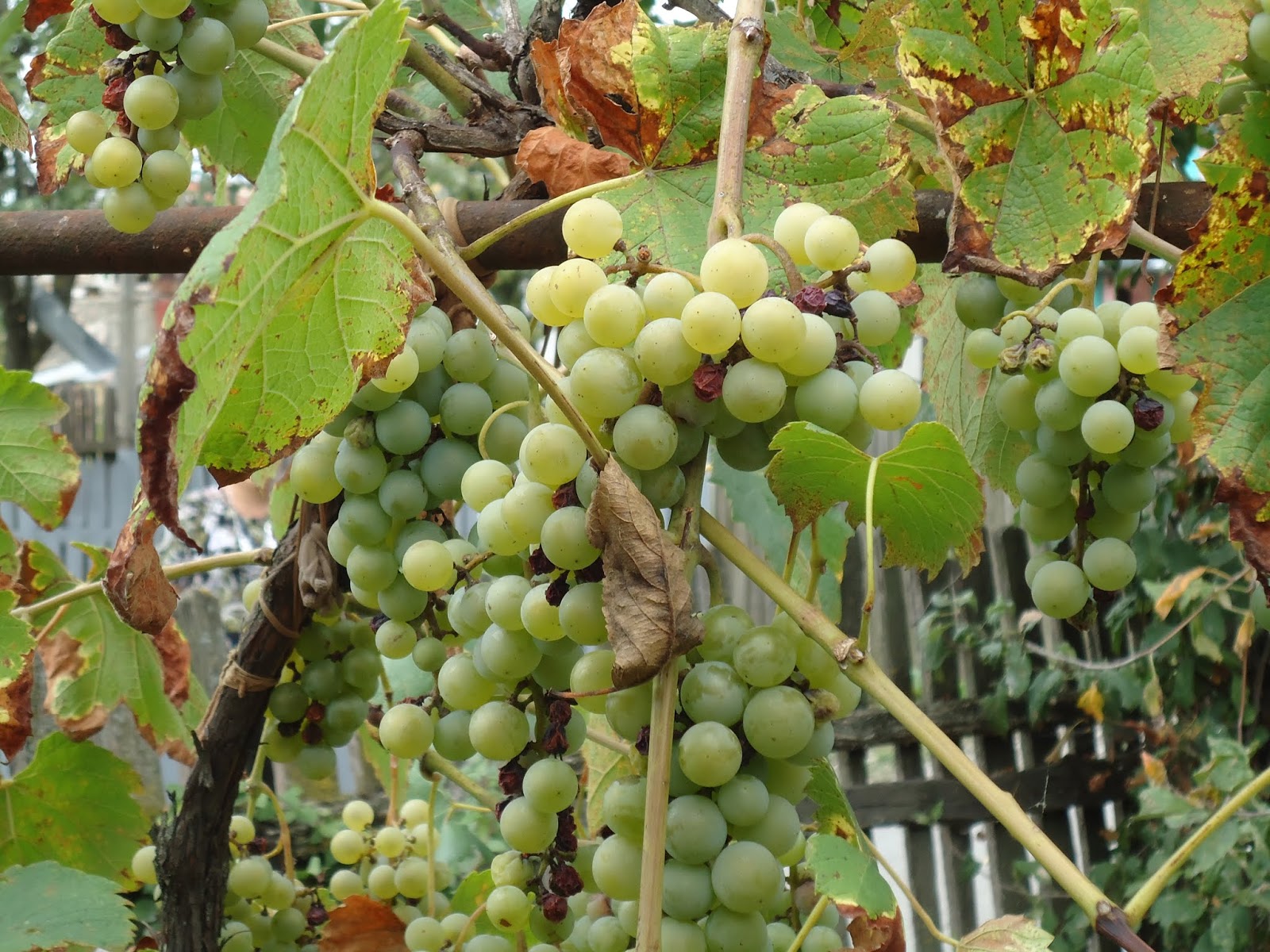
Maita’s grapes were always a treat in the fall – we knew the green ones were ready to eat when the color turned a light green with golden hues. She would say to me, “the grapes are turning gold with rusty edges, let’s go pick some off the vine.” She taught me how to appreciate other fruits and to be able to tell with precision when a fruit is ripe or not.


Saturday, December 22, 2018

Memories of Maita

Maita's house, after a fresh coat of paint in 2012
Maita’s real name was Elizabeta. Her intense blue eyes and will power could pierce through steel. She wore her long light brown hair tight in a bun and covered with a dark bandana to protect her head and face from the intense sunlight. With advanced age, her thick hair turned snow white. A tiny spitfire of a woman of maybe 80 lbs., she lost her husband in her early thirties, leaving her to raise eight children alone. Grandpa Mihail was a busy man, in-between farm chores and fathering children. Dead long before I was born, I was told that daddy favored him the most, out of three boys and five girls.

The clay-brick and wooden logs homestead was perched on a beautiful mountain surrounded by fruit orchards and small vineyards. Underneath the rich black soil were layers upon layers of salt that would someday doom the entire side of the mountain and the small farms as the topsoil slid down the foothill crashing everything in its path, trees, homes, barns, and vineyards, burying everything many families held dear for generations.  Fortunately nobody was seriously hurt as most people were working other fields or in government factories at the edge of the nearest town.

The communist party rulers made a meek attempt at helping those who lost their homes by offering them for sale small plots of land elsewhere in the village, not so isolated from their grasp.

Photo: Ileana Johnson 2012
 
The front porch would offer a shady respite in summer time but in wintertime hungry wolves would be so brazen as to climb the few front steps in their quest for food.  Shiny eyes could be seen in the dark followed by hair-raising howls echoing in the distance, sometimes really close.

The chicken coup and shed were safe and tightly latched. The pig, sheep, and the cow, which provided milk, butter, and cheese for her large family, were also sheltered and locked at night.

Maita's gate and grapevines
Photo: Ileana Johnson 2011
 
Each child had a well-defined role and daily chores in her family. There were no idle little hands; everyone had to care for each other and to earn their keep. The most hated chore was walking up and down the mountain to the deep well activated by a wooden chained bucket and a wheel and covered by a heavy wood cover to prevent debris, animals, and small children from falling in. With each trip, boys had to carry back to the house two large buckets of ice-cold water balanced on a very heavy stick on both shoulders.

If a lot of snow accumulated, the clusters of trees, vines, and the orchards kept it in place; now and then mini-avalanches would bury some trees and fences in their path.

When the three boys were old enough to get jobs in the city, they joined the village men on the open transport truck. Traveling like cattle every day on the bumpy unpaved road for miles of miserably wet or frigid weather to a menial job, they resigned themselves to the proletariat’s  fate, working for slave wages for the communist utopia which pretended to protect them. On at least one occasion, a passenger was let off at his stop but he never made the long walk on foot up the mountain to his home; he was found frozen in the ditch along the way. After a six-month period of mourning, the tough life moved on.

Photo: Ileana Johnson 2012
 
Sound carried so well across the valleys that it was hard to judge how far people or animals making the sounds were. As a child, I often heard aunt Leana calling out from the front porch of her tiny house above the tree lines to Maita’s home, telling us to come for lunch or a special treat she had baked. And it was a long and breath-taking hike to her house or so it seemed to a small child.

I would judge the distance based on the beautiful cross and Orthodox icon along the way, nestled in a covered shelter where the villagers would stop briefly for a prayer and a drink of water from the bucket and cup left fresh each day by the nearby community well.

Photo: Ileana Johnson 2012
 
The silence punctuated by our huffs and puffs would be startled sometimes by a concealed voice coming from a person behind a fence covered in grape vines, saying hello or asking how we were doing. Maita was so proud when her neighbors would fawn over her visiting granddaughter.

After the landslide precipitated by melting snow and gliding layers of salt, Maita rebuilt a home next to her oldest son Nicolae in the middle of the village, conveniently close to the only store, the bus stop, the cemetery, and the village church.  From the front porch we could see the valley below shrouded in mist at dawn and filled with endless rows of grapevines and fruit trees. When the sun came up, the cold creek we bathed in each week sparkled like a jewel.

I stayed in this mud-brick home every summer. It was always cool and smelled of quince and autumn smoke. Maita cooked on a spit fire her famous chicken in the cast iron pot and tasty smoked beans when she was fasting. She had a large garden with plenty of vegetables to feed herself and her son’s large family next door.  A small opening in the fence allowed for quick passage to the two properties separated by a weathered fence.

Today the house is sadly abandoned. The heirs cannot agree on what to do with the property that nobody wants. The blue metal gate is in need of a new coat of paint and creaks in the wind when it opens. The rust spots match the grape leaves on the vines overhanging the walkway. I tread lightly, careful not to disturb the past. The porch is latched just as Maita and her son Ion used to do it. Her last child passed away last summer but his presence is still felt in the garden now overrun with weeds.

Maita's last house
Photo: Ileana 2011
 
I peer inside through a window. The furniture looks just like the furniture I grew up with in our home. He must have transferred it here from the city after my daddy passed away. I am looking for my grandma’s icon and garnet rosary that used to hang on the wall but it is missing, probably sold long time ago by uncle Ion.  A priceless work of art, the 19th century rosary and icon must have fetched good money on the market. When we no longer care for history, even valuable prayer objects become disposable. Poor and suffering people in a collectivist society cannot afford to be sentimental.

Aunt Leana's grape vines
Photo: Ileana 2011
 
I walked up the mountain to visit aunt Leana’s surviving husband, uncle Stelian. After a long hike, I found their stucco home with the porch I used to play on as a child. Somehow the climb seemed much shorter but just as breathless and difficult, and the homes and plots of land much smaller than I had remembered them as a child.

Uncle Stelian in his yard
Photo: Ileana 2011
 
Stelian was in the yard, sitting on a makeshift stool, drinking his beloved homemade wine and prune brandy. We spoke through the same fence I recall from decades ago. He did not invite me in. Confused as if he’d seen a ghost from the past, it took him a while to remember me and my name. I snapped his photo through the wooden slats of the fence, wishing sadly that I could have seen aunt Leana once more. Her caring hands and sky-blue eyes have long left this earth. Her beautiful and devout Christian voice still echoes in the Orthodox Church by the cemetery.

Leana and Maita's water well
Photo: Ileana 2011
 
The shade cast by the grape vines above sheltered the courtyard from the hot sun just as I remembered it.  The smell of ripened quince, purple plums, and crushed grapes carried by a gentle breeze flooded my memory.  I returned to my world, thousands of miles away, with a painful and unexplainable regret and a feeling of permanent loss, taking a moment in time back with me, stuck on a memory card.