Showing posts with label Vlad Tepes. Show all posts

Thursday, June 12, 2025

Vlad Tepes, Cruelty, and the Janissaries

For five hundred years my people have fought the yoke of the Ottoman Empire, and their passage and battles have left an imprint in the national psyche and in the Romanian language.

The territory of what is now Romania, was a buffer zone between the advancement of the Ottoman Empire towards medieval Europe and their demands for treasure and heavy tribute.

One of our national heroes, Vlad Tepes, had fought the Ottomans to his eventual death. Vlad was a Prince of Wallachia; a province located between the Transylvanian Carpathian Mountains and the Danube River. The 15th-century Wallachia was the state between the central European kingdom of Hungary and the Turkish Ottoman Empire.

When the Turkish Ottoman Empire captured Constantinople in 1453, the ruler of Wallachia was Vlad Dracul, or Vlad the Dragon. His personal coat of arms was a dragon, hence the name. When his son, also named Vlad, ascended to the throne, he received the title of “Son of the Dragon,” Vlad Dracula.

Vlad Tepes was born in 1430. He was exposed at an early age to medieval cruelty because, as a boy, was held hostage by the Turks in a fortress called Egrigoz, “Crooked Eyes.”

He also witnessed the murder of his own father and his elder brother being buried alive on orders of the Regent of Hungary. Medieval Europe was not lacking in utter cruelty, violence, and savagery among the princes and kings in power who devised the most disgusting ways to torture and kill their enemies.

Called Vlad Tepes, “the Impaler,” after his favorite method of killing Turkish prisoners and others, Vlad proceeded to rule with an iron fist. The impaling stakes were often blunted and greased to extend the agony, the impalement of a vital organ, and the eventual death of the victim.

Vlad continued campaigns against the invading Turks and helped save Christian Europe from Islamic conquest. He helped peasants fight the ruthless feudal lords of Eastern Europe called “boyars” and “restored order to a land torn apart by foreign invasion and civil strife.

Vlad did lock up a group of beggars and disabled people in a church and set them on fire, but the utter cruelty was explained away as stamping out disease when threatened by the plague.

He allegedly skinned women alive who were found guilty of committing adultery.

The myth of vampirism that Bram Stoker, a British author, assigned to Vlad Dracula is certainly not true. Stoker never traveled to Romania to investigate elements for his book; he just visited his local library and found the history of Vlad Tepes fascinating.

There is no doubt that he was a monster of cruelty as he strangled, boiled, roasted, and put to death a minimum of 50,000 people in his reign of ten years. He met a violent end in 1476, but nobody knows if the was killed by the Ottomans or his political rivals. His severed head was impaled on a spike for all to see. He was allegedly buried on an island in Romania, but, when they opened the tomb in modern times, it was empty.

His alleged residence, Bran Castle, was not his home even though the castle advertises some loose connection to one of his campaign stays. The Poenari castle ruins in Transylvania are more credibly the place where he lived. Its location is hard to access via 1480 concrete stairs. The citadel was destroyed partially by three different earthquakes and the masonry fell in the river below.

Poenari castle ruins are located on Mount Cetatea, a canyon formed by the Arges River. It was built in the first part of the 13th century to be used by the Basarab rulers. Vlad repaired it in 1459 when he saw its potential for a hard to access fortress and became his residence until his death.

As a boy, held hostage by the Turks, Vlad witnessed what the Ottomans did to Christian boys they held captive. Turks used a system called “devsirme” (collect) to conscript physically and intellectually gifted Christian boys from the territories they conquered in places like Anatolia, Armenia, and the Balkans.

They used Christian boys because Turkish law forbade them to enslave Muslims and they could also keep powerful enemies under control, such as Vlad’s dad.

The Christian boys were circumcised, forcibly converted to Islam, and sent to the capital which is today Istanbul. Most of them were forced to join the forces of the Janissaries, “the shock troops” of the sultans. The Janissaries (yeniceri, Turkish) were founded in 1300s as the sultan’s body guards, later as the standing army of the Ottoman Empire. They wore a distinctive hat with feathers and spoons. Every Janissary regiment had a huge cooking pot called “kazan” (cazan, Romanian) and a huge ladle to distribute the food cooked. If said kazan was lost in battle, the punishment was expulsion; an overturned ladle meant mutiny.

Vlad was lucky to have escaped the conscription into Janissaries and all the military schools involved prior to being included in such a regiment. After centuries of thuggery and even murder of sultans, the Janissaries fell in disfavor and in 1826 in the Auspicious Incident, thousands of Janissaries were murdered in their barracks. Their influence disappeared and the Ottoman Empire disappeared a century later replaced by general Mustafa Kemal Ataturk, the founder of the post-Ottoman Turkey.

Vlad Dracul, as an imprisoned boy in Egrigoz, dodged the bullet of Janissaries.


Saturday, February 6, 2016

Ionuț Sabău, a Hero for Europeans

Photo: Wikipedia
After the fall of the Western Roman Empire in 476 A.D., Europe has been besieged by waves of invasion from tribes of peoples such as Goths, Ostrogoths, Visigoths, Vandals, Angles, Saxons, Lombards, Suebi, Frisii, Jutes, Franks, Huns, Cumans, Avars, Bulgars, Alans, Moors, Mongolians, Khazars, Tatars, Vikings, Normans, to name a few, who brought war and pillage across Europe from 376 to 800 A.D.

These attacks were followed by the bloody incursions and invasions of the Ottoman Empire in various European countries for several centuries in their quest to establish the sought-after Caliphate. The Crusades were the logical Christian reaction to defend their faith, territories, and way of life.
Romanians fought against and pushed back the Turks and their rule for centuries and eventually paid tribute in gold and lost lives to the Ottoman Empire. The most prominent defender of Romanian territory against the Ottoman invasion was the famous Vlad Tepes.

French and Italian scholars viewed this part of history as catastrophic; it followed the destruction of the great Roman civilization which was replaced in the West with a period they termed the “Dark Ages” because it “set Europe back a millennium.” German and English scholars saw this invasion as replacing the “tired, effete, and decadent Mediterranean civilization with a more virile, martial, Nordic one.”  German and Slavic historians used the term ‘migration.’ (Halsall, Guy (2006), "The Barbarian invasions", in Fouracre, Paul, The New Cambridge Medieval History, Vol. 1: c. 500 – c. 700, Cambridge University Press, ISBN 0-521-36291-1)
This brings us to the current orchestrated mass invasion of Muslim “refugees” across the senescent continent of Europe which needs an infusion of new and virile blood from the Middle East and north Africa. These single young men of military age are quite willing to install the promised Caliphate across Europe and are not shy in their overt (but media-covered) effort to rape, pillage, and destroy across civilized society.

Secular Europe has a problem with continuing to exist by not having enough babies and is committing willful demographic suicide sped up by the politics of the European Union technocrats who are eager to have global governance under the U.N. umbrella.

It seems that one Romanian young man, Ionuț Sabău, has what it takes to defend his country, his family, and his way of life from the Muslim “refugee” social engineering plan. Non-governmental organizations have been preparing this flood of male humanity (if we can be so kind to men who behave like savages) with money from billionaire donors and socialist governments interested in changing the demographic face of old Europe.

Bill Still reported that “In early January, 28 year-old Ionuț Sabău found out that the Association Freres Romania (an NGO), in partnership with the Ministry for Internal Affairs was planning to make a ‘refugee’ center in the neighborhood of the small town of Ardud, in Satu Mare county.” https://www.youtube.com/watch?v=LcMcFmNdFvA

Ionuț Sabău, who had worked and lived in Paris in a prominently Muslim neighborhood, gathered 200 signatures and petitioned the local government to stop the planned settlement; the mayor set up a meeting with the prefect, the representative of the local government.

Ionuț Sabău told the prefect bluntly that he does not agree with this migration in any shape or form based on the simple fact that he wants his family safe from harm; he wants his children to be able to go to school and his wife and children to walk the streets alone safely. This is a small village (5,000 inhabitants) where children are not bussed to school, they walk.

“We don’t care what the law says or what the state says, we do not agree.  We are disposed to use violence and we want everyone to know that.” The prefect responded, “Please don’t talk about doing justice yourself. There are institutions for that.” Sabău rejoined, “I understand, but our children must also grow up in safe and optimal conditions and we don’t want a situation like in Western Europe where people are afraid to let children go to school alone or leave our wives alone in the streets. We don’t want any of that here! Under no circumstance! This is not an issue of defending the Romanian state as a whole, we are simply defending our own families.” https://www.youtube.com/watch?feature=player_embedded&v=5cw-8OT-EWc#t=116

Following the hearing, the Freres Romania Association, an NGO, canceled the project of resettling the Muslim refugees in a Christian country and culture that is totally alien to the Islamic faith and theocratic culture. http://breizatao.com/2016/02/03/roumanie-des-villageois-salues-en-heros-pour-setre-revoltes-contre-un-plan-secret-de-lue-visant-a-installer-des-migrants/

If only the men in the EU countries that have already been invaded and their lives violently disrupted would get half of this man’s courage!
Leaving aside the facts of who caused the Arab Spring and who financed this massive invasion, true war refugees can best be helped in countries that share their own culture and faith and provide safe-haven for their families. If these people are bona fide war refugees, young men of military age should stay in their home-countries and fight the enemy instead of fleeing like cowards and leaving women, children, and old people behind to suffer.


Wednesday, October 14, 2015

An Existential Dilemma in the Land of Vlad Tepes

A heated debate is raging on in the eastern European country of Romania, a member of EU since 2007 but not of the Schengen zone.  Members of the Schengen zone can travel freely without a passport between the member states. The debate has divided the population along party lines, ideology, faith, experience, education, and even families in their extended relationships.

Romania is a paradise of spectacular landscapes, mountains, valleys, rivers, gorges, the famous Danube River, the Danube Delta with its rich fauna and flora, the Black Sea, and fertile lands that could grow so much wheat and corn, it was known as the bread basket of the Balkans. Many yet to be explored natural resources are hidden beneath the soil and rocks:  gold, coal, iron core, bauxite, manganese, lead, salt, silver, zinc, petroleum, and natural gas.

Temporarily forgotten are the economic problems that ail a crony capitalist system emerging from decades of communist dictatorial oppression. What is important at the moment is whether Bucharest will build the biggest mosque in Europe, in the middle of predominantly Orthodox and Catholic Christianity. It is an existential dilemma in the lands that Vlad Tepes, the infamous Dracula, and many voivodes and rulers after him, protected with guts, blood, and glory, from the constant invasions of the Ottoman Empire during five centuries.

Why would Bucharest need such a huge mosque? Who will pray there? The population is atheist, agnostic, or Christian. Dobrogea, in the eastern part of Romania, already has mosques to accommodate the Turks whose ancestors had settled in these parts of the Black Sea.

Can the country, struggling with many economic issues,  afford the influx of Middle Eastern men of fighting age who are sure to come as war “refugees?” Apparently the prime minster, who allegedly received a new knee in Turkey, was quoted as saying that Romania is prepared to receive refugees and has opened two camps with a capacity of 500 each in the western part of Romania, but so far, few “refugees” have petitioned for asylum. Asked if such refugees will be distributed by areas or by counties, Ponta answered that the said “refugees” are free to go wherever they wish, with only one interdiction, they cannot vote.  http://www.ziare.com/victor-ponta/premier/romania-pregatita-pentru-refugiati-ponta-sa-i-integram-sa-nu-ramana-pe-cheltuiala-statului-1385886

“The mayor of Arad, where unemployment is zero, told me that they need workers, especially those who are easy to train. Nothing happened what ‘the crusader Basescu’ said,” Ponta concluded. Basescu, the former president, vehemently opposed the Bucharest mosque and the “refugees” being settled in Romania.

Those who survived Ceausescu’s four-decade long dictatorship are divided. Some who are too old to work and fend for themselves, are nostalgic for his tyranny because they did not have to work very hard, did not have to be responsible for themselves. As long as comrade government provided meager rations and salaries, enough to survive on, they were satisfied.

The young, representing the “tyranny of the oppressed,” have no memory of Ceausescu’s regime and thus think that socialism and communism are great ideas – who would not want to be taken care of in the fashion of the western European Fabian socialist societies whose governments are bankrupt?

These two groups do not see any problem with building the largest mosques in Bucharest – the more the merrier. The fact that the two cultures, Islamic and western, are incompatible, does not seem to faze them.

A short list highlights the alleged corruption and theft affecting society and the economy profoundly. These events took place after Ceausescu was executed on Christmas 1989 when a period of chaos ensued. How long this period lasted is debatable but the results are still felt today.

-          Part of the national bank’s gold was allegedly taken out of the country.

-          Factories that may or may not have been productive were sold to foreign investors or destroyed and sold for scrap metal and the money was pocketed by those in power.

-          Diesel payments for ships sailing under Romanian flag were stopped, the ships were sold as scrap metal in the ports where they happened to be docked, and the money was pocketed by those governing and making such decisions.

-          Even though Romania had no debt, once some industrial and agricultural production was stopped, it was necessary to make loans from foreign banks in order to keep the country afloat, thus Romania began its indebtedness to the western bankers.

-          Oil, gas, and gold were given to foreign investors in exchange for substantial bribes to governing individuals.

-          Laws were passed that allowed foreigners with money to invest in “agriculture” to exploit the land and to harvest timber, gold, and frack for natural gas, desertifying large tracks of land in the process, and poisoning rivers with cyanide and other toxic chemicals; the said foreign investors were not required to clean up the ecological disaster they left behind.

-          As more and more taxes were imposed, the money were not put to good use, benefitting or building schools, hospitals, and orphanages; the money built thousands of churches and fattened the pockets of the governing individuals who used priests to preach to their flocks to vote in the most corrupt politicians who were skilled orators.

-          The alleged sabotage of Romanian investors who found efficient and non-toxic ways to explore for gold without destroying the natural habitat.

-          Out of control deforestation resulted in landslides and floods and the destruction of entire villages.

-          Alleged damage to tourism at the Black Sea due to fracking for natural gas in Dobrogea.

-          Creation of a class of EU-style welfare dependent citizens and parasites who watch mind-numbing telenovelas while their country is being destroyed.

-          Laws that allow politicians to purchase land for prices below real estate values in beautiful areas and to build villas on that land.

-          Exacerbating the decades-old divide between Hungarians, Swabians, and Romanians in Transylvania through corrupt political moves, keeping the population at odds.

-          Passing laws of immunity for crimes committed by those in power who undermined the country’s economy for personal and political gain.

-          Expropriating private land of those who opposed the land grab across the country.

-          The irrational decision to pay Holocaust reparations of 60 billion euros to Israel (even though 95 percent of Jews were alleged to have survived in Romania when they were sent to Transnistria, away from Hitler’s grab) at a time when former soldiers, workers, teachers, and other poor Romanians living on pensions of 300 euros per month had to take substantial EU-dictated austerity cuts; 20 billion euros were already paid even though Romania had to likely borrow the money.

-          The Penal Code was changed and expunged of the punishment for undermining the national economy.

-          Billions of euros were allegedly funneled to finance electoral campaigns of those in power who speak so eloquently and convincingly, promising to eradicate the blatant corruption in society but deliver nothing except more wealth and power to themselves.

Despite the bleak economic reality, the useful idiot voters who applaud and reelect to power the very same corrupt politicians who have relegated them to comfortable poverty, are busy on social media, discussing passionately the pros and cons of the mosque, while the economic and societal quagmire around them continues unabated. They seem to be deaf and ambivalent to the historic song of previous generations, “Wake up, Romanians, from the sleep of death.”

Whether some of the allegations can be proven and could stand up in a court of law remains to be seen. It is a fact that the majority of the population is still relatively poor even after twenty-five years since communism “fell” while a few politicians and oligarchs have become millionaires and billionaires many times over.  Crony capitalism has replaced one set of ruling elites with another. The only difference now is that the masses can idle their time with tele-entertainment on every channel and food is available. They can criticize the new regime, but nobody listens.


Friday, June 12, 2015

Transylvania, the Land of Enchantment

Cantacuzino Castle (photo: Ileana 2015)
Transylvania is a land of enchantment of middle and northern Romania with its breathtaking and spectacular landscapes, its rich and tumultuous history, bloody battles, occupations, and a proud population that maintains its distinct culture and art.

It is bordered on three sides by the Carpathian Mountains that appear on maps like a natural boundary between Transylvania and Wallachia, the province made famous by Vlad the Impaler, “Dracula,” Prince of Wallachia, who made Bucharest its capital in 1459. The pristine and wild countryside of Transylvania (Latin for “across the forest”) is sometimes impassable to humans.
Transylvania has a distinct Hungarian and German influence which can be seen in its fairy tale Hansel and Gretel architecture, its cuisine, the spotless streets, order and civility, in how successfully cities are run, and the seriousness on the faces of its population. However, many ethnic Germans have left in the 1970s when the communist Romanian state signed an agreement with West Germany.

Romanian settlements dating back to the Iron Age were found in the southwestern part of Transylvania. Because the area has been part of the Hungarian and later the Austro-Hungarian Empire for hundreds of years, there is a strong Hungarian and German influence everywhere. Schools, colleges, and theaters are still operating in Hungarian and German languages.

Hungarian kings had invited Saxons (from the province of Sachsen) in the 12th and 13th centuries to settle in Transylvania. Some of them were gifted goldsmiths, others were wood carvers  and builders. Their presence is reflected in the beautiful medieval citadel churches built in southern Transylvania.


Bran Castle in Brasov (photo: Ileana 2015)
Hungarians and Germans left behind castles, imposing manors, palaces, and churches in towns such as Cluj-Napoca, Alba Iulia, Sighisoara, and in the old Saxon city of Sibiu (Hermannstadt) with its famous medieval houses with rooftop “eyes,” roof vents that look like watchful eyes.

The miners and farmers in western Transylvania called “Moti” trace their roots for thousands of years. The Apuseni Mountains are rich in mineral reserves, rare metals, and gold, particularly in the contentious region of Rosia Montana.

The archeological evidence found at Sarmizegetusa speaks volumes of the rich civilization of the Dacians who were conquered by the Romans in 106 A.D. and colonized into a Roman Empire province. The story of the battles between the Romans and the Dacians is vividly told in the freezes of Trajan’s Column in Rome.

According to National Geographic , the eastern part of Transylvania has “the highest concentration of ethnic Hungarians.” Buildings have a different style, ethnic costumes vary, and many inhabitants speak both Romanian and Hungarian.

Cluj-Napoca is “the cultural and economic hub of Transylvania.” Alba Iulia, the former Hungarian capital, has an interesting Habsburg baroque citadel. It was the city where Romania and Transylvania became one on the great Union Day, December 1, 1918.

Bistrita, in the northern part, is the location where Bram Stoker set his novel “Dracula” in 1897. His fictional character, Jonathan Harker, spends the night in Bistritz (Bistrita) on his way to Tihuta Pass (Borgo Pass in Hungarian) where Voivode Vlad Tepes’ real castle ruins are located.  Bram Stoker never traveled to Romania; he used geographical information from his local library.

Sibiu house with "eyes" (photo: Ileana 2015)
Sibiu is the largest medieval town in Romania, built in the 12th century with three concentric fortified walls (a few have survived), squares (a large and a small one), stairways, and strongholds built and fortified between the 13th to the 18th centuries.

The two famous battles of Sibiu on March 18 and March 25 1442 were fought nearby between the army of the Hungarian Empire and the army of the Ottoman Empire. Approximately 4,000 Hungarians and 15-20,000 Turks were killed in the two battles which resulted in a defeat and push back of the Ottomans.

Tiny restaurant in Sibiu (photo: Ileana 2015)
 
The Large Square (Piata Mare) served as a grain market in 1411, medieval executions, and later used for carnivals, meetings, and now rock concerts. The little restaurant called Butoiul de Aur (The Golden Barrel) has been serving patrons since the 15th century. Houses dating back to the 13th and 14th centuries are the oldest surviving homes with colorful tiles, sometimes mosaic-ed in beautiful patterns and with “eyes” on the roof for air venting.


17th century iron vial (photo: Ileana 2015)
The tiny four-room pharmacy museum, that used to be a 17th century apothecary, displays curious instruments and recipes for potions perhaps made by Samuel Hahnemann (1755-1843), the father of homeopathy.

Sibiu Church (photo: Ileana 2015)
The largest Catholic Church in Sibiu stands majestically between Piata Mica (Little Square) and Piata Mare (Large Square). Interestingly, on the day I visited, it was displaying a large banner at the back entrance urging people to stop fracking for natural gas and to stop mining in Rosia Montana.  Since the Pope is now a climate change expert and population control expert, why not turn the church into an environmentalist NGO?

Brukenthal Museum courtyard (photo: Ileana 2015)
 
Brukenthal steam porcelain stove (photo: Ileana 2015)
 
Brukenthal Roman lapidarium (photo: Ileana 2015)
 
Medieval door (photo: Ileana 2015)
 
The National Brukenthal Museum is a treasure trove of art collections which Baron Samuel Von Brukenthal, the former Governor of Transylvania (1777-1787), housed in his Palace built in the Grand Square in Sibiu. Showcased in the baroque and rococo interiors are famous masters like Jan van Eyck from 1420, German and Austrian painters, Romanian painters, personal favorites like Teodor Aman and Nicolae Grigorescu, gold and silver coins, jewels, engravings, intricately carved furniture, books, weapons, silver and gold drinking cups and goblets, medals displayed in his former library, sculptures, costumes of the era, whimsical porcelain steam stoves interconnected throughout the palace, a novelty for that period,  a lapidarium with statues of Roman gods, Roman roads mile markers, and votive altars from Apulum and Ulpia Traiana Sarmizegetusa, dating to the 2nd and 3rd centuries A.D.

ASTRA barn with carriages (photo: Ileana 2015)
 
 
Interior of a floating mill at ASTRA (photo: Ileana 2015)
 
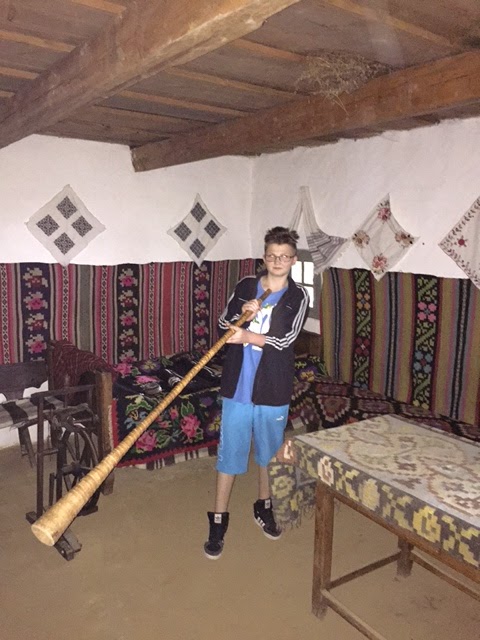
Four miles south of Sibiu, in the forest of Dumbrava, we found the largest Museum of Popular Traditional Civilization ASTRA in the country. Spread on 237 acres of rolling hills and lakes, it is the largest museum in Europe that showcases homes from different parts of the country, windmills, boats, barns with complete carriages, and many implements and tools necessary for everyday living. Each home is surrounded by a typical yard with ploughs, carts, barns, and interiors are decorated just like people were still living there and have left for the day to tend to the gardens or crops. The smell of old wood, mildew, wildflowers, and crushed fruits was overwhelming. A slow-moving red fox, accustomed to human presence, crossed the nearby yard.

ASTRA home interior (photo: Ileana 2015)
 
 
ASTRA home interior (photo: Ileana 2015)
 
The outdoor ASTRA museum is so hugely popular that locals use it for recreation, boating, and celebration of major life events. On the day we visited, there were three weddings at the wooden chapel and brides and their entourage were taking photos on the premises. I was fascinated by the various windmills displayed, and particularly a floating mill that used hydropower to grind grain.

All the workshops manufacturing silk and hemp, distilleries, forges, wine presses, paddle-wheel ferry, the blacksmith’s shop, and other machinery used by Romania’s country folk were actually in working order.

It is only fitting that this huge outdoor museum with its well-preserved history is called ASTRA. ASTRA was a patriotic literary society of the 18th century, located in Sibiu, which was instrumental in Transylvania’s unification with Romania in 1918.

To the east of Transylvania is the famous Seckler Land. The Secklers are Hungarian-speaking people which are called “secui” in Romanian. They use their own language, have fascinating traditions, customs, delicious cuisine, and schools. No industrial development has touched this plateau where old farming methods are still used today to cultivate the land. It is a land where Hungarians have migrated to in the 9th century from the Don River. The Hungarians were given land in exchange for the promise that they would protect the western Hungarian border against the invading hordes of Turkish tribes. There is a Crusader’s cross decorating a church in Tusnad as evidence of Christian support against the invading Muslims. Signs abound both in Magyar (the Hungarian language) and Romanian language.

The Hungarian king Endre II brought in the Teutonic Knights in 1211 to protect the southeast border of Transylvania from the Cumans, a migratory Turkic tribe.  It was these knights who built stone castles all over the area surrounding Brasov.  According to National Geographic, because the Teutonic Knights liked this magnificent area called Barsa Land and were going to claim it for the Pope, King Endre II forced them out in 1225 with Saxon help.

Brasov (photo: Ileana 2015)
The jewel of Transylvania is Brasov (Kronstadt). There are so many significant places in Brasov  and its vicinity that it merits a story onto itself.