 |
| View of Brescia from castle armory museum |
Dave dodged
them artfully, paid attention to the GPS directions, and made sure he did not
run into buildings. The streets were so narrow;
I could stretch out my arm through the open window, and touch the walls. We
finally came to the 11th century Scaligeri castle and exited through
the even narrower moat gate. I
videotaped the entire gauntlet through the windshield wipers, just in in case
our children would not believe us. We
drove by the police sentry gate where two days earlier we had to be checked off
a police registry as hotel guests in the fortress.
With the
beautiful Sirmione in the rear view mirror, we made it to the autostrada, on
our way to Brescia, the former Roman castrum called Brixia. I had mixed feelings
and memories of Brescia when, years earlier, our plane from Paris to Venice had
to make an emergency landing in Brescia where the passengers were deplaned and
transported the rest of the way to Venice by buses. My husband, who was
expecting me at the airport in Venice, was very confused when he finally found
me getting off a bus and without luggage.
 |
| The fortress moat entrance in Sirmione (Wikipedia photo) |
We passed by
Mantua, the 2016 Capital of Culture, 45 km out of our way. We had spent an
entire day on a previous trip, visiting the centro
storico, the Gonzaga family castles (Palazzo Te, Palazzo Ducale, and
Palazzo Valenti Gonzaga), House of Mantegna, hanging gardens, and grottoes.
 |
| Mantua Photo credit: Wikipedia.org |
The medieval
and Renaissance flavor give Mantua an important place in the cultural history
of western civilization. In addition to architectural treasures and works of
art, Mantua is known for its role in the history of opera.
Monteverdi’s
L’Orfeo premiered here and
Shakespeare’s Romeo was banished to Mantua. Giuseppe Verdi’s opera Rigoletto is set in Mantua. The medieval
house that Verdi chose as residence for his character is said to be “Rigoletto’s
house.” It was a building that belonged to the cathedral.
Mantua’s
most famous inhabitant was Virgil (Publius Vergilius Maro), born in 70 B.C. in
a village nearby now called Virgilio.
Brescia was
a truly fascinating experience. After we parked in an underground garage called
Piazzale Aranaldo (pretty much most parking in Italy is underground for lack of
space and esthetics), we walked towards the 15 century castle perched on top of
a hill overlooking Brescia.

The painful road to Castello
The hike up
the road gave me particular agony as it was formed with small oblong river
rocks embedded upright into the soil as a form of paving. With every step, the
rocks dug through my shoes and I felt the pain in the soles of my feet. I suffered
in silence like a penitent, while walking up to a sanctuary church, completely
deserted, open, and eerie.

View of Brescia from our trail hike
Walking past
round stones inlaid into the pavement with names of deceased Brescians, we ran
into a group of Italian school kids having bagged lunches in a room on the
premises of the church. Their presence was explained by the city’s museum of
history, located nearby.

Mossy woods
The province
of Brescia, located in Lombardy, is one of the largest in Italy, the industrial
capital of Italy, with 1.2 million inhabitants. It is an area where utility
companies, a steel producer, the firearms manufacturer Beretta, the shotgun
manufacturer Perazzi, and machine tools manufacturer Camozzi have their
headquarters. Brescia, nicknamed Leonessa
d’Italia (The Lioness of Italy), is also home to Italian caviar, sparkling wine,
and the Mille Miglia classic car
race.
The actual
town of Brescia, located at the foot of the Alps is rather small, 196,480
inhabitants. It was founded 3,200 years ago and it holds the best preserved
Roman public buildings in northern Italy, specifically a Roman Forum. The
medieval castle, to which we were hiking in a slow but steady rain, is a fascinating
place to visit despite the long and arduous trek that we took. Coming down, we
realized that we could have driven and parked the car not far from the
entrance. But, why do things simply when the hike was so much more fascinating
and the photo ops were amazing.

Misionari Saveriani in Brescia

Chiesa di Corpo di Cristo in Brescia

Cloister inner courtyard in Brescia

Corridor to Chiesa San Cristo

Cloister in Brescia
All photos: Ileana Johnson 2016
The monastic
complex San Salvatore-Santa Giulia has a beautiful basilica from the 9th
century, dedicated to San Salvatore. It
was built on a previous church which was also built on a Roman edifice from the
first century B. C. A church was dedicated to Santa Giulia after it was
finished in 1599. There is a museum on the premises with artifacts from the
Bronze Age to Roman times and excavated Roman houses.
Charlemagne’s wife, Desiderata, and daughter of the Lombard King Desiderius,
is said to have spent her exile years in this monastery after the annulment of their
marriage in 771.
The Church of the Most Holy Body of Christ (Chiesa del Santissimo Corpo di Cristo) is also part of the convent
complex built in the late 15th century by Jesuits on previous
religious buildings towering above the Roman theater. There are 16th
century frescoes by Friar Benedetto Marone, planned on the Sistine Chapel
model. There is also a Romanino fresco with the Last Supper, reproduced on
canvas. Near the church is the convent surrounding three cloisters. One of the
cloister’s loggias opens up into a breathtaking panoramic view of Brescia.

View of the Castello from our hiking trail
We took the wrong turn to the castle, which led us on a steep uneven
pebbled stone climb on the back side to the castle, with a dizzying drop to the
city and to a vineyard below. We could see the turret to the castle but we were
unable to reach it this way. We walked to the left, circling the hill on the
lower levels, past trees so old and shady that they were completely covered by
moss. This time we started climbing again on the side facing the castle.

Almost there - Castello's entrance
We reached the parking lot, climbed four more levels and entrances before
we were actually able to see the moat of the castle with a drawbridge with creaking,
rusty chains, and old mechanisms that raised and lowered the huge gate. We
watched with amusement as a medium sized truck attempted to make a delivery to
the museum inside but could not clear the height of the entrance to the castle,
past the stony drawbridge. It was built in the first half of the 14th
century, activated by ropes and chains and operated by winches. The mechanism “was
faithfully recreated in the 20th century copy that can be seen
today."

Entrance through the gate with the drawbridge
This main gate, between the rampart of St. Mark to the east and St.
Faustino to the west, was built during the Venetian rule at the end of the 16th
century. The portal is built from local calcareous stone, the famous Botticino
marble. The sides display the Venetian rulers' coats of arms and the center
displayed the coat of arms of the Doge, unfortunately destroyed by Napoleon’s
soldiers. The whole structure shows the emblem of the Republic of Venice.

Governor's seat in Castello
A two-story yellow painted building, overlooking the Locomotive Square, is
the former Governor’s seat built by Venetians in the 16th century.

Mirabella Tower
Upon entering the castle, the tower where they kept prisoners came into
view. The prisoner’s tower, called the Burned Tower, was part of the defense
system during the rule of the Visconti family of Milan. The four-story tower
can be visited through a small door located below the porch leaning against the
parapet.

The light came from my camera flash otherwise it was pitch dark

Downward spiraling tunnels
We went into the dungeons that offered an escape route as well as a
delivery of supplies route. It was dank, dark, and scary.

Drawbridge with its rusted mechanism

Prisoner cell

Castello's inner courtyard

Drawbridge mechanism

Inner courtyard with Roman sarcophagus
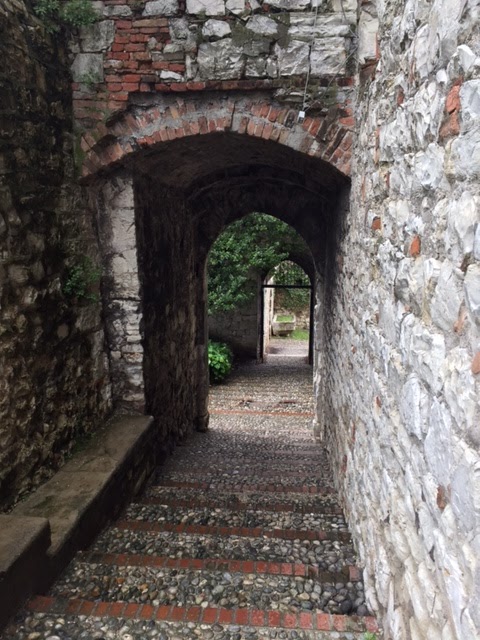
More above ground tunnels
The 22-meters tall Mirabella Tower was one of the bell towers that flanked
the Romanesque church of St. Stefano in Arce, whose foundation is below the
lawn level. Climbing the spiral staircase, we could admire traces of the 13th
century frescoes inside the tower.

Armory Museum

Horse armor

Fanning sword

View of Brescia from inside armory

Walking towards the underground escape and supply tunnels

Modern Brescia seen from the castle's tower

Roman Temple ruins inside the armory museum
The castle had been built on the foundation of a Roman temple and the steps
and ruins were still visible in the large opening in the floor. It is not
unusual in northern Italy to find buildings such as restaurants and public
places that have heavy glass floors exhibiting foundations with Roman ruins and
mosaics. There is one restaurant in Piazza Erbe in Verona with such a large
floor, and glass-covered escape tunnels in the old town of Assisi.

Brescia Castello side view

Tiled roof seen from armory museum interior
The staff of the arms museum in the Brescia Castello was not very friendly
at all even though we were the only visitors on that rainy day and have paid 4
euros each entrance fee. I asked one of the attendants if he knew what the
roofs looked like five centuries ago. It was plenty obvious that the tiled roof
was relatively new. He gave me a snide remark in Italian as an answer, “how
could I be so stupid to ask about the shape of roofs back then? Did I not know
that none were preserved?” Actually there is archeological preserved evidence
as I found out later.

Locomotive built in 1901
Locomotive Square
There was a room on the castle grounds dedicated to an Italian club of engine
modelers. A steam engine stood on the grounds in the Locomotive Square which
survived WWI and WWII. It was built in 1901 and had over 2.5 million km on
board before it was decommissioned and eventually placed in this park.
We made our way down on the front side of the castle this time and it
seemed so much easier than the back side we had made earlier.
We found an interesting shop, a cobbler who actually made shoes to order,
fitting a person’s foot, taste in leather, style, and comfort or fashion style.
Mr. Alba reminded me of Dad’s cousin who was a cobbler by trade. He made many
elegant and comfortable shoes for Dad and my husband Bill to the tune of 500
lei a pair. At that time, during the communist regime, 500 lei was more than
half of most workers’ monthly salary determined by the Communist Party. The
cheap shoes made by the communist regime for the masses were ugly,
uncomfortable, and hard to find.
My first real purchase that I made in the States once I came in 1978 was a
very soft leather pair of Clarks taupe sandals. I will never forget the joy of
walking in something so heavenly comfortable and beautiful!
A few years later, on my first trip to Assisi, I discovered the Mephisto brand,
“holy shoes,” as my husband called them. I bought my first pair in a tiny shop
in Assisi, so narrow that two people could barely squeeze by. The building had
been a prison prior to being bought by this lovely Italian couple who made a
tiny shoe shop on the first floor and their apartment on the second. The
windows still had the heavy bars from the prison period of the 13th
century.
In Italy, no matter how old a person may be, pain and suffering must yield
to fashion, style, and inimitable Italian flair. I’ve seen old ladies with
canes, wearing impractical high heels. But no self-respecting Italian woman, even a
handicapped one, would find herself wearing orthopedic shoes meant for comfort
and ease of walking. Tennis shoes are gauche unless they are bowling style in strange
colors.

Roman forum ruins of the former Brixia castrum
As we were trying to find the parking garage to retrieve the car, we walked
past the ruins of the former Roman castrum called Brixia. We took pictures of
the imposing columns of the forum, the arena, or what was left of it with the
tunnels, and the aqueducts. A few blocks further, we found a house that had
remains of a Roman fresco embedded into the exterior wall.

Chiesa di Santa Maria della Carita during mass
A beautiful Baroque Roman Catholic church, St. Mary of Charity, was holding
mass. This church and the monastery were erected by a wealthy patron, Laura
Gambara, from 1481 to 1531. The current church was replaced in 1640 and
consecrated in 1655. The convent sheltered fallen women or prostitutes. The
portal had two columns of Egyptian marble and spoli, repurposed building stones from a Roman temple.
I entered, prayed, and listened for a bit while the priest was praying for
the wisdom and health of Father Francesco, the sitting Argentinian Pope.

Last view of the town before we climbed down to town
We found our car in the public garage, paid for parking, and left for
Milan. We had another 45 km to go our NH hotel by the airport. It was a four star
but in a heavy industrial area, 2 km from the airport, with grey, dirty, and
dingy exterior from traffic pollution. We filled the car with Diesel at the
nearby Agip station. Diesel was about
1.44 euros per liter.
We had supper at an interesting restaurant across the street called U-56,
alluding to the German submarine U-56. In April 1945, a U.S. raid air raid
badly damaged the submarine in Kiel and was decommissioned. Her crew scuttled
it on May 3, 1945. The wreck was raised shortly after the war ended, but the
boat was broken up.
The restaurant was painted solid black inside and outside, had a moat full
of green water with tropical fish and mosquitoes, and the seating was bright
red, with chairs arranged in a bizarre military style. Dandelion like pollen
was flying from the surrounding trees and landing everywhere, including our
clothes and the surface of the water, turning it into a gooey mess.
I expected the food to be terrible but, to my surprise, it was delicious.
We sat across from a young couple on their first date and we enjoyed people
watching, as more and more Italians started to show up. Nobody eats before 8
p.m.
We turned in for an early night as we were planning on getting up really
early for our 11 a.m. flight to Paris and then to Dulles.
After packing and a very early breakfast, we took a few wrong turns, of
course, necessitating help from a policewoman who directed us to the rental car
return. The agent motioned for Dave to park the car in a very, very narrow
space that only the petite Italians could fit and squeeze through with ease.
Dave was angry and mumbling under his breath as he had to exit through the
passenger side. It was no easy fit as a massage the day earlier had reinjured
his rotator cuff wound. The agent looked over the car with a fine toothcomb, a
flash light to be exact, but he found nothing. He was probably drooling at the
prospect of charging the hapless Americans extra fees for some imaginary,
non-existent damage. There are few people who can drive a car and maneuver it
into tight spaces like Dave, without causing any damage. He is an exceptional
and calm driver. The agent kept mumbling with huge disappointment in his voice,
“perfetto, perfetto.”
The flight to Paris was uneventful, seated in very narrow seats that did
not recline. The bare bone amenities and the smaller airport in Milan explained
somewhat our reasonable tickets and car rental. The guy seated on my left was a
retired Marine One crew chief who had served under Clinton and said, he really
liked Bill but hated Hillary who was cussing people all the time. He told me,
he would never vote for her, or Donald Trump. But he would have gladly voted
Joe Biden for President because he liked the guy. I pretended that I was not
into politics because I did not want to get into a political discussion with
this gentleman.
The flight lasted one hour and thirty minutes and we looked around during
our four hour layover in Paris, bought some chocolate, and boarded the eight-hour
flight, hoping it would be more comfortable. The Air France, Airbus 777 had
even narrower seats, the food was bad, but the entertainment was great.
After almost two hours through customs and luggage retrieval, our
magnificent journey through central and northern Italy seemed like a world away
and came sadly to an end. We were ready to go home and sleep in our own beds.
It is also very hard to live out of two suitcases for 17 days. I was sad to
leave so much beauty and history behind but glad to be home.
THE END


