Tuesday, November 29, 2022

Incitatus, Political Ineptitude, and Senators

When in Rome, do as the Romans do. – attributed to St. Augustine

The Roman Empire lasted over a period of 1,000 years, beginning with the 27 B.C., and ending in the East with the Byzantine Empire. The Roman Empire is the post-Republican period of ancient Rome, and it stretched around the Mediterranean Sea in Europe, North Africa, and Western Asia. It was ruled by emperors, with the capital Rome in Latium until 476 A.D.

The imperial insignia was sent to Constantinople (the Eastern Empire eventually became the Byzantine Empire) after the capture of the Western Empire capital in Ravenna by Germanic barbarians when the last Emperor Romulus Augustus was deposed by the barbarian leader Odoacer.

The end of classical antiquity is considered 380 A.D. when Christianity became the official religion of the Roman Empire. According to historians, the Middle Ages began after this significant event.

There were approximately 185 emperors in the Western and Eastern Empire throughout its tumultuous history, some better than others.

The Roman Empire died slowly for many reasons, i.e., greed, political ineptitude, criminality, imperial insanity, murder, immorality, expansion across the globe, far and wide colonization mismanagement, severe political corruption, military campaigns, lead poisoning causing severe debilitations, sexual perversions and depravity, barbaric tribal invasions, and more.

Historians, often writing years and decades after specific emperors had died, with prejudice and often minimal and biased sources, have been considered as the ultimate source of information for that period.

Suetonius wrote in the Lives of the Twelve Caesars (121 A.D.) about Caligula’s (third Roman Emperor) alleged deeds and intentions during his reign (37-41 A.D.).

Caligula planned, derisively perhaps, to make his beloved horse, Incitatus (Fast Moving in Latin), a consul. The equine Incitatus would welcome politicians and patricians to dine with him in a house where servants fed him in a marble stable with an ivory manger and imperial purple blankets. Incitatus was purportedly adorned with a collar of precious gems.

Cassius Dio (155-235 A.D.) wrote that Incitatus was fed oats mixed with gold flakes and Caligula had made him a priest.

These accounts were discredited by some historians who believed that the current emperors were perhaps discrediting previous emperors, or the writers were after more readership indulged by sensationalism. Some historians wrote that perhaps Caligula had intended to provoke the Senate staffed initially by 100 senex (“old men”) from the patrician class, whose jobs were so easy to perform that even a horse could do it.

There is no solid evidence that Incitatus was ever made a consul. The story of Incitatus seems to exemplify political ineptitude.

There is a record via Josephus, writing under his emperor-patron Vespasian, that the “mad” Emperor Caligula tried to have a statue of himself installed in the Temple of Jerusalem in 39 and 40 A.D. Had he not been murdered in 41 A.D., this desecration would have started a war as the Jews would not have taken kindly to such an insult.

The history of the Roman emperors is brutal, as the use of violence was a typical method to obtain and to keep power. For example, the reigns of both Claudius and Caligula had been blood-soaked.

According to the World History Encyclopedia, there were initially 100, then 300 members of the Senate chosen from the patrician class during the 3rd century B.C. During the reforms of Sulla in 81 B.C., the number increased to 500 senex. Julius Caesar increased the number to 900, some of whom came from non-patrician classes, important individuals from cities. Augustus reduced that number to around 600. Roman Senate - World History Encyclopedia

Roman Senators served for life and their rank “carried certain privileges such as the right to wear a toga with Tyrian purple stripe (latus clavus), a senatorial ring, special shoes, an epithet (later with three ranks: clarissimi, spectabiles, illustres), certain fiscal benefits, and the best seats at public festivals and games.” Senators could not leave Italy without the entire Senate’s approval, could not own large ships, or bid for state contracts. Roman Senate - World History Encyclopedia

How things have changed over the centuries! All it takes today to become one of the 100 powerful Senators, often for life, is an ignorant populace who votes by mail because they might get sick with a virus they are vaccinated and boosted against, swayed by a brainwashing and disingenuous main stream media, the deep pockets of a few elites interested in the election of the candidate they support, and sufficient boxes of ballots “cast” for Democrats by dead Americans and illegals, found miraculously in dark hidden places, and then counted weeks and weeks after election day.

Saturday, November 19, 2022

The American Left Marches to Deliver Cultural Marxism

The midterm elections are over. The predicted red tsunami fizzled to a few bubbles in a washtub. The blues have won again. Who chose the color for the conservative party to be red and the socialists to be blue? Was this another ploy to conceal how communist red the Democrat Party had become?

Congress barely returned to the GOP with a razor thin margin and, as such, will predictably do nothing to salvage what is left of the country and of the economy. The Socialist Democrats have been re-elected in most states and their new brethren joined them in Congress.

The Millennials and the Generation Z have turned up to vote, in uncharacteristically high numbers, motivated by the abortion slogan, ‘my right, my body.' They needed a venue besides TikTok to whine about their pronouns, facial rings, tattoos, having to work, and having to pay for their social justice college degrees.

Generation Z voters and Millennials are destroying the west. Their brainwashed, uninformed, and drug-happy individuals drive the narrative in the mainstream media and through outrageous and nonsensical acts of civil disobedience. They are malleable tools/fools in the arsenal of the rich globalists and American elitists, the “useful idiots” the Soviets described artfully.

Older generations, dedicated to their ways of voting, are helping in the destruction because they are swayed by the media, happy to read the communist papers, too tired to search for themselves, or entrenched in their old Democrat Party, not understanding that the Democrat Party had been hijacked long time ago by the Soviet commie activists who had promised that they will turn America into communism through miseducation.

It is important to lefties that abortion, marijuana, and other debauched ways be continued under the Democrat Party who promises perennial welfare and does not shy away from introducing more perversions and immorality into public schools, starting in kindergarten.

As you destroy the western civilization, Millennials and Generation Z, remember that there is no such thing as a free meal and socialist dictators are not very tolerant, and your debauched and crazy lifestyle will come to an end in a truly socialist society.

Gen Z and Millennials, as you are actively destroying your country, screaming in public that you want a better future, free of climate change, and you are tired of capitalism, remember that, once you are at the mercy of the totalitarian government, all the benefits afforded to you by a capitalist economy will cease to exist.

Destroying public property, chaining yourselves on major streets, and gluing yourselves to priceless works of art, while screaming that “the planet is dying, stop using fossil fuels,” you are shooting yourselves in the proverbial foot and worse.

Without fossil fuels, life as you know it, will cease to exist. You will be very cold, very hot, in the dark, unable to go very far, no smart devices, no food, no water, no sanitation, no medical care, no medicines, no cars, everything that you enjoy and makes life worth living will disappear and you will exist in a state of constant misery and pain unlike any you can possibly imagine. You will be just a cog in the government machine, you will own nothing, and be forcibly happy about it.

You are going to have to work in many unpleasant and undesirable jobs and locations, wherever the communist party in charge of the government tells you to go. The TikTok barista whining and crying about how hard his job at Starbucks is, where there are too many customers and not enough help for the baristas, will be history.

As you cry that your human “rights’ are taken away from you and you cannot have an abortion on demand in your neighborhood, and even kill your baby after it is born, remember that dictatorial regimes do not offer abortions at all, and it is harder and more expensive to even find birth control pills. Nobody offers them to you for free and you cannot demand or get any freebies.

Employees at Twitter, Facebook, and Google, while you enjoy safe spaces to find yourselves, yoga, free health food, lattes, free daycare, free gyms, and other obscene benefits at work, remember that socialist regimes do not give you such a work environment, on the contrary, you get bare minimums, and your “rights” are constantly infringed upon and even taken away at the comrade in charge’s whims.

I did not grow up in America, but I experienced the tail end of the seventies when the journalist liars and brazen socialists anchored the five channels we could watch, the same famous media “giants” and personalities who kept us in the dark with their monopoly on public opinion and asymmetric information.

Before the social media arrived in the twenty-first century, we venerated these public opinion shapers, adopting their Democrat Socialism one report and one news hour at a time, while we firmly believed that we had “capitalism,” i.e., free markets, fair elections, and an American culture free of indoctrination by media stars, public schools, and academia.

It is not the social media that caused the fundamental transformation of society, it is the owners and executive of various corporate boards, colleges, schools, who control the platforms, aiding and abetting the “deconstruction of American education” which is now identified as cultural Marxism. People smarter than I am know that, to fix this problem, we must have technology in the right hands. But who decides what the right hands are?

Technology so far, fully in the hands of the “woke and progressive” generations, has stifled debate and divergent opinions through heavy censorship on their social platforms and ad hominem attacks, and has controlled what they deem “disinformation” and “misinformation” by using and citing as reliable sources the same news media empires who had helped shape the Cultural Marxist public opinion in the first place.

Woke-ism is now present in many TV shows, movies, series, and books.

Publishers no longer pretend to print books by conservative or libertarian authors. The bookstores are drowning in woke and liberal authors, on more outrageous topics than one can recount, authors whose ramblings are not worthy of publishing but come in many editions. Democrat Socialist politicians have many books in print, dedicated to their “accomplishments.”

Formerly family-friendly channels have adopted scripts and made movies in which the characters represent racial diversity (even when the original books were written for Caucasian characters), homosexuality, transgenderism, social justice, and other topics dear to the woke generation’s heart.

Ads present non-whites as more intelligent and the “dumb” white people have either disappeared, have a minor role, or a non-speaking part in the ads.

Characters in movies and TikTok video “celebs” sport heavy facial rings, more tattoos than ever, and pink, green, orange, purple, and blue hair.

Unattractive and fat men pretend to be women, models, women sports contestants, and beauty pageant winners. Dishonest reporters of all stripes address the woke pretenders with the pronouns of their fantasy reality, further distorting truth, and making an insane mockery of biology. In this insane world, men can have babies, and women must share a bathroom with men suffering from dysphoria.

The American left marches on to deliver Cultural Marxism. Everything degenerate and immoral goes as America devolves into the days, months, and years of a comatose empire moving into a reality worthy of the twilight zone.

Monday, October 31, 2022

Our Road Trip to New England (Part VI)

On our last leg of the New England trip, it was a bit disappointing to leave the beautiful New Hampshire and cross into Vermont. I did not expect much from a state with such a small population (645,275), yet I was surprised at the village poverty we passed by, surrounded by beautiful countryside and well-maintained pastures, hay fields, and dairy farms.

With no major urban areas, Vermont has a small surface area of 9,614 square miles, with an average of 67.11 people per square mile.

We crossed through the Vermont’s capital Montpelier and drove in the direction of Burlington. Located in the north-central area of Vermont and name after the town in France, Montpelier is the seat of Washington County. The Vermont’s state government, Montpelier is the least populous state capital in the U.S. with a 2020 population of 8,074.

The most populous city in Vermont (44,743) and the seat of Chittenden County, Burlington is located 45 miles south of the Canada-U.S. border and 95 miles south of Montreal. A typical college town, Burlington is home to Champlain College and the University of Vermont. Globalists claim that Burlington is run entirely on renewable energy since 2015.


Walking through Burlington’s Church Street and towards Lake Champlain, we encountered numerous homeless white people, a large contingent when compared to the population.


Burlington is so liberal and hateful against white people, that every business we walked past had posters and banners praising Black Lives Matter in every shop, including the pharmacy and bookstore. Everyone was praising the BLM movement yet there were no black people around to benefit from this alleged “protection and care.”


But none of the signs were so vitriolic as Ben & Jerry’s ice cream store which had a very large poster in the window, “WE MUST DISMANTLE WHITE SUPREMACY.” This sign was highly offensive to me, and it contradicted the front door message of “Peace, Love, and Ice Cream.” Selling ice cream with the lie of peace and love while threatening to dismantle the alleged “white supremacy” in America, is bizarre and distasteful to a Caucasian person like me who suffered many indignities at the hands of socialism run by the Communist Party.


The day was cold but sunny and the leaves were turning beautiful hues of red and orange everywhere. An interesting detail we observed everywhere was that the population was white. The only evidence of black people in Burlington were two African women in a hotel lobby and a solitaire black man sitting on the steps of City Hall.

White college students were gathered in groups talking or sitting around with their computers and light backpacks. The mood of the people we encountered was unfriendliness and disdain, a sort of, you are here now, but you are not welcome because you are white like the rest of us, and you should feel guilty.

We encountered nicer white people at a chain steak house and in the health-conscious grocery store where we bought a few bottles of the famous Vermont (labeled organic) maple syrup. And I wondered, if maple syrup is the sap of a tree, how exactly is it not organic?


As we were pumping gas first thing in the morning, I noticed a free-standing and separate Kerosene pump. I have never seen a Kerosene pump in my 44 years of living and traveling across the United States. I assumed that they used Kerosene to heat their homes. Additionally, the sign on the pump urged customers to pay inside first due to the increased theft and high prices. Thieves, like the homeless, must be abundant in this socialist “paradise.” The question popped in my head, how exactly is Burlington run entirely on renewable energy since 2015, as they claim. Isn’t kerosene a “dirty” fossil fuel?

Burlington is a typical college town with a strong odor of socialism. As a survivor of a socialist republic run by the communist party, I was very uncomfortable in this town, and I felt attacked by the many signs maligning the white race. I could not wait to depart from such a place even though the landscape was beautiful.


The Democrat Party headquarters were located on Church Street, right next to the aptly named, The Red Café. There is no confusing the fact that this town is a communist RED town, a town populated by the politically ignorant, like most of the young supporters of Bernie Sanders, who advocate socialism over capitalism, without any concrete idea of what it is like to live in a socialist society where everything, including the means of production, are owned by the government run into the ground by the Communist Party.

Even the church at the end of Church Street and Pearl was advertising a large yellow, Black Lives Matter banner. There was no way to find a business or a government building in downtown Burlington that did not pander to BLM.


We walked to the shores of Lake Champlain and watched the white ferry depart. I wished we could have taken the ride but, although sunny, it was very cold. As my mother always said, when referring to cold weather, it was a sunny day with sharp teeth.


The hue of blue water meeting the perfect sky was indescribable. The grass on the banks was luscious green and the trees were changing into New England’s fall palette. There were no flowers nearby, but a lost monarch butterfly flew around us for a minute and my husband greeted it with, “hello mom.”


By late afternoon, we were quite anxious to depart socialist Burlington, and drove for miles and miles through low country with beautiful dairy farms, meadows, and green pastures set against the backdrop of faraway blue mountains. The farms looked well maintained and the fields were green as far as the eyes could see. Pastoral images of dairy cattle grazing flew by our car windows.


We had quite a road trip ahead for the day, 326 miles to Scranton, PA via Albany, New York. We took a different route back as we did not want to cross through New York City again as we did on the way to New Haven, CT. We planned to spend the night in Scranton and to visit the Steam town Museum the next day.

Five and half hours later Scranton greeted us with President Joe Biden’s interstate and signs everywhere about Scranton’s beloved son who made it all the way to the ultimate seat of power, the White House, and, judging by the many signs, made this region quite proud.


Early next morning, on a chilly but sunny day, we joined twenty other visitors in the Steam Town Museum and railroad park. I was not sure what to expect but I was fascinated by the history, the display of steam engines, the depo, the railroad tracks, the history of railroad transportation in America, its significance to the rapid industrial development, and the demonstration of actual operational engines in the depot.


The steam engine changed our lives for the better, starting with how we traveled and how we viewed distances. For example, in 1812, a trip from Philadelphia to Pittsburgh took six days on a stagecoach. By 1901 the same trip by steam train took just five hours. Shipping goods, expand businesses, and visit loved ones became so much easier by train.


During the period of 1850-1860, there were more railroad tracks per square mile in this region than anywhere else in the country. George and Seldon Scranton, owners of the local iron foundry, made nails, spikes, and railroad rails to support these tracks. New England’s freight passed through the Lackawanna Valley.


The Scranton brothers established the Delaware, Lackawanna & Western Railroad (DL&W) which connected to the Erie Railroad and delivered iron rails to New York and later anthracite from their coal mining.


During the 1860-1900 period, the DL&W freighted (by 1874) ninety percent of the hard coal. Anthracite had become the preferred fuel for homes and businesses. During 1900-1907, the DL&W upgraded its fleet with longer and more powerful locomotives. This enabled railroads to carry large volumes of freight at low rates.

During the period of 1912-1920 the dominance of coal began to decline by the end of WWI, replaced by oil and natural gas. The federal government had nationalized the railroads when the U.S. entered the war. To support this war effort, the nation’s railroads burned bituminous coal. Industries and utilities still used anthracite, but the federal government reserved oil for military use.

The use of anthracite began declining by mid 1920s. Technology made oil and natural gas popular alternative fuels. Anthracite use revived briefly during the Great Depression, but it started collapsing into bankruptcy during the period of 1920-1940.

Cars, trucks, buses, airplanes, pipelines, and barges contributed heavily to the railroads’ decline. To make matters worse, DL&W acquired locomotive with enormous tractive power, requiring less locomotives and many railroad employees became unemployed.

World War II revived the railroad industry and coal mining but the period of 1940-1960 experienced developments that replaced the steam locomotive with Diesel engines, thus ending many of the labor-intensive jobs of the steam era.

In October 1960, the DL&W merged with the Erie Railroad and the 3,031-mile Erie-Lackawanna Railroad was formed. Six years later the passenger service was discontinued, and the merger failed. Hurricane Agnes in 1972 was the final disaster and the Erie-Lackawanna declared bankruptcy, its railroad remains being absorbed by Conrail in 1976.

The rail yard contains many locomotives, some still operational, and the Long Island Railroad #193 Rotary Snowplow. A Canadian-invented plow designed to reduce the cost of snow removal, this snowplow was built in 1898 and was used for sixty-nine years until its retirement in 1967. A gigantic snow blower, it was used to disperse snow on routes from Great Plains and western mountain ranges where deep snow drifts were common.

One of the fascinating details was the invention of Samuel F. B. Morse who typed in 1844 the world’s first telegraph message, “What hath God wrought?” over an experimental telegraph line strung between Washington D.C. and Baltimore, MD. The telegraph revolutionized long-distance communication and the operation of railroads around the world.

As locomotives became heavier and trains longer, railroad bridges had to be built in such a way that would withstand strains and vibrations of heavier trains. In the late 1800s structural steel, a strong, light weight, and affordable metal was used which allowed for the building of bridges and viaducts using semi-circular arches, a design from Roman times. In the early twentieth century, “Built of iron and steel reinforced concrete, these bridges and viaducts proved to be safe, strong, and durable. Many still stand today.”


One such wonder was the Nicholson Viaduct. Located twenty miles south of the Erie Railroad’s Starruca Viaduct, it towers 240 feet above Tunkahannock Creek with ten 180-foot concrete arches and two 100-foot spans buried in the earth at each end. The viaduct is 2,375 feet long and it was built with 162,000 cubic yards of concrete, supported on eleven piers set in bedrock. After three years of construction, the viaduct opened on November 6, 1915, and it is still the world’s largest reinforced concrete railroad bridge.

After a demonstration of a locomotive being brought out onto a rotating bridge and then moved onto another rail in the yard, we left the museum with a feeling of loss – such great giants of iron sitting forgotten in the rail yard, yet they have contributed so much to our western civilization.

As anthracite had been replaced by fossil fuels, Diesel, gasoline, jet fuel, cutting railroads down to size, civilization has moved into the right direction, changing our lives constantly for the better. But now the globalists are moving the entire planet in the direction of replacing fossil fuels entirely by 2035 with renewable energy which is nowhere near enough to supply our large economy. In the end, our mobility will be reduced radically, and our standard of living will decline drastically.

We concluded our nine-day road trip to New England with the wish that smarter heads will prevail in this insane and irrational war against fossil fuels. Gasoline has helped drive us around for 1,700 miles to far away and beautiful places. Without gasoline, our trip would have taken so much longer, constantly having to stop to recharge an electric car, if we could have afforded to purchase one.

By the time we reached our home in Virginia, we had covered 1,700 miles through 12 states, Virginia, Maryland, Pennsylvania, Delaware, New Jersey, New York, Connecticut, Rhode Island, Massachusetts, New Hampshire, Maine, and Vermont.

Wednesday, October 26, 2022

Our Road Trip to New England (Part V)

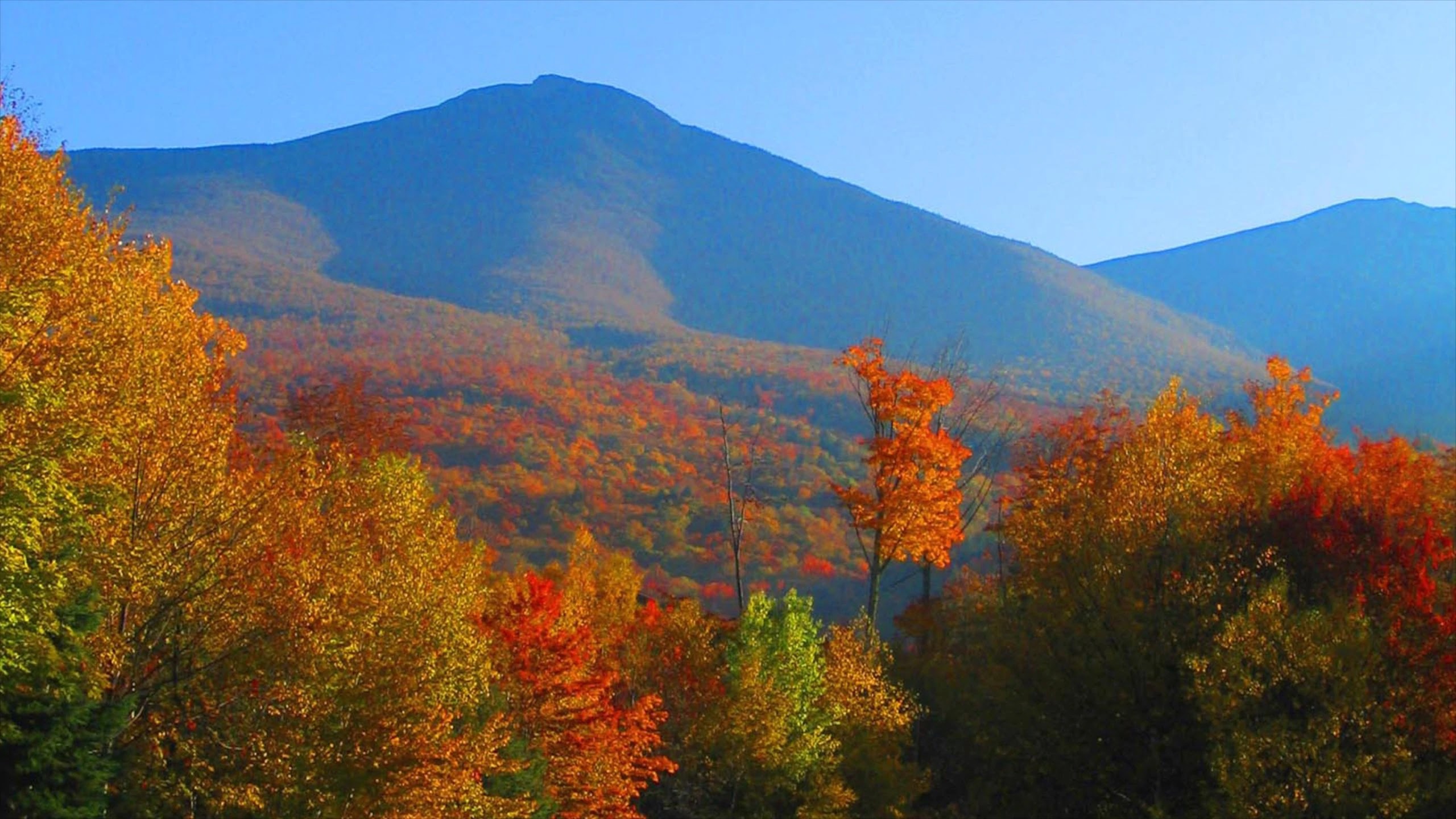
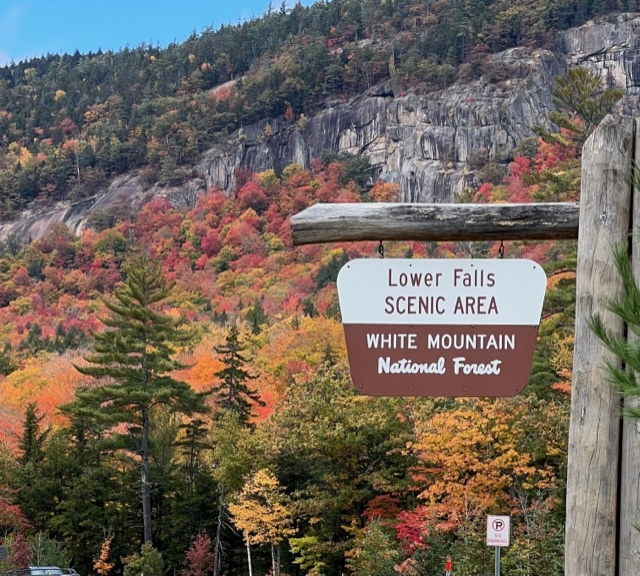
The most beautiful part of our nine-day self-guided road tour of New England was the White Mountain National Forest across the 34-mile Kancamagus National Scenic Byway through New Hampshire’s White Mountains.

Although there were signs along the highways to be aware of moose crossings and sightings, we never saw one. However, when we stopped at the park entrance ranger station, I purchased a stuffed moose which I named Moe. Moe traveled on our dashboard for the rest of our trip through New Hampshire and Vermont.

Not even the grey, dreary day altered our spirit of adventure. We drove by thick forests of russet, yellow, magenta, orange, gold, sometimes reflected in the ponds so beautifully that we had to stop on the side of the road to admire God’s beauty. Even ordinary vines were turning beautiful colors.


Each stop we made along the 34-mile drive through a wonderland of color, we had to pay a fee of $5 to park or have an annual national park entry and parking permit.


The first parking spot was across from the Albany Covered Bridge, with a breathtaking view on the left of the Nanamocomuck ski trail, paralleling the Swift River. Under the bridge, we tested the cold water. The 950 feet elevation gain offered great views of Mt. Chocorua on the right.


At the Blackberry Crossing, we learned about the Civilian Conservation Corp (CCC) camp and its essential work in developing access to the beauty before our eyes. The archeological relics bore witness to the many peoples who have lived, trekked, and hunted in this area.


Next stop was the Rocky Gorge, a testament to the water’s fury and power which had carved enormous blocks of stone, creating a flume and falls on the Swift River.


The Lovequist Loop and Falls Pond stop allowed us to cross the Rocky Gorge through a footbridge. Once in the forest, about 100 yards up a slight hill which crossed the Nanamocomuck Ski Trail, we came upon a beautiful pond with breathtaking views of the forest across reflecting into the waters. It was so beautiful and unexpected that I was overwhelmed with tears of joy; taking in such visual magnificence and fresh air, I was speechless.


We found evidence of the past inhabitants of the White Mountain in the remains of the Passaconaway Village displayed in the Russell-Colbath House Historic Site.


The Rail and River Trail and the Sabbaday Falls were next. The 75 feet elevation gain on the trail hike took us to a remarkable waterfall and emerald pool. The rocks were wet and slippery, but many hikers attempted to walk on rocks in the middle of the Swift River in order to get that perfect shot of the falls.


At a gravel pull off, we found a Lily Pond where moose were often spotted grazing. Alas, we were not lucky to see a moose on this entire trip.


The highest point of the Kancamagus Highway was the Kancamagus Pass, elevation 2855 ft (870 meters). “An optical illusion made the sign designating the pass appear to be below the actual high point from either direction.”


An unnamed and highly trafficked overlook and the Hancock Overlook opened to a 180-degree view of Mt. Osceola. Not far were the Otter Rocks where kids could splash in the water.


The last stop was Lincoln Woods with a log cabin and a suspension bridge. The flat and wide path begins the exhausting journey into the Pemigewasset Wilderness area and the alpine terrain of the Franconia Mountain Range at the 5261 ft elevation.


It is hard to describe the joy in my eyes and the sensation of pure oxygen in my lungs
when reaching the top of a steep incline and seeing below forests of thousands of trees, like a thick Persian rug in fall colors that could only come from God’s palette. It felt as if I was riding a roll-a-coaster and, if I could reach the treetops, I could run my hands through them like a piece of velvety fabric in striking colors of russet, orange, pink, yellow, marigold, magenta, and dark red. Like the clusters of sunflowers in a sea of yellows, these trees were sprayed with all colors in a sea that God could find in his artistic imagination.


What gave the trees such amazing, intense, blazing colors against the blue or grey sky? What made the trees so beautiful in New England?


It is a natural process triggered by the reduction of chlorophyll that produces green leaves. When the reduction takes place, then yellow pigments already inside the leaves are exposed. In the case of reds, it is the anthocyanin pigments produced by certain environmental conditions such as years with bright sunny days and cold nights, and the right amount of moisture, abundantly found in New England. During droughts, the colors are not so bright and leaves fall before the pigments have a chance to reveal themselves. The trees have to be of a particular kind, such as maples, be at the right elevation, and the right temperate zone, all found in a perfect combination in New England.

TO BE CONTINUED


Monday, October 24, 2022

Our Road Trip to New England (Part IV)

The next morning, we drove to the site of the Boston Tea Party, the middle of the Fort Point Channel along Boston Harbor, to learn more about the 1773 act of resistance re-enacted by talented young Bostonians and holographic displays and films.

The waterfront views and the modern background of the city gave the two reconstructed ships, the Eleanor and the Beaver, full scale and historically accurate replicas of the 18th century ships, the appearance of jewels from a past that time did not forget.

In a blatant move of taxation without representation, the British Parliament authorized the East India Company in May 1773 to export over half a million pounds of surplus tea to the American colonies without the usual tariffs and allowed them to choose their own consignees to receive and sell the tea, excluding all other colonial dealers.

The East India Company, facing bankruptcy due to corruption and mismanagement, would have had the privilege to undersell all American merchants and dominate the colonial tea trade. The Tea Act was thus unfair and dangerous to the colonists who were trying to make a living. It is no surprise that their discontent boiled into the now infamous destructive act of rebellion.

Before the Boston Tea Party, the colonists had asked the Massachusetts Governor, Thomas Hutchinson, to return the tea of the three ships, Beaver, Dartmouth, and Eleanor, but the Governor refused. Samuel Adams then organized “the tea party” with his underground resistance group, the Sons of Liberty.


Eleanor


Beaver


Under the cover of darkness, sixty members of the Sons of Liberty, led by Samuel Adams, armed with axes, and allegedly disguised as Mohawk Indians, boarded the three British ships at midnight and smashed the 342 chests, and one by one dumped the 92,000 pounds of tea (about 46 tons) overboard the Beaver, Dartmouth, and Eleanor into the Boston Harbor.

 The Robinson tea chest on display 

The only surviving [Robinson] tea chest from the Boston Tea Party is on display – its previous owners, although viewed the chest an important part of history, have used it for various domestic purposes before it reached the museum. For more than two centuries this tea chest was protected as a symbol of the iconic event on December 16, 1773, at Griffin’s Wharf.

The Harbor was shut down until the chests of tea were paid for. Obviously, so much tea caused the water to take on an odor, and it did not smell like a freshly brewed cup of tea. The value of the chests filled with tea dumped in the Boston Harbor was $18,000.

Strawberry Banke Museum

Saying good-bye to Boston, we traveled 62 miles via Salem, to Portsmouth, New Hampshire. The day was cloudy and drizzly, but it did not deter us from enjoying the lovely town with its rich history and the Strawberry Banke Museum.


Located in downtown Portsmouth, this 10-acre outdoor museum brings back 300 years of life through 32 original buildings, 8 vegetable, fruit, and ethno-botanical gardens, role-players dressed in period costumes, and well-documented traditional crafts, tools, and furniture.


Rationed items


Among the many lovely and well-preserved structures are Gov. Goodwin Mansion and garden, the 1814-1816 home of statesman Daniel Webster at the beginning of his law career, a carpentry shop, an apple and pear orchard which reminded me of my paternal grandma’s orchard in the hills, the victory garden from 1940 with its indoor collection of original posters and rationing cards from the period when everything was rationed for the war, the Dinsmore shop, a cotton tenant’s house, the Jackson house, the Jefferson house, Jones house with its discovery center, Penhallow house, Walsh House, Aldrich house garden, Patch house, Chase house, and many others. 

Some of the homes were furnished and well preserved while others were in the original state and empty. The Lowd house was an interesting lesson in carpentry skills, the home of cooper Peter Lowd with early craftsmen’s tools and trades, dating back to 1810.

We strolled through lovely green and flowery arcades; the flower gardens were still in bloom, and the trees were changing foliage to intense shades of orange, magenta, russets, and yellow. The governor’s garden was blooming with pink and maroon dahlias and a whispering water fountain was surrounded by bushes and a few evergreens.

The large green lawn overlooking the Gulf of Maine still bore evidence of the rock where the dock used to be when the ocean flooded the area 10-12 feet deep.

Portsmouth is also famous for the museum which houses the USS Albacore, a preserved research submarine, designed by the U.S. Navy to test experimental features for modern submarines. Top-secret (at the time) features tested led to the high-speed silent operation of modern submarines.

We crossed the bridge into Maine. We spent the night in the small town of Kittery, where the stores were cute trading posts along the highway. Arriving in Maine was a pleasant experience as the people were friendly and talkative, a difference of night and day when compared to the previous states’ New Englanders.


Kittery is known as the Gateway to Maine, the state’s oldest and southernmost town. Situated between the Atlantic Ocean and the Piscataqua River, it is home to Portsmouth Naval Shipyard on Seavey Island.

Robert’s Bar and Grill was a delight in fresh seafood, clams, lobsters, and lobster rolls. I think, I had three lobster rolls during our nine-day adventure through New England. The water outside the restaurant was at low tide.

Kittery also includes Badger’s Island, the seaside district of Kittery Point, and seven islands at the Isles of Shoals 10 miles out to sea.

Maine is a state full of surprises. The city of York is the first chartered city in America in 1641. Maine has over 3,100 islands, is home to Paul Bunyan [Bangor] has a beautiful state insect, the honeybee, and boasts the coldest recorded temperature of -50 F in January 2009.

TO BE CONTINUED